Tag Archives: spirituality

Doors

The other night, we watched a re-run of the Montana episode of Parts Unknown hosted by the late Anthony Bourdain. I enjoy watching the series and this episdoe about Montana drew to it as we have visited Montana several times.

Bourdain ate with a poet I had not heard of before: Jim Harrison. He spoke about being part of nature and how he feels small under the big sky of Montana. I looked him up and felt I should have heard of him before. He was a celebrated and well-published poet.

I chose this poem as it speaks to how we create binary choices in a complex world and universe filled with a myriad of choices that we follow depending on the spirit. For example, we often think we have to separate the economy and the environment.

The etymology of economy is from the Greek, oikos, meaning household and suggests keeping a good house. We only have to think about animals and how they do not soil their living quarters to understand how economy and ecology are related.

Harrison created wonderful imagery about the sky being a door never closed, but the sun and moon are not doorknobs. He lived in Montana for years where the sky is big and stretches on, as does the land.

I had to look up Dersu Uzala. It was a movie made about a man who lived his life integrated with nature and the universe, who dies when he moves inside.

I’m trying to create an option for all
these doors in life. You’re inside
or out, outside or in. Of late, doors
have failed us more than the two-party system
or marriages comprising only one person.
We’ve been fooled into thousands of dualisms
which the Buddha says is a bad idea.
Nature has portals rather than doors.
There are two vast cottonwoods near a creek
and when I walk between them I shiver.
Winding through my field of seventy-seven
large white pine stumps from about 1903
I take various paths depending on spirit.
The sky is a door never closed to us.
The sun and moon aren’t doorknobs.
Dersu Uzala slept outside for forty-five years.
When he finally moved inside he died.

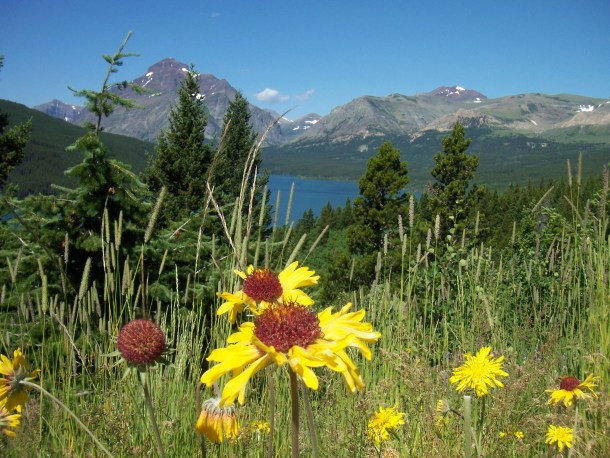
I took this picture several years ago as I looked from Alberta towards Montana across the field, with fresh bales of hay in the forefront and the mountains and sky forming the backdrop.
What Have I Learned so Far?

I enjoy Mary Oliver and questions she asks in her poems. Living is a question, as I am uncertain what will happen, even in the next second, and how I will respond/react.

How we each live is the answer to a Mary Oliver question from The Summer Day: Tell me, what is it you plan to do with your one wild and precious life? Do I sow seeds of kindness? Do I somehow make the world a better place, without understanding what that means in advance, perhaps ever?

As I rise from meditation and prayer, I do I move in a mindful way, more attentive to my words and acts. Meditation and prayer help make the world holy, more whole as I attend to it. We each live Living in our particular concrete and real world of human relationships with each other and the world.

Meditation is old and honorable, so why should I
not sit, every morning of my life, on the hillside,
looking into the shining world? Because, properly
attended to, delight, as well as havoc, is suggestion.
Can one be passionate about the just, the
ideal, the sublime, and the holy, and yet commit
to no labor in its cause? I don’t think so.

All summations have a beginning, all effect has a
story, all kindness begins with the sown seed.
Thought buds toward radiance. The gospel of
light is the crossroads of — indolence, or action.

Be ignited, or be gone.

From The Irony of American History

Although Reinhold Niebuhr his book The Irony of American History, I think it speaks to each person’s and each collective’s history.

As I read this and his autobiography, I wondered what it means to be a refugee, to seek refuge, and be an immigrant. My family traces its roots in Canada to the mid 1600’s and Kathy traces her’s to the latter part of the 1700’s. On both sides of our family, our ancestors could not expect what was to come for them and us.

Parker Palmer and Allan Watts speak of faith, which allows each of us to step into the future, without understanding what that brings. My ancestors, coming from France, did not know the risks and opportunities that lay ahead. They had faith in what was to come, without knowing what was to come.

What is to come in my life is emerging through the lives of each person that follows. Thich Nhat Hanh writes we are an amalgam of our ancestors. We are individuals that emerge within a collective that is both present and absent in our daily lives. Who we are is a result of product of virtue and love we receive from others. Who we are is not accomplished alone. It is an act of compassion and faith; an act of forgiveness that we will do what is proper.

Nothing that is worth doing can be achieved in our lifetime; therefore we must be saved by hope.
Nothing which is true or beautiful or good makes complete sense in any immediate context of history; therefore we must be saved by faith.
Nothing we do, however virtuous, can be accomplished alone; therefore we must be saved by love.
No virtuous act is quite as virtuous from the standpoint of our friend or foe as it is from our standpoint. Therefore we must be saved by the final form of love which is forgiveness.

The Summer Day

I could have entitled this post calling, vocation, voice, etc. Mary Oliver shares what it means to be called and how we respond to this call through our particular life. Voice and vocation share etymology and come from the Latin verb to call: vocare.

Mary Oliver captures the essence of a calling with a metaphor of a grasshopper, which has its role to play and expresses herself in how she fulfills this role. This poem reminds me of Matthew‘s verse about the lily of the field and how God provides for each plant and animal. We each have a role and place in a complex way of being and we each respond according to how we interpret what that might mean.

The first three lines and the last two, as questions, speak to me. I am never certain of what life holds for me. Life emerges as eloquent questions that are open and not foreclosed by easy answers, yet emerge from the first three questions. I ask eloquent questions without predetermined answers. They inform my dialogue with the world and with others.

Since completing my dissertation, the last question has become part of my thinking about the themes. It was not in the dissertation, but is essential to experiencing and understanding teaching as a calling, which holds deep spiritual meaning.

I posted my dissertation on Academia and an executive summary on Medium.

Who made the world?

Who made the swan, and the black bear?

Who made the grasshopper?

This grasshopper, I mean-

the one who has flung herself out of the grass,

the one who is eating sugar out of my hand,

who is moving her jaws back and forth instead of up and down-

who is gazing around with her enormous and complicated eyes.

Now she lifts her pale forearms and thoroughly washes her face.

Now she snaps her wings open, and floats away.

I don’t know exactly what a prayer is.

I do know how to pay attention, how to fall down

into the grass, how to kneel down in the grass,

how to be idle and blessed, how to stroll through the fields,

which is what I have been doing all day.

Tell me, what else should I have done?

Doesn’t everything die at last, and too soon?

Tell me, what is it you plan to do

with your one wild and precious life?


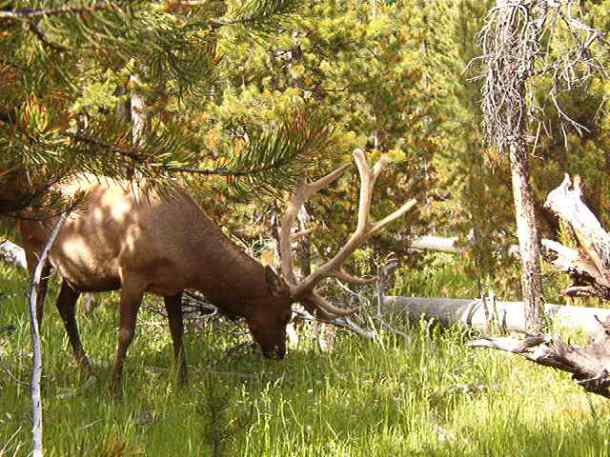
I took this picture in Yellowstone several years ago. I was about 25-30 feet (8-10 metres) away from this wonderful animal. He knew I was there, but seemed unconcerned. We were both living our lives.

The Prayer of St. Francis

Today, is our anniversary. We recited the Prayer of St. Francis at our wedding and have it displayed on a small and simple plaque. It reminds me of what it means to be human, in relationship with another person, and in relationship with God.

When I was in Spokane, I printed a copy and put it on the wall of the small room I stayed in. I refer to the room as my monastic cell and the Prayer of St. Francis seems a fitting complement to any monastic cell.

During challenging moments, I recite parts of the prayer to bring me peace and be present in the world.

Lord, make me an instrument of your peace:
where there is hatred, let me sow love;
where there is injury, pardon;
where there is doubt, faith;
where there is despair, hope;
where there is darkness, light;
where there is sadness, joy.

O divine Master, grant that I may not so much seek
to be consoled as to console,
to be understood as to understand,
to be loved as to love.
For it is in giving that we receive,
it is in pardoning that we are pardoned,
and it is in dying that we are born to eternal life.
Amen.

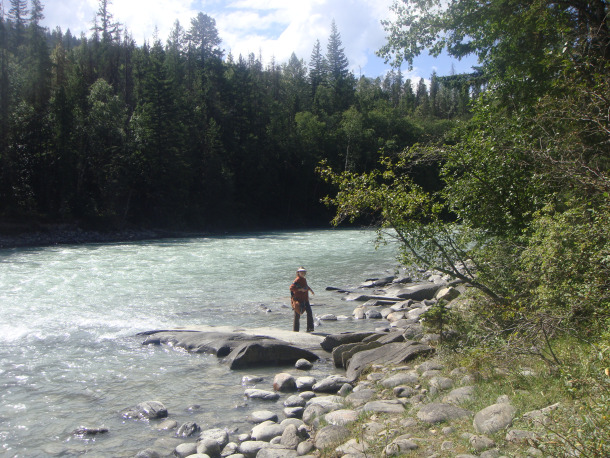
The picture is one I took several years ago of Kathy standing above a set of waterfalls close to the headwaters of the Fraser River.

Leap of Faith

via Quote: Mary Oliver

Mary Oliver is one of my favourite poets. Even when she writes lines in declaratory ways, there is a profound question being asked.

In this wonderful quote shared on Rethinking Life the question is what happens next. Even under the best and most controlled of circumstances, we do not know what will happen in the next moment.

Living is a leap of faith filled with mystery we can embrace. When we believe we control the next moment, the next instance, we fall short. Mindfulness can help us embrace the mystery. Being grounded in each ensuing moment is the only place we can be.

Wildness

via Wildness

Michele‘s post reminded me of poems by two of my favourite poets.

Environmentalists refer to Wendell Berry and Mary Oliver‘s poems. An educated guess is that Henry David Thoreau, who Michele quotes, informed their writing.

Wendell Berry wrote in moments of despair he “comes into the peace of wild things who do not tax their lives with forethought.”

Mary Oliver ends Summer Day with the following question: “Tell me, what is it you plan to do/ with your one wild and precious life?” Paradoxically, the question is an answer to her eloquent questions about who created nature.

Nature has a way of being and providing us with lessons for life. It is in meditative moments, when we just are, we grow to understand what that can mean. We grow and value what is essential not to us, but to those who come after us.

“We do not inherit the world from our ancestors, but borrow it from our children.”

Take Sides

Source: Take Sides

The link is to a quote by Elie Wiesel, a Holocaust survivor and Nobel Peace Prize winner. He is not referring to taking sides over a game. Instead, he speaks to taking sides when we witness wrong-doing and immoral acts. His book Night is a worthwhile reading.

I remind other Christians Jesus reached out to those who were most in need, living on the margins of society. He ate with sinners and tax collectors and stood up against the Pharisees and scribes (Luke 15:1–4) and (Romans 3:23).

We each have to decide what we is immoral and moral. It is not upholding abstract laws and rules, but the spirit of doing what is proper. I did not use the word right or correct . When I do, I fall into a trap of checking a binary box of right or wrong. Instead, I ask “is this proper?” In French, this is a matter of comportment and conduct.

I think the last sentence in the quote are important, worthwhile repeating. It is worth spending time whiling and linger over the words and the depth of their meaning, from a person who suffered and witnessed unthinkable human tragedy perpretrated by other people. “Whereever men and women are persecuted because of their race, religion, or political views, that place must — at that moment — become the center of the universe.”

I am not a big believer in thinking about my legacy, whatever that might be, but I want to be remembered as someone who stood up and spoke out against the wrong done to other people.

Love says, there is a way..

Source: Love says, there is a way..

Karen‘s post included quote from two of my favourite poets: Hafiz and Rumi. Love is the essential idea behind the quotes.

The second Hafiz quote says fear is the cheapest room in the house. As we lift each other up with our love, we expand the rooms in the house we can each live in. Loving each other is a gift and a serving of each other. It can make people and the world whole again.

Take a Knee

I begin this post with two points. First, I am not American. I spend time in the US and enjoy my time there. One thing I enjoy, and I shared with my students, is the way Americans respond to their National Anthem. Second, Canada, where I live, has social and historical skeletons in the closet i.e. residential schools.

My aim is not to pass judgment, but to cast a different light on what it means to take a knee. In a world that is increasingly secular, perhaps I lose my way in what it means to live in a spiritual way and it can mean many things to different people.

The image that comes to mind when I think of is people kneeling and standing at the foot of the cross of the crucified Jesus. We were not there, but we are told his friends, family members, and followers knelt and stood. It seems there was no one right way.

When Colin Kaepernick first took a knee, I thought of it as praying. The etymology of prayer is to ask earnestly, to beg, and to entreat. Prayer is asking someone i.e. God or something bigger i.e. Universe or a nation than I am to intercede in a concern to me.

To genuflect is to kneel, usually with one knee. It is an act of worship and respect. Parker Palmer wrote about fidelity as something other than mere loyalty. It is loyalty to an obligation, cause, and idea one holds dear.

Who or what one asks depends on one’s spiritual and religious background. What I understand is that there are no fixed answers when I take a knee and pray. I have to listen. Part of praying is silence, listening to what Parker Palmer calls my inner voice. It is only in moments of silence, whether kneeling, standing, or walking, that I hear that inner voice.

I pray in various ways and have since I was a child. When I enter a church, I find holy water, bow to the cross, and complete the sign of the cross. I stand. As I enter a pew I genuflect, taking a knee. I do so with two surgically repaired knees. At times before, during, and after service, I kneel, I pray, and I listen to what my heart says. Other times, I stand. During the Lord’s prayer, I stand and join hands with others asking God to intercede on each of our behalf. As I receive communion, I walk slowly and quietly, bowing my head as I accept the host.

For me, kneeling, standing, and walking quietly show my fidelity to a cause and purpose larger than me. In this case, it is plight of people and our shared humanity. I make a point of being quiet, because it is a time of thoughtful meditation and mindfulness of how the world and I are broken. I beseech someone or something larger than me to intercede and, as Parker Palmer says, to make whole the broken.