Tag Archives: teacher as transformer

Paradox in Nature

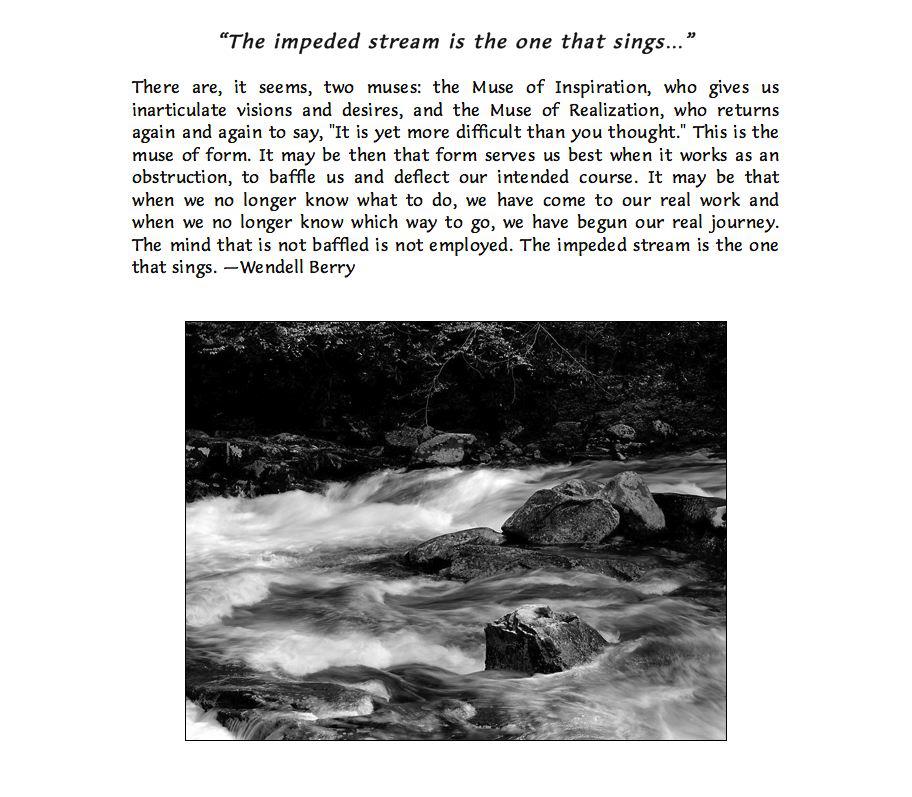
I found these picture of a small lake in the Crowsnest Pass when I was looking at the pictures I posted at A Time to Listen. Nature is a spectacular and paradoxical part of creation and I hope this is revealed in the following.

Green, aqua, granite

Nature draws from her palette

Drawing me to her.

Water cascading

Suddenly appears out of rock

Disappears again.

Calmness and chaos

Nature speaks in paradox

Harmony emerges.

A Time to Listen – Visually and Poetry

Kathy and I travel. We spend time during the summer touring Alberta, British Columbia, Saskatchewan, and adjoining American states. This summer we are revisiting Waterton Lakes National Park as part of my rehab. We travel through this area regularly and it brings back great memories.

On one trip, we stopped at a provincial park just above Lundbreck Falls. Recently, I went through pictures of the Crowsnest River downstream and it reminded of what I notice and don’t notice in life. Wendell Berry wrote a beautiful piece: The Impeded Stream is the One that Sings. I realized I  heard the river before I saw it. I recalled the life around the river: cottonwood fluff flying, flowering wild rose, insects pollinating, and a musky smell perhaps of a bear recently by. The river is a living instrument sharing a song to others forming a web of life.

I read Wendell Berry’s words while reliving the picture and was inspired to write a Haiku.

Observe life’s current

Pausing, listening, caring

Present with my self.

Autobiography in Five Short Chapters by Portia Nelson

A medical practitioner I visit once a week to try resolve some issues with chronic, physical pain was the source of this wonderful, insightful poem. Whether physical, emotional, spiritual, or intellectual, I fall into habits and absolve my self of responsibility f or my actions.
Autobiography in Five Short Chapters
Chapter 1
I walk down the street.
There is a deep hole in the sidewalk.
I fall in.
I am lost … I am helpless.
It isn’t my fault.
It takes forever to find a way out.
Chapter 2
I walk down the same street.
There is a deep hole in the sidewalk.
I pretend I don’t see it.
I fall in again.
I can’t believe I am in the same place.
But it isn’t my fault.
It still takes a long time to get out.
Chapter 3
I walk down the same street.
There is a deep hole in the sidewalk.
I see it is there.
I still fall in … it’s a habit.
My eyes are open.
I know where I am.
It is my fault.
I get out immediately.
Chapter 4
I walk down the same street.
There is a deep hole in the sidewalk.
I walk around it.
Chapter 5
I walk down another street.
 
~ Portia Nelson ~

Human Being Instead of Human Doing

Many days I wonder about what other are doing, what causes them to do it, and what I can do to control their behaviours. I used the word do a lot in that first sentence. When I wonder that way, I become angry, frustrated, and hurt. I become a human doing instead of a human being. Being present and living each moment mindfully is part of this being.

Some words and an image to help us be today. Happy summer solstice.

The art of life isn’t controlling what happens, which is impossible; it’s using what happens.

~Gloria Steinem

Teachers as Storytellers

Think of the people we call teachers, not just in classrooms but in every facet of our lives. A quality they share is storytelling. They connect with our hearts and minds. We laugh, cry, yell, and carry on in every imaginable way with them. We remember them not because of what they taught us, but what they revealed about themselves and helped us discover about our self.

The best teachers are the best storytellers. We learn in the form of stories.

~Frank Smith

Five Steps to Destroy Public Education

Five Steps to Destroy Public Education.

Diane Ravitch is a real educational reformer in the US. I think parts of her message in this post is universal. I particularly like her comments about underfunding our schools and overcrowded classrooms.

It is just not the underfunding that starves the schools; it is the poor management and decision-making by the bureaucrats, technocrats, and oligarchs. What is the latest fad?

Overcrowding our classrooms silences the teachers. Do I even have time to lift my head and uplift students under those conditions?

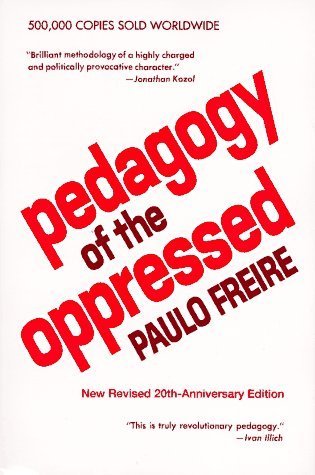
pedagogy of the oppressed by Paulo Freire

I read pedagogy of the oppressed by Paulo Freire during my undergraduate experience and return to it as a source of reflection and when I write. Similar to Parker Palmer, Paulo Freire left an indelible mark on my life’s practice. Education is an uplifting, liberating experience which shines light on each step Antonio Machado described: “Wanderer, your footsteps are the road, and nothing more; wanderer, there is no road, the road is made by walking.” Freire’ s contention was everyone can act as an agent in their learning thus freeing them and transforming the world they live in.

Freire used the Portuguese word conscientização which “refers to learning to perceive social, political, and economic contradictions and to take action against the oppressive elements of reality” (17).   Humans become mindful of and present in the world and act to transform it. Freire used a banking metaphor and described traditional education where  knowledge is deposited into students. Teachers and the system act oppressively in determining what is important to learn. Freire felt education uplifted people and their learning. “Liberation is a praxis: the action and reflection of men and women upon their world in order to transform it” (p. 60).  Learning occurs when  compliance and conformity are rejected in favour of dialogue based on love which allows each human to name their world and what is of value in it. The student is a teacher and student; the teacher both student and teacher.
Questions: What can we do to truly bring a new pedagogical structure into our schools and communities of learning? What function would school play in this pedagogical structure? What is dialogue based on love?  What role do educators and communities play in liberation education?

Recommendation: I love the book. It is a challenging, but I return to it often and find something new each time. Today, I became aware of the following: “Concepts such as unity, organization, and struggle are immediately labeled as dangerous. … These concepts are dangerous—to the oppressors” (p. 122). What does this mean in supposedly modern, liberated, and affluent societies?

A second point was the similar language used by Freire and Martin Buber. There is a shared understanding of respectful dialogue using the words I and Thou to describe the uplifting, liberating, loving dialogic process.

Freire, P. (1993). pedagogy of the oppressed. (M. B. Ramos, Trans.).  New York: Continuum.

Advice From Ivon

There was an image here and some of you responded. I appreciated your comments and left them in place. Apparently, I infringed on a copyright of a group that sells the postcard I posted. I leave you with this.

What advice can I give?

Stand firmly rooted to the Earth.

Reach and touch the sky.

Take risks.

Trust those closest to you.

Love those closest to you.

Find your voice.

Speak right.

Act right.

Apologize sincerely when it is right do so.

And wonder in awe when it is time do so.

About the rights of nature and humans.

Take care.

I humbly apologize for using an image posted in various other places. I meant no harm … Here is what I am legally obliged to present for making a human error:

The Advice from a Tree image and words previously posted were an infringement of the copyrights of Ilan Shamir and Your True Nature and has been shared around the Internet. I am reposting the correct version of this and encourage you to visit the Advice from Nature website at http://www.yourtruenature.com for Advice from a Tree and over 100 other advice bookmarks, posters, journals, tshirts and other eco products.                                                                                    copyright 1993-2012 YTN

Again, enjoy.

ivonprefontaine's avatar

Father Day’s

I subscribe to a daily meditation written by Father Richard Rohr. a Franciscan priest.I talk and write about the concept of common sense, which I understand as local and global. Father Rohr cast it from a theological perspective, I think the explanation provides an insight gained without reading Gadamer’s Truth and Method. I believe there is a universal truth or common sense (Vico called this sensus communis), something that makes us all brothers and sisters bringing us together in community. I think Father Rohr offers an explanation though his meditation on Father’s Day helping us to live in community each day. Certainly, Rilke does.

“It is this sense that founds community” (Gadamer, 1989, p. 19).

Gadamer, H-G. (1989). Truth and method. (J. Weinsheimer & D. G. Marshall, Trans.).  New York: Continuum.

Catch only what you’ve thrown yourself, all is

mere skill and little gain;

but when you’re suddenly the catcher of a ball

thrown by an eternal partner

with accurate and measured swing

towards you, to your center, in an arch

from the great bridgebuilding of God;

why catching then becomes a power–

not yours, a world’s.

–Rainier Maria Rilke

Santiago by David Whyte

The road seen, then not seen, the hillside
hiding then revealing the way you should take,
the road dropping away from you as if leaving you
to walk on thin air, then catching you, holding you up,
when you thought you would fall,
all the way forward always in the end
the way that you followed, the way that carried you
into your future, that brought you to this place […]
David Whyte
from “Pilgrim”