Several people reached out asking about the outcome of my presentation at the International Peace Research Association Conference (IPRA) in Ngāmotu, Aotearoa (New Plymouth, New Zealand). The title of the presentation was entitled Re-imagining Teacher Education: An Andragogy of Hope, Peace, and Nonviolence. There was 20-30 people in the room and I received positive feedback at the end of my presentation, during meals, and since the conference. People asked for the slide show and we talked about changes they might make in their teaching. For example, one instructor in an education program said they would try to have students, after degree and post-graduate, sit in dialogic circles with the subject in the middle. For those familiar with my posts, I take this from Parker Palmer. Parker proposes this as a way to have the disciplines, which he refers to as big stories, guide each of our little stories. As a result the subject, nonviolence education, comes alive. The person suggested this was a small change. I understand it as transforming what they and their students are doing. It runs against the grain in education, including at the post-secondary level.
As I reflected, I realized I was preaching to the choir. In that room, we are all reading out of the same hymnal. The excitement in those rooms and in conversations is challenging to replicate outside the rooms when I engage with others, particularly gatekeepers in teacher education. My “intellectual interests” are known by these people, yet there is no attempt to ask me to prepare syllabi for a full-blown course or a mini-syllabi to integrate into a co-taught a methods class e.g. Social Studies. Essentially, it is important for me to enter a liminal space between the theoretical, abstract work I have done for the past few years and prepare syllabi to present to gatekeepers. It is the transition from preaching to the choir and making myself vulnerable to people saying no to what I propose.
On the surface, this looks like an easy proposition. Who doesn’t think nonviolence education is a good idea? Despite thinking it fits well, people’s understanding of schools and what they are for are entrenched in a neo-liberal, capitalist world. My first published article used systems thinking by Peter Senge. One of the five disciplines is mental models, which are closely held beliefs that form one’s worldview of how they understand reality. Mental models are shared by groups of people. Schools are largely unchanged from when I attended. The mental models of what school is and is for are entrenched. People push back when I say this, but change is superficial e.g. projectors and screens as opposed to blackboards (shows you how old I am), hardly transformational. Teachers prescribe the layout of the classroom and who sits where and how seating is configured. This extends from K-12 and beyond. There are pockets where things are done differently, but they are isolated and treated as one offs. Without going into this, I speak from experience.
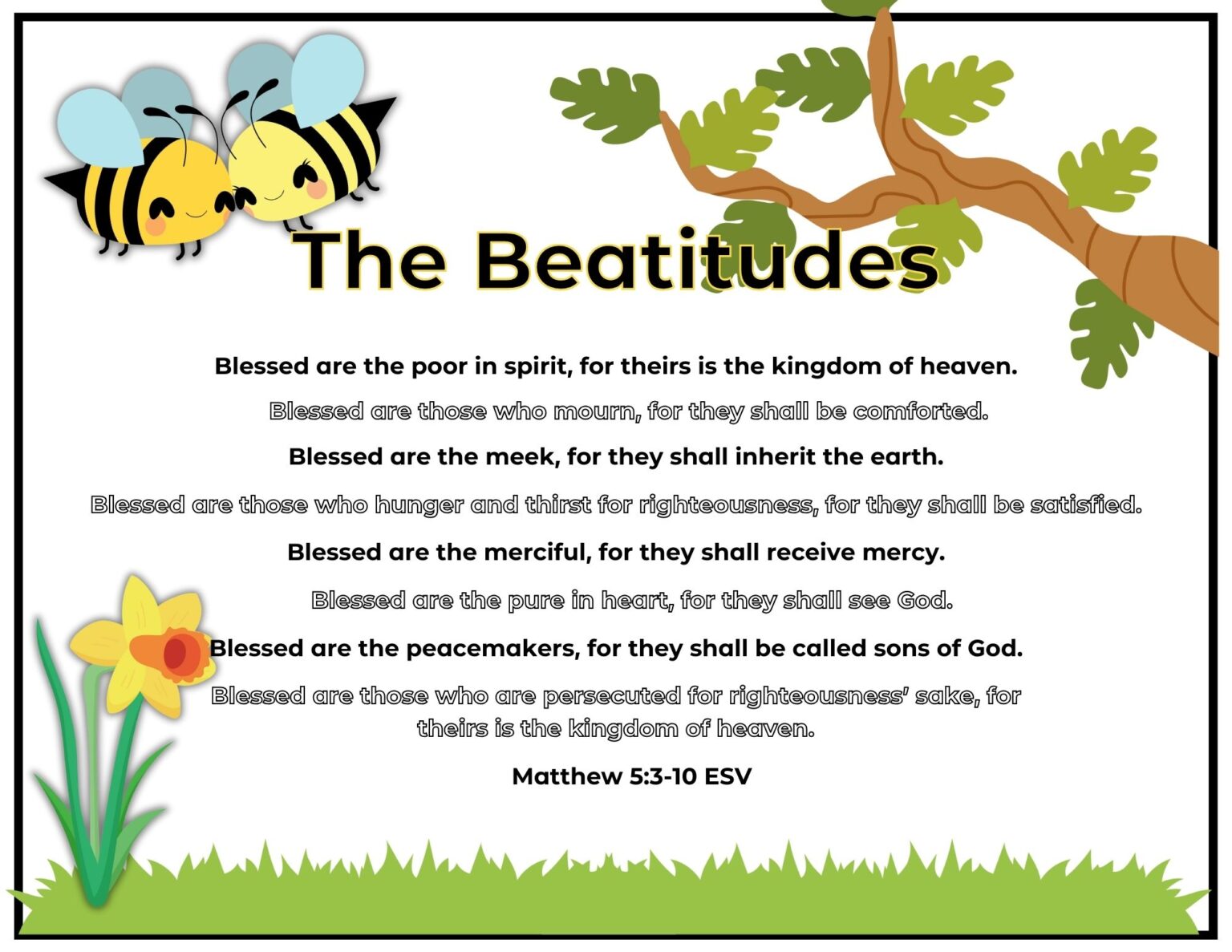
The university I contract to (I am not tenure track and never will be) is a private, Christian school. Again, on the surface, it would look promising in terms of a viable partnership. They share posters with Faculty and administration are aware of my intellectual interests, yet they have made no offers to bring me on board to see how we might integrate this with current curricula in the Faculty of Education. Part of my efforts is grounded in my Catholic faith, including from the Sermon on the Mount giving rise to the Beatitudes. When I walk around the campus, I observe posters sharing the Beatitudes. How does this inform my next step as I try to convince people not in the choir that this is worthwhile and timely?
I intend to prepare several syllabi for different contexts. One will be for the university I currently contract to, based on its Christian ethos. Another will be for a small, private university with Lutheran roots that promotes itself as nondenominational. A third will be for the University of Alberta, a large publicly funded secular university. They do have an Anglican and Catholic college attached to the University of Alberta. If there is anyone out there who has ideas and connections to tap into, let me know. I need all the help I can get.
Below is a video by Maria Muldaur called Yes, We Can! A number of other female artists accompany her e.g. Joan Baez. The song has a twofold purpose for me. First, it is about making a change for a better world. To resist oppression in all its forms: poverty, war, climate injustice, etc. Second, it is about me having faith that somehow I can do this.


 ivonprefontaine
 Teacher as Transformer
Thanks for the update on the conference. Change is always difficult in any facet of our life. I admire you taking on the challenge to improve our education system. Think it is very wise of you to be designing different syllabi for institutions based on different beliefs. Good luck on your journey.
Thank you. Yes, it will be a challenge. I think it is worthwhile.
I love to see what you share for music, we have very similar interests, you and I. 😉
I am sorry you brought all of your passion, knowledge, and experience to bear in this conference – and still felt like you were preaching to the choir.
I have been doing this for many years.
And still, we must give ourselves credit that we do not give up. The little glimmers of light here and there are no more than tiny cracks in the boulders we might walk amongst. Yet if we bend down and lower our vision a bit, we can close one eye and see right through the cracks. I think it’s what we’re here for.
The kind of change that we’re looking for is bound to be far more sweeping than humanity is capable of taking in, apparently. Change seems to move at a glacial pace. Yet we never know the consequences of our actions. We put it out, but there is no way to measure how it is impacting in the smallest of ways.
Culture teaches us to only recognize the big bangs. But the small and nearly undetectable reverberations are having impact, nonetheless. You went to this conference, Ivon, and you left feeling perhaps a little discouraged.
But even now, somebody who heard your ideas but didn’t really respond may be discussing your ideas with someone over Sunday dinner.
So I hope you do continue on, with the passion and the drive that you are known for.
Blessings!🙏♥️
One of my favourite songs and artists is Anthem by Leonard Cohen. My favourite lines in the song are the chorus: “Ring the bells that still can ring, forget your perfect offering. There is a crack in everything, that’s how the light gets in.” Your comment reminded me of these lines, which are about imperfection and hope.
I think the part about preaching to the choir Is reflecting on what the next steps are. It will be an uphill journey. Writing about the Myth of Sisyphus, Albert Camus is telling us the rock rolling back and having to restart is part of life. I am drawn to his existentialism more so than that of Jean-Paul Sartre, which I often find mired in pessimism. Since we returned from New Zealand and Australia, actually it began on the trip, I spent time thinking of next steps. As a result, I began to organize my thoughts and materials related to potential syllabi. I am hopeful there will be someone who sees value in what I offer.
I hope, as the rock rolls back each time, I find myself a little further ahead of where I was the last time. You are right, and I have these conversations with others, big change–transforming change–is hard to accomplish, so baby steps are in order.
I think we come from a similar generation in terms of music. One of the epiphanic moments was realizing the genesis of my intellectual interests in hope-based nonviolence education and music I listened to in the 1960’s and 70’s. One song was “Where Have all the Flowers Gone.” The music, particularly the lyrics, informed my poetry of the time and I think, as I write later in life, it remains embodied.
Brilliant, Ivon. And I got chills when you quoted Cohen from Anthem. Still get them, just writing this. So I suspect we discover the perfection bit, at long last, has not ultimately served our peace of mind. I definitely know this is true for me, anyway – I call myself a recovering perfectionist. I mean, it’s perhaps good in the way that we strive for the integrity it invites, but not so good when expectations roll around for review. (Again, only speaking from my own experience.) And yes, I was born in 1953, so from your comment, likely we are of the same generation.
I remain a huge folkie when it comes to music, though I appreciate all music that speaks to me and has, as you say, embodied itself within me. Sidelight: Noel Paul Stookey actually lives on the coast of Maine, and it was in his chicken barn that we began the radio station WERU, where I was a host for 9 years, interviewing many forward thinkers. Also – agreed on Camus vs Sartre (never got into his groove).
And Sisiphus! Haven’t I referred to his labors over the years. Both Chris and I can relate. And yet we continue -if moved – inching that rock, even if it seems futile. You don’t seem built for despair, so my hope is that you keep reinventing until you hit that sweet spot of satisfaction with the work, no matter how it reveals itself . And again, one cannot gauge one’s impact – it’s impossible. If one person or one thousand have their thinking altered, the ripples in the ocean eventually become swells that thunder to shore. Blessings in the quest!
Where passion meets persistence and innovation.
My best wishes with this work, Ivon.
Thank you Cynthia.
Timely post – I just finished watching “Move When the Spirit Says Move” about American Civil Rights activist Dorothy Cotton’s legacy. Truly an amazing woman. Inspiring!
There are so many of these stories and some we do not hear about. I will have to look for this, as this is a new name.
It was all about the community education initiatives underpinning the non-violence civil rights movement.
Yes, Parker Palmer writes about how Rosa Parks and others in the civil rights movement had community support and education to follow through on nonviolent civil disobedience.
A TALL ORDER, FRIEND…but if this little pipsqueak of a man can run a blog for at least—gosh—14 years—you can do this.Ny teaching was minor and inconsequentia whereas yours has reached international proportions—please excuse my spelling! Knowing your Christian roots is a comfort to me—I can’t always tell. GO GET ‘EM TIGER!
Thank you Jonathan. I will go get them.
AND GIVE ‘EN HELL HARRY—PEACEABLY…of course! ❤
Of course
Pingback: “PEACE STUDIES CONFERENCE” | By the Mighty Mumford
You, Ivon, and many such as you leave ripples of understanding and grace that may seem small in the overall. However, they do, in many cases reach the shore where they leave their indelible mark upon the sand. Those who are able will be blessed, and carry the message forward. It is for us to do as we are inspired without concern for the result – a difficult position in which to be. Yet, can we refrain from doing that which is intrinsic within? I think not.
Thank you for the kind words Carolyn. Yes, I have reached a point in life where I think in terms of leaving what I can in place for others to pick up the mantle, so to speak. There are many who are willing to join and it might take time to reach them.
Well shared. Thanks ☺️
Thank you Priti.
An educator such as yourself is certainly needed in these times, Ivon. We need to understand and thoughtfully discuss Jesus’ teachings, and also make them applicable in our lives.
Two challenges facing Christian leaders, and other people who try to truly follow and help others to understand Christ’s teachings:
How to make it relevant and applicable to younger generations, lapsed Christians, and others. Meanwhile, some “Christian” churches have perverted Christianity and made it their own, offering easy solutions.
Mainstream Christian churches can also seem stuck in their dogma; people who have questions feel afraid of expressing them. Faith isn’t the total absence of doubt; questions should be welcome.
Well-stated Cynthia. Alain de Botton wrote a book called Religion for Atheists, focusing on the virtues. He is a self-proclaimed atheist. The title suggests there are similar concepts in all religions.
I agree there is a movement away from organized religion. I hope those who move away remain spiritually informed in ways that can help the planet and all its inhabitants as a single interconnected entity.
thanks for always visiting my blog.
You are welcome and thank you for subscribing to mine.