Category Archives: Education

From Earth, Fire and Water by William Butler Yeats

Today, an interesting thing happened. All three grades are at key points in Science. The Grade 8 class was learning and applying the equation for density. They were completing a worksheet, but got bogged down with the equation when it was not straightforward and had to think algebraically. I was moving between the Grade 7 and 9 tables and looked up. There was a colleague who had stopped by on her day off helping the Grade 8 students and the parent helper. I had not asked for help; it arrived in the quiet and I thought of this poem.

We can make our own minds so like still water

that beings gather about us that they may see,

it may be, their own images,

and so live for a moment with a clearer,

perhaps even with a fiercer life

because of our quiet.

The Soul’s Choice

It was cool, rainy, and windy at times today. We are going to go through a couple of days of below seasonal and bounce back on the weekend. Today, a new parent was the parent-helper. She did a wonderful job and told me how much her child was enjoying our little corner of paradise. It warmed the heart on a dreary day.

The day broke

Cool and wet

Grey.

Able to dampen one’s spirit;

If allowed–

And let the dull prevail.

A glow emerged

Warmth radiates

Revealed in community.

In communal spirit

Discover my world

Leads me forward.

The Root of Extraordinary

Friday I spend without students, at least for now. There are rumours teaching four core junior high subjects is not enough. Apparently, I don’t need time to plan, mark, complete report cards, and other sundry tasks which keep the classroom humming.

I work hard to stay positive. Sometimes the tendency is to create negative narratives rather than let each moment live itself fully. I find this is hard work, but it grows easier to set aside the dis-ease.

Alone is different

Not loneliness.

In solitude

Gifts of deep silence

The presence of presents

I grow whole

Energize the spirit

Recollect the ordinary in extraordinary–

Not just a root word;

It is the root.

A Time of Rest

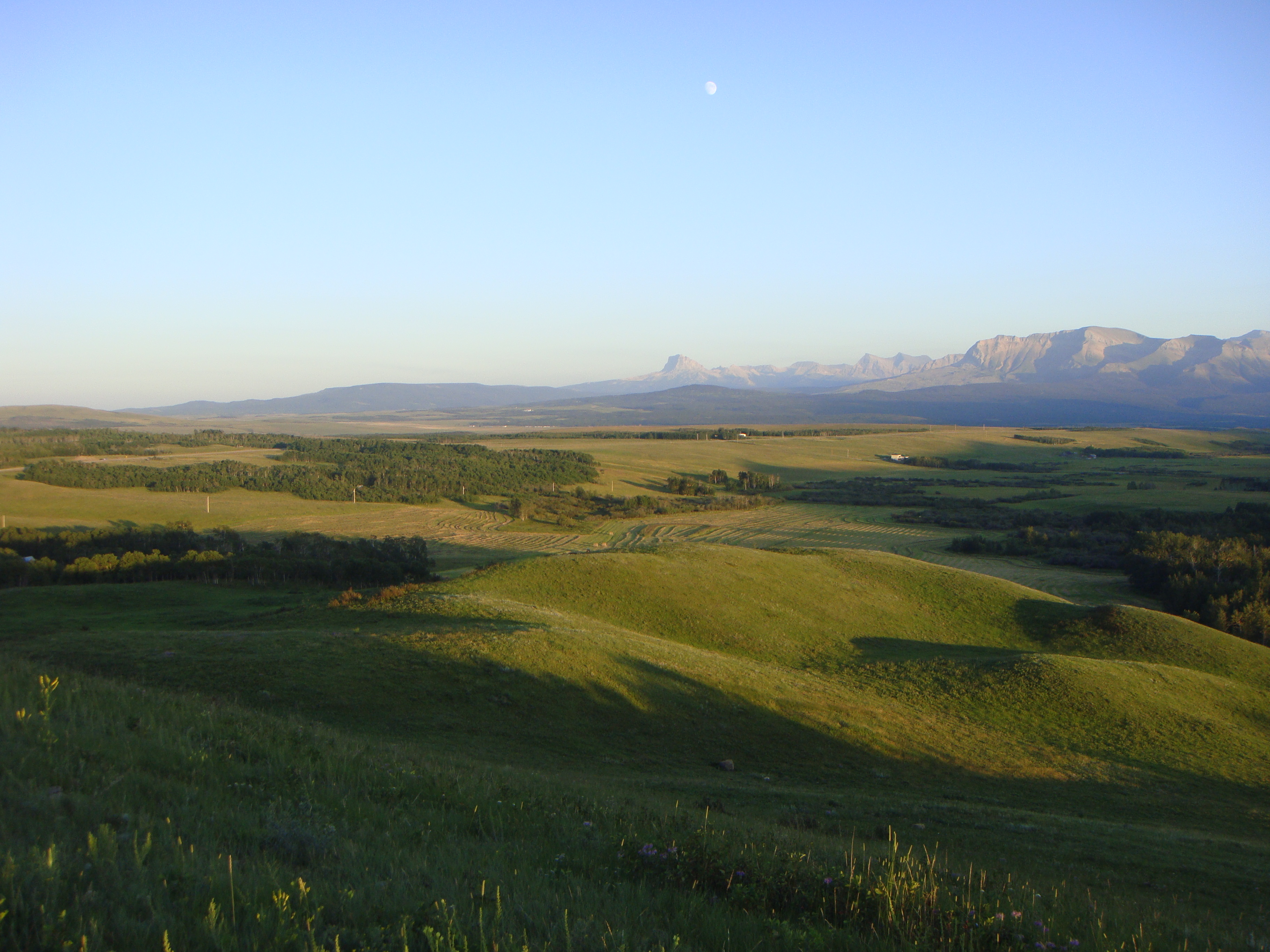
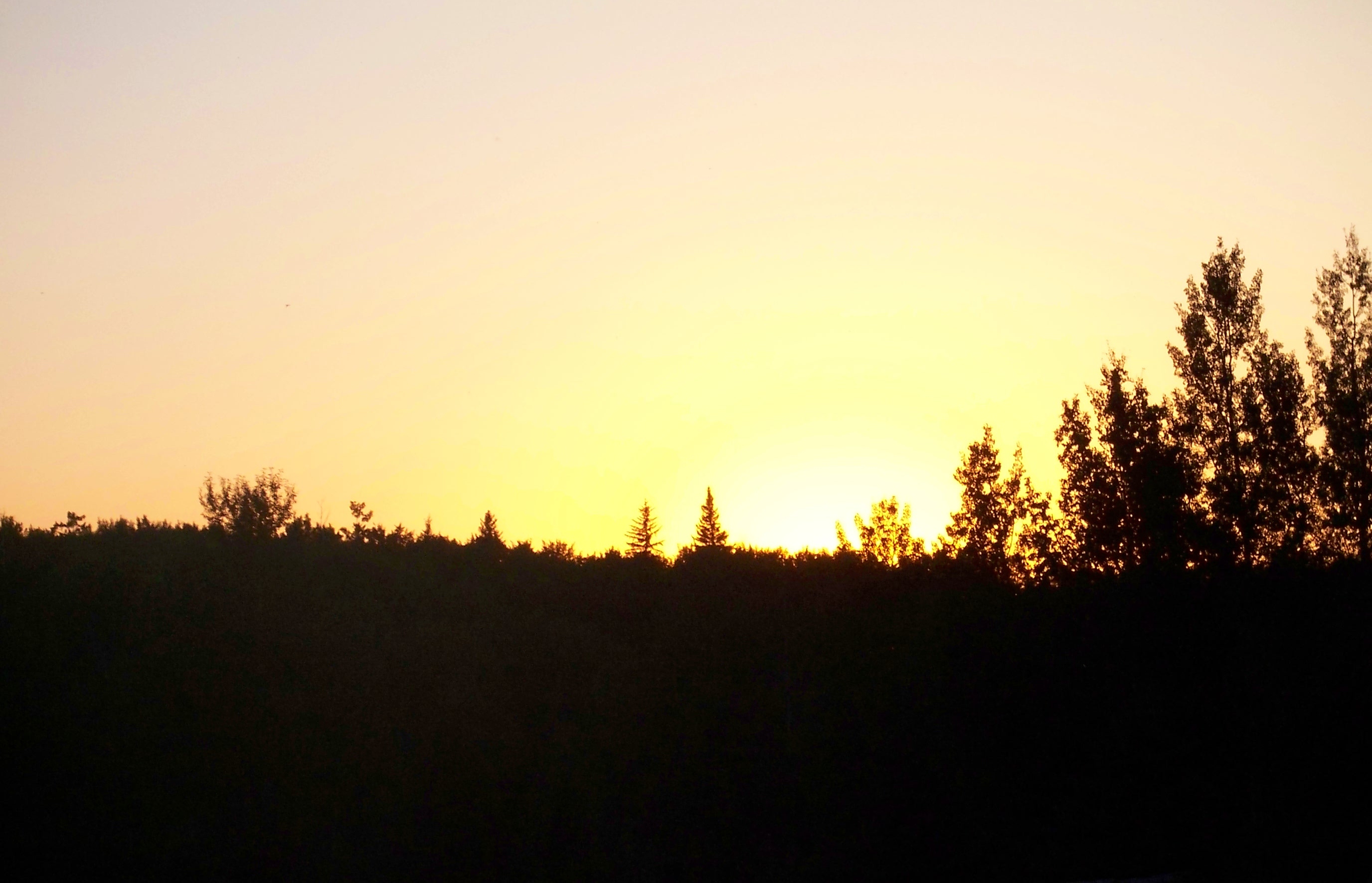
Kathy took this picture last weekend. They finished a day cleaning the farmhouse and it is livable. The sun, after a dreary day, appeared and the sky was awash with golden rays. I feel this way in the classroom. I love what I do. I am whole and find voice. I am a learner, a teacher, and the two are inseparable, but I remind my self to be mindful and give thanks.

Fleetingly framed

Trees against golden skyline

Nature paints day’s end.

Glorious moment

Sky awash with golden light

I am fulfilled.

Conversation Circles

In our classroom, we use a conversation circle. I use it as a time to clarify things from my perspective and allow students to speak about what they would like to do. At other times, we talk about upcoming events. Today in the conversation circle, each student introduced themselves to the group, which seems like a small thing, but sometimes goes unattended in classrooms.   I also asked the students about what they want for complementary courses. This is an outgrowth of the conversation circles we held last year. Students want a voice in their learning.

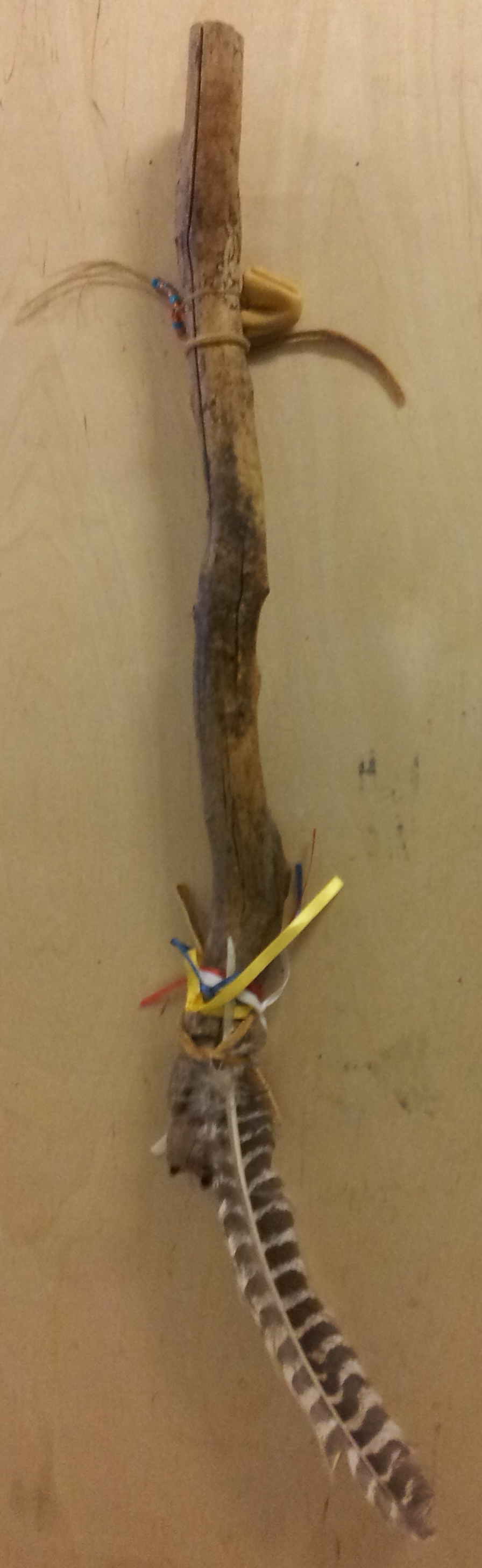
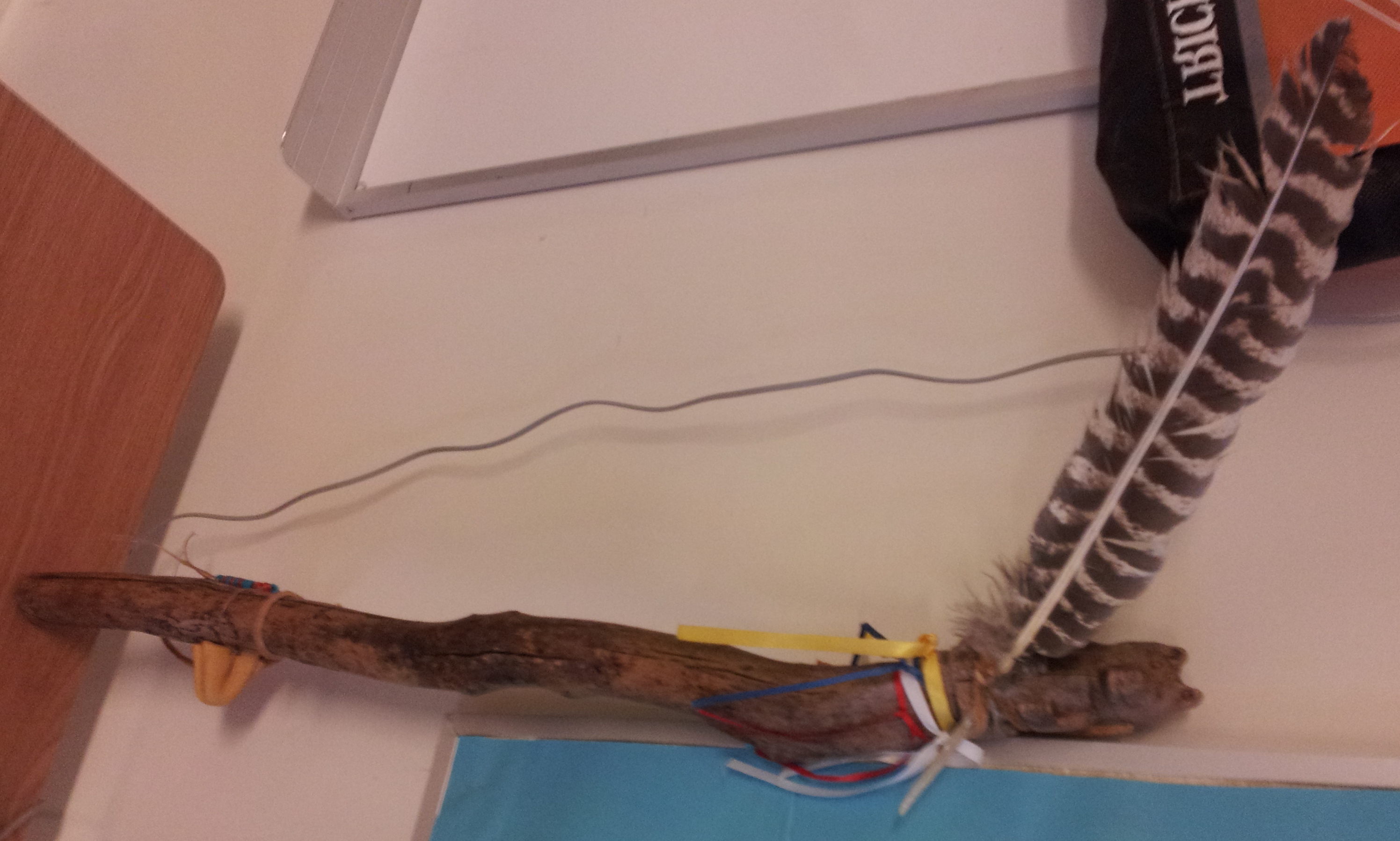
We use a ‘talking stick.’ The person with the ‘talking stick’ is the speaker and others listen. In an era of digital technologies, the stick reinforces a protocol of face-to-face conversation which we increasingly need in our world. The ‘talking stick’ was a gift from a parent last year. She is a member of a First Nation so it has some traditional meaning attached to its design.

The wood is driftwood which came from a local lake and reflects nature’s contributions to the circle. Someone carved a bear head into the top of the stick. In some traditions, the bear symbolizes courage, freedom, and power. The feather is from a hawk. Hawks are visionary and guide the person. The coloured ribbons represent the four directions in the circle. The parent attached a medicine bag. The medicine bag heals, guides and protects, and has materials or objects of value to its carrier.

Why Write Poetry

Yesterday, I read a haiku written by someone who appeared to not enjoy writing haiku. Despite this, the person wrote an interesting, amusing, and thought-provoking poem.

I am not sure this is verbatim but it goes somewhat like this:

Here are five syllables

And here I write seven more!

Are you happy now?

The person who presented this poem indicated that despite having written haiku they were unsure why teachers wanted them written. I think there are good reasons, but I could be wrong.

1. Poetry calls for the best possible word choices. Most poetry is simultaneously spare and spacious. The spareness is in the number of words; the fewer the better. The space allows the reader room for interpretation. What did the poet mean? What senses are invoked through the word choice.

Words chosen

Describe my moment.

No two experiences identical

A jungle of meaning revealed.

Each sense sameness different

Worlds bridged.

2. Students learn about figures of speech and their importance in expressing what we want to say. We can compare unlike things and make sense of a complex world.

3. I tell students who struggle with reading and writing poetry is an alternative way of expressing themselves. I use ee cummings as a model so they overcome their worries about grammar, spelling, and capitalization.

i dig ee cummings

no punctuation

no capitols

won’t worry about spellin either

no sweat

aint no problem

i write poetry

4. I enjoy poetry. I always have. I remember a poem, The Elevator, I memorized in Grade 4. I think it Walter de la Mare wrote it. My friend memorized a poem called Douglas Fir, because his name was Douglas. What my enjoyment means, is I bring enthusiasm to the process.

I believe we need to tell students what they are learning and the reasons they are important. But, then it might just be me.

Sabbath and Haiku Haven

I am unsure whether I will be back today. We are sorting out our home Internet issues. We think the router blew up in a recent storm. This was good, because it was an unplanned daily Sabbath for me.

On a routine morning drive, I observed the sun rising in my rear view mirror with the moon still visible. It was early in the school year and I had just returned from BC. I began that morning’s haiku class with poems which described phenomena I took for granted most days. I try to emphasize for students poetry is the routinely observed. Poetry lifts it to the extraordinary nature of things often taken for granted. I try model this through poetry chosen and shared i.e. Pablo Neruda and Mary Oliver and I write poetry on what I observe in life.

Majestically,

Touching endless sky above

Roots firmly grounded.

Greeting and adieu

Sun and moon share the one sky

Guide our daily drive.

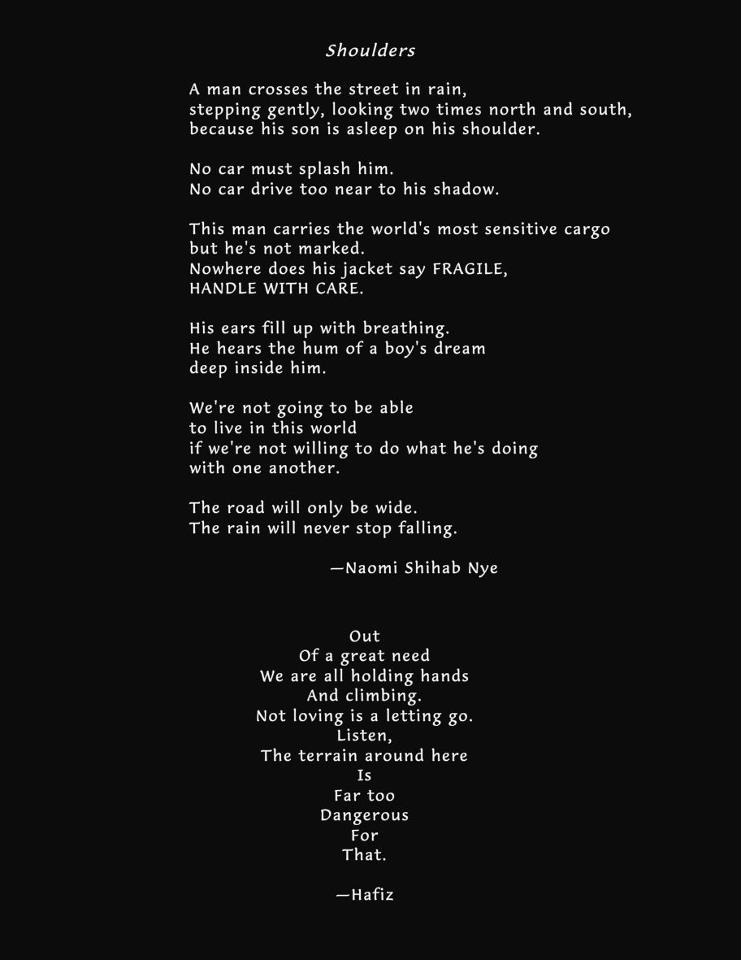
Shoulders by Naomi Shihab Nye and Out of Great Need by Hafiz

I finished reading Healing the Heart of Democracy by Parker Palmer. It is a wonderful book and, even though he wrote it from an American perspective, it has many universal messages. These poems focus on a message we are in life together-we share, reciprocate, appreciate.

I am reaching the point of settling into the dissertation process. My theme is technology, its implications in learning, mindful practices, and the role of leadership in the use of technology. Today, the responses I received from yesterday’s post, Inspiring Blog Award, was evidence that various social media offer opportunities to build digital community. Gonzaga has a journal club for its doctoral students. We find research articles, read them and summarize key points, and present our understanding as they relate to leadership. I presented one about Virtual Communities of Practice today. A key point is reciprocity or the giving and receiving of gifts. This is not a material gift, but one demonstrated through appreciation for the other when they post or say something online. I was able to share I saw the reciprocity and appreciation fully today. You are part of an emerging phenomenological study.

These poems are for you.

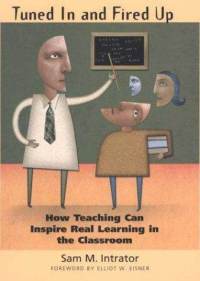
Tuned In and Fired Up

I mentioned this book in Culture of Peace and Angry Young Poet. It was worth a read. I start with a haiku which emerged from the book.


Who stretches the teacher?

Journey into their essence

Reveal the learner.

I read Tuned In and Fired Up by Sam Intrator for two reasons: as a teacher and as a graduate student preparing for the dissertation process. Sam contributes to the work of the Centre for Courage and Renewal which based on Parker Palmer’s writings and thinking.

The book is enjoyable, informative, and motivating. Teachers need to take time and pause, reflect upon, and recall the reasons they were called to teaching. There are alchemical moments of discovery we artfully use and define teacher, students, and subject. It is surreal and its magic can never be underestimated as the three blends into a single whole and respects individual integrity.

Part of the magic in this book is Mr. Quinn, the teacher. He took risks and students tuned in and fired up to his genuine presence. Parker Palmer, in The Courage to Teach, suggested “teaching is always done at the most dangerous intersection of personal and private life” (p. 18). Mr. Quinn’s teaching was learning and realized he could wrong. The magical aspect takes a teacher onto the boundary and, then, into uncharted waters. Good teachers take that risk and students sense it.

Towards the end Sam cited William Ayers: “Since teaching is always a search for better teaching, I am still in a fundamental sense becoming a teacher. I am stretching, searching, and reaching toward teaching” (p. 134). This is a virtuous cycle of learning-teaching-learning to infinity.

Sam leaves the reader with an incredible list of those things teachers can reflect upon and use according to their setting. Many are well-known: cultivate rapport with students, compete tenaciously for their attention, and spark their desire to create. Others were ones I felt were lesser known: embrace your role as a performer, tap into their senses, and acknowledge boring. That last one is challenging. At the adolescent level, treat them like they are becoming adults.
Questions: A concern expressed by Sam was a need for genuine collaboration. What practices do you use in your workplace or learning that foster collaboration between adults? If you teach, what ways do you include students?

Recommendation: I loved the book and let me leave you with just two ways. It was easy to read without losing meaning. Sam used simplexity and achieved his aims. Second, he left a thorough recipe without the quantities. I need to figure those out with students and subject.

Intrator, S. M. (2003). Tune in and fired up: How teaching can inspire real learning in the classroom. New Haven, CT: Yale University Press.

Palmer, P. J. (2007). The courage to teach: Exploring the inner landscape of a teacher’s life. San Francisco: Jossey-Bass.
 

An Angry Young Poet

Each year, I spend time on poetry with the students. Two years ago, a student asked if I wrote poetry in junior high school and I was able to say, “Yes!”. He asked me to share with them. I found them in a small lock box I keep at home and shared several with the class.

I mentioned in Culture of Peace Sam Intrator. He suggested teachers expose adolescent students complex, existential questions of life as they move through those formative years. I wrote my poems in about 1969. It was a time when identity was increasingly rooted in the global nature of the world, not just immediate community and family. War, even in Canada, entered our homes via television. I found voice in poetry and expressed an abhorrence to institutional and government approved murder. What set me apart from my peers, was I took no sides. Each was equally wrong in my mind. Mr. McKenzie, an innovative English teacher, encouraged that in us-find our voices.

I shared the following poem with my students. I concede it is not exactly the original, as it was pretty angry. I hope the original message is still there. Students asked for more poems and I complied. These past few months I rediscovered my poet’s voice. It is a gentler voice, I hope.

Win or Lose: What Difference Does it Make?

 One game

If it is one

No fun to lose

No great thing to win.

War!

Hollow

Men, women, children gone

In no time

Woe! The vanquished losers;

No winner

Each, vanquished in every sense.

Divided

In ruins

Rebuilding

On countless graves

Rudderless.

Without pride

Beggaring citizens

Values of others

Resenting conquerors

What does war bring?

No jobs

No hospitals

No schools

No homes, but the streets

Destruction everywhere.

What does war bring?

Death of innocence

Loss even in victory

Comrades fallen

But see an enemy vanquished.

Killing

Proving nothing

What fools

Going on forever

Will we learn?

We must

I pray

For human survival.

Take care and have a great 20th of July, 2012.