Category Archives: Education

Culture of Peace

Each child has a voice

In a secure space

Voices are revealed.

I am reading Tuned in and fired up: How teaching can inspire real learning in the classroom by Sam Intrator. It is the published version of his doctoral dissertation so I read it out of a twofold interest: as a teacher and as someone getting ready for the dissertation process. Sam asks teachers to consider the following question: “What engages children in learning?” That was the focus of his study and he found an innovative teacher, Mr. Quinn, who lived up to the challenge.

Mr. Quinn was studying Cannery Row by John Steinbeck, but found the students were not enjoying the early part of the book. He took them outside to the ball diamond, had them select a small patch of ground, and spread out from their classmates. Mr. Quinn asked students to observe, collect data, and write about a 1 foot by 1 foot (30 cm by 30 cm) patch of grass. They were to try see the world as a poet-scientist and find their way to describe their small ecosystem. Despite initial grumbling, the students became engaged and wrote poetry, reflective journals, and connected that patch to their lives in many ways. For many, it was the highlight of their learning that year.

In Grade 8 Social Studies, I found an activity in the Teacher Resource Manual called A Culture of Peace. This activity engages students and brings out even the voice of those who generally choose not speak up. This is one of those activities with no right or wrong answer.

First we discuss a Culture of War, which by the standards of the day should be easy to do, but an interesting thing happens. About 10-15 minutes into this discussion, students run out of descriptors for a culture of war or they repeat what has already been said. I record comments on the whiteboard and say, “It is time for a change of pace. What are some descriptors for a Culture of Peace?” I fill up a whiteboard with student responses. They are so engaged they know when they are duplicating previous responses. They are listening intently to each other. The shy, reluctant students engage in the conversation, because they feel no risk of being wrong.

The first time we did this we had to stop after an hour because we were borrowing another classroom and the teacher needed it back. When we walked out of the classroom to return to our classroom, one of the boys turned to a friend and said, “I could do this all day.” As a teacher, I felt like I was on Cloud 9. I look forward to this activity each year. The students and I become engaged in our learning.

Question: What was one learning experience that engaged you fully and made learning worthwhile and so memorable to be vividly recalled years later?

Ode to Teachers

I wanted to blog and post pictures of some great cloud formations around Edmonton last night, but I received an email and there was an idea I could not resist. We each had teachers, and I use the word in its broadest definition, who made an impact on our lives. Ruth is someone I taught with for 12 years.  I use the word taught guardedly and refuse to use the work word to describe our relationship. We learned together. Learning is different and is relational. In her email, she described a visit with a parent of a former student and shared this phrase, ‘child whisperer.’

Each of us, had or have people in our lives in many forms who fit the phrase. They remind us of what the root word of educate is–educare. Even the Latin word speaks of care, which I think is vital to the relational nature of learning.

I can think of many who filled the role. Sister Phillips was my first grade teacher. She was a member of the Catholic order the Sisters of Service and it was special in her class. Later, in high school, I had Ms. Lyford, a short, stocky Australian woman who loved Shakespeare. She once said, “Ivon, if you only tried you would be an A student.” She did it loving and in a caring way, I think. I was good with a B and explained that to her.

Outside school it was my grandmother and mother. I still learn from them although the former is long past away and my mother lives 8 hours away. I learned from my father-in-law and mother-in-law and, needless to say, I learn from the daughter I married. I learn from our boys and my students in many ways. This list is incomplete, but the point is : Great teachers are great not because they tell you do something, but because they lead you to want to do it and ignite your imagination and spirit for learning in a magical way .”

Blend compassion and passion

Bring out the best in each child

Walk with them

Open your heart

Greet them

With your story

Receive their stories gently

Reveal vulnerability

Be a guide they need

In each moment

Learn, share, create

Listen and hear

And speak in a voice

Only a child whisperer can.

Take a moment, tell us about a teacher or teachers who made a difference for you, who whispered at the right moment and spoke the right words lighting a fire in your spirit.

Larry Cuban is a leading writer and researcher in school reform or I think a better way to phrase it is a lack of true reform. He points out several key points in this excellent article. His first paragraph about teachers working together daily is not prophetic as you will see in the article. It has been part of the educational reform lexicon for a several years, perhaps decades is a better word. Why do the ‘reforms’ with all their pat answers and revolving, recycled fads secret this away in the closet? I think they are afraid.


First, top down measures are not the order of the day. Second, schooling and learning (my added word) at all ages are complex systems and forged out of relationship not transactional activities. This nature does not invite top-down. It encourages community and collaboration. The leading thinkers he refers to part way through the article are a short but impressive list. I would add others who contribute in many ways i.e. Deb Meier, James Comer, and Nel Noddings come to mind. Finally, real communities actually are dysfunctional. It is what we do in those moments that leads us to collaboration. Joining hands around the camp fire is nice, but only superficially functional. Agree to disagree is sometimes the path.


I read another blog today and my conclusion is slow is sometimes the way forward.


We in Canada who think we are doing something better are wrong. We all need the same wake up calls, a new conversation, and a reimagining of schooling and learning. Note I did not say school. That is the brick and mortar that in some cases is passé.

larrycuban's avatarLarry Cuban on School Reform and Classroom Practice

Want to give a “no excuses” reformer a stroke? Suggest that teachers working together on a daily basis have a better shot at improving teaching and learning than the highly marketed structural changes of standards-based testing and accountability, Common Core standards, more charter schools, and evaluating educator performance through student scores.

Too many reform-driven policymakers high on the rhetoric of these current reforms ignore how much improvement in teaching and learning can occur when  teachers work collectively in their classrooms and schools to improve their content knowledge and teaching skills aimed at common district goals.

For many years, teachers, administrators, researchers, and a sprinkling of policymakers have concentrated on both traditional and innovative professional development and learning communities to build teachers’ capacities in knowledge of subject and teaching skills to improve instruction in schools and districts. Such school-based efforts converge on the teacher simply because within the complex system of…

View original post 1,209 more words

Trying to Learn by Lydia Davis

Today, I read part of Experiments in Ethics by Kwame Appiah, a professor at Princeton. It is an interesting book and I doubt I can do it justice in a blog posting, but, as the title suggests, it is about ethics and their complex nature due to human complexity.

He provided a very short story by Lydia Davis. I might compare it to Heraclitus’ quote: “No man ever steps in the same river twice, for it’s not the same river and he’s not the same man.” No person steps twice in the same river, because the river is constantly changing. I also think the complexity nature of our human being is such that we change as we move into each ensuing moment. I cannot be the same person in the next moment. Living an ethical life is challenging as I am not the same person at each moment. In French, the word for experiment is experience. I think a life fully lived is one that is an experiment. I constantly learn from this fully lived life if I am mindful and use my beginner’s mind.

 
“I am trying to learn that this playful man who teases me is the same as that serious man talking money so seriously he does not eve see me anymore and that patient man offering me advice in times of trouble and that angry man as he leaves the home. I have often wanted the playful man to be more serious, and the serious man to be less serious, and the patient man to be more playful. As for the angry man, he is a stranger to me and I do not feel it is wrong to hate him. Now I am learning that if I say bitter words to the angry man as he leaves the house, I am at the same time wounding the others, the others I do not want to wound, the playful man teasing, the serious man talking money, and the patient man offering advice. Yet I look at the patient man, for instance, whom I would want above all to protect from such bitter words as mine, and though I tell myself he is the same man as the others, I believe I said those words, not to him, but to another, my enemy, who deserved all my anger.”

What other ways can we learn to live a life fully, ethically, and in an experiential manner?

Cartoon Time along with an Ivon Rant

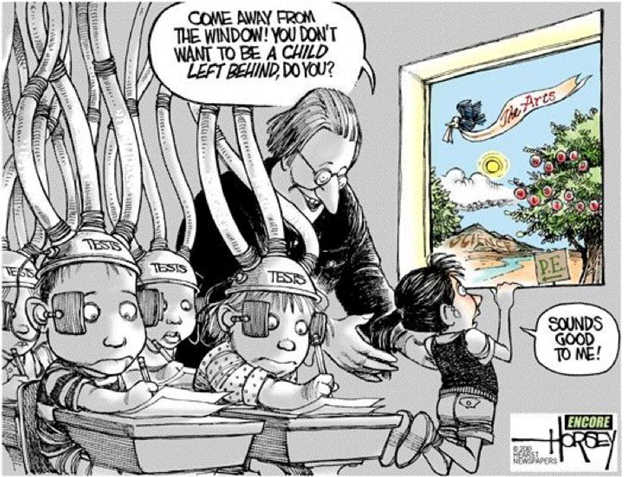
Another Alberta-based educator at The Love of Learning posted this. It reminded me of a Ken Robinson video The Educational Revolution…Why? Because Schools Kill Creativity posted by Gen Y Girl. The video is worth watching several times. The first time I watched the video several years ago an administrator informed me the message was a need to add layers of technology on top of what we are doing.

I am not a neo-Luddite. The original Luddites were not opposed to technology. They opposed potentially catastrophic outcomes blind, thoughtless implementation of technology might have on British society of the time. A message I gleaned was a positive correlation between ADHD/ADD diagnosis and an increase in various forms of imposed, standardized, high stakes testing.

The second message is statistical evidence the highest levels of creativity in school are at the kindergarten levels. After that, it is all down hill.

These are not technology issues, but simply change for the sake of change.

Technology is the artful use of the tools available to us.

Questions: What changes would you suggest for education to make it more child-friendly and child-focused? What can we do to increase the creativity for children in classrooms?

A bit of an American slant to it, but where do Canadian educational systems take their lead from? Is this what we want?

This is a post from Torbs Lindgren at Slappshot. We seem to share a love of hockey, ice hockey that is.

Torbs provided a great story about teacher who learned from her students and helped them find their way in life. Torbs also honoured me in the preface of the story.

Naming Values

I posted several times about the need to name values. I think this is important at the personal and collective levels. The word value shares the same root as the French word valoir which connects to such words as valour and valiant. Values give us strength and courage so we can act in a meaningful, purposeful, and courageous manner.Values anchor us our lives. We are not simply adrift on the sea losing sight of the horizon.

I think naming values, as nouns, brings them to life differently than saying something like, “I value” which monetizes the value as if it were currency. Naming a value allows me to hold the value. Although I do not think values are fluid in the sense they change definitions, certain values are important at times and others at other times in life. In this regard, it is important to not only name the values, but to return to them from time to time and tend to them like a gardener would to their flower bed.

Some values I will name and explain connect to others either in creating a balance or without the other they would not be fully understood.

Compassion – Buddhists refer to this as loving/kindness and it begins with one’s self. Compassion and its close cousin patience allows me to make mistakes or to be distracted and gently return my self to the moment. It balances the passion I have for certain things in my life. Without compassion the flame burns hot and is quickly extinguished.

Respect is the honouring of one’s truths and respecting the truth of others. Truth comes from the word troth and happens in relationship. Mindful listening and speaking are essential to respect. It is more than nodding one’s head and turning away.

Community is living with another, sharing what is common and important – the named values – and lifting each other up in difficult times. Mindful listening and speaking play a critical role. The functional community, one with purpose, is able to recognize its moments of dysfunction and communicate effectively. Within community, there is an honouring and respecting of the diversity and autonomy of each other.

Responsibility allows one to respond mindfully. I am responsible for my words and actions. Living in community calls on its members to be responsible or the community cannot survive. I think autonomy and responsibility are companions. Autonomy is the freedom to choose, but not at the expense of others. I set aside self-interest as I mindfully attend to the truths of others.

Wisdom is that which is shared and passed on from generation to generation. It allows the community to act prudently while expanding. Wisdom in this way is a common sense held by the community and learned by each ensuing generation. Carefully and attentively, we choose those things which apply and add as necessary.

Open-mindedness is in part the honouring of truths. Curiosity and the concept of beginner’s mind play a critical role. I step away from my expert’s role with predetermined solutions and replace it with the beginner’s mind of mindful listening, mindful speaking, and right action. The possibilities are generously fueled by curiosity with a sometimes playful face.

Justice is the fairness and equity we find in the most functional of communities. Things are not always equal, but understanding the multiple truths within a community, respecting those truths, and working with a beginner’s mind allows justice to emerge. This is not relativism gone wild, but born out of wisdom, being responsible for words and actions, and being compassionate brings justice to the forefront.

This list is not exhaustive. For the moment, these are the values I choose and name as the most important.

Human Being Instead of Human Doing

Many days I wonder about what other are doing, what causes them to do it, and what I can do to control their behaviours. I used the word do a lot in that first sentence. When I wonder that way, I become angry, frustrated, and hurt. I become a human doing instead of a human being. Being present and living each moment mindfully is part of this being.

Some words and an image to help us be today. Happy summer solstice.

The art of life isn’t controlling what happens, which is impossible; it’s using what happens.

~Gloria Steinem

Teachers as Storytellers

Think of the people we call teachers, not just in classrooms but in every facet of our lives. A quality they share is storytelling. They connect with our hearts and minds. We laugh, cry, yell, and carry on in every imaginable way with them. We remember them not because of what they taught us, but what they revealed about themselves and helped us discover about our self.

The best teachers are the best storytellers. We learn in the form of stories.

~Frank Smith

Five Steps to Destroy Public Education

Five Steps to Destroy Public Education.

Diane Ravitch is a real educational reformer in the US. I think parts of her message in this post is universal. I particularly like her comments about underfunding our schools and overcrowded classrooms.

It is just not the underfunding that starves the schools; it is the poor management and decision-making by the bureaucrats, technocrats, and oligarchs. What is the latest fad?

Overcrowding our classrooms silences the teachers. Do I even have time to lift my head and uplift students under those conditions?