Category Archives: Leadership

Ode to Teachers

I wanted to blog and post pictures of some great cloud formations around Edmonton last night, but I received an email and there was an idea I could not resist. We each had teachers, and I use the word in its broadest definition, who made an impact on our lives. Ruth is someone I taught with for 12 years.  I use the word taught guardedly and refuse to use the work word to describe our relationship. We learned together. Learning is different and is relational. In her email, she described a visit with a parent of a former student and shared this phrase, ‘child whisperer.’

Each of us, had or have people in our lives in many forms who fit the phrase. They remind us of what the root word of educate is–educare. Even the Latin word speaks of care, which I think is vital to the relational nature of learning.

I can think of many who filled the role. Sister Phillips was my first grade teacher. She was a member of the Catholic order the Sisters of Service and it was special in her class. Later, in high school, I had Ms. Lyford, a short, stocky Australian woman who loved Shakespeare. She once said, “Ivon, if you only tried you would be an A student.” She did it loving and in a caring way, I think. I was good with a B and explained that to her.

Outside school it was my grandmother and mother. I still learn from them although the former is long past away and my mother lives 8 hours away. I learned from my father-in-law and mother-in-law and, needless to say, I learn from the daughter I married. I learn from our boys and my students in many ways. This list is incomplete, but the point is : Great teachers are great not because they tell you do something, but because they lead you to want to do it and ignite your imagination and spirit for learning in a magical way .”

Blend compassion and passion

Bring out the best in each child

Walk with them

Open your heart

Greet them

With your story

Receive their stories gently

Reveal vulnerability

Be a guide they need

In each moment

Learn, share, create

Listen and hear

And speak in a voice

Only a child whisperer can.

Take a moment, tell us about a teacher or teachers who made a difference for you, who whispered at the right moment and spoke the right words lighting a fire in your spirit.

Larry Cuban is a leading writer and researcher in school reform or I think a better way to phrase it is a lack of true reform. He points out several key points in this excellent article. His first paragraph about teachers working together daily is not prophetic as you will see in the article. It has been part of the educational reform lexicon for a several years, perhaps decades is a better word. Why do the ‘reforms’ with all their pat answers and revolving, recycled fads secret this away in the closet? I think they are afraid.


First, top down measures are not the order of the day. Second, schooling and learning (my added word) at all ages are complex systems and forged out of relationship not transactional activities. This nature does not invite top-down. It encourages community and collaboration. The leading thinkers he refers to part way through the article are a short but impressive list. I would add others who contribute in many ways i.e. Deb Meier, James Comer, and Nel Noddings come to mind. Finally, real communities actually are dysfunctional. It is what we do in those moments that leads us to collaboration. Joining hands around the camp fire is nice, but only superficially functional. Agree to disagree is sometimes the path.


I read another blog today and my conclusion is slow is sometimes the way forward.


We in Canada who think we are doing something better are wrong. We all need the same wake up calls, a new conversation, and a reimagining of schooling and learning. Note I did not say school. That is the brick and mortar that in some cases is passé.

larrycuban's avatarLarry Cuban on School Reform and Classroom Practice

Want to give a “no excuses” reformer a stroke? Suggest that teachers working together on a daily basis have a better shot at improving teaching and learning than the highly marketed structural changes of standards-based testing and accountability, Common Core standards, more charter schools, and evaluating educator performance through student scores.

Too many reform-driven policymakers high on the rhetoric of these current reforms ignore how much improvement in teaching and learning can occur when  teachers work collectively in their classrooms and schools to improve their content knowledge and teaching skills aimed at common district goals.

For many years, teachers, administrators, researchers, and a sprinkling of policymakers have concentrated on both traditional and innovative professional development and learning communities to build teachers’ capacities in knowledge of subject and teaching skills to improve instruction in schools and districts. Such school-based efforts converge on the teacher simply because within the complex system of…

View original post 1,209 more words

Trying to Learn by Lydia Davis

Today, I read part of Experiments in Ethics by Kwame Appiah, a professor at Princeton. It is an interesting book and I doubt I can do it justice in a blog posting, but, as the title suggests, it is about ethics and their complex nature due to human complexity.

He provided a very short story by Lydia Davis. I might compare it to Heraclitus’ quote: “No man ever steps in the same river twice, for it’s not the same river and he’s not the same man.” No person steps twice in the same river, because the river is constantly changing. I also think the complexity nature of our human being is such that we change as we move into each ensuing moment. I cannot be the same person in the next moment. Living an ethical life is challenging as I am not the same person at each moment. In French, the word for experiment is experience. I think a life fully lived is one that is an experiment. I constantly learn from this fully lived life if I am mindful and use my beginner’s mind.

 
“I am trying to learn that this playful man who teases me is the same as that serious man talking money so seriously he does not eve see me anymore and that patient man offering me advice in times of trouble and that angry man as he leaves the home. I have often wanted the playful man to be more serious, and the serious man to be less serious, and the patient man to be more playful. As for the angry man, he is a stranger to me and I do not feel it is wrong to hate him. Now I am learning that if I say bitter words to the angry man as he leaves the house, I am at the same time wounding the others, the others I do not want to wound, the playful man teasing, the serious man talking money, and the patient man offering advice. Yet I look at the patient man, for instance, whom I would want above all to protect from such bitter words as mine, and though I tell myself he is the same man as the others, I believe I said those words, not to him, but to another, my enemy, who deserved all my anger.”

What other ways can we learn to live a life fully, ethically, and in an experiential manner?

Cartoon Time along with an Ivon Rant

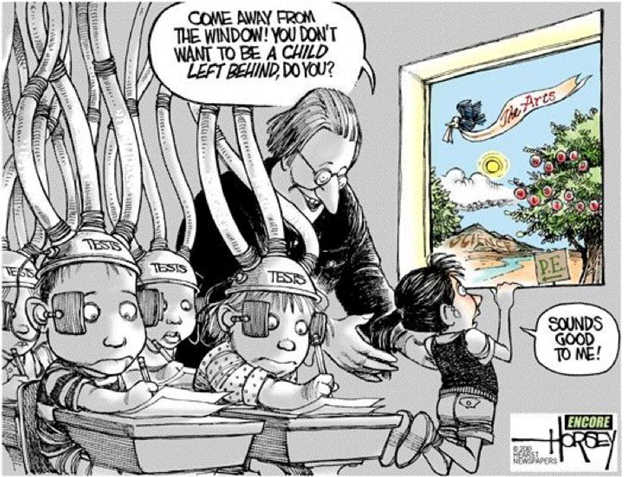
Another Alberta-based educator at The Love of Learning posted this. It reminded me of a Ken Robinson video The Educational Revolution…Why? Because Schools Kill Creativity posted by Gen Y Girl. The video is worth watching several times. The first time I watched the video several years ago an administrator informed me the message was a need to add layers of technology on top of what we are doing.

I am not a neo-Luddite. The original Luddites were not opposed to technology. They opposed potentially catastrophic outcomes blind, thoughtless implementation of technology might have on British society of the time. A message I gleaned was a positive correlation between ADHD/ADD diagnosis and an increase in various forms of imposed, standardized, high stakes testing.

The second message is statistical evidence the highest levels of creativity in school are at the kindergarten levels. After that, it is all down hill.

These are not technology issues, but simply change for the sake of change.

Technology is the artful use of the tools available to us.

Questions: What changes would you suggest for education to make it more child-friendly and child-focused? What can we do to increase the creativity for children in classrooms?

A bit of an American slant to it, but where do Canadian educational systems take their lead from? Is this what we want?

Five Steps to Destroy Public Education

Five Steps to Destroy Public Education.

Diane Ravitch is a real educational reformer in the US. I think parts of her message in this post is universal. I particularly like her comments about underfunding our schools and overcrowded classrooms.

It is just not the underfunding that starves the schools; it is the poor management and decision-making by the bureaucrats, technocrats, and oligarchs. What is the latest fad?

Overcrowding our classrooms silences the teachers. Do I even have time to lift my head and uplift students under those conditions?

Santiago by David Whyte

The road seen, then not seen, the hillside
hiding then revealing the way you should take,
the road dropping away from you as if leaving you
to walk on thin air, then catching you, holding you up,
when you thought you would fall,
all the way forward always in the end
the way that you followed, the way that carried you
into your future, that brought you to this place […]
David Whyte
from “Pilgrim”

leading and learning: Lets value individual creative teachers.

leading and learning: Lets value individual creative teachers..

This is a rather lengthy article written by a New Zealand based educator. I think it fits with a previous reblog of video featuring Sir Ken Robinson called The Educational Revolution: Why Schools Kill Creativity.

Read, watch, and weep. A lack of creativity and resulting innovation is killing public education with sameness. Let us all do it one way is the current creed. What can we do about it? It is high time we invited a new conversation to emerge.

Leadership Is a Conversation – Harvard Business Review

Leadership Is a Conversation – Harvard Business Review. Here is an excellent article form Harvard Business Review. Leading is about a conversation. Leaders need to recognize the importance of listening mindfully and attentively otherwise their role is one of management.

Are educators ready for this? Conversations are much harder work than using glib commentary.

Blueberries | Jamie Vollmer

Blueberries | Jamie Vollmer.

This is worth reading. It fell into one of my email boxes this morning. In theory, I agree with the idea that we cannot, as teachers, return our students like Mr. Vollmer could return his blueberries. Fundamentally though, there is still a problem. In the province of Alberta. there are over 25% of students who will not finish high school. Those are the ones who leave our schools. What about those who do not leave and finish? There are still some amongst them who are on the margins and school has not served well. The 25% is an average.What about students who live in First Nation communities, in the inner city, or face any number of other life issues?

Education needs an overhaul. There is a genuine need for a different conversation and not sticking our heads in the sand. Please take a few minutes to read.

Diane Ravitch is a leading American educator. Although what happens south of the border is not important to us, this article poses a great question. Who is advantaged; those with resources or those without resources? Servant-leadership, which is lost in education, asks the leader to serve those around him or her and help them grow. That focus increases for the most disadvantaged. When will politicians, bureaucrats, and technocrats allow teachers in the classroom to become leaders who serve students and the community?

dianeravitch's avatarDiane Ravitch's blog

Mitt Romney launched his foray into education by visiting the Universal Bluford charter school in West Philadelphia, an impoverished, largely African-American neighborhood. He went to tout his plan for vouchers and charters as the new civil rights crusade of our era.

While there, thinking he was in friendly territory, he made some unfortunate remarks. First, he asserted that class size wasn’t important. That is no doubt the advice he had received from his advisors, who like to claim that having a “great teacher” is far more important than class size reduction. Then, he advised his listeners that one of the keys to education success is to be a child of a two-parent family. He got called out on both comments.

A music teacher rebuked him on the class size issue, saying: “I can’t think of any teacher in the whole time I’ve been teaching, over 10 years — 13 years —…

View original post 292 more words