Category Archives: Poetry

A Vision

I am preparing to go to Miami of Ohio to attend a writing retreat. It is a curriculum theory called currere, which is the root word for curriculum and is an infinitive verb meaning to run the course of one’s life.

Currere overlaps with the methodology, hermeneutic phenomenology I used in my writing my dissertation. The two are reflective, explore one’s lived-experiences, and interpret them as data . After a person reflects on a lived-experience, they imagine how it might inform their teaching. They create a vision of the past and future in a way to create a vision for the present.

William Pinar compared this process to photographs that gain clarity as they develop. I had not used the method, but referenced Dr. Pinar’s work and he was on my dissertation committee.

Part of the process of preparing has been to use the method of currere. As I wrote, read, and reflected this Wendell Berry poem came into my view. Even though I am not teaching, I wanted to create a vision of what the wisdom might be like. As a young teacher, I can envision having used the process as a way to survive, to be still, enrich my teaching and student learning, and creating a memory native to my teaching. As Wendell Berry says, it was a paradisal dream. Hard work never is. It is its own reward.

If we will have the wisdom to survive,

to stand like slow-growing trees

on a ruined place, renewing, enriching it,

if we make our seasons welcome here,

asking not too much of earth or heaven,

then a long time after we are dead

the lives our lives prepare will live

here, their houses strongly placed

upon the valley sides, fields and gardens

rich in the windows. The river will run

clear, as we will never know it,

and over it, birdsong like a canopy.

On the levels of the hills will be

green meadows, stock bells in noon shade.

On the steeps where greed and ignorance

            cut down

the old forest, an old forest will stand,

its rich leaf-fall drifting its roots.

The veins of forgotten springs will have

            opened..

Families will be singing in their fields.

In the voices they will hear a music

risen out of the ground. They will take

nothing from the ground they will not

            return,

whatever the grief at parting. Memory,

native to this valley, will spread over it

like a grove, and memory will grow

into a legend, legend into song, song

into sacrament. The abundance of this

            place,

the songs of its people and its birds,

will be health and wisdom and indwelling

light. This is no paradisal dream.

Its hardship is its possibilities.

In Those Years

Adrienne Rich points out the paradox of living in community and being a person. It is in community that we uplift each other. It can be easy to forget about the you and the we that makes up community in the midst of what we perceive as our personal struggles. When that happens, we can find ourselves reduced to individuals and I.

We try to live a personal life and it is the only one we can bear witness to. It is in remembering our personal life carries an ethical responsibility for others, even those who we do not know. It is in locking elbows and holding hands with one another we overcome the tyranny and terror that strikes at us. The weather is not personal. It is something we share with each other.

In those years, people will say, we lost track
of the meaning of we, of you
we found ourselves
reduced to I
and the whole thing became
silly, ironic, terrible:
we were trying to live a personal life
and yes, that was the only life
we could bear witness to

But the great dark birds of history screamed and plunged
into our personal weather
They were headed somewhere else but their beaks and pinions drove
along the shore, through the rags of fog
where we stood, saying I.

Anne Murray performed a song called Good News. It seems appropriate on a day filled with heartbreak and loss for many in the world.

The Prayer of St. Francis

Today is a special day in our lives. 41 years ago, Kathy and I were married. We chose The Prayer of St. Francis was one of our readings and have a simple plaque on our bedroom wall of the prayer.

The prayer is a reminder of how we affect the world, beginning with those closest to us. It is a reminder of how being mindful and present are essential in relationships.

Lord, make me an instrument of your peace.
Where there is hatred, let me bring love.
Where there is offense, let me bring pardon.
Where there is discord, let me bring union.
Where there is error, let me bring truth.
Where there is doubt, let me bring faith.
Where there is despair, let me bring hope.
Where there is darkness, let me bring your light.
Where there is sadness, let me bring joy.
O Master, let me not seek as much
to be consoled as to console,
to be understood as to understand,
to be loved as to love,
for it is in giving that one receives,
it is in self-forgetting that one finds,
it is in pardoning that one is pardoned,
it is in dying that one is raised to eternal life.

Silver Star

When I looked for a poem, this one by William Stafford found me. Mountains appear to be immovable and unchangeable, yet as people do they do so without immediate notice. Yet, when we revisit them, we realize the changes that occurred.

In the case of teachers, Parker Palmer speaks about asking the question “who is the self who teaches?” We are each teachers in our own particular ways, so asking this question is essential. We often overlook this question in pursuit of easier to answer questions about the what, when, where, why, and how.

When we ask who we are, we explore the values that anchor us in living life. In times of crisis, those values guide us and help us through those tough times. Attending to them in mindful ways each day as a gardener would her/his garden grounds us in them in times of real need. They have spiritual meaning that come to life in living and expressing them daily through who we are as a human being.

If we serve our values well, “we will hear the world say, ‘Well done.'” The patience of living a good life, which in Aristotle‘s terms, is indefinable will be the reward. Like a mountain guiding us on our journey, the values we live and express guide us and others on a shared journey.

To be a mountain you have to climb alone

and accept all that rain and snow. You have to look

far away, when evening comes. If a forest

grows, you care; you stand there leaning against

the wind, waiting for someone with faith enough

to ask you to move. Great stones will tumble

against each other and gouge your sides. A storm

will live somewhere in your canyons hoarding its lightning.

If you are lucky, people will give you a dignified

name and bring crowds to admire how sturdy you are,

how long you can hold still for the camera. And some time,

they say, if you last long enough you will hear God;

a voice will roll down from the sky and all your patience

will be rewarded. The whole world will hear it: “Well done.”

The Uses of Not

Jacques Derrida wrote, when we speak of one thing, we invoke its opposite and what it is not. For example, to speak of a man or woman I speak of its opposite a woman or a man. Instead of understood as opposites, things, including words and ideas, complement each other, making them whole.

Albert Camus suggested “there is no love of life without despair of life.” Without one, we cannot have the other. Compassion means to share one’s love and suffering with each other. When we look deeper and are mindful of what we see, we recognize the how what is not readily evident is needed to make the whole of something.

This is not a new idea. Lao Tzu wrote this poem about what makes something useful is what complements it: the hub and spokes of a wheel; the hollow of a pot and the clay; and doors and windows and the room. Each profits from what it is not.

Often, there is paradox in understanding how things and people complement one another, making them whole.

Thirty spokes

meet in the hub.

Where the wheel isn’t

is where it’s useful

Hollowed out,

clay makes a pot.

Where the pot’s not

is where it’s useful.

Cut doors and windows

to make a room.

Where the room isn’t,

there’s room for you.

So the profit in what is

is in the use of what isn’t.

How do I listen?

When I began to look for a poem today, I chose one by Hafiz. It reminds me of the following Buddhist proverb:

How do I listen? The question is eloquent, as it does not have a fixed and expected answer. It suggests being present and mindful as another person speaks and as the universe speaks to me. Hafiz counsels me to treat what the other says as a gift to be cherished as the last words of a Master.

It is when I listen that the teacher appears. I am ready for the teachings of the Other. Emmanuel Levinas capitalized other to point out an unconditional responsibility for the Other. How I listen reveres the Other, who is my teacher in that moment.

How

Do I

Listen to Others?

As if everyone were my Master

Speaking to me

His

Cherished

Last

Words.


Watch “Damien Rice – Hallelujah” on YouTube

Source: Watch “Damien Rice – Hallelujah” on YouTube

When I taught, I often played music when I arrived at school and left it on until we were ready to begin the day. It gave students insight into me as a person. Hallelujah is one of my favourite songs and I shared it with them in various forms.

Today, when George posted this version, I thought of the two versions I shared with my students. Granted, I have not heard a version I do not like. It may be it is because I have been a Leonard Cohen fan since the late 1960’s and he wrote the song.

Here is his version:

Kathy and I have seen k.d. lang in concert several times and her version, which she performs about half-way through the set, is spine tingling.

I first saw k.d. many years ago when she performed as part of The Reclines, which performed “punk country” and was a Patsy Cline tribute band. When I hear her sing Crying with Roy Orbison I cannot distinguish their voices.

In the introduction to the song, which she sang at the Vancouver Olympics in 2010, the announcer referred to it as “a song of peace.” This is her version, which is the one many people think of when they hear the song.


From “The Rock Will Wear Away”

Today on the way home, we stopped the Okotoks Erratic or Big Rock. In the Blackfoot language, it is Okotok, which means rock. It weighs about 16, 500 tonnes (18, 000 tons), is about 41 by 18 metres (135 by 60) feet wide, and is about 9 metres high (30 feet).

During the Pleistocene Era between 12, 000 and 17, ooo years, a glacier dropped the big rock in what is now prairie just below the foothills and Rocky Mountains. There are two rocks and on the flat of the prairie they seem erratic and out-of-place. The size of the rocks speaks to the power of nature.

I have a question about this rock. How big was it when the glacier dropped it in its place?

Holly Near is a singer-songwriter. The following is a short excerpt from one of her songs. As she proposes, the rock appears stronger than water. But, is it?

Humans and water are resilient, they come back time and again. Our fragility makes us vulnerable, but, at the same time, provides durability. Like water slowly eroding a large rock down into smaller and smaller bits, humans, through their mindful and collective efforts, can bring about dramatic change to the world.

Can we be like drops of water falling on the stone

Splashing, breaking, disbursing in air

Weaker than the stone by far but be aware

That as time goes by the rock will wear away

And the water comes again

Face

This is my first attempt with embedding a video in my blog. So far, it appeared on Twitter. I started a YouTube channel, which I have wanted to do for some time. I hope you enjoy.

We walked to Spokane Falls last night. The river is running high with lots of water flowing over the series of falls. The video below is in the middle of falls.

What grabbed my attention was the rock towards the far side from us. It looks like a weathered face, having lived a full life. As we walked back to the place we stay at in Spokane, these words began to run through my mind.

A weathered face,

Facing life’s travails,

Always facing into the journey;

One that has been arduous,

Leaving its marks.

It has a pugilist’s nose,

Cauliflowered ears without shape,

A toothless mouth,

Puckered from many punches,

Always facing into the journey.

Looking ahead,

He feels the force pushing him,

Not stopping,

Holding his head high,

Always facing into the journey.


Mindful

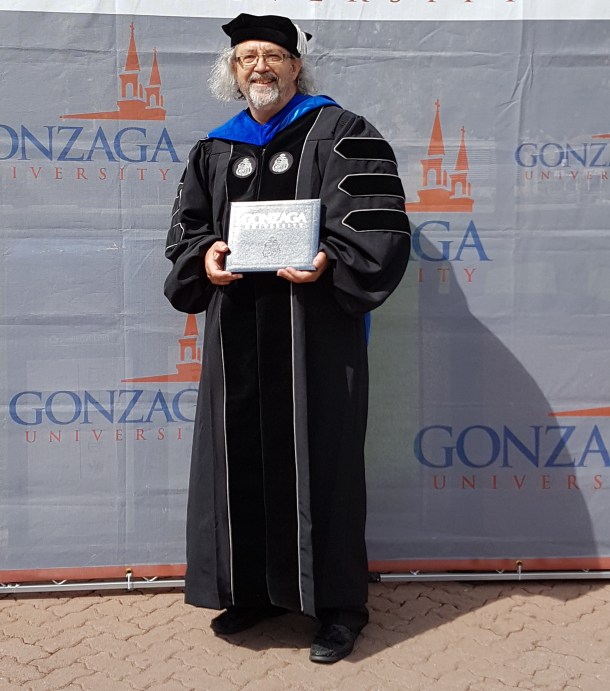
Today’s post is short. I was hooded today and the poem that ran through my mind was Mindful by Mary Oliver. This is the ultimate poem for me on a day like today. There is always something that can more or less kill me with delight.

Several speakers today reminded us that it is not the extraordinary we are looking for, but the ordinary that propels us into the extraordinary. Being mindful and attentive in and to the world is an essential element in being propelled.

Everyday
I see or hear
something
that more or less

kills me
with delight,
that leaves me
like a needle

in the haystack
of light.
It was what I was born for —
to look, to listen,

to lose myself
inside this soft world —
to instruct myself
over and over

in joy,
and acclamation.
Nor am I talking
about the exceptional,

the fearful, the dreadful,
the very extravagant —
but of the ordinary,
the common, the very drab,

the daily presentations.
Oh, good scholar,
I say to myself,
how can you help

but grow wise
with such teachings
as these —
the untrimmable light

of the world,
the ocean’s shine,
the prayers that are made
out of grass?