Category Archives: servant-leadership

Being Alive

I originally wrote this on Bowen Island, attending an Art of Hosting retreat. It reminded me of the counter cultural nature of Parker Palmer’s writing and events focused on his work. It is about communicating and seeing others as fully human.

In today’s divided world, this seems countercultural. An essential element to hosting and dialogue is listening to others in respectful ways. It does not mean we agree with them. What it means is we are open and listen to hear how they experience living their life, guided by one’s conscience and sense of values that ground us. Values give each of us strength, anchoring us and letting us understand what is proper and improper.

When we invite people into conversation, listen deeply, and ask questions which shake our certainty about the world we turn inward and focus on what grounds us to respond to them and help heal a hurting world.

Perching pensively–

Holding pen tentatively;

Senses coming,

In the midst of nature’s beauty.

Awakening–

Becoming aware;

Listening deeply;

In the midst of sounds flowing.

Breeze caressing gently–

Sunlight bathing softly;

Basking in these moments,

Resting in peace.

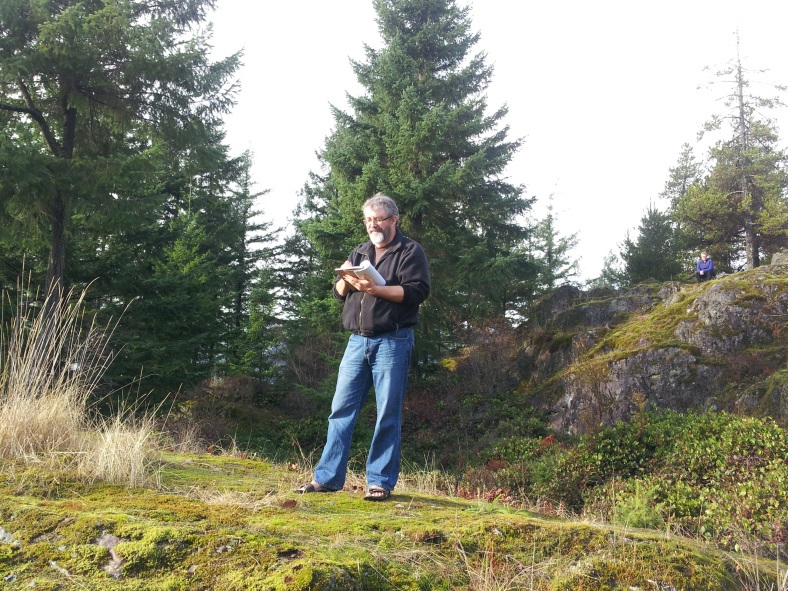
A colleague took this picture of me on top of Cates Hill on Bowen Island as I wrote and they were gracious enough to share it with me. It is spectacular with water and land in the panoramic view.

One Thread

I began to think about what I might post today and, as a good fortune would have it, Eddie’s post showed up and answered my question.

Eddie shares a lovely quote from Chief Seattle about humankind’s interconnectedness with the web of life. We have not woven the web, but a thread in it, binding and connecting us to one another and to the universe.

Hannah Arendt wrote about how our actions, including speech, transcend the time and space we currently inhabit. This is particularly the case for teachers. We are connected and bound to a future we cannot predict, that is far more complex and larger than the immediate environment we inhabit, which is incredibly complex and large.

A word spoken in haste to a student, a parent, a colleague has the potential to resonate in ways we cannot anticipate, regardless of profession or role in someone’s life. How we each treat our local environment has considerable impact on those downstream in terms of time and place. Cutting down old growth forests has more than an immediate impact. It resonates for generations. As humans, we have free will to act and speak in responsible ways. How we do these things has great meaning about who we each are as a human.

This video echoes Chief Seattle’s message of interconnectedness and how, in recognizing that point, we find our way to the peace train arriving from the darkness. Yussuf Islam (Cat Stevens) has received several awards for his work in the area of peace.

Rhythms of Living

In the poem, The Uses of Not, Lao Tzu reminds me there is often an empty space that completes something and, for that matter, someone. A wheel needs spokes, a clay pot the hole in the clay to hold things, and rooms need doors and windows.

In life, I find myself trying to fill gaps and holes. When I am mindful, I recall to make something (w)hole it has gaps and holes embedded in it. The gaps and holes serve as spaces for energy to enter and exit. Without energy exchanges, I can grow stagnant and stale.

This poem was about the busyness of life. At times it seemed to overwhelm me when I taught. I tried to do more, rather than stepping back and finding space that served to heal and make me whole again.

Filling holes–

Plugging gaps–

Digging holes in water–

Seeking to be whole;

In the end, futile.

Remaining indivisible–

Complementing one another–

Completing one another–

Beauty reflecting one another;

Emerging in paradox.

Inviting, calling–

Opening life’s arms–

In its embrace–

Discovering loving space;

Living in life’s healing rhythms.

I opted for this video, as, despite the fact they are struggling, Tommy and Gina have each other. It is what makes them whole; that and living on a prayer.

Warrior’s Quest

Sometimes, I make sense of the life and the worl in paradox. With questions I can deepen conversations. I serve questions. Father Richard Rohr says  maturity leads us to stop chasing certainty. In this way, I seek eloquent questions without ready answers: and invite others into dialogue.

After I read Chögyam Trungpa‘s Shambhala:The Path of the Sacred Warrior, I realized a warrior combats his/her own self-ignorance, moving towards being a human with a brave mind and ethical impulse. I cannot attain these qualities, but they are always worth questing towards and they do not come without struggle. Shunryu Suzuki and Thomas Merton used the analogy of a meadow to explore how we each can meditate, contemplate, and pray.

Warrior’s quest;

Resting in paradox–

Seemingly incompatible;

Space inviting space,

Forming spacious meadow.

Deepening dialogue;

Lacking pre-formed answers–

Questioning with eloquences;

Remaining open,

Experiencing wonder.

Lightening load;

Being grateful for gifts–

Even suffering,

Serving the journey;

The questing.

Emerging path;

Readying to step–

Understanding it is meant,

Fulfilling its rightness;

Knowing only it is unknown.

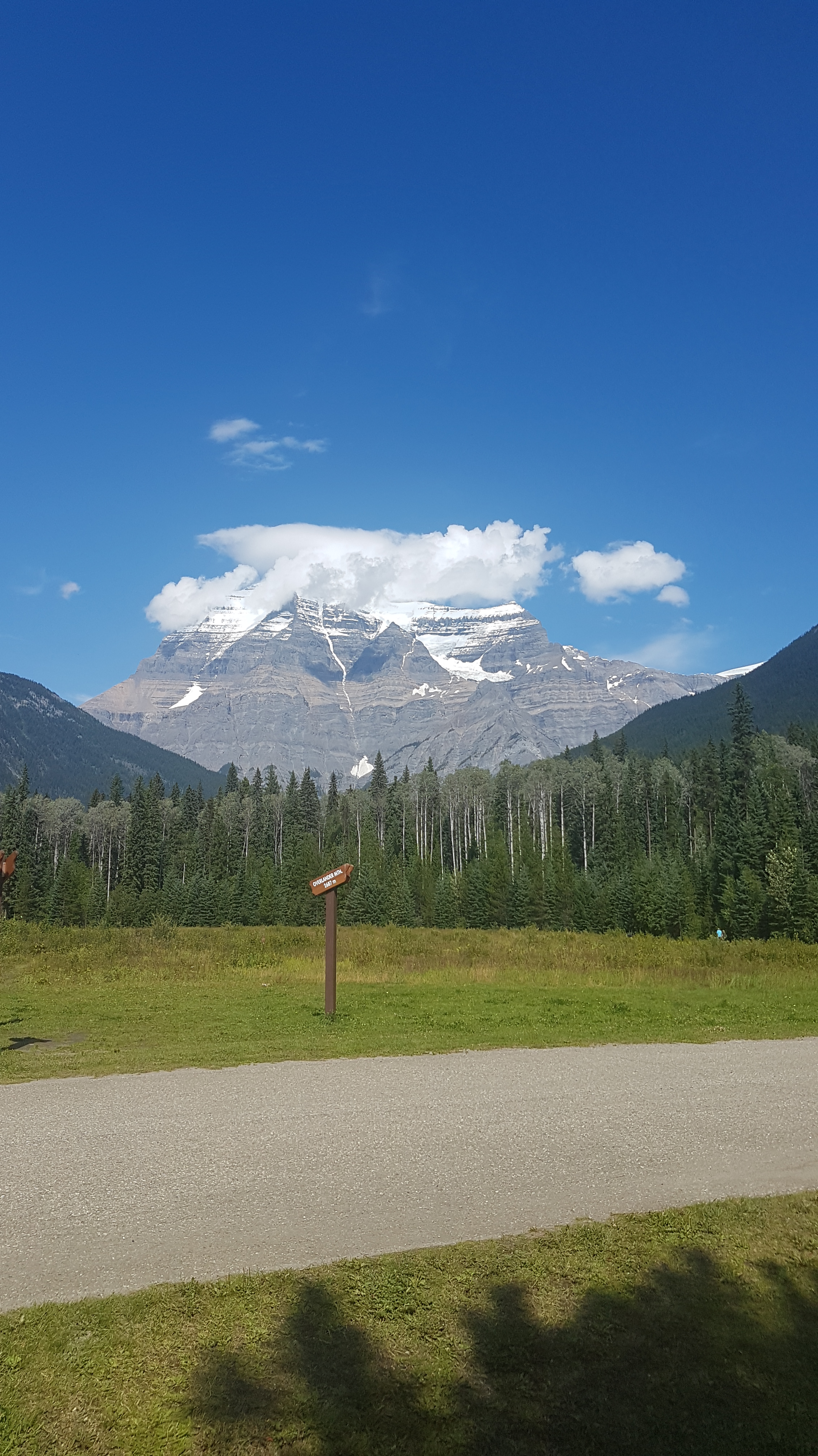
The warrior’s quest is much like standing at the base of a mountain. It is exhilirating and creates a sense of wonder: What is there on that mountain? On the other sides? I took this picture of Mount Robson on one of our many trips to visit family and friends.

A Child Sits

Several years ago, during a family discussion about war, my mother asked me where I stood on war. I am opposed to war on the grounds: “Thou shall not kill!” This edict underpins Abrahamic traditions guiding Judeo-Christian and Islamic faiths. It is a central premise is central to the universal Golden Rule.  Who suffers? Inevitably, it is the weakest, the most vulnerable.

I used an activity with students to demonstrate the difference between cultures of war and peace. I asked for words to describe a culture of war. Usually, the list was short; maybe 10-12 words and phrases. When I asked for words to describe a culture of peace, the list was long and students did not struggle to find new words. The conversation often went for an hour or so.

Despite this, we struggle to find peace. In today’s high tech world, we no longer need to be physically present to attack. It can be done via computer commands ordering pilotless aircraft and rockets launched from distance.


Child sitting–

Unable to shed tears;

Shivering–

Cold, wet,

Fragile, weak;

Hungering for reprieve.

Despairing amidst carnage–

Seeking refuge;

Finding only chaos–

From distant places,

Raining down hell;

From heavens that should protect.

School yard bullies–

Feigning courage;

Kicking those already down–

Seeing no human face,

No suffering,

Lacking care, compassion.

Humans seeking true courage–

Begging, imploring;

Returning to good senses–

Leaving behind,

Wanton, senseless,

Violence, death!

I chose this video, because it shows the outcomes of zero-sum situations and how we fool ourselves there has to be winners and losers.

A Place; A Space

Over the last few years, I have increasingly exlored how we use language. For example, we use the word organization as a noun for places where we work, learn, and play. It grows static and lifeless Yet, its root, organ, suggests life and interacting with one another. John Dewey and Ivan Illich referred to interacting and communicating as intercourse. This suggests we engage in intimacy and love as we communicate with one another.

As well, an organ, as a musical instrument, needs a human touch. At our best, we organize, work, and learn, through a common purpose, like in a jazz ensemble, and what calls each of us in some meanfinful way. In a neo-liberal and neo-conservative world, organizing, working, and learning fall short of the common good (common weal) and what calls each of us to feel fufilled, perhaps self-actualized.

Out of this reflecting emerged the following poem.

This place–

This space–

Welcoming–

Beckoning.

When cold, aloof–

As a frigid lover–

Pushing us away;

Denying intimacy.

As an anxious lover–

Frantically clinging;

Giving no room to breath.

As a capricious lover–

Now here;

Now gone.

At its best–

Fully alive;

Not on life support!

Exuding hearty warmth–

Healthy, vibrant;

Touching in human ways.

Gentle lover embracing–

Inviting and holding close;

Letting us breath.

A place–

A space–

Wanting to be.

A place–

A space–

Calling, giving voice.

Sharing–

Drawing us each closer;

To our common humanity.

Yesterday, I heard the following song by Mavis Staples. It reminded me, regardless of how things are going, there are always high notes in life.