Category Archives: Social Justice

The Panther

I learned new words today. I read an article by Judith Butler who used the word carceral, meaning “relating to prison.” It fits with systemic prejudices e.g., racism, where particular groups of people are imprisoned at a greater rate than their percentage of a society or country.

But, it includes how people are limited to a geographic space, so they do not come in contact with the elites. It extends injustice and oppression those groups and individuals experience. Paulo Freire argued this cuts across racial, gender, and linguistic lines and includes class distinction. People are trapped and imprisoned within a life that offers little hope for them and their children.

I am unsure Rainer Maria Rilke intended to make a political statement in The Panther, but it serves as an analogy to understand how another might experiences life in the midst of oppression. In not witness ing another’s disenfranchisement e.g., economic, political, educational, etc., I grow to think their plight is not real. But, bars, literal and figurative, become reality. As Rilke states “a great will stands stunned and numbed.”

The opposite of my indifference is love and serving, reaching out to give a hand to those who need help to cut the bars away that oppression has built around them. It is less about doing for them and more about valuing their lived-experiences in meaningful ways. Freire said to read the word, humans first read their world, bringing their understanding of living to formal education.

From seeing the bars, his seeing is so exhausted

that it no longer holds anything anymore.

To him the world is bars, a hundred thousand

bars, and behind the bars, nothing.

The lithe swinging of that rhythmical easy stride

which circles down to the tiniest hub

is like a dance of energy around a point

in which a great will stands stunned and numb.

Only at times the curtains of the pupil rise

without a second … then a shape enters,

slips through the tightened silence of the shoulders,

reaches the heart, and dies.

I love the blues. A sad thing about the genre is many women who were pioneers were not recorded as often as men. It is a treat to hear someone like Sister Rosetta Tharpe sing.

Being Alive

I originally wrote this on Bowen Island, attending an Art of Hosting retreat. It reminded me of the counter cultural nature of Parker Palmer’s writing and events focused on his work. It is about communicating and seeing others as fully human.

In today’s divided world, this seems countercultural. An essential element to hosting and dialogue is listening to others in respectful ways. It does not mean we agree with them. What it means is we are open and listen to hear how they experience living their life, guided by one’s conscience and sense of values that ground us. Values give each of us strength, anchoring us and letting us understand what is proper and improper.

When we invite people into conversation, listen deeply, and ask questions which shake our certainty about the world we turn inward and focus on what grounds us to respond to them and help heal a hurting world.

Perching pensively–

Holding pen tentatively;

Senses coming,

In the midst of nature’s beauty.

Awakening–

Becoming aware;

Listening deeply;

In the midst of sounds flowing.

Breeze caressing gently–

Sunlight bathing softly;

Basking in these moments,

Resting in peace.

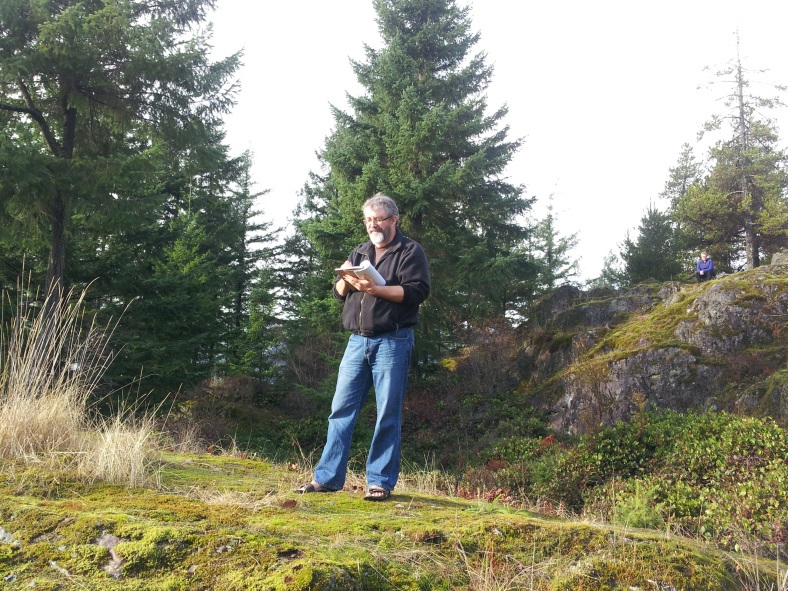
A colleague took this picture of me on top of Cates Hill on Bowen Island as I wrote and they were gracious enough to share it with me. It is spectacular with water and land in the panoramic view.

One Thread

I began to think about what I might post today and, as a good fortune would have it, Eddie’s post showed up and answered my question.

Eddie shares a lovely quote from Chief Seattle about humankind’s interconnectedness with the web of life. We have not woven the web, but a thread in it, binding and connecting us to one another and to the universe.

Hannah Arendt wrote about how our actions, including speech, transcend the time and space we currently inhabit. This is particularly the case for teachers. We are connected and bound to a future we cannot predict, that is far more complex and larger than the immediate environment we inhabit, which is incredibly complex and large.

A word spoken in haste to a student, a parent, a colleague has the potential to resonate in ways we cannot anticipate, regardless of profession or role in someone’s life. How we each treat our local environment has considerable impact on those downstream in terms of time and place. Cutting down old growth forests has more than an immediate impact. It resonates for generations. As humans, we have free will to act and speak in responsible ways. How we do these things has great meaning about who we each are as a human.

This video echoes Chief Seattle’s message of interconnectedness and how, in recognizing that point, we find our way to the peace train arriving from the darkness. Yussuf Islam (Cat Stevens) has received several awards for his work in the area of peace.

A Child Sits

Several years ago, during a family discussion about war, my mother asked me where I stood on war. I am opposed to war on the grounds: “Thou shall not kill!” This edict underpins Abrahamic traditions guiding Judeo-Christian and Islamic faiths. It is a central premise is central to the universal Golden Rule.  Who suffers? Inevitably, it is the weakest, the most vulnerable.

I used an activity with students to demonstrate the difference between cultures of war and peace. I asked for words to describe a culture of war. Usually, the list was short; maybe 10-12 words and phrases. When I asked for words to describe a culture of peace, the list was long and students did not struggle to find new words. The conversation often went for an hour or so.

Despite this, we struggle to find peace. In today’s high tech world, we no longer need to be physically present to attack. It can be done via computer commands ordering pilotless aircraft and rockets launched from distance.


Child sitting–

Unable to shed tears;

Shivering–

Cold, wet,

Fragile, weak;

Hungering for reprieve.

Despairing amidst carnage–

Seeking refuge;

Finding only chaos–

From distant places,

Raining down hell;

From heavens that should protect.

School yard bullies–

Feigning courage;

Kicking those already down–

Seeing no human face,

No suffering,

Lacking care, compassion.

Humans seeking true courage–

Begging, imploring;

Returning to good senses–

Leaving behind,

Wanton, senseless,

Violence, death!

I chose this video, because it shows the outcomes of zero-sum situations and how we fool ourselves there has to be winners and losers.

A Place; A Space

Over the last few years, I have increasingly exlored how we use language. For example, we use the word organization as a noun for places where we work, learn, and play. It grows static and lifeless Yet, its root, organ, suggests life and interacting with one another. John Dewey and Ivan Illich referred to interacting and communicating as intercourse. This suggests we engage in intimacy and love as we communicate with one another.

As well, an organ, as a musical instrument, needs a human touch. At our best, we organize, work, and learn, through a common purpose, like in a jazz ensemble, and what calls each of us in some meanfinful way. In a neo-liberal and neo-conservative world, organizing, working, and learning fall short of the common good (common weal) and what calls each of us to feel fufilled, perhaps self-actualized.

Out of this reflecting emerged the following poem.

This place–

This space–

Welcoming–

Beckoning.

When cold, aloof–

As a frigid lover–

Pushing us away;

Denying intimacy.

As an anxious lover–

Frantically clinging;

Giving no room to breath.

As a capricious lover–

Now here;

Now gone.

At its best–

Fully alive;

Not on life support!

Exuding hearty warmth–

Healthy, vibrant;

Touching in human ways.

Gentle lover embracing–

Inviting and holding close;

Letting us breath.

A place–

A space–

Wanting to be.

A place–

A space–

Calling, giving voice.

Sharing–

Drawing us each closer;

To our common humanity.

Yesterday, I heard the following song by Mavis Staples. It reminded me, regardless of how things are going, there are always high notes in life.

How Do I Listen?

Several year ago, I watched a PBS show about a branch of neuroscience called Contemplative Mindfulness. Rudolph Tanzi is central in this work which grew out of research by Richard Davidson, Ellen Langer, and Jon Kabat-Zinn.

Mindful practices have been with us for centuries and informed Jesus’, the Buddha’s and Mohammed’s teachings. Mindful listening begins with me listening to the other, moves outward, and is eloquently described by Hafiz, a Sufi poet. Mindful listening requires humility those teachers emulated in lived practice as the servant as leader.

In a world that seems filled with ego and narcissim, listening to the other is essential to healing the world and each human. I am re-reading Ivan Illich and authors who use his work. His best known book is Deschooling Society, which was originally titled The Dawn of Epimethean Man and Other Essays. The title was changed by the publisher, something Illich regretted later.

Illich was a priest and his writing, including about education, was informed by The Parable of the Good Samaritan. His understanding was we do not get to choose who are neighbours are. Instead, others we encounter depend on us to listen and demonstrate compassion, dropping our ego in the process. It also fits with Epimetheus who was more comfortable with uncertainty than his more famous sibling, Prometheus.

Encountering the stranger as neighbour comes both with reward and risk. The words hospitality and hostile are linked etymologically.

How

Do I

Listen to others?

As if everyone were my Master

Speaking to me

His

Cherished

Last

Words.

Here is a Mary Oliver reading I Happened To Be Standing and an inteview with her. You have to wait until the end to get to the listening aspect. Being mindful weaves its way through the poem.

Gettin’ My Mojo Back

I looked at this poem a month ago and decided not to post it. As I listened to music today, a song came on called Getting My Mojo Back and felt it was time to post it.

I wrote this during a retreat on Bainsbridge Island based on the work of Parker Palmer. It was at a time I was wrestling with staying in teaching due to the politics. I felt I was not giving it my all and lacked confidence in my teaching.

During the retreat, I reflected and had candid conversations with others and concluded it was time to control what I could control. Interestingly, it was in the conversations with others that I had to choose to be all in really came to the forefront. I went back to my classroom, spent another 5 years teaching, and giving it my all.

I think, when we lose confidence, we do not realize it. It sneaks up on us, rather than being a cataclysmic shift. Recovering confidence is similar. It is done in small steps and realizing we are not alone in the moment.

I had to realize anger was born out of fear and loss. Once I acknowledged this, I was at ease with letting go and moving forward.

It just happens–

Letting go;

Speaking without anger–

Embracing one’s sadness;

For what is lost.

Staring into an abyss–

Sitting with unformed questions;

Terrifying darkness–

Sensing incompleteness,

Feeling uncertainty.

Taking stock–

Looking inwards;

Accepting extended hands–

Discarding baggage

Moving towards a place of light.

Mojo gaining momentum–

Emerging at its pace;

Creating healing space–

Living one’s own truth;

Living in each moment’s question.

I attended a John Lee Hooker concert in 1972 or 1973. I grew up listening to jazz, gospel, folk, and blues with traditional country, early rock and roll. I took it for granted that I attended a John Lee concert until an American, who shared a love for the blues, told me he never did. African-American performers toured in Canada on a regular basis at a time they did not have that same ease of movement in their own country.

When I used Langston Hughes’ poetry in my teaching, I remembered he wrote from a different understanding of what America was. This was an outgrowth of an awareness of my privilege as a white Canadian male.

Listening

I began to write this poem after a long and tiring week. Sometimes, when I step back from the visceral nature of my emotions, postive and negative, I find a kernel to prompt writing, thinking, and acting.

Too often, I find myself talking when I should be listening. This includes listening to me, and, more importantly, listening to those whose stories are silenced in unjust ways. I think those two forms of listening go hand-in-hand. Not listening to others is often a product of being so busy with the noise of my own life. When I listen from the heart, I hear words anew.

Rich stories silenced–

Seeking just spaces,

Sharing and healing;

To speak freely.

Listening deeply–

Sadly, stories unheard,

Of being oppressed;

Shunted to the margins.

Listening with heart–

Leaning into stories,

With grace and humility,

Hearing for the first time.

Am I ready to act?

Listening, hearing–

But, without doing;

(In)justice remains.

I listen to the blues, gospel, and jazz most of my life. When it comes to the blues, gospel, and jazz music I am aware of the privilege I experience and do not take it for granted.  As a Canadian, I attended concerts, because African-American performers came to Canada. They had access to venues I could attend here that they did not have in their own country.

Today, I heard Mavis Staples (on her latest album) singing and it resonated. For real and just change to emerge, I must be willing to listen and change the things I can.  When I listen to the blues and gospel music, particularlyperformed by African-American women, there is an undercurrent for meaningful and just change in the world.

Ongoing Quest

I wrote this during my last year teaching. It had been a particularly challenging day in the classroom and beyond. The students were full of energy and it was not always healthy. I grew frustrated and visibly annoyed part way through the afternoon. Part of it was a lack of a healthy relationship with the administration, which seeped into my teaching at times. It was challenging to set those frustrations aside, particularly with little support and how it impacted my teaching.

Having said thi, I chose to teach anothere year and wanted to teach those particular students. On myway home, I realized I need to establish a different, encouraging tone. In a sense, my ability to influence is my ability to recognize my reality and walk into the fire, the crucible, so to speak.In his teaching, Thich Nhat Hanh reminds me even weeds of a tough day serve a purpose. They fertilize and increase the yield of a crop: children’s learning and this could be lost on on me. For the remainder of the school year, some 7-8 months, I used this as my touchstone.

Sometimes, I allow myself to assume what is out there makes me who I am. If I let it, I succumb to those forces. On the other hand and stepping back from the brink, I reclaim my view and my callings in life. I do not let others and circumstances dictate who I am. I can choose how to respond. This is no mean feat as, in the heat of  the battle, it is hard to not be reactionary. The best I can do is be the best I can be in a moment, reflect later, and grow anew with fertilizer provided by tough moments.

transforming–

ongoing quest,

seeking vision,

unearthing a better, truer self–

digging deep,

resting in my heart.

transforming–

polishing the gems of self,

righting speech! righting action!

influencing others properly–

reclaiming my voice,

bringing forth my best.

Much to my mother’s chagrin, I got The Freewheelin’ Bob Dylan when I was in high school. I still have it and still spin the vinyl after all these years. Although it is now almost 60 years old, A Hard Rain’s A-Gonna Fall still rings true for me today. Dylan wrote this in the midst of the Cold War with nuclear threats all around. Today, we are in the midst of multiple crises: health, wealth distribution, inequities, etc. The question I should ask in difficult times, small and large, is how can I be the difference I want to see in the world to paraphrase Mahatma Gandhi? Even if it is difficult, it is noble, virtuous, and hopeful, in the face of great obstacles, to speak truth to power, (re)calling I can only make the difference I can make.

Medicine Wheel

I am unsure the title fits the poem , but I left it as is. This was a hard poem to write as I delved into something I am not 100% confident with and that is quantum spirituality. As a quantum physicist writing from a feminist perspective, Karen Barad writes about entanglement. In short, we are entangled with one another, with non-sentient beings, and the inanimate of the Universe. This involves moral responsiblities in relating to those other beings and things, without even knowing what it is and how we are related to each of them.

Medicine wheels are part of many First Nations’ cultures. They connect people to Nature and reflect our interdependence with Nature and each other. They signal the need for harmony in lives and ground us with and in our world. In my understanding, they have quantum aspects to them as we are entangled in ways that suggest we are always seeking harmony in hopeful ways. What a medicine wheel asks us is to acknowledge interdependence, something those who wield levers are woefully reluctant to do. Instead, humans become resources and chattel in making profits in a zero sum game.

After my post In Seeming Chaos, Hope, I wondered about the current state of world affairs e.g. political crises, health crisis, economic crisis, etc. They are entangled with each other. I cannot simply wish one away and the others remain. Moreover, they existed before COVID-19. We did not see them easily. A lack of access to health care was in place for many people before the pandemic. We warehoused elderly people (the not-so nice term is aging people) as has become our custom in the advanced world e.g. schools.

I began to look for a spiritual connection with quantum physics and entanglement and found it. What was interesting was I have been reading about the connections for years in the writings of The Dalai Lama and Fritoj Capra. (The link is to an article where both are referenced.) What Karen Barad does is presents a detailed case for it from a scientific and feminist perspective. I think the feminine perspective is essential, as I consider bell hooks, Mary Belenky, Riane Eisler, etc. to understand how we move away from what Eisler termed a dominator, patriarchal world based on binaries and assigning a number to one that incorporates a participatory, matriarchal world. In this world, Belenky refers to intuitive, feminine, and I would argue, indigenous ways of knowing and wisdom based on the quality of living we each experience. These are impossible to quantify. However, we can describe them in poetic language. What if we had leaders like Jacinda Ardern and Angela Merkel instead of people who pass themselves off as leaders and fall far short of leading?

Basking in Brother Sun’s warmth–

Healing (in)spiriting waters–

(In)haling sweet air–

Replenishing.

Here,

Feeling welcomed–

Homing in on what’s proper,

Resting in one’s responsibilities.

In relating to the Universe–

While standing in Nature–

When Supporting other beings–

Discovering hope(ful) ways.

Intuiting as quantum beings–

Accepting unfelt entanglement–

Hearing unheard voices–

“Crossing love’s hearth.”

Enriching alchemy–

Inspiring magic.

Seeking peace,

Speaking truth to power.

I took the picture on Bowen Island and began to write the poem.