Category Archives: Uncategorized

Politics as Usual

We are in the midst of a provincial election and I find myself in a quandary of who to vote for. This is an essential question and served as a catalyst for examining the issues. The concerns that emerged are the inability of politicians to stop using catch phrases, stop making illogical promises, and stop thinking all the electorate do not get it.

Danielle Smith, the leader of the Wildrose Alliance, claimed her party, if they formed the government, would act as servant-leaders. Her logic is that they would serve the interests of the people of Alberta. Robert Greenleaf proposed the ultimate test of servant-leadership is the growth of those most marginalized within an organization or society. What would Ms. Smith do for those who have the least, live on the street, are undereducated, and lack access to supports they require to grow as people? Several days later she promised, when a surplus budget was achieved, her government would pay each Albertan $400/year. What does that do for those who are most needy? I submit, if the roughly $1.2 billion that amounts to was used to upgrade, not close, schools in settings with the greatest need and further transformed them into community hubs to provide a broad range of social, health, and educational supports for people in those communities, there would be money left. For those living on the streets, allocate resources to responsible charities to help people in need. There would still be money left. When a similar enticement was sent out some years ago, I turned it over to a charity but not everyone is able or willing to do that. I believe governments, modeling true servant-leadership, have mechanisms to effectively develop and distribute resources. Moreover, I can only think of a handful of politicians who deserve the label of servant-leaders. Liberal Senator Romeo Dallaire and former Conservative MP Doug Roche, come to mind. Surely, Ms. Smith is not suggesting she and her party fit that mold?

Premier Alison Redford made promises, as well. She seems to have fallen out of favour with some media people and is taking a bit of a hit. My concerns are about building a number of schools and refurbishing others. Besides asking where the money will come from, what happened to the concept of transformative education? That term suggests the possibility of real conversations about public education happening at and with the grassroots in this province. Are politicians not aware of a growing trend towards alternative, private, and home school decisions made by families in this province? It seems to go unnoticed by politicians and bureaucrats alike. What does this trend mean to the future of public education? This question is long overdue; and we need to consider it and develop real, meaningful dialogue around it. If we consider the increasing usage of technology in our lives, do schools have to be buildings or is that, in some cases, an outmoded way of thinking? Surely, Ms. Redford and her party do not think they are promising anything transformative in public education? Keep in mind, there are other areas requiring transformation. What would transformation of education, health care, social services, and environmental stewardship look like in this province?

The most likely candidates for the Premier’s office make promises, use catch phrases, and will spend money and resources in ways that perpetuate the status quo. Both are nominally politically conservative, but what are they trying to conserve? I want to conserve things, too—the environment, public education, affordable, accessible health care, and a social support system working for all citizens of Alberta. This conservation assumes a different view of community, leadership, conversation, and resource development. No politician or media shill has the right to say they speak for all Albertans until they have spoken to all Albertans. When did that happen? Will it ever happen?

What Was not Said at the World Cafe Events

I intentionally let the World Cafe Events and results lay fallow to provide reflective space so new ideas could emerge. What surprised me was it was not what was said explicitly, but what went unsaid—no reference to the importance of subject matter in learning and teaching was made. I considered this and arrived at possible explanations.

First, perhaps the group saw the area of expert subject knowledge as unimportant. This is the most unlikely assumption. There were educators in the conversations and I imagine they think this is important. Teachers  train to deliver material in specific subject areas. I have a Physical Education major and a French minor. I chose those areas and, while I no longer actively teach either subject on a regular basis, I enjoy both and feel they contribute positively to my teaching. I cannot generalize my experiences or conclusions to the work of all teachers, but one still could see it as important to teachers, as professionals.

Second, it could be, in education, life-long learning is a given; by definition educators are life-long learners. This is also hard to generalize, but I can speak from personal experience. Currently, I teach Science, Social Studies, and English Language Arts in a multi-grade junior high classroom. I consciously chose to shift from earlier subject area training. To be personally successful and for student success, I actively and purposefully upgrade. There is evidence teachers  serve as models of life-long learning for students when they engage in life-long learning themselves. A question here is, “What does life-long learning mean in this context? Is it different from other professions and work settings?” Defining life-long learning is hard to do. so my conclusions are, at best, specific to me and my experience.

Third, and I think the most likely explanation is based on the adage, “Students care how much you know as a teacher, if they know how much you care about them as people.” The ethic of care in education might be more important than it is given credit for. The World Cafe group acknowledged that mastery was based on meaningful and purposeful learning that prepared and motivated students to learn. Those observations suggest subject matter is important but, at the same time, a real focus on qualities such as communication, compassion, reciprocity, community, affirmation, mutualism, etc. require greater attention. It is easy to dismiss these characteristics as soft, but educational luminaries, Nel Noddings, Deb Meier, and Parker Palmer, have pointed out these are challenging and critical aspects of teaching and learning. Mike Seymour devoted the book Educating for Humanity to building healthy, vibrant, and truly democratic communities in schools. These purported ‘soft’ qualities build positive environments with relational trust and commitment only found in true community (a link to an article by Anthony Bryk) and suggests we should know students, their parents, and our colleagues. Engaging in and building caring, compassionate, and supportive relationships is hard work, but worthwhile. Why do we avoid this effort?

My reflections led to a hypothesis that teachers are expert in chosen subject matter and, when given choice, do continuously work at life-long learning. This means deep, mufti-layered, nuanced learning as opposed to superficial simple attendance to the latest fad. To make real differences, adults should care enough about students individually and collectively to reach and grow beyond themselves. This carries a responsibility with it that educators need to learn about students, their needs, and their environments outside school walls. That is relational and commits teachers, by the nature of a variety of choices, to be learners and co-creators of knowledge with students, families, and community.

An Extraordinary World

I am reading a book called The Radical Christian Life by Joan Chittister. A line that stood out was “spend our time well, to contemplate the divine in the human, to treat everything in the world as sacred. We need the wisdom of stewardship.” I recalled the Buddhist concept of the extraordinary explained by Thich Nhat Hanh. A story he recounted was about an oak tree at Plum Village. Attendees stop and literally become tree huggers as they hug that tree and admire its splendour. With small actions, humans move from seeing themselves as part of the world not separate and superior to the world we share with all of Creation. There are things and times I take for granted.

We regularly drive the Yellowhead Highway between Prince George and Edmonton. Recently, I realized it is extraordinary. Each trip we pass Mount Robson. Sometimes it is shrouded in clouds. Other times, it looks like this. It is always spectacular.

We observe wildlife: bear, elk, deer, goats, bald eagle etc. Last summer, I took a picture of two black bear feeding along the side of the road. They seemed quite unaware of my presence.

We took a picture of an Inukshuk in Jasper National Park. An Inukshuk is an Inuit symbol reminding us others were there before or that we are on the right path. It is an excellent reminder of the need to stop, reflect on the world, and take stock of our role in the world. It is an extraordinary place.

I was reminded of the extraordinary nature of the world as I read Malou’s blog entry. She wrote about tulips in Holland. Tulips might seem ordinary to people who see them everyday just like driving through the Rocky Mountains has been to me. When I mindfully, attentively observe the world and become aware of it, its breathtaking beauty is readily revealed.

Godly Play: A Setting for Eloquent Questions?

A question was posed about the role of eloquent questions and how they might apply to the concept of Godly Play. I chose to flesh out my thinking on eloquent questions in that context. Eloquent questions lead inquiry into what is important within a community and  shared by a community, big or small. Access to the wisdom of past generations gained through questions posed by members of a group. Gadamer in Truth and Method suggested the prudence and eloquence derived from eloquent questions “gives the human will its direction, is the concrete universality represented by the community of a group, a people, a nation. … [Therefore, its] youth demands images for its imagination and for forming its memory.”

I am not expert on the concept of Godly Play, but the questions posed by children in that setting could be understood as eloquent questions. Eloquence, as it relates to language, suggests capacity to articulate questions about those things that are important and people are curious about in their lives. Yes, it could mean being persuasive and convincing, but I think as it applies to inquiry, eloquence has to do with articulating questions crucial to the existence and survival of the group. With this curiosity and wonder, children participating in Godly Play are encouraged to ask wondering questions and are provided with open-ended response time. This last description suggests there is time to consider answers and, over time, to reconsider them.

Gadamer proposed that prejudice guides understanding, but we are aware of the prejudice and the role it plays in understanding. An open-minded stance allows people  awareness of their prejudices or personal agendas and not be attached to them. We stay open to accepting new evidence and there is a constant maturing of views and understanding of the world. This stance brings to mind the Buddhist concept of the Beginner’s Mind which Senryu Suzuki defined as “in the beginner’s mind there are many possibilities.” Children benefit from the beginner’s mind and constantly seek to make sense of the world while remaining open to the many possibilities the emerging world holds for them.

This openness and questioning stance leads to the prudence or wisdom that is important to the existence of the group, not only in its present form, but recognizable with each ensuing generation. St. Thomas Aquinas considered prudence in this sense as benevolent and based upon a supernatural good. The community hopes that the children, through their inquiry, will gain the prudence and wisdom to sustain the community through the rhetoric and the words they speak and the intent of their actions. Prudence is not driven by self-interest. That is deceit and cunning. Prudence takes the form of actions that would be well-intended and for the greater good.

Although I lack in-depth expertise in both eloquent questions and Godly Play, Godly Play does seem to encourage children to ask eloquent questions to better understand their community and grow with their community in a prudent way.

Images to Provoke Thought

I am doing two things with this posting. First, this is the first time I am posting twice on the same day. Second, it is the first time I am posting something other than a professional reflection. These images do reflect learning. I am terrified of heights. Even when I sit in the car, with my eyes closed at the Grand Canyon, I am aware I am at the edge of an abyss. This fear is both irrational and ironic. As an ice hockey player, I play goal and have faced shots of approximately 90 miles an hour. It could be argued this is foolish and I must be afraid. The irrational nature of fear and non-fear allows me to say, “I am not afraid.” If I could explain what draws me play goal, I would probably not do it. What I have concluded is I feel in control when I play goal, but do not when I fly, sit at the edge of the Grand Canyon, or climb a ladder and, as a result, suffer. Richard Rohr, a Franciscan priest, shared this about suffering in a recent posting: “Suffering of some sort seems to be the only thing strong enough to destabilize our arrogance and our ignorance. I would define suffering very simply as ‘whenever you are not in control’.”

Fortunately, Kathy comes to my rescue in moments of suffering and takes great pictures to share her experience. In that way, it is a shared experience and, for that, I am grateful. I see and experience these moments through her eyes.

Image

This is the Chapel of the Holy Cross built into the wall of the canyon overlooking Sedona, Arizona.

Image

This is the Grand Canyon at Desert View which is the beginning of the trip along the North Rim of the Canyon. At the bottom of the several thousand foot drop, you catch a glimpse of the Colorado River.

Image

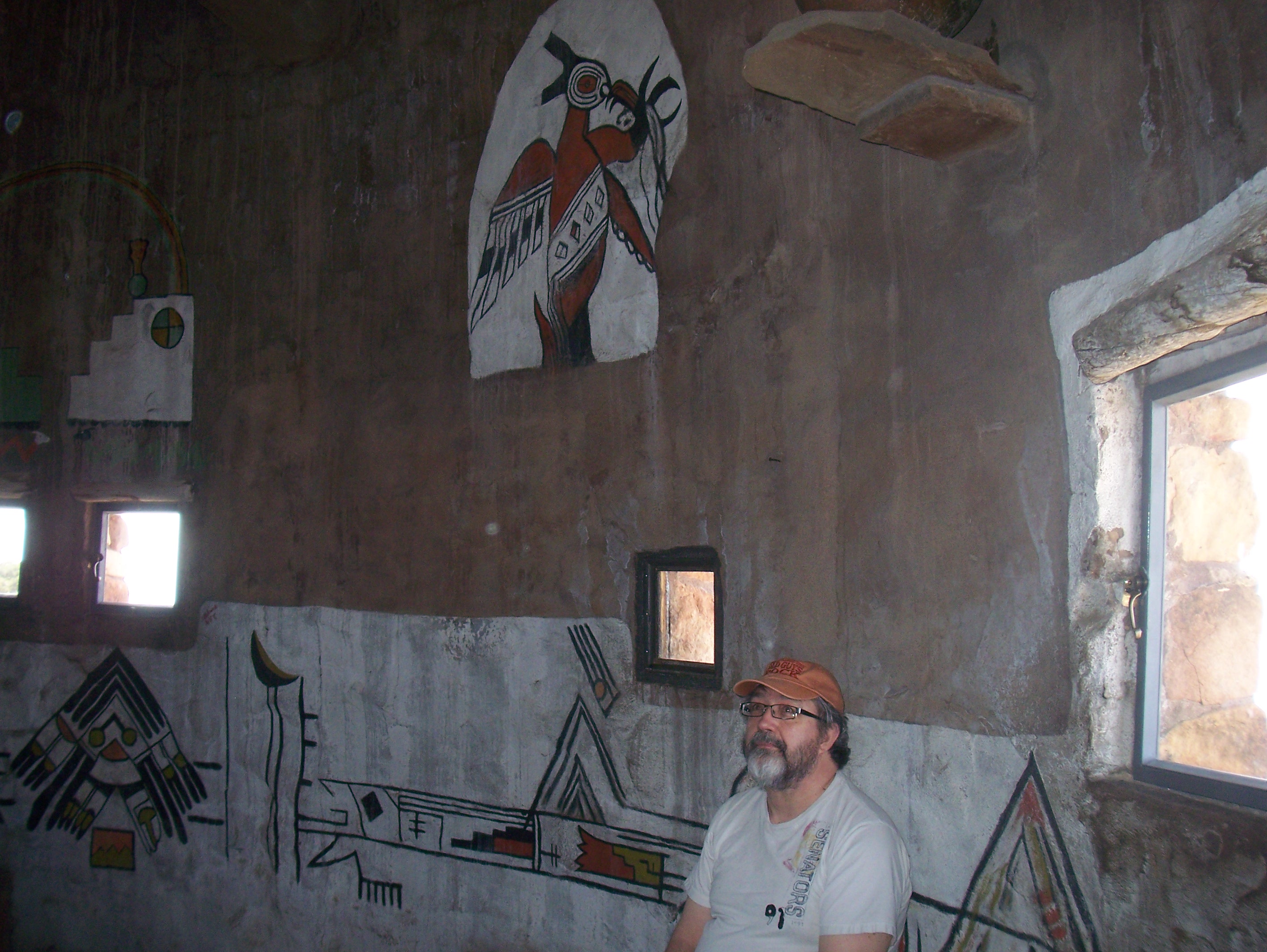
This is the watchtower where the previous photo was taken. I did make it inside and felt somewhat secure in the idea that I would not fall to the bottom of the canyon. I did look out the windows. The watchtower is an amazing, contemporary acknowledgement of the history and nature of the region as evidenced by the art work on the walls.

Image

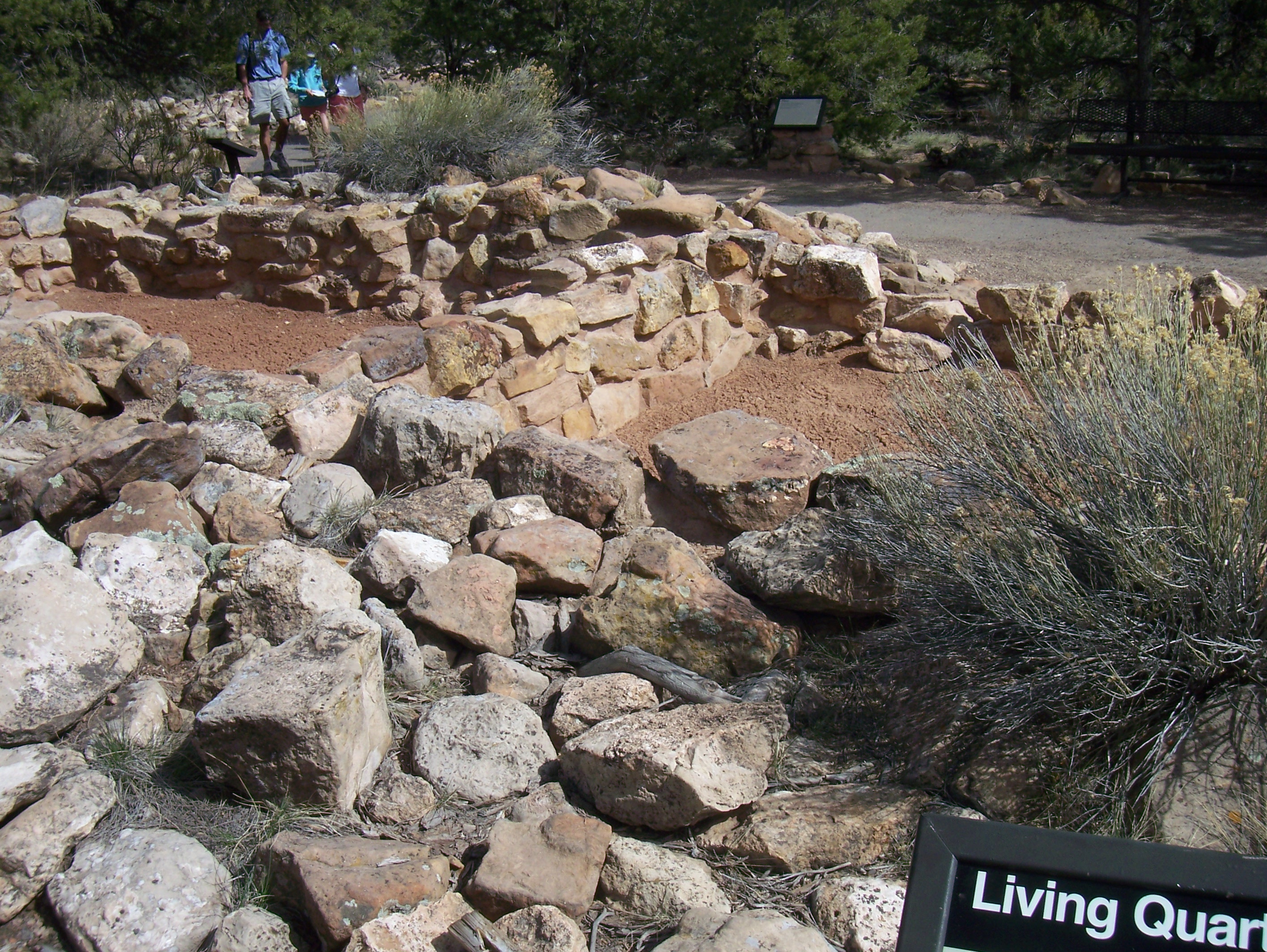
These are the remnants of living quarters of a group of people who lived in the Grand Canyon area about 800-900 years ago. It is part of what is called the Tusayan Ruins. I was able to get out of the car as this was on the other side of the highway from the Grand Canyon. The people who lived here were small and did not grow to more than 5 feet in height, so the living quarters were quite small. What caused them to leave? That is an eloquent question open to discussion.

Image

This is a picture of Kathy and I at Tusayan. You can see I am still concerned about the idea we are 7000 feet above sea level. Only a small smile sneaks out. If you squint, the snow-covered peaks of the San Francisco mountain range are in the background. This weekend concluded the Arizona ski season. The highest peak is 12,000 plus feet and several peaks remain snow covered year round.

This is a tiny sampling of pictures taken over the past week. Kathy takes pictures to overcome my fear of heights while visiting  places like the Grand Canyon, Jasper, and Yellowstone.

Table Poster Summary March 17, 2012 World Cafe

Attached is the summary of the Table Posters March 17, 2012 table posters world café event. I was able to share some of our experience over the past 2 months at the Servant-Leadership conference in Portland this past weekend.

I devoted a slide to some  of the descriptors that emerged at our tables. These descriptors serve as a nexus for the servant-leader, mindful practice for all  leaders, and the necessary building of community that is so vital in education today.

Last night, I was re-reading an interview with Parker Palmer conducted by Mike Seymour for his book Educating for Humanity. This line stood out for me: “The professional context in school allows very little reflective time for the important questions of selfhood and meaning.” This lack of time extends to adults and children in schools. Without caring and open conversations, the purpose of education remains a question unanswered. The questions about the purposes of education need to placed in the middle of our conversations, attended to carefully, allow spaces to open up for truly democratic participation to emerge, and not assume there are pat answers. That is what I have taken from our time together. There is so much gained from purposeful conversations framed around appreciative and eloquent questions. We took time and reflected on what we felt was important.

What can we do to extend these conversations? What can we do to bring these conversations to schools regardless of how they are organized? Children and adults will benefit from conversations that allow reflective spaces to take root and grow in their schools.

Community and its Role in Learning

Community has been a recurring theme throughout the World Café conversations and events, with many descriptors alluding to communal practices and relationships needed for learning to happen. Reciprocity, connection, supportive, affirmation, and other words expressing interactions suggest community. The summary posters of the March 17, 2012 World Café Event confirmed this recurring theme of community and the table posters, to be posted, also bear this out. The theme of community is important not just in learning, but in life itself. Without community, can life and learning be as meaningful?

Parker Palmer recently shared in a Facebook posting: “Community does not mean living face-to-face with others—it means never losing the awareness that we are connected with each other…” This link is to a short video of Dr. Palmer discussing the Myth of the Individual.

The servant-leadership conference I attended in Portland reinforced that, although community continually evolves, as a value it can remain intact. Here are some examples.

Professor Shann Ferch, from Gonzaga University, spoke about the “beloved community” that the late Martin Luther King so eloquently referred to. It is the necessity to see each other, including oppressors and those who have done harm to us, as human. Dr. Ferch also quoted Viktor Frankl: “We are made to turn outward, toward another human being to whom we can love and give ourselves. … Only when in service of another does a person truly know his or her humanity.”

We easily dismiss these references to community as the extreme and needed actions and words of those in different settings. After all, Dr. King led the Civil Rights movement in its halcyon days and paid the ultimate sacrifice. Dr. Frankl survived the atrocities of concentration camps during World War II. What do their experiences have to do with simply getting through the day?

Kirk Young, a colleague from Gonzaga, elaborated on what could be understood as community in the form of a value. The communities we choose to belong to share one common ingredient: intimacy. Ferdinand Tonnies, a German sociologist, used the word gemeinschaft and described this form of community as “a tighter and more cohesive social entity. [It is] exemplified in family and kinship” suggesting when humans gather in community, intimate experiences can be shared. Members share the good, the bad, and grow together towards common purposes, thus are mission driven. Values and mission serve as glue for community.

John Dear, a Jesuit priest, proposed in The Rebel Jesus, a second, mostly unnoticed miracle occurred during the Sermon on the Mount: the forming of community. Community allowed people to see the human nature of each other as Jesus instructed those closest to him to organize the large group (some believe well over 5,000 people) into small, more intimate groupings of about 50 people each. Father Dear suggested that in these small communities, people interacted differently and shared as they made connections with those now close to them. People were no longer strangers; whereas moments before they were simply part of a large and increasingly hungry throng. In contemporary parlance, they were statistics.

By witnessing the humanity in each other, we are better able to form community and share intimacy without fear. Our humanity is the one thing we can claim to share with others and in this, we find purpose to gather and form community around the universality of human values.

World Cafe March 17, 2012

I took a deep breath and slowed down for a few moments to post these very important contributions you made to my learning. You will find the images of the March 17 World Cafe Table Posters and March 17 Wall Posters posters on the blog. I will summarize them in the next few days and post them. They look amazing. I apologize for the delay and only offer that in the days leading to spring break, appointments, and flying to Portland, time was stretched. Your time and contributions to each event were appreciated and valued.

I want to express my gratitude to each of you for taking time to advance my learning through the World Cafe events and Appreciative Inquiry. You contributed to and guided my thinking as I prepared a presentation I am delivering entitled The Mindful Servant-Leader. The four events we attended demonstrated that a positive focus on important questions asked in a safe and spacious manner yield unexpected answers and directions. Community emerged through the process and people communicated about ordinary and extraordinary aspects of learning. Dialogue and conversation give and affirm voice to each member of a community. Voices are greatest in the collective and we found new, eloquent questions. Answers were assumed to be unknown when the questions were formed and asked.

I will leave you with a passage from Mindful by Mary Oliver: I say to myself/how can you help/but grow wise/with such teachings/as these–/the untrimmable light/of the world,/the ocean’s shine,/the prayers that are made/out of grass?

The Mindful Servant-Leader

Larry Spears suggested servant-leadership “begins with the natural feeling that one wants to serve, to serve first. Then conscious choice brings one to aspire to lead.” This aspiration to lead is based on an awareness of the leader’s feelings and an awareness of the environmental needs, including those of the people that are being served and led. This understanding leads to mindfulness which is essential to the work of the servant-leader.

Harvard psychologist, Ronald Siegel, proposed mindfulness provides skills to help “recognize our feelings and choose whether or not to act on them. This helps us to respond to others skillfully.” The definition of servant-leadership intersects with the skill set of mindfulness. We are aware of our feelings and through careful observation can recognize that needs also exist outside us. This understanding guides the servant-leader to be conscious of the choices made and be aware when he engages in non-choices.

Bob Stahl and Elisha Goldstein offered a definition of mindfulness: “the practice of cultivating nonjudgmental awareness in day-to-day life.” Awareness is a characteristic of the servant-leader. You might ask, “Am I walking my talk?” The servant-leader makes himself aware if he is simply downloading those things he does not want to do; the mundane, the risky, the confrontational. He recognizes his moral position has a direct bearing on the morale of those he serves and leads.

The servant-leader is a deep listener, a vigilant observer. Listening is a full sensory and heart-felt experience suspending judgement. Appreciative inquiry opens spaces for others to speak and feel heard. Trust is built and a path of non-violence is found in these moments. Mindfulness creates safe, trusting, and inviolate environments where questions of the servant-leader are gentle, humble, nurturing, and safe. The leader is attentive to others while listening and while speaking. Vico suggested prudent and wise questions be posed for the sense of the community to be revealed. Common sense is the wisdom of the community revealed through deep listening and vigilant observation.

Quiet spaces for personal reflection are set aside. We listen to ourselves or, as Parker Palmer suggested, we allow the soul or the inner teacher to come out and play in quiet, nonjudgmental spaces. There it find its voice, speaks softly, and reveals wisdom. Richard Rohr proposed discernment is led through the questions we ask ourselves. What questions are we asking in meditative, prayerful, or contemplative times? No matter the name we choose, these are quiet, spacious moments of solitude to seek guidance by quieting our internal judge and cynic. The answers to the questions are often there waiting to be revealed, to guide us when we listen carefully and willingly.

Jack Kornfield proposed “mindfulness is attention.” Respectfully tending to our voice and all voices signals compassion. Compassion or empathy emerges from deep listening. The servant-leader is not cast in the role of problem solver or expert. What if we only asked questions and truly sought to understand by listening first? The great teachers of history learned by listening to the responses of others. The root of responsibility is response. What do others know that makes them responsive and responsible?

Parker Palmer and Thomas Merton spoke of the importance of wholeness in the lives of those we come in contact with. Both wrote of the foundational importance of healing broken spirits with deep listening and reflection led by great questions. If we broke the spirit of another person, an animal, or a community, what could we do to heal and make them whole? As people, and communities as living organisms of people, discover what gives life meaning and calls them to vocation, they become whole and healed, able to serve and lead.

David Rome and Hope Martin suggested the best ways to begin “shifting our patterns of communication [is] with our listening. … Good listening means open-minded, genuinely interested attention to others and allowing yourself the time and space to fully absorb what they say. … Good listening encourages others to feel heard and to speak more openly and honestly.” Mindfully listening empowers the voices of those served and is a powerful form of persuasion. It is a signal of compassion and that the servant-leader is aware of and recognizes worth in others to truly lend a hand. Being the expert problem solver excludes common sense revealed from an open-minded, genuinely interested stance, while attending to others allows time and space to respond, not simply react.

Conceptualization in mindfulness is the beginner’s mind. Thomas Merton and other Christian writers and thinkers have referred to it frequently so it is not only a Buddhist concept. The beginner’s mind sees many possibilities; whereas the expert mind is restricted to one possibility. Harvard psychologist, Ellen Langer, defined mindfulness as “noticing something new” but we close our minds in the pursuit of stability that we recognize as an illusion. Langer has researched mindfulness extensively as the opposite of mindlessness or automaticity which is a cognitive, not spiritual, construct. The beginner’s mind should remind the leader of Einstein’s quote that insanity is solving our problems with the same thinking that created those very problems. The servant-leader remains open to the possibilities others offer through their thinking to help solve problems of the organization.

The beginner’s mind provides foresight to learn from the past, from the realities of the moment, and anticipate potential consequences. Living in the moment and being fully present opens the heart and mind of the servant-leader. Trusting the community to share the burden allows common sense to emerge. The servant leader listens deeply and mindfully while asking questions to appreciate the individual and collective wisdom.

The ‘good shepherd’ tends his flock carefully, devotedly, and mindfully provides refuge and nourishment for each member to grow and the flock to flourish. Metaphorically, the pasture provides safe haven for individual and collective voices to emerge signalling the meaning of the group. The purpose of the group and its very being is in trust, shepherded forward to benefit ensuing generations. We inherit the world from our children; therefore we are its stewards and servants as we lead from the future. What world would we want to leave for our children?

To be stewards and servants for the benefit of those who trust us is heady and demands the fullest possible awareness to the commitment undertaken. The servant-leader nurtures the growth of each individual and the community, allowing gifts to be revealed and, in turn, others to become servant-leaders. I coached hockey for years and when parents would complain about a team’s performance, I would gently point out I  was committed to their grandchildren. Their sons and daughters were the next generation of coaches. Being mindfully aware of my commitment allowed me to better serve that commitment, the individuals, and the team.

The servant-leader is aware community is changing and understands community as a value. The servant-leader is aware of a shift from local community to large institutions to global networks as primary and interwoven shapers of human lives. This awareness calls the servant-leader to search for and identify the means to build, sustain, and refresh community and in the company of others maintain community as a value. Mike Seymour explained that companion and community were breaking of bread with others. Breaking bread has gone viral and this suggests the servant-leader is attentive to and mindful of the common purposes shared within a community or between communities.

Greenleaf proposed the best test of the servant-leader is to ask, “Do those served grow as people? Do they, while being served, become healthier, wiser, freer, more autonomous, more likely themselves to become servants? What is the effect on the least privileged in society? Will they benefit or at least not be further deprived?”

When I consider the best test questions, I am inclined to wonder, “What will be the role of mindfulness in the service of the leadership construct known as servant-leadership?”


Servant Leadership — An Overview

Leadership came up several times in the first three World Cafe events including an explicit reference to servant-leadership which I feel it is a concept worth exploring. Serving and opening a path to leadership should have merit in education and I want to expand on the characteristics used to describe the servant-leader. I drew extensively from an article written by Larry Spears (2004) called Practicing Servant Leadership. Spears was the CEO at the Robert K. Greenleaf Center for Servant-Leadership. Its namesake, Robert Greenleaf, was the person responsible for developing and articulating servant-leadership.

A definition cited by Spears was servant-leadership “begins with the natural feeling that one wants to serve, to serve first. Then conscious choice brings one to aspire to lead. The difference manifests itself in the care taken by the servant–first to make sure that other people’s highest priority needs are being served.” Making sure people’s highest priority needs are served came up several times in our conversations. Words such as community, safe, listening, empathy, and compassion are a small sampler of descriptors provided in conversations. The following represent 10 characteristics attributed to a servant-leader, drawn from Greenleaf’s writings.

1. Listening: This can be broken into two parts. There is a deep listening to others, but also quiet reflection. Listening deeply to others represents compassion and quiet.regular reflection reveals wisdom.

2. Empathy: Through listening to others to understand, the servant-leader seeks empathy to accept and recognize special and unique spirits of those he/she listens to. Empathy calls for appropriate behaviour or acceptable performance from those being led.

3. Healing: The relationship between the servant and others carries an implicit message. There is a search for wholeness, integrity and completeness of the person. To be whole, one must feel listened to and served.

4. Awareness: Awareness is a disturber and awakener. The servant-leader is aware of both internal and external landscapes allowing for an integrated, holistic person to emerge. This awareness is a seeking to understand issues related to values and ethics.

5. Persuasion: This refers to the servant-leader using persuasive rather than positional power to make organizational decisions. Persuasion acts to build consensus rather than using coercion, manipulation, or power.

6. Conceptualization: This is the ability to balance the need to ‘dream great dreams’ and simultaneously remain focused on day-to-day functions of an organization.

7. Foresight: Allows the servant leader to learn lessons from the past, the immediate realities of the moment, and potential consequences that might arise in the future.

8. Stewardship: The rubric of servant-leadership is one in which all CEO’s, staff, and trustees act as stewards holding something in trust for the greater good of society. Stewardship is based on openness and persuasion rather than power and control.

9. Commitment to the growth of people: This is the responsibility to nurture the growth of each individual in a community. Members are allowed to reveal their gifts and, in turn, serve.

10. Building community: The servant-leader is aware of a shift from local community to large institutions to global networks as the primary shaper of human lives. This awareness calls the servant-leader to search for and identify various means to build and sustain community.

Greenleaf proposed the best test of the servant-leader is to ask, “Do those served grow as people? Do they, while being served, become healthier, wiser, freer, more autonomous, more likely themselves to become servants? What is the effect on the least privileged in society? Will they benefit or at least not be further deprived?”

When I consider the best test, I am inclined to further wonder, “Is the role of a teacher ideal to serve? Is the role of teachers, in whatever capacity, best defined by asking: do children in their care become healthier, wiser, freer, more autonomous, and more likely to become servants?” I include a vast grouping of people as teachers because many are called to serve and teach in various capacities. Parents and family members want their children to grow just as teachers in schools want their students to grow.