Category Archives: Videos

Speaking One’s Truth

I wrote this as I was making decisions about continuing to teach. There had been considerable upheaval as new administrators arrived and left, families left, and a friend and colleague retired. I found myself constantly in the midst of a storm with little or no control in how things might move forward. At a retreat in Oakland, I spent considerable time reflecting and journaling about the issue at hand, so this was not intended to be a poem and it took a year to write itself.

What I wrote was a summary of the past year and the struggle to ways to create in my teaching and be more present to my students. What I lacked was confidence in who I was and what I was enacting as a teacher, the performativity and improvisation essential to my teaching. I planned a lot in my teaching, but the depth of planning allowed me to improvise in ways that a lack of planning could not.

In The Book of Joy, The Dalai Lama and Desmond Tutu discuss how loss and fear lead to anger. What is important is during challenging times to try to be aware of what gives us meaning and hope in life. Although I would love to teach and be part of educating the next generation of teachers, I find it easier to accept that is not happening, focusing energies on writing and teaching in a new way. If the situation arose to teach and educate the next generation of teachers, I would consider it. What it is not doing is defining who I am and my life.

It’s emerging,

Happening–

Letting go;

Speaking with love–

Accepting the lost.

Sitting with questions,

Accepting uncertainty, incompleteness–

Taking stock;

Gazing inwards–

Feeling humbling hope.

Accepting extended hands,

Discarding baggage–

Walking forwards;

Living my truth;

Questing in each moment.

I took this picture in Arizona in March. It was the last of five I took. Each day, as I walked back, the cactus had bloomed one or two more flowers. The cactus and its flowers exist just to be a cactus and its flowers, beautifying the world. They remind me, even in harsh conditions, plants and animals flourish in their time.

As I was writing, Curtis Mayfield’s Move On Up played. It is appropriate. As we face challenges, we move on up and achieve, albeit an unpredictable, something.
Focusing on the Essential

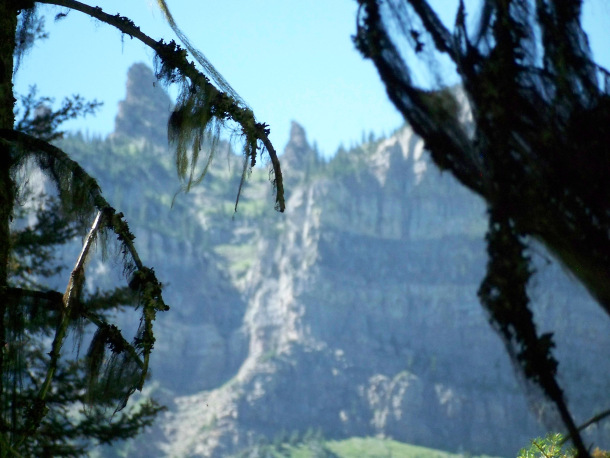
I took this picture in the summer of 2012. I sometimes keep blurry phots to remind me to try bring and keep things in focus. They remind me life is not always in sharp focus and there are times to step back, pause, and reflect. I think this is essential amidst multiple crises we are experiening: health, economic, and social justice. The health crisis accentuated and made more visible the social and economic fault lines in the world, including in so-called advanced countries. These inequities include the wars, hunger, Amazonian deforestation, accelerating climate change, etc.

It is essential to keep our eye not on the outcome to correct the injustices, inequities, and lack of democracy in the world, but on the processes that will overcome those phenomena. John Lewis in Across that Bridge: A Vision for Change and the Future of America stated

“You are a light. You are the light. Never let anyone—any person or any force—dampen, dim or diminish your light. Study the path of others to make your way easier and more abundant. Lean toward the whispers of your own heart, discover the universal truth, and follow its dictates. […] Release the need to hate, to harbor division, and the enticement of revenge. Release all bitterness. Hold only love, only peace in your heart, knowing that the battle of good to overcome evil is already won. Choose confrontation wisely, but when it is your time don’t be afraid to stand up, speak up, and speak out against injustice. And if you follow your truth down the road to peace and the affirmation of love, if you shine like a beacon for all to see, then the poetry of all the great dreamers and philosophers is yours to manifest in a nation, a world community, and a Beloved Community that is finally at peace with itself.”

The title could read any country in the world and the world itself. In focusing each of our light, we can gradually transform the world, making it better, more just, more equitable, and more democratic; a beloved community.

One’s spirit wearies;

One’s travails weighing heavy–

From within,

A voice calling.

Seeking peace;

Turning inward–

Posing prayerfully,

Listening for wisdom.

Paying homage;

Celebrating–

Carving paths through wilderness,

Cherishing one another.

Appreciating difference in unity;

Opening hearts to one another–

Reaching outstretched hands,

Grateful for common humanity.

I leave you with the video of the reading of the poem Invictus by Tybre Faw. What gives me hope is there are young people like this who are the light.


The Establishment

I wrote this poem when I was in high school, so some 50 years ago about the time I wrote Angry Young Poet. I updated both poems several years ago, but the underlying theme was evident in the orginals and I tried to keep that in mind in editing.

I found both poems as part of handwritten notes I dug through one weeked while Kathy was away. What struck me was how little things change. In fact, I might argue things are more entrenched than ever; the rich got richer and the poor poorer. One only has to consider the enormous wealth being accumlated by billionaires during the multiple crises we are experiencing.

Multiple crises, health, economic, and social justice, might give us room to re-imagine the world we want for our children and grandchildren. Instead, I am afraid we are more entrenched in our binary positions. Despite this, I hold out hope, not optimism and positivity, that we can begin the process of transforming the world to make it more democratic, socially just, and equitable. Part of my writing is revisiting an article I published in 2012 called Rocky River: Building a Learning Organization to re-imagine how we might educate children, youth, and adults. I begin re-imagining with a simple shift in language and call those engaged in teaching and learning educands a word Paulo Freire used in Pedagogy of Hope: Revisiting Pedagogy of the Oppressed.

More broadly, we can apply the learning organization’s principles to other institutions. Peter Senge cautioned it is hard work and takes time. Unlike other revolutionaries, Freire stated incremental change, based on dialogue between humans, was essential to transforming the world. Although Senge does not draw on Freire’s dialogic model, he suggests dialogue, with deep and caring listening, is at the heart of transforming institutions.

They know best for the rest–

Indoctrinating,

Not transforming,

Recalling non-existent good old days.

In disagreeing–

Simply wrong-headedness,

Daring to rebel:

Who are we to question?

Having it made–

Hunting and gathering,

Material wealth signaling success,

Repress, suppress, oppress.

Depending them to know best.

Maintaining existing order,

Demanding blind loyalty,

Failing to practice what preach.

I re-worded the poem again. I see how little changed in 50 years. Without a picture, I thought of which blues musician might best convey my message. I immediately thought of Nina Simone, who sings with edge. When I play her songs for undergrads, those with backgrounds of privilege demonstrate a visible level of discomfort.


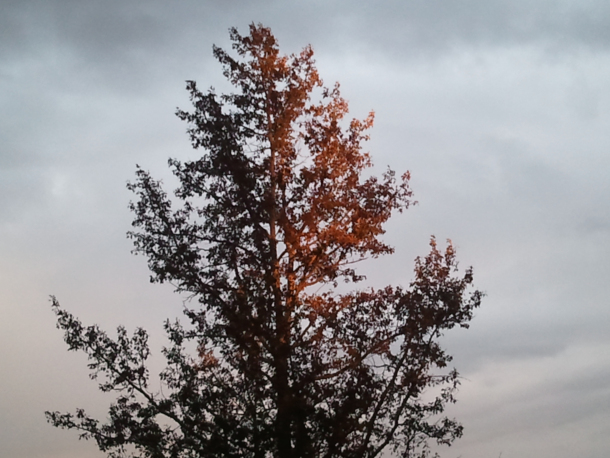
Sun Set Tree

The same day Kathy took the picture for my post Time to Rest she took this picture of a single tree standing against the horizon as the sun set. She called it the sun set tree.

This spring and summer has been cool and dreary with many days below average for temperature and with. Yesterday, we began to turn the corner with some heat that is supposed to continue for at least a week. If we wait, the sun comes out and warms things up. For growth to occur, we need rain. As the heat takes hold and the sun does it job, a little rain must fall.

The same applies to our lives. We conflate passion and love. Passion contains love. It also holds moments of sorrow and pain. Compassion is sharing the good, the not-so-good, and refraining from doing harm to other sentient and non-sentient beings. We cannot go it alone. Nature teaches us about the essential idea of inter-being, a concept Thich Nhat Hanh writes about. Being mindful of Nature’s teaching gives insight into how we might inter-be with and in the world. It is not always clear. Into our lives a little rain will fall and there will cloudy days to help produce the sun and growth.


Sentinel stands guard;

Blurry silhouette.

Against leaden backdrop;

Appearing lonely.

Gently smiling sun;

Sharing tentative rays.

Receiving warming glow;

Gathering to grow.

Revealing that hidden by shadows;

Stretching boldly.

Smiling with Brother Sun;

Sharing sacred moments.

In a time where social inequity has been laid bare in incredibly visible ways, brought out of the shadows, we need to think, not about what privilege we might lose, but about how we can help each other be lifted up, particularly the most oppressed amongst us. I listened to Simon and Garfunkel growing up and enjoyed The Sound of Silence. This cover is my favourite version and reminds us we need prophets to write words on the subway walls.

A Half a Dragonfly Is Fine

I took this picture while at the retreat I posted about the other day. It picture out better than others. I had trouble with the sun over my shoulder; pretty good excuse. Initially, I was disappointed because the dragonfly posed and cooperated. In retrospect, the title says it all and the moment was a lesson in living.

As I mentioned, the retreat was a great experience. I reminded my self it is OK to be imperfect. I am human with that. The dragonfly showed up and shared a quiet moment with me; for that I am grateful.

Lighting down,

Oh, so gently.

Posing,

Oh, so perfectly.

He spoke;

He really did!

“Take my picture please

My time almost done

My memorial moment.”

Posing ever so gracefully,

As if expressing gratitude,

Sharing a momentous moment,

Done, we each took leave–

Jobs nearly complete.

We each are learning about who we are in life. Living is a gerund and, as result, is an unfolding and becoming we are always experiencing. I think this is best said in the poem of Derek Walcott, Love After Love. It is in accepting our imperfections we come to love the self who continuously emerges.

Flowers

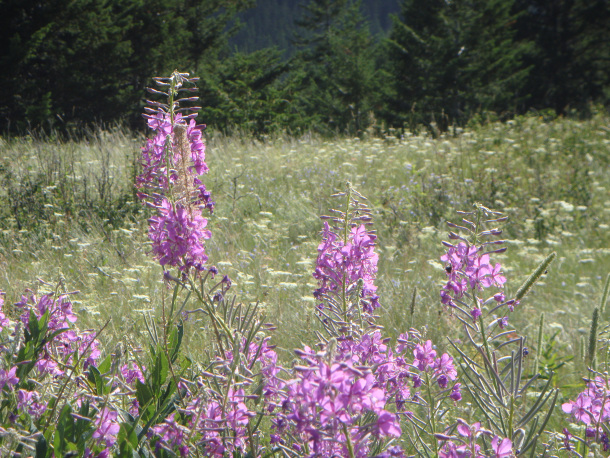
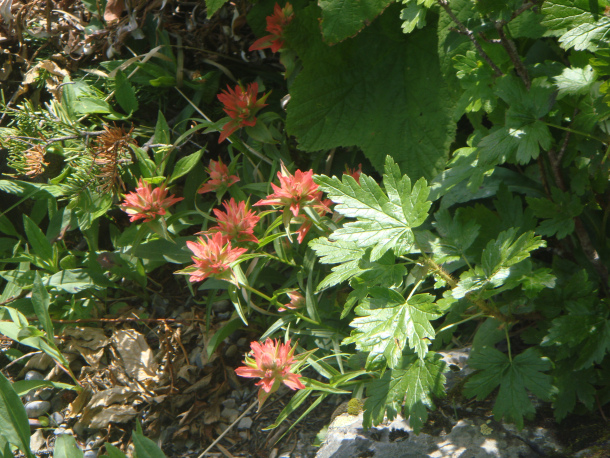
I wrote this poetry and took these pictures on a trip to British Columbia with Kathy via Jasper National Park and Mount Robson Provincial Park. It was for my mother’s 88th birthday and, at that point in her life, each birthday was an important event. She was the last of her generation in our family, on both sides.

I took pictures of two flowers common to temperate areas in North America: Fireweed and Paintbrush. Fireweed is hardy and is often found in areas which were disturbed by fire or oil spills generally spreading out in open areas left behind. It is part of the first step in ecological succession.


Appearing amidst destruction,

Flourishing,

Restoring,

Inviting to embrace.

Filling alpine meadows,

Colouring once damaged landscapes,

Lighting paths,

Giving hope.

The Indian Paintbrush or Prairie-Fire is widespread and was used by Indigenous peoples for food, hair conditioner, and to treat rheumatism. This is an example of the coastal variety.

Painting the world alive,

Gently,

Sensously.

Off Nature’s palette,

Dancing vibrantly,

Living colours.

During these times with the COVID-19 health crisis, which revealed the deep social, economic, and political fissures in our world and the social activism emerging after the murder of George Floyd, Canada has to take time to look at its own history and treatment of marginalized peoples. This begins, but does not end, with how we treated and continue to treat First Nations’ people. This is a song by a local singer-songwriter, Connie Kaldor, who sings poignantly about the murdered and missing indigenous women across Canada. The report, completed in June 2019, had over 90 recommendations, which have not been acted on. In Canada, protests against systemic racism highlight this lack of action.


Beauty

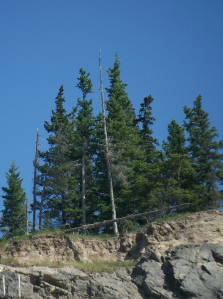
This tree stood all by itself on the crest surrounded by the pretty ones. What attracted me was it stood out from the crowd and thrived. I alluded to this in On the Edge. They were in the same area as we drove up to the Columbia Ice Fields in Jasper National Park. These trees do not just survive. They thrive in demanding conditions, sometimes for 100’s of years. There is little soil, water, and nourishment on the embankments, so they appear stunted. It thrives on the margins of its ecosystem. Perhaps, we find beauty in places we do not anticipate. We have to be ready for this or it will slip by.

In today’s environment, with calls for greater equity and social justice, it is not enough to ask people to survive with less than living wages, inadequate housing, little or no healthcare, etc. as if that is a major accomplishment. We must allow them to thrive as humans.

I took one class in special education in my B Ed. and another in my M Ed. I learned we have more in common than makes us different. Paulo Freire wrote of unity in diversity; John Dewey about communicating what we have in common to form community, and Parker Palmer about the paradox of living in community and with solitude. If we are more alike than different, we have a lot to communicate. It takes listening deeply, reflecting critically on one’s views (biases) of the world, and ethically transforming (moving beyond) the world, particularly that which is immediate to each of us. It is not enough to reform, but it may be a start to the process. It is becoming more and better, individually and collectively, in ways we cannot anticipate and can not be fully finished. There will always be good work to do, not matter how far we come.

On the margins;

Thriving–

Separate from the crowd.

Elements taking a toll;

World weighing heavy;

Thin, mottled.

Standing proud;

Reaching high–

Believing in something better.

Valuing who you are;

Individual, non-conformist–

Separate from the crowd.

Lonely, not alone;

Spacious, gracious solitude–

Revealing your own beauty.

Today, as I cruised Facebook, I found Parker Palmer posted Mary Oliver‘s poem The Summer Day. I love the closing lines: “Tell me, what is it you plan to do with your one wild and precious life?” It is a wild and precious life.


Stairway to Heaven

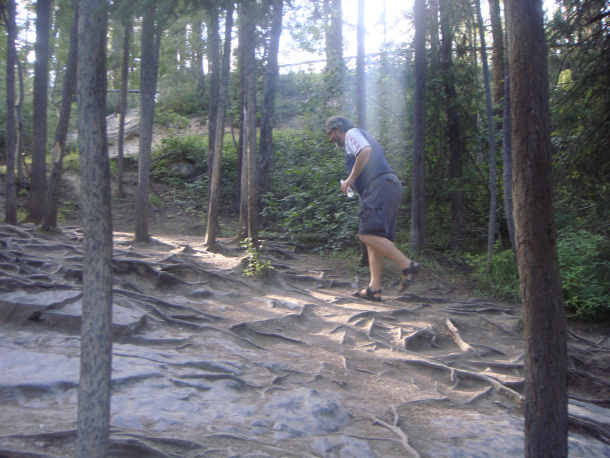
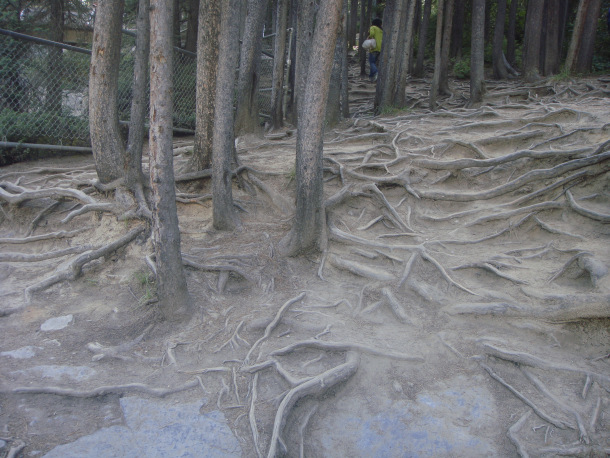
Kathy took these pictures at Sunwapta Falls in Jasper National Park. The Sunwapta River flows from Athabasca Glacier and the falls plunge over a hanging valley left by receding glaciers about 8000 years ago. The path down to the overview above the falls is unique with the tree roots playing an integral role in the stairway. The “staircase” is a product of human and nature wearing the surface. With the help of the stairway, I got closer to the edge than I usually do.

I wrote the following poem to accompany the pictures of the and borrowed the title from a more famous group, Led Zeppelin. I took time to read about the meaning behind the lyrics. It appears to be a statement about money not buying one’s way into heaven, whatever one might think that is.

Gnarled and gnarly,

Wending its way upwards,

Nature’s stairway

Revealing beauty.

Gaining confidence,

Moving safely,

Finding my way,

Fuller, richer.

Nature awaiting,

Golden rays find space–

Guiding steps,

Shining on each step,

On a ‘highway to heaven.’

For those who want to compare my poetry to that of Jimmy Page and Robert Plant, here is a version of the video.

The Weighing

Jane Hirshfield wrote the following poem, speaking to hope and resilience. At the end of our rope, we find we have more to give than we realized. It is a sense “this to shall pass” and we can only live in the present moment, which is fleeting.

Hard times reveal fissures in our world and society. Look at who has been hardest hit by Covid-19: people of colour, elderly, poor, etc. We can then see the fissures and who is left out. This became clearer with George Floyd’s killing. It is not enough to question who is left out, but how these humans are left out, dehumanized in the process. Injustice calls us to take account of the life we live, the world we live in, and ask how do we make this better, for each human being we encounter. Injustice calls us to weigh how we speak and act towards one another and to transform who we are for the better.

There are no easy answers to large questions, despite what politicians, carnival barkers, and reality TV hosts would have us believe with their divisive language and actions. We can embrace that we have more in common than separates us. As Paulo Freire proposed, there is unity in difference beyond superficial multiculuralism.

The heart’s reasons
seen clearly,
even the hardest
will carry
its whip-marks and sadness
and must be forgiven.
As the drought-starved
eland forgives
the drought-starved lion
who finally takes her,
enters willingly then
the life she cannot refuse,
and is lion, is fed,
and does not remember the other.
So few grains of happiness
measured against all the dark
and still the scales balance.
The world asks of us
only the strength we have and we give it.
Then it asks more, and we give it.

When I hike in wildnerness settings, I wonder what is around the next curve, over the horizon, on the other side of the mountain, below the surface, etc. I am unaware of so much. What is essential is I lift into critical consciousness what I can to better understand how I can make the world a better place and act on that as best as I can. I will likely never get to the other side of Kootenai Lake or the mountains on the far side, so I can only imagine what is there, a utopia of sorts. The same applies for the world we live in. The difference is we can incrementally get there, together.

As I am called to be a steward of the world, I am called to be a steward and servant in leading others. Without fully understanding where I am going, I am going there.

After I posted, I was listening to the radio and they played this song. It seemed appropriate.

Angry Young Poet

In keeping with Why Do I Write Poetry, the following poem is one I wrote many at about the same time. This is the third time I visited the poem in terms of writing and editing. Several years ago and while explaining the importance of teaching poetry, a student asked if I wrote poetry in junior high school and I responded, “Yes!”. He asked me to share with them. I found them in a small lock box I keep at home and shared several with the class. We talked about the context I wrote the poem in. Even in Canada, I lived in the shadow of the Vietnam conflict and struggled with what that meant.

Sam Intrator suggested teachers expose adolescent students complex, existential questions of life as they move through those formative years. I wrote my poems in 1969. It was a time when identity was increasingly rooted in a global nature of the world, not just immediate community and family. War entered homes via television. Increasingly, I discovered my voice through poetry, expressing an abhorrence to institutional and government sanctioned killing. What set me apart from my peers, was I took no sides. Each was equally wrong in my mind, advancing their ideological stance. My teacher, Mr. McKenzie, an innovative English teacher, encouraged us to discover our voices.

I shared the following poem with my students. We talked about how metaphors of war are used commonly in various institutions and how I found this as troubling as the violence and trauma of war. That feeling re-emerged over the past months with describing dealing with Covid-19 in war-like terms and the troubling events of the past weeks where purported leaders feel it is OK to speak about human beings, not citizens, as an enemy and objects to be manipulated for financial gain based on the basest forms of self-interests. It is worse than the war as it takes on invisible and pervasive forms. It is a form of Social Darwinism where the strong survive, trampling on those further down what is understood as a food chain premised on unfettered oppression of other humans, including various forms of systemic violence. Consider billionaires, in the Covid-19 crisis, gained while those in most need lose what little support they had.

I contrast this with Jacinda Ardern‘s message as the Prime Minister of New Zealand. In The Atlantic, Uri Friedman describes her as an empathetic leader. What emerged in reading the article was we de-serve better leadership, mindful, transforming, serving, etc. focusing on people as humans, not objects.

Students asked me to share poems and I did, with the context within which I wrote them. Parents, who were in the classroom each day, asked about my candour. I responded “I am not about changing minds. I try to change how each student thinks about the world, to see under the surface, reveal a sordid underbelly, and revel in the wonderfulness of human life.” This is a hopeful message, and the leadership we need is evident e.g. Jesus, Buddha, Muhammed, Mary Wollenstonecroft, Anne Frank, Maya Angelou, Soujouner Truth, Rosa Parks, etc.

Win or Lose: What Difference Does it Make?

A game–

Darwin misunderstood,

No great thing to win.

War and it language!

Bells ringing hollow,

Men, women, children gone!

Woe! vanquished losers and winners;

Humans, vanquished in every sense–

Thriving on dividing.

Resenting conquerors,

Rebuilding ruins–

On countless graves.

Morally rudderless,

Blaming the fallen,

Beggaring humans.

Homes on streets,

Hollowing souls–

What war brings?

Innocence dying–

Prryhric victories,

What war brings?

Comrades fallen,

Enemies vanquished–

Proving nothing.

Will we learn?

I pray

For human survival.

I leave you with the following video and song. We listened to Harry Belafonte, and I still do, with his uplifting and hopeful message. We are in this together, not against one another, with each other.