Mountains Speak

Source: Mountains Speak

Let the mountains speak and share their story. As leaders, we must let the world and people speak to us and be sensitive and attentive listeners as it shares its stories.

I enjoy traveling through mountains. It is hard work, because heights terrify me. Kathy and I tell others that she drove on the Going to the Sun Road, because the driver has to have their eyes open. There are places that the drop off of a narrow road is thousands of feet.

The beauty of mountains is hard to fully describe in words. It is an experience, soaking in the moment. We lived in a small town, McBride, BC, for 2 years. It is in a mountain valley.

Mountains speak to me. The wind is different. The weather socks in for days and weeks. Animals appear at the door and appear unthreatened by human presence. One Sunday morning in McBride, I waited for Kathy on the front steps and about 20 feet away was a young cow moose, eating, and keeping a close eye on me. She moved when we decided it was time to get in the car. We were not separate from nature, but part of it in those moments.

When we are sensitive and mindful of the environment, so much of it speaks to us. This includes nature, the workplace, our families, and in our communities.
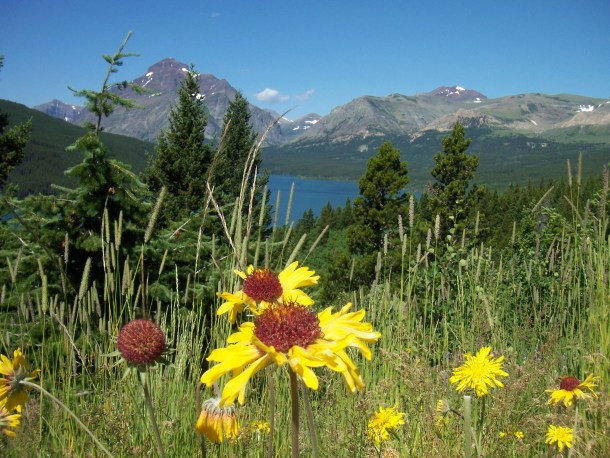
Daffodils, Lake, and Mountain in Glacier

I did not take that picture. Kathy did as she drove through Glacier National Park, MT.
Walker

Antonio Machado reminds us that the path we follow is both made anew when we walk it and that once we step we can no longer go back.

We can look back and see where we came from, but that is a distorted image and, the further we move away from that point in time, the more distorted the memories we recall. We can reflect upon those moments and steps in a caring way that takes place only after the step.

It is in mindful walking that we make the path. There is an awareness and senstivity that only happens in the very moment we exist in, the present. Our presence is important in that moment as we step and live at that point on our path of life.

The mindfulness of our steps is important when we realize we lead others in their steps. They cannot walk the identitical path to our path, but the way we compose ourselves is a model for how they might live.

Walker, your footsteps

are the road, and nothing more.

Walker, there is no road,

the road is made by walking.

Walking you make the road,

and turning to look behind

you see the path you never

again will step upon.

Walker, there is no road,

only foam trails on the sea.

…HEALING…

πŸ€ I HAVE PICKED UP THE PIECES πŸ€

Source: …HEALING…

The words healthy, heal, whole share a common etymology about wholeness. It is in picking up the pieces and making ourselves whole that we find good health and heal.

This includes being in community whether we are face-to-face with each other. Parker Palmer suggested “Community does not necessarily mean living face-to-face with others; rather, it means never losing the awareness that we are connected to each other. It is not about the presence of other people-it is about being fully open to the reality of relationship, whether or not we are alone.”

When we connect with each other, we become whole and belong to community. When we are mindful and attentive of the other, we become whole and belong to community.

Spring

Source: Spring

Mary Oliver is one of my favourite poets. There is something deeply spiritual about her poetry that finds its way into my heart.

I was not familiar with this poem. Poetry allows us to imagine that we have wings. With those wings. we tap our experiences more fully as we fly with others who join us. When we share the journey with others, it becomes much richer. It is not only our journey.

Even in Temples

Deng Ming-Dao writes how silence has sound. When I meditate, the sounds I hear strike me. Leonard Cohen’s quote echos that with “There is a crack in everything. That’s how the light gets in.”

Our senses cannot be totally shut off. We feel, hear, see, smell, taste, etc. even when we do not realize it. It is in the moments of quiet or darkness that we see sounds and light are always there. When we are mindful and attentive to our activities and senses, what we did not sense is there. It is in the mindful and meditative moments that the world–its allness–are there for us to soak in.

I told my students that much of the meaning to be found in poetry came in the pauses and silences between words, lines, and stanzas. Poetry touches our souls in those silences. When we pause and soak in the poetry, including the silences it shares with us, the meaning comes to life, only to change the next time we read the lines. In this sense, poetry, like life, is about living its meaning, sensing that is fleeting, incomplete, and fluid.

Even in temples
Where residents vow never to talk,
And silence is worshiped,
There is sound.
There are songs.
There is poetry.

Memories incarnated,
Lifetimes pulled through a thousand minds,
Cadences bearing time,
Rhymes connecting life,
Stanzas stacked like the generations.

Those who follow Tao write poetry.
Read poetry.
Live poetry.
And enter Tao through its lines.

Simplicity is Beautiful

Simplicity is beautiful. We find beauty in things that just are whether it is a sunset, a smile, or the kind word someone shares. Despite the simplicity involved, these are full of complexity. There is paradox in much of what we experience in life. But, it is that paradox of simplicity and complexity that rewards us in our living.

nature is never finished. – robert smithson

out walking with the kinders we happened upon a white swan happy and in betweenΒ seasons. the same as us.

Source: nature is never finished. – robert smithson

When I saw the title of Beth‘s post and read her poem, I thought what a profound moment. Nature has many stories to tell us and many ways of telling them that leave a mystery in each story. We are always between the moments and seasons that desribe the beauty of nature and who we are becoming.

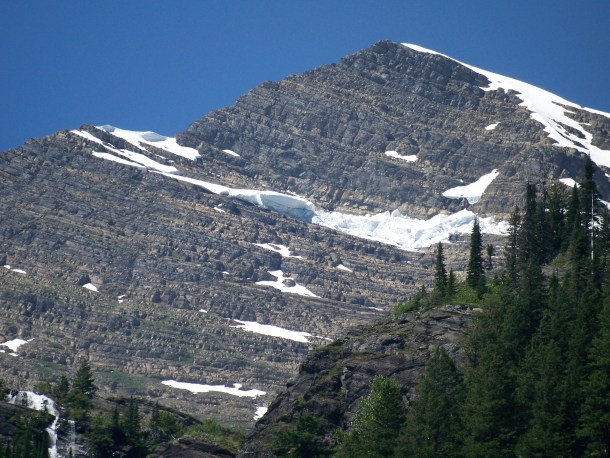
Several years ago, I took a picture of a mountain face. I did not have any idea why I took. It just spoke to me, like the swan in Beth’s poem. I used the picture in a presentation about eco-ethics, after I read an article about geologists who use the striations of a mountain to allow it to tell them its story, knowing it can never be completely told.

When I look at that picture, the mountain tells an even less complete story. The mystery in the story is what draws me back to the picture and maybe is what drew me, without knowing that, when I took the picture.

Mountain's Layers

Smart Cookie

Richard Schiffman counsels that when we are hunting for something, whether it is a cookie or wisdom, it is harder to find it. What we look for can sometimes be right there in front of us, but, in looking for it, we cannot find it. In fact, what we are looking for can end up in the most unexpected places: in a jar in Tennessee.

It is in mindful, sensitive being in the present moment that what we look for finds us. When we apply this to leadership and education, it is about listening to the world and others.

What we each seek is unique to each of us. When we tell the stories and speak the poems about what we seek, we do so finding the words that suit our stories and our poems. Leaders sense this and offer others space to find the words for their stories and poems. In finding and choosing our paths and our words, we can become the smart cookies we seek.

The fortune that you seek is in another cookie,

was my fortune. So I’ll be equally frankβ€”the wisdom

that you covet is in another poem. The life that you desire

is in a different universe. The cookie you are craving

is in another jar. The jar is buried somewhere in Tennessee.

Don’t even think of searching for it. If you found that jar,

everything would go kerflooey for a thousand miles around.

It is the jar of your fate in an alternate reality. Don’t even

think of living that life. Don’t even think of eating that cookie.

Be a smart cookieβ€”eat what’s on your plate, not in some jar

in Tennessee. That’s my wisdom for today, though I know

it’s not what you were looking for.

Prayer to Mansur Al-Hallaj

Source: Prayer to Mansur Al-Hallaj

Prayer is about listening to the world and is part of an internal conversation. The Sufi prayer is about listening closely. Each stanza of the poem begins with a word that entreats God guide me in sensing the world more deeply, not as something I hear, but as something all my senses are able to engage with.

We think of leadership as action and speech, but it is about sensing the world in a sensitive and mindful manner. Leadership is about a conversation and the questions we ask. It opens up space where there are no preconceived answers and followers can be part of conversation and lead, as well. Leadership and its communication is about community, a gathering of people who do not always agree, but hold something in common.

Dreams To Reality Take Determination

Source: Dreams To Reality Take Determination

The Jesse Owens movie that is coming out is a reminder of the importance of dreams and a person’s determination to follow those dreams. We often forget his story and how he helped break down race barriers in a quiet way with his dreams and determination.

He attended Ohio State University without a scholarship, working several jobs, married, and found time to practice and compete. All this in an era when it would have been unusual and challenging for an African-American to attend an NCAA school like Ohio State.

Kathy worked with one of his grandchildren who told her that Jessie Owens was a quiet and humble man. He worked as a playground supervisor giving back to children and providing a positive role model for young people to follow. Jimmy Carter suggested Jessie Owens did more to break down racial barriers through his determination and his efforts were “a prelude to helping others.”