Tag Archives: creativity

Merry Christmas

I grew up in Northern Alberta and Christmas was a special time of the year. I recall cold winter nights. I mean they were cold–almost minus 40 at night. Our windows upstairs were partly frosted over and on moonlit nights the light kept me awake or that is what I told others.

During Advent, my mom and older brothers walked across the street for evening Mass. The younger ones, including me, went to bed. I did not fall asleep right away and would watch out the window for them to come home. I thought no one saw me, but my Mom would come up and tell me to go to bed.

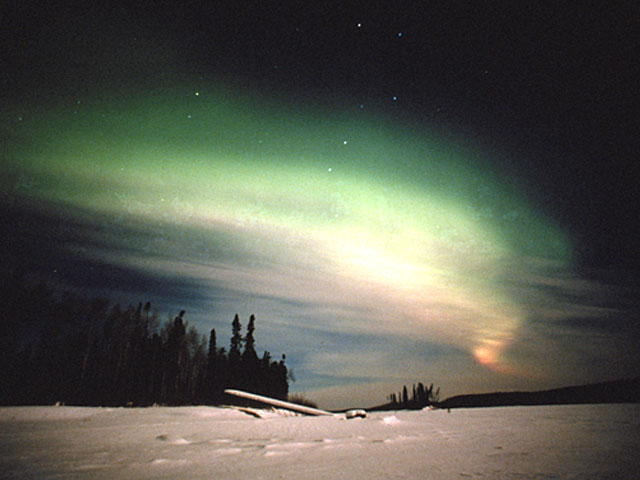
The other experience I recall is the Northern Lights and how you could hear them as they lit up the sky. We don’t see them very often in Edmonton with the urban light. When we spent time at the farm at Christmas, we heard and saw them there. Again, on cold nights we heard the train (about a mile away) and it sounded like it was coming right through the house.

I wrote this poem several years ago about the magic provided by the Northern Lights (Aurora Borealis) and Christmas. What message was in those celestial colours and sounds? As a child, I thought the sky talked to me and told me a creation story.

Small children–

Breathlessly wait,

Peer through frosted window

Soak it in.

Heavens ripple–

Lights undulate;

A celebratory fury

An indisputable guide.

This old house speaks;

Nature answers–

The heavens crackle

Sweet symphonic sounds shimmer.

Earth’s floor–

Blanketed in white

Celestial colours speak to me

Captures young senses.

A vivid winter scene,

A sensual, sensory palette,

Reminds me–

Christ’s Mass is here.
pic_wonder_northern_lights_lg

“The Good Samaritan” by French artist Maximilien Luce (1858-1941)

Photo post by @georgebost.

Source: “The Good Samaritan” by French artist Maximilien Luce (1858-1941)

I enjoy this parable. It should raise questions about what I do for others and how, when I do right , my life is enriched. It is a spiritual richeness that can make each day Christmas, rather than one day a year.

Several years ago, I heard a sermon that explained how the first two people who passed by may have felt they had to do so based on their understanding of certain laws. The Samaritan did not feel he was and stopped to care for someone in need.

The Angels and the Furies

May Sarton used the questions about the light and dark sides we each possess, but often go unnoticed. They inhabit our souls, which she calls premier danseur–first dancer. The angels and furies of our personalities are always with us, dancing with each other to gain our attention.

When I read this poem some time ago, I jotted down that to notice the furies sometimes they have to dance furiously to gain our attention. We prefer not to acknowledge their presence, but they are there and real along with our angels.

It is the mindful inner work that helps us understand the paradox of living in a world with both our angels and furies. It is not a choice between them. They exist with each other and both need our time and attention.

Have you not wounded yourself
And battered those you love
By sudden motions of evil,
Black rage in the blood
When the soul, premier danseur,
Springs toward a murderous fall?
The furies possess you.

2

Have you not surprised yourself
Sometimes by sudden motions
Or intimations of goodness,
When the soul, premier danseur,
Perfectly poised,
Could shower blessings
With a graceful turn of the head?
The angels are there.

3

The angels, the furies
Are never far away
While we dance, we dance,
Trying to keep a balance
To be perfectly human
(Not perfect, never perfect,
Never an end to growth and peril),
Able to bless and forgive
Ourselves.
This is what is asked of us.

4

It is light that matters,
The light of understanding.
Who has ever reached it
Who has not met the furies again and again?
Who has reached it without
Those sudden acts of grace?

The Night Ship

William Ayot reminds me how much goes unexplored in my life. In the busyness and noise of my living, I do not hear what is calling me to be explored.

When I am mindful to the universe and my self, I hear whispers that come in  gentle breezes and on the sun’s rays. Being present to the universe and my self, helps me explore stars that seemed beyond my reach and climb peaks I believed unscalable.

The universe is a great ocean calling to me and patiently waiting my response.

What do you want to do in this world?

What is your star, your far distant peak?

What dream lies unexplored within you

like a vast uncharted southern ocean:

daunting, demanding, compelling in the night,

yet receding in the bright and busy light of day?

What discoveries invite you to the water?

What deck awaits your first excited step?

What ship, what clipper, what brave caravel?

what crowded ferry crosses back and forth,

from dream to waking, dream to waking,

every morning of your undiscovered life?


The world offers itself to your imagination ~ Mary Oliver

“You do not have to be good. You do not have to walk on your knees for a hundred miles through the desert, repenting. You only have to let the soft animal of your body love what it loves. Tell me a…

Source: The world offers itself to your imagination ~ Mary Oliver

Mary Oliver is one of my many favorite poets. The poem Wild Geese, which is the poem these lines are from, comes from Poetry Showcase.

In the poem, Mary Oliver reminds us that we are part of a larger family and are being called home. When we are mindful, we can hear who and what calls us and we can imagine what that means to each of us. Even in the busyness of our living, there is something calling us to awaken and listen more closely.


FATHER CHARLES BRANDT… THE LAND AS SACRED COMMONS

~ the Brandt Series ~   Fr. Charles Brandt is a hermit monk from Vancouver Island, British Columbia, who recently celebrated 64 years of ordination. At 91 years of age, his gentle activism and…

Source: FATHER CHARLES BRANDT… THE LAND AS SACRED COMMONS

In a day and age of environmental concerns, I think a post from Bruce is appropriate. It is important to keep in mind that, with each economic choice we make, there are ecological choices and consequences, some more obvious than others.

Wendell Berry writes about economy from an etymological point of view. Economy from comes from the Greek oikos, meaning to manage one’s household and is about stewardship. If we think of ourselves as living outside the environment, being a good steward seems less important. If we choose to live in the environment, being a good steward is essential to the prosperity of the world and ourselves.

To me, it is not about economy over environment. How do we understand both as interconnected, and not separate? It is not an easy question, but questions of social justice, and the environment is one, are ever easy. Being mindful and living in the moment will help.

Look deep…

**Images found on Pinterest

Source: Look deep…

Natalie shared an Einstein quote about looking deep into nature if we want to understand the world and people better. It does not mean we will understand them completely, just better and that is not a given.

Better is an incomplete process. There is always something to be experienced and learned about nature. It keeps telling us its story in ways that we cannot completely understand.

When we experience nature, it is about being mindful and attentive to it. We experience it more fully when we understand we are part of nature, as opposed to outside of it.

To Be of Use

Marge Piercy wrote this poem about what it means to immerse one’s self in one’s life. She does use the word work, which is not always what we immerse ourselves in.

Hans-Georg Gadamer used a German word that means to while over the worth of something. We linger over those things that have meaning to us and make us feel useful in our lives. We do not want those things to end. When we find work that feels like that, we do not want it to end.

Something magical happens when we encounter something worth taking our time with in life. It is like it waits for us and we feel real when we come to know it. When are doing that, we experience being useful and giving back in a very real way.

The people I love the best

jump into work head first

without dallying in the shallows

and swim off with sure strokes almost out of sight.

They seem to become natives of that element,

the black sleek heads of seals

bouncing like half-submerged balls.

I love people who harness themselves, an ox to a heavy cart,

who pull like water buffalo, with massive patience,

who strain in the mud and the muck to move things forward,

who do what has to be done, again and again.

I want to be with people who submerge

in the task, who go into the fields to harvest

and work in a row and pass the bags along,

who are not parlor generals and field deserters

but move in a common rhythm

when the food must come in or the fire be put out.

The work of the world is common as mud.

Botched, it smears the hands, crumbles to dust.

But the thing worth doing well done

has a shape that satisfies, clean and evident.

Greek amphoras for wine or oil,

Hopi vases that held corn, are put in museums

but you know they were made to be used.

The pitcher cries for water to carry

and a person for work that is real.


The Place Where We Are Right

Yehuda Amichai is an Israeli poet who was born in pre-war Germany. He described his poetry as non-ideological, but based in reality that includes politics.

I chose this poem, as it points out challenges we face when we think life is simple and others will deliver solutions for us. Jacques Rancière wrote that politics is not an all the time event. It arises occasionally and we must be mindful to recognize the need to act politically. Hannah Arendt contended living with others means we live in polis or community, suggesting a political reality always exists in life.

Living with others is political, but not every act is political. It is hard to live with others and be in community. Amichai suggested the trampled and hardened ground we share is unlikely go produce flowers . Yet, there is always something happening below the surface that we cannot see. Metaphoric moles we do not see dig up and plough our world. It is the whispers of what passed that way that provides compost for the communal soil.

Even in the barren, we find richness. Barry Lopez describes how even in the most desolate places something draws us and we are interested in what we do not see: the mystery of the place.

From the place where we are right
Flowers will never grow
In the spring.

The place where we are right
Is hard and trampled
Like a yard.

But doubts and loves
Dig up the world
Like a mole, a plow.
And a whisper will be heard in the place
Where the ruined
House once stood.

For an Occasion of Celebration

John O’Donohue was a Catholic priest who left the priesthood. Throughout his life, he retained and shared a deep spirituality and his poetry often was in the form of blessings.

Although this poem is not titled as a blessing, it still feels like one. I send this to my American friends, colleagues, and acquaintances as they celebrate Thanksgiving. We set aside certain days to pay special thanks, but we should celebrate each day and take time to be thankful for our blessings: friends, gifts we receive, health, and the wonder and mystery of living.

Now is the time to free the heart,
Let all intentions and worries stop,
Free the joy inside the self,
Awaken to the wonder of your life.

Open your eyes and see the friends,
Whose hearts recognize your face as kin,
Those whose kindness watchful and near,
Encouraging you to live everything here.

See the gifts the years have given,
Things your effort could never earn,
The health to enjoy who you want to be
And the mind to mirror mystery.