Tag Archives: creativity

…HEALING…

🍀 I HAVE PICKED UP THE PIECES 🍀

Source: …HEALING…

The words healthy, heal, whole share a common etymology about wholeness. It is in picking up the pieces and making ourselves whole that we find good health and heal.

This includes being in community whether we are face-to-face with each other. Parker Palmer suggested “Community does not necessarily mean living face-to-face with others; rather, it means never losing the awareness that we are connected to each other. It is not about the presence of other people-it is about being fully open to the reality of relationship, whether or not we are alone.”

When we connect with each other, we become whole and belong to community. When we are mindful and attentive of the other, we become whole and belong to community.

Spring

Source: Spring

Mary Oliver is one of my favourite poets. There is something deeply spiritual about her poetry that finds its way into my heart.

I was not familiar with this poem. Poetry allows us to imagine that we have wings. With those wings. we tap our experiences more fully as we fly with others who join us. When we share the journey with others, it becomes much richer. It is not only our journey.

Even in Temples

Deng Ming-Dao writes how silence has sound. When I meditate, the sounds I hear strike me. Leonard Cohen’s quote echos that with “There is a crack in everything. That’s how the light gets in.”

Our senses cannot be totally shut off. We feel, hear, see, smell, taste, etc. even when we do not realize it. It is in the moments of quiet or darkness that we see sounds and light are always there. When we are mindful and attentive to our activities and senses, what we did not sense is there. It is in the mindful and meditative moments that the world–its allness–are there for us to soak in.

I told my students that much of the meaning to be found in poetry came in the pauses and silences between words, lines, and stanzas. Poetry touches our souls in those silences. When we pause and soak in the poetry, including the silences it shares with us, the meaning comes to life, only to change the next time we read the lines. In this sense, poetry, like life, is about living its meaning, sensing that is fleeting, incomplete, and fluid.

Even in temples
Where residents vow never to talk,
And silence is worshiped,
There is sound.
There are songs.
There is poetry.

Memories incarnated,
Lifetimes pulled through a thousand minds,
Cadences bearing time,
Rhymes connecting life,
Stanzas stacked like the generations.

Those who follow Tao write poetry.
Read poetry.
Live poetry.
And enter Tao through its lines.

nature is never finished. – robert smithson

out walking with the kinders we happened upon a white swan happy and in between seasons. the same as us.

Source: nature is never finished. – robert smithson

When I saw the title of Beth‘s post and read her poem, I thought what a profound moment. Nature has many stories to tell us and many ways of telling them that leave a mystery in each story. We are always between the moments and seasons that desribe the beauty of nature and who we are becoming.

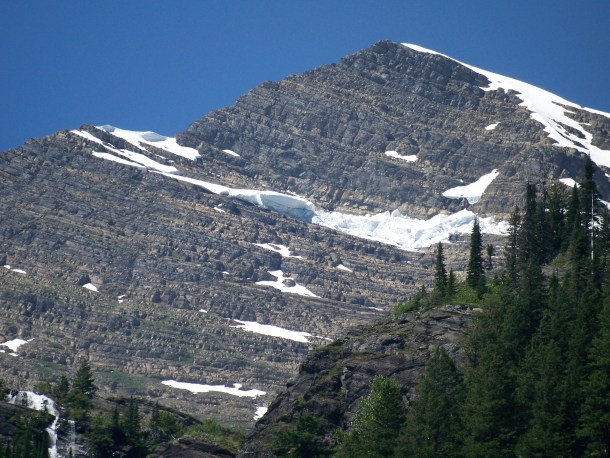
Several years ago, I took a picture of a mountain face. I did not have any idea why I took. It just spoke to me, like the swan in Beth’s poem. I used the picture in a presentation about eco-ethics, after I read an article about geologists who use the striations of a mountain to allow it to tell them its story, knowing it can never be completely told.

When I look at that picture, the mountain tells an even less complete story. The mystery in the story is what draws me back to the picture and maybe is what drew me, without knowing that, when I took the picture.

Mountain's Layers

Smart Cookie

Richard Schiffman counsels that when we are hunting for something, whether it is a cookie or wisdom, it is harder to find it. What we look for can sometimes be right there in front of us, but, in looking for it, we cannot find it. In fact, what we are looking for can end up in the most unexpected places: in a jar in Tennessee.

It is in mindful, sensitive being in the present moment that what we look for finds us. When we apply this to leadership and education, it is about listening to the world and others.

What we each seek is unique to each of us. When we tell the stories and speak the poems about what we seek, we do so finding the words that suit our stories and our poems. Leaders sense this and offer others space to find the words for their stories and poems. In finding and choosing our paths and our words, we can become the smart cookies we seek.

The fortune that you seek is in another cookie,

was my fortune. So I’ll be equally frank—the wisdom

that you covet is in another poem. The life that you desire

is in a different universe. The cookie you are craving

is in another jar. The jar is buried somewhere in Tennessee.

Don’t even think of searching for it. If you found that jar,

everything would go kerflooey for a thousand miles around.

It is the jar of your fate in an alternate reality. Don’t even

think of living that life. Don’t even think of eating that cookie.

Be a smart cookie—eat what’s on your plate, not in some jar

in Tennessee. That’s my wisdom for today, though I know

it’s not what you were looking for.
Be Still in Haste

I find Wendell Berry’s poetry speaks to me about being mindful and attentive in each moment I live. It calls me to be present and explore the mystery in each moment, knowing each moment carries me like a river flowing without knowing where it is going.

The etymology of anarchy suggests we continuously begin anew in each moment. It is not a free-for-all with no rules. Instead, the universe provides us with the rules of what it means to live in that moment. In being present, I come to understand each moment is a re-beginning that is forever unfolding.

Taking the time to be present, allows me to be still even when the world and others are in haste.

How quietly I
begin again

from this moment

looking at the
clock, I start over

so much time has
passed, and is equaled
by whatever
split-second is present

from this
moment this moment
is the first


Types of Rose Flower by Color – Red Rose Bud

Hold fast to dreams For if dreams die Life is a broken-winged bird That cannot fly. Dreams by Langston Hughes

Source: Types of Rose Flower by Color – Red Rose Bud

When I taught, I used this poem and Mother to Son written by Langston Hughes. The two poems carry deep thematic meanings about living life, having dreams to follow, and not making excuses when we come up short. I found that for junior high students these themes were important and helped them focus on how they were becoming adults.

Dreams give us a way to imagine we can figuratively fly in life. Mother to Son reminded us that it was not always easy to follow those dreams.

The red rose buds in the pictures add to the imagery about how fragile dreams are in real-time. We need to nurture them and bring them to life as we feed them.

Hold fast to dreams

For if dreams die

Life is a broken-winged bird

That cannot fly.

Hold fast to dreams

For when dreams go

Life is a barren field

Frozen with snow.

Living Things

Anne Porter used poetry to describe how text becomes a living thing, always seeking new meaning from readers and listeners. As we read and listen, we find new meaning in the words, the spaces, and the punctuation.

Text is not only about the words, but about the context (who, where, and when), pretext (previous meanings), and subtext (what is hidden from sight). As we read and listen, we ask questions that cannot be fully answered.

Our poems
Are like the wart-hogs
In the zoo
It’s hard to say
Why there should be such creatures

But once our life gets into them
As sometimes happens
Our poems
Turn into living things
And there’s no arguing
With living things
They are
The way they are

Our poems
May be rough
Or delicate
Little
Or great

But always
They have inside them
A confluence of cries
And secret languages

And always
They are improvident
And free
They keep
A kind of Sabbath

They play
On sooty fire escapes
And window ledges

They wander in and out
Of jails and gardens
They sparkle
In the deep mines
They sing
In breaking waves
And rock like wooden cradles.

Live

Notes: Full poem here: a blind flaneur. Poem Source: quotes from books

Source: Live

David posted this wonderful Mary Oliver quote. We can embrace the world as a place that amazes us and not merely one we visit in passing. I love the paradox of simultaneously being bride and bridegroom embracing and being amazed.

When we live fully, we engage in a conversation full of questions that can never be fully answered, but that guide us in our journey. This life is not about a planned legacy, but one that emerges in the memories we leave for others.


The Other Kingdoms

Mary Oliver writes such wonderful poetry, even when it looks like prose. I find a depth in the words and spaces that calls me to reflect upon the cultural and personal constraints that surround me. Certainly, I need those constraints. They guide me through the moment-to-moment actions of my daily life. I need those words that help me make sense of the most immediate world that I often take-for-granted.

What if I lived in the north? I would need those many words and an awareness of what the snow told me to survive. I read today that mother orangutans spend 7-8 years with each offspring. During that time, the mothers appear to teach the ways of life necessary for the offspring’s survival. I say appear, because we cannot communicate with them well enough to know with certainty. There is something mystical about that existence that cannot be fully grasped. So even in the orangutan world, there is a culture and communication that helps them negotiate their terrain instinctively.

I love the line “Their infallible sense of what their lives are meant to be.” Just like the lilies of the field, those other kingdoms exist in ways that allow the world that includes us to grow sweetly wild, when we are attentive and mindful to the world.

Consider the other kingdoms. The
trees, for example, with their mellow-sounding
titles: oak, aspen, willow.
Or the snow, for which the peoples of the north
have dozens of words to describe its
different arrivals. Or the creatures, with their
thick fur, their shy and wordless gaze. Their
infallible sense of what their lives
are meant to be. Thus the world
grows rich, grows wild, and you too,
grow rich, grow sweetly wild, as you too
were born to be.