Tag Archives: creativity

Beauty

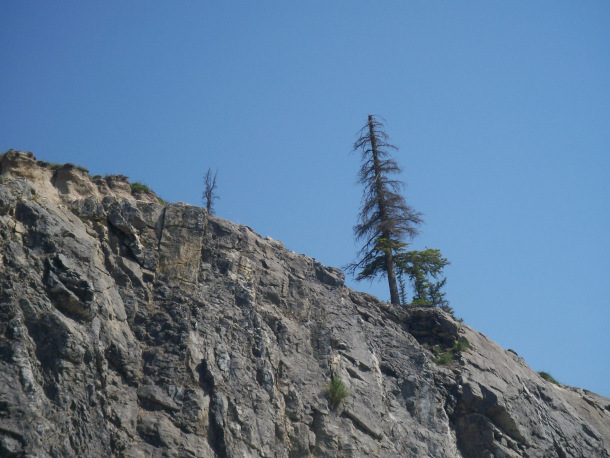
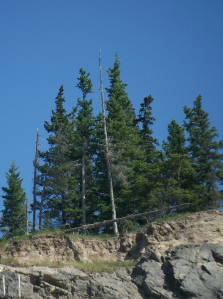
This tree stood all by itself on the crest surrounded by the pretty ones. What attracted me was it stood out from the crowd and thrived. I alluded to this in On the Edge. They were in the same area as we drove up to the Columbia Ice Fields in Jasper National Park. These trees do not just survive. They thrive in demanding conditions, sometimes for 100’s of years. There is little soil, water, and nourishment on the embankments, so they appear stunted. It thrives on the margins of its ecosystem. Perhaps, we find beauty in places we do not anticipate. We have to be ready for this or it will slip by.
In today’s environment, with calls for greater equity and social justice, it is not enough to ask people to survive with less than living wages, inadequate housing, little or no healthcare, etc. as if that is a major accomplishment. We must allow them to thrive as humans.

I took one class in special education in my B Ed. and another in my M Ed. I learned we have more in common than makes us different. Paulo Freire wrote of unity in diversity; John Dewey about communicating what we have in common to form community, and Parker Palmer about the paradox of living in community and with solitude. If we are more alike than different, we have a lot to communicate. It takes listening deeply, reflecting critically on one’s views (biases) of the world, and ethically transforming (moving beyond) the world, particularly that which is immediate to each of us. It is not enough to reform, but it may be a start to the process. It is becoming more and better, individually and collectively, in ways we cannot anticipate and can not be fully finished. There will always be good work to do, not matter how far we come.

On the margins;

Thriving–

Separate from the crowd.

Elements taking a toll;

World weighing heavy;

Thin, mottled.

Standing proud;

Reaching high–

Believing in something better.

Valuing who you are;

Individual, non-conformist–

Separate from the crowd.

Lonely, not alone;

Spacious, gracious solitude–

Revealing your own beauty.

Today, as I cruised Facebook, I found Parker Palmer posted Mary Oliver‘s poem The Summer Day. I love the closing lines: “Tell me, what is it you plan to do with your one wild and precious life?” It is a wild and precious life.
					

Stairway to Heaven

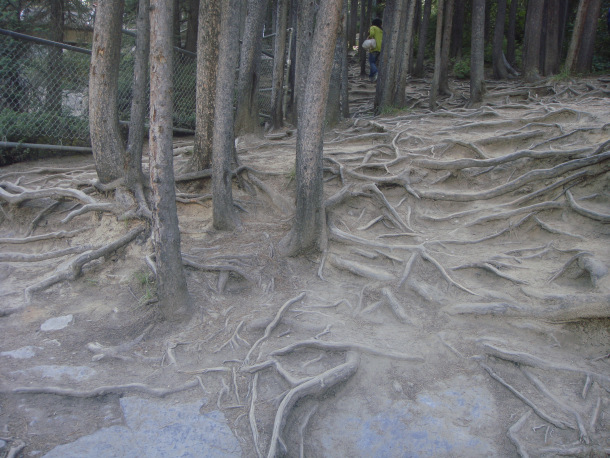
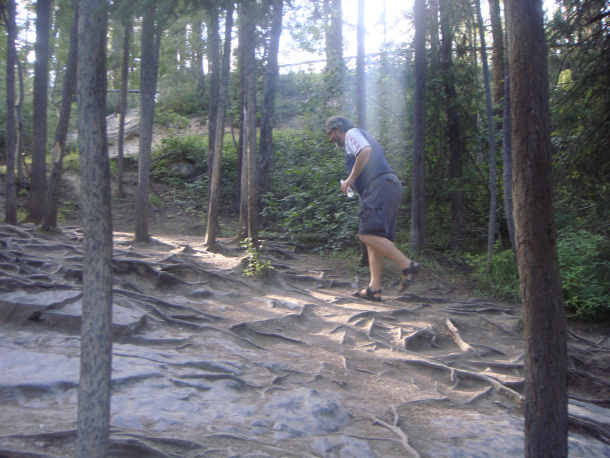
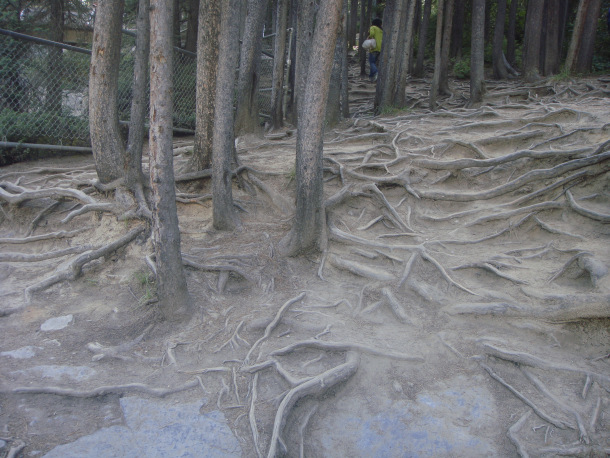
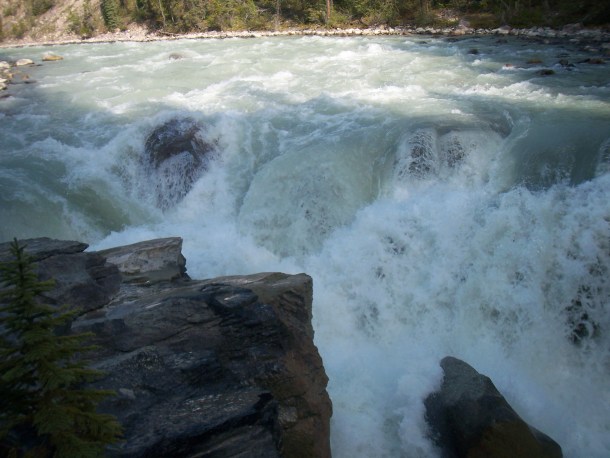
Kathy took these pictures at Sunwapta Falls in Jasper National Park. The Sunwapta River flows from Athabasca Glacier and the falls plunge over a hanging valley left by receding glaciers about 8000 years ago. The path down to the overview above the falls is unique with the tree roots playing an integral role in the stairway. The “staircase” is a product of human and nature wearing the surface. With the help of the stairway, I got closer to the edge than I usually do.

I wrote the following poem to accompany the pictures of the and borrowed the title from a more famous group, Led Zeppelin. I took time to read about the meaning behind the lyrics. It appears to be a statement about money not buying one’s way into heaven, whatever one might think that is.

Gnarled and gnarly,

Wending its way upwards,

Nature’s stairway

Revealing beauty.

Gaining confidence,

Moving safely,

Finding my way,

Fuller, richer.

Nature awaiting,

Golden rays find space–

Guiding steps,

Shining on each step,

On a ‘highway to heaven.’

For those who want to compare my poetry to that of Jimmy Page and Robert Plant, here is a version of the video.

https://www.youtube.com/watch?v=Nnu1E5Kslig

On the Edge

When I wrote this poem, it was at a time I was unhappy going back into the classroom and teaching. I loved the students and looked forward to being with them. So much had changed in the little school I taught in with change imposed upon us, rather than negotiated with us. In my writing, I am beginning to look at what is essential to the spirit for each of us to flourish. What gives each of us hope? it will be different. What is certain is we each want to have a voice in what we are doing.

When I wrote the poem, I wrote from a negative place. Now, as I look at the image, the tree on the dge of the cliff fourished in its environment, which is rock with little soil. The tree is actually quite old. Our tour guide said about 300 years old. Despite its lack of size, it flourishes and that is what I failed to see in the last two years I taught. It begs the question: “what might I have done differently.” I was not very patient at times. Cornel West tells young people looking for change to be patient. Real, transformative, democratic, and sustainable change takes time and patience.

In being with each student and present to them, I found something other than gave me the impetus to teach for two more years and find ways to cope with the imposed change. One of the challenges I faced was what we did was so different than what other classrooms looked and felt like it was difficult to convince other educators what we did had merit. Teachers teach one grade at a time in isolation with children separated from families, like a workplace. We had a parent in the classroom each day to assist, many of the families knew each other, and I had a multi-grade classroom with 3 or 4 grades together. Children and youth attend school each day and homework is something we assign, because often there is not time to complete everything at school. Students attended our school 40-50% of the time on a set schedule, depending on grade level. I negotiated with parents the extra things to be done at home. Often, they were large culminating projects at the end of a unit. I taught and students learned what was necessary in class and had little homework. I did not teach all subjects in school. Parents taught Math, Health, and some Phys Ed at home. I went on home visits to support their teaching and make sure we were on track. I had no desks in my classroom. We sat at tables usually based on grade level, but, during complementary courses e.g. Art, Food Sciences, Programming, etc., students sat in mixed grade groups.

In short, we were on the margins, the edge of what was perceived as “normal’ school. Today, in the midst of a pandemic that sent children home to learn online, the relationships and support we had in our small community would have helped many families and teachers cope with the sudden and unpredictable change.

With each step,

Closer–

Be bold.

Balance precariously,

Hover over abyss

Be brave.

Instability and stability dancing–

To soundless music;

Be graceful.

Quieting one’s self;

Listening to soul’s–

Be poetic.

Between lines and stanzas–

 Wisdom emerges–

Be patient.

On the edge,

Sisters and brothers–

What calls you with passion?

I try to walk in the neighbourhood each day. When I do, I listen to music. Yesterday, I heard a song by Bela Fleck and Abigail Washburn, which fit with this poem and how I felt when I wrote it. In talking to one’s younger self, they use words like bold, love, bold, and fear. I use passion, which suggests suffering as a necessary piece to flourishing.

The Weighing

Jane Hirshfield wrote the following poem, speaking to hope and resilience. At the end of our rope, we find we have more to give than we realized. It is a sense “this to shall pass” and we can only live in the present moment, which is fleeting.

Hard times reveal fissures in our world and society. Look at who has been hardest hit by Covid-19: people of colour, elderly, poor, etc. We can then see the fissures and who is left out. This became clearer with George Floyd’s killing. It is not enough to question who is left out, but how these humans are left out, dehumanized in the process. Injustice calls us to take account of the life we live, the world we live in, and ask how do we make this better, for each human being we encounter. Injustice calls us to weigh how we speak and act towards one another and to transform who we are for the better.

There are no easy answers to large questions, despite what politicians, carnival barkers, and reality TV hosts would have us believe with their divisive language and actions. We can embrace that we have more in common than separates us. As Paulo Freire proposed, there is unity in difference beyond superficial multiculuralism.

The heart’s reasons
seen clearly,
even the hardest
will carry
its whip-marks and sadness
and must be forgiven.
As the drought-starved
eland forgives
the drought-starved lion
who finally takes her,
enters willingly then
the life she cannot refuse,
and is lion, is fed,
and does not remember the other.
So few grains of happiness
measured against all the dark
and still the scales balance.
The world asks of us
only the strength we have and we give it.
Then it asks more, and we give it.

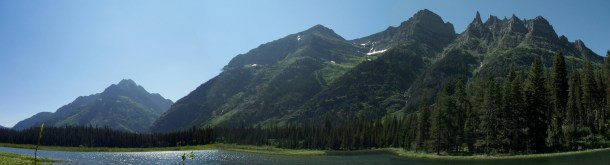
When I hike in wildnerness settings, I wonder what is around the next curve, over the horizon, on the other side of the mountain, below the surface, etc. I am unaware of so much. What is essential is I lift into critical consciousness what I can to better understand how I can make the world a better place and act on that as best as I can. I will likely never get to the other side of Kootenai Lake or the mountains on the far side, so I can only imagine what is there, a utopia of sorts. The same applies for the world we live in. The difference is we can incrementally get there, together.

As I am called to be a steward of the world, I am called to be a steward and servant in leading others. Without fully understanding where I am going, I am going there.

After I posted, I was listening to the radio and they played this song. It seemed appropriate.

On the Road

As a result of where family and friends live, Kathy and I drive through the mountains on a regular basis. We see spectacular scenery and inhabitants. We met and lived in Prince George, British Columbia and then lived in other communities in the general area. Despite this, it is always exciting to see the wildlife in these trips.

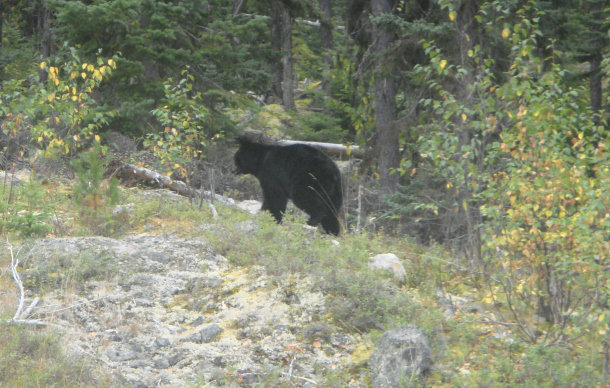
These pictures and the poem emerged on one of our annunal trips. Barely on the road, we spotted a bear browsing on the shoulder above the highway about 10-15 metres from the car. We rolled the window down and he/she posed before disappearing.

A few kilometres up the road, I took this picture of mountains shrouded in clouds. In the foreground, there is evidence of colours turning as summer merged into autumn.

peaks peeking

snow trying to hide

clouds blurring my view.

colours changing

nature’s rich canvas

gentle brush.

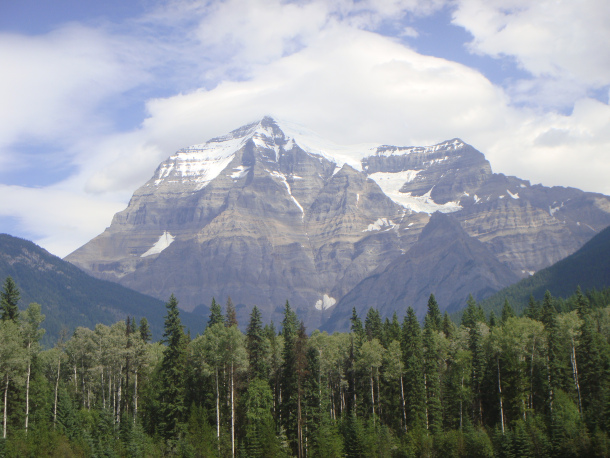
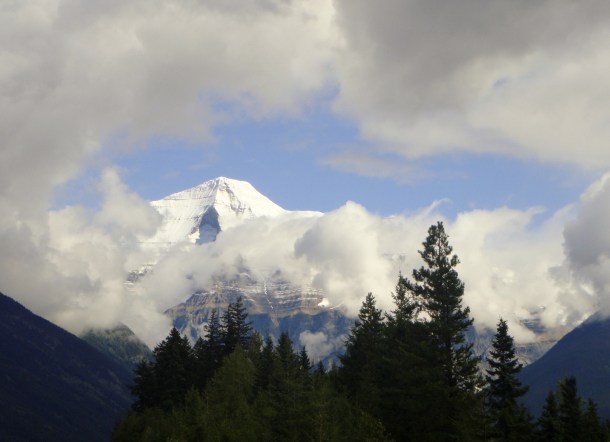
Mount Robson appeared with a cloud-like frame. I enjoy taking pictures of Mount Robson when the clouds show something different.


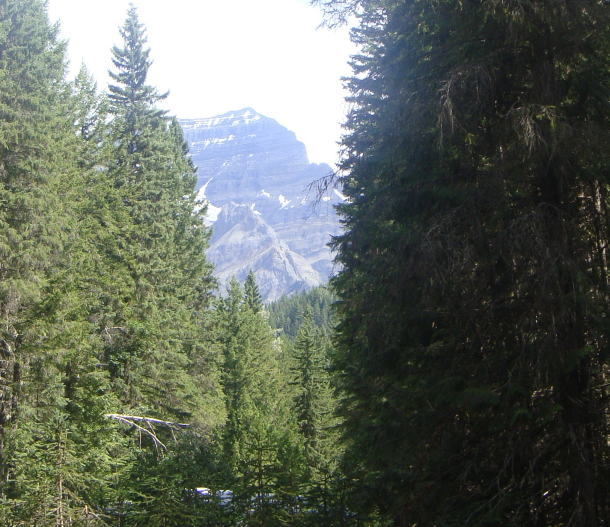
Kathy and I hiked a few hundred metres along the Berg Lake trail. I settled for this shot of Mount Robson which disappears from sight as you move along the path. Peaking out between the trees, is the Robson River which has its headwaters on Mount Robson and flows into the Fraser River a few kilometres down the highway.

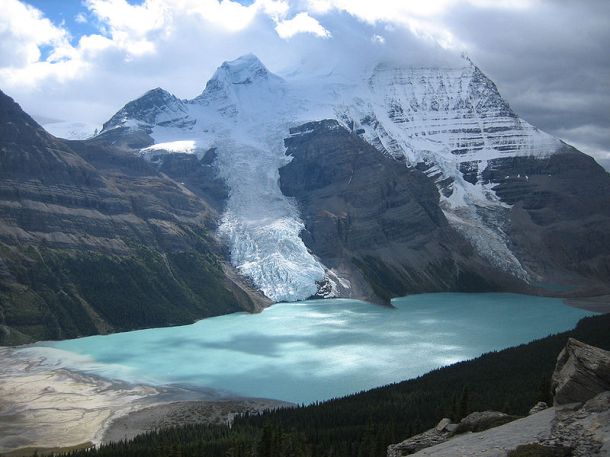
I borrowed this picture from Wikipedia . A bucket list goal is to hike to Berg Lake, camp, and bring back pictures. I am getting old, so who knows if it will happen.


Angry Young Poet

In keeping with Why Do I Write Poetry, the following poem is one I wrote many at about the same time. This is the third time I visited the poem in terms of writing and editing. Several years ago and while explaining the importance of teaching poetry, a student asked if I wrote poetry in junior high school and I responded, “Yes!”. He asked me to share with them. I found them in a small lock box I keep at home and shared several with the class. We talked about the context I wrote the poem in. Even in Canada, I lived in the shadow of the Vietnam conflict and struggled with what that meant.

Sam Intrator suggested teachers expose adolescent students complex, existential questions of life as they move through those formative years. I wrote my poems in 1969. It was a time when identity was increasingly rooted in a global nature of the world, not just immediate community and family. War entered homes via television. Increasingly, I discovered my voice through poetry, expressing an abhorrence to institutional and government sanctioned killing. What set me apart from my peers, was I took no sides. Each was equally wrong in my mind, advancing their ideological stance. My teacher, Mr. McKenzie, an innovative English teacher, encouraged us to discover our voices.

I shared the following poem with my students. We talked about how metaphors of war are used commonly in various institutions and how I found this as troubling as the violence and trauma of war. That feeling re-emerged over the past months with describing dealing with Covid-19 in war-like terms and the troubling events of the past weeks where purported leaders feel it is OK to speak about human beings, not citizens, as an enemy and objects to be manipulated for financial gain based on the basest forms of self-interests. It is worse than the war as it takes on invisible and pervasive forms. It is a form of Social Darwinism where the strong survive, trampling on those further down what is understood as a food chain premised on unfettered oppression of other humans, including various forms of systemic violence. Consider billionaires, in the Covid-19 crisis, gained while those in most need lose what little support they had.

I contrast this with Jacinda Ardern‘s message as the Prime Minister of New Zealand. In The Atlantic, Uri Friedman describes her as an empathetic leader. What emerged in reading the article was we de-serve better leadership, mindful, transforming, serving, etc. focusing on people as humans, not objects.

Students asked me to share poems and I did, with the context within which I wrote them. Parents, who were in the classroom each day, asked about my candour. I responded “I am not about changing minds. I try to change how each student thinks about the world, to see under the surface, reveal a sordid underbelly, and revel in the wonderfulness of human life.” This is a hopeful message, and the leadership we need is evident e.g. Jesus, Buddha, Muhammed, Mary Wollenstonecroft, Anne Frank, Maya Angelou, Soujouner Truth, Rosa Parks, etc.

Win or Lose: What Difference Does it Make?

A game–

Darwin misunderstood,

No great thing to win.

War and it language!

Bells ringing hollow,

Men, women, children gone!

Woe! vanquished losers and winners;

Humans, vanquished in every sense–

Thriving on dividing.

Resenting conquerors,

Rebuilding ruins–

On countless graves.

Morally rudderless,

Blaming the fallen,

Beggaring humans.

Homes on streets,

Hollowing souls–

What war brings?

Innocence dying–

Prryhric victories,

What war brings?

Comrades fallen,

Enemies vanquished–

Proving nothing.

Will we learn?

I pray

For human survival.

I leave you with the following video and song. We listened to Harry Belafonte, and I still do, with his uplifting and hopeful message. We are in this together, not against one another, with each other.

Why Do I Write Poetry

During a professinal development event, a presenter spoke about teaching poetry. To my knowledge, this person spent little time teaching, yet he was a supposed expert about all things teaching. In the course of his presentation, he expressed disdain for poetry. He claimed, without evidence, we teach poetry without explaining to students why we teach it.

In my teaching, I described reasons why I taught something, opening up learning to include what students considered important. This included questions about topics and content. Often, students began with a negative view of poetry. With time, we got over hurdles together. Without a collective effort, we do not overcome issues in life and learning. We end up with haiku written through rote formula:

Here are five syllables

And here I write seven more!

Are you happy now?

The presenter indicated, despite having written poetry, he was unsure why teachers taught poems written. I think there are good reasons, but I could be wrong.

Poetry calls me to choose words, paradoxically spare and spacious. Spareness is in the number of words; the fewer the better. The space allows the reader room to interpret. What did the poet mean? What senses are invoked through the word choice?

Instead of counting something, poetry asks me to explore life and understand quality is not evenly distributed. I have privileges, maleness, whiteness, education, that others do not have the eauitable access to.

Choosing words,

Caring about each–

Describing feelings,

Experiences never identical.

Revealing thickness in meaning,

Experiencing sameness different–

Bringing us together,

Bridging worlds.

I told students, who struggled with reading and writing, poetry was an alternative to express themselves. I used ee cummings, as a model, to overcome worries about grammar, spelling, and capitalization.

i dig ee cummings

no punctuation

no capitols

won’t worry about spellin either

no sweat

aint no problem

i write poetry

I enjoy poetry. I always have. I remember a poem, The Elevator, I memorized in Grade 4. I think it Walter de la Mare wrote it. My friend memorized a poem called Douglas Fir. His name was Douglas. When I enjoy who and what I teach, I bring enthusiasm to writing poetry.

Artists, including poets, are often at the forefront, addressing social issues. In our times this includes Maya Angelou, Thomas Merton, Wendell Berry, Adrienne Rich, Parker Palmer, Thich Nhat Hanh, etc. Sometimes, I do not think of these authors as poets. Each of them wrote/writes poetry helping to raise my awareness about issues.

Below are the wonderful and poetic words of Thich Nhat Hanh.

Peace in our heart

I close with a poem I wrote many years ago as a 15 year old in high school. I have never been a fan of what we call capitalism. What we have is predatory and is at the root of current political, economic, and social issues. Only a handful are admitted to the club.

Captains of Society

Captains of Society

Shallow, superficial, arrogant

Single ambition

Greatness in the eyes of others

Only those with resources can apply

The rest

Forgotten

Pay a high price, but…

It’s their fault

They own their misery.

A cheque to charity

Assuages my conscience

What about the despair?

Don’t care

I claim I do

Donations in badfaith,

It’s a tax receipt

I really claim, but…

Done on the backs of others

Get the staff to donate time

Not mine.

Increase taxes

Not mine!

No way!

It’s wrong!

Tax others!

What is work?

I create jobs

It’s a spectator sport

This work, which

I manage from afar.

Drive luxury wheels

Shout

Curse

What’s the hold up?

Who’s blocking my way?

The ‘75 Ford station wagon

Engine shot

Dead broke!

Is it their home?

 Throw a party

Drink

Eat

Be merry

No concern for homeless

A romantic notion this ‘hobo jungle’

Not my world

What’s wrong?

It’s not my fault

I gave at the office.

After all.

Throw money at problems

It might help

Don’t

Stop, see, care

If it really helps

Denying, refusing, unfeeling

I pay for a clear conscience

After all.

 The misery

In surround sound…

Is out of sight;

Out of mind

Transforming

Several years ago, I arrived home, after spending time in Spokane. I struggled in the first few days back and reflected on what was happening. Quite often, I resist routine and find it is hard work.

Rarely, are we alone in our travails. It is universal Real change, transformation is slow, purposeful, and patient process. Upon looking at pictures we took on our travels and for all of nature’s ability to sometimes erupt and change rapidly, most change is slow and transformational. For the most part, deep change, transforming, in nature is a great model to observe.

I wrote the following poem in response to those reflections.

Waiting,

Impatient–

Desiring more

Leaning into headwinds,

Transforming–

Slow, patient, with purpose

Lacking blueprint.

Journeying,

With one’s self–

With companions,

Breaking bread,.

Trusting–

Devoting,

Changing together.

Embracing,

No explaining,

Words unnecessary–

Smiling assurances.

Looking back,

Revealing worn paths–

Sharing,

Sheltering one another

Pressing ahead–

Certain in uncertainty.

I took the picture on the way to Kootenai Lake in Glacier National Park. Even on a well worn path, there is a limited view of what is behind and ahead. As well, there are many things hidden along the path, there and invisible. There is always a trust in other people and in the path as I move ahead with purpose. Paradox exists in the feeling of certainty in an always uncertain world.

On some mornings and evenings, I observe the sun rising/setting with the moon in the sky. Several years ago, early in the school year this occured. I began haiku class with poems describing phenomena we often take for granted. I emphasized poetry  often emerges from what is overlooked.

Great poets have a way of lifting extraordinary phenomena into fuller view for us. I modeled this with shared from Pablo Neruda, Mary Oliver, Wendell Berry, etc. I try to write poetry in a similar way.

Greeting and adieu

Sharing the sky together,

Guiding one’s journey.

I took this picture as I approached Waterton Lakes National Park enroute to Spokane. It was a beautiful evening with just a wisp of cloud below the rising moon. It was as if Nature decided a needed two guides on my trip.

On many trips, I pass mountains, which, even when I stopped, I did not grasp their majesty. It is as if they have their own language and ways of being.

Clouds surrounding,

Momentarily crowning,

In regal splendour.

I take many pictures of Mount Robson as I drive from Edmonton to parts of British Columbia. Even with clouds, it has a majesty about it.


.


Metamorphosis

As I reflect on my blogging, I note a significant change in tone, voice, and content. When I began, I did it for the wrong reasons, driven from ego. Transformation is about one’s self.

Thich Nhat Hanh shared the following about the miracle of being alive:

“People usually consider walking on water or in thin air a miracle. But I think the real miracle is not to walk either on water or in thin air, but to walk on earth. Every day we are engaged in a miracle which we don’t even recognize: a blue sky, white clouds, green leaves, the black, curious eyes of a child—our own two eyes. All is a miracle.”

Transforming is not the same as change. Change is always happening, often running below the radar. When something or someone transforms, I bear witness to it or that human. I am pulled up short and take a second look, perhaps more. I become aware of the remarkable change, which is part of a larger, less visible cycle. I am aware of the remarkableness of the world and its inhabitants.

Experiencing metamorphosis is about seeing one’s life in its simplicity and ordinary elements, in the extraordinary. In this way, living is the miracle. Just being aware of what surrounds me and what I encounter is the mindfulness that makes life a miracle.

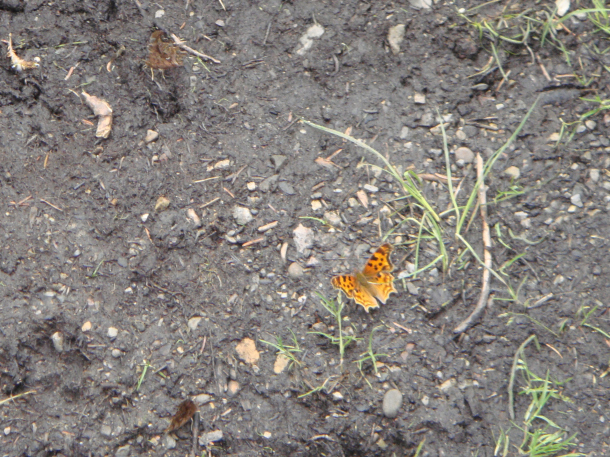
I took this picture of a butterfly. I was aware of its beauty and how it made life fuller.

Merely changing,

Occupies my idle mind.

Denying, silencing–

Another self.

Questioning–

One’s inner terrain.

Who is this self?

What life is this self living?

Maturing,

Emerging,

A chrysalis–

Thoughtful gift.

Flourishing beyond rhetoric,

Journeying with others,

Appreciating–

Valorizing.