Tag Archives: education

Tuned In and Fired Up

I mentioned this book in Culture of Peace and Angry Young Poet. It was worth a read. I start with a haiku which emerged from the book.


Who stretches the teacher?

Journey into their essence

Reveal the learner.

I read Tuned In and Fired Up by Sam Intrator for two reasons: as a teacher and as a graduate student preparing for the dissertation process. Sam contributes to the work of the Centre for Courage and Renewal which based on Parker Palmer’s writings and thinking.

The book is enjoyable, informative, and motivating. Teachers need to take time and pause, reflect upon, and recall the reasons they were called to teaching. There are alchemical moments of discovery we artfully use and define teacher, students, and subject. It is surreal and its magic can never be underestimated as the three blends into a single whole and respects individual integrity.

Part of the magic in this book is Mr. Quinn, the teacher. He took risks and students tuned in and fired up to his genuine presence. Parker Palmer, in The Courage to Teach, suggested “teaching is always done at the most dangerous intersection of personal and private life” (p. 18). Mr. Quinn’s teaching was learning and realized he could wrong. The magical aspect takes a teacher onto the boundary and, then, into uncharted waters. Good teachers take that risk and students sense it.

Towards the end Sam cited William Ayers: “Since teaching is always a search for better teaching, I am still in a fundamental sense becoming a teacher. I am stretching, searching, and reaching toward teaching” (p. 134). This is a virtuous cycle of learning-teaching-learning to infinity.

Sam leaves the reader with an incredible list of those things teachers can reflect upon and use according to their setting. Many are well-known: cultivate rapport with students, compete tenaciously for their attention, and spark their desire to create. Others were ones I felt were lesser known: embrace your role as a performer, tap into their senses, and acknowledge boring. That last one is challenging. At the adolescent level, treat them like they are becoming adults.

Questions: A concern expressed by Sam was a need for genuine collaboration. What practices do you use in your workplace or learning that foster collaboration between adults? If you teach, what ways do you include students?

Recommendation: I loved the book and let me leave you with just two ways. It was easy to read without losing meaning. Sam used simplexity and achieved his aims. Second, he left a thorough recipe without the quantities. I need to figure those out with students and subject.

Intrator, S. M. (2003). Tune in and fired up: How teaching can inspire real learning in the classroom. New Haven, CT: Yale University Press.

Palmer, P. J. (2007). The courage to teach: Exploring the inner landscape of a teacher’s life. San Francisco: Jossey-Bass.

 

An Angry Young Poet

Each year, I spend time on poetry with the students. Two years ago, a student asked if I wrote poetry in junior high school and I was able to say, “Yes!”. He asked me to share with them. I found them in a small lock box I keep at home and shared several with the class.

I mentioned in Culture of Peace Sam Intrator. He suggested teachers expose adolescent students complex, existential questions of life as they move through those formative years. I wrote my poems in about 1969. It was a time when identity was increasingly rooted in the global nature of the world, not just immediate community and family. War, even in Canada, entered our homes via television. I found voice in poetry and expressed an abhorrence to institutional and government approved murder. What set me apart from my peers, was I took no sides. Each was equally wrong in my mind. Mr. McKenzie, an innovative English teacher, encouraged that in us-find our voices.

I shared the following poem with my students. I concede it is not exactly the original, as it was pretty angry. I hope the original message is still there. Students asked for more poems and I complied. These past few months I rediscovered my poet’s voice. It is a gentler voice, I hope.

Win or Lose: What Difference Does it Make?

 One game

If it is one

No fun to lose

No great thing to win.

War!

Hollow

Men, women, children gone

In no time

Woe! The vanquished losers;

No winner

Each, vanquished in every sense.

Divided

In ruins

Rebuilding

On countless graves

Rudderless.

Without pride

Beggaring citizens

Values of others

Resenting conquerors

What does war bring?

No jobs

No hospitals

No schools

No homes, but the streets

Destruction everywhere.

What does war bring?

Death of innocence

Loss even in victory

Comrades fallen

But see an enemy vanquished.

Killing

Proving nothing

What fools

Going on forever

Will we learn?

We must

I pray

For human survival.

Take care and have a great 20th of July, 2012.

Culture of Peace

Each child has a voice

In a secure space

Voices are revealed.

I am reading Tuned in and fired up: How teaching can inspire real learning in the classroom by Sam Intrator. It is the published version of his doctoral dissertation so I read it out of a twofold interest: as a teacher and as someone getting ready for the dissertation process. Sam asks teachers to consider the following question: “What engages children in learning?” That was the focus of his study and he found an innovative teacher, Mr. Quinn, who lived up to the challenge.

Mr. Quinn was studying Cannery Row by John Steinbeck, but found the students were not enjoying the early part of the book. He took them outside to the ball diamond, had them select a small patch of ground, and spread out from their classmates. Mr. Quinn asked students to observe, collect data, and write about a 1 foot by 1 foot (30 cm by 30 cm) patch of grass. They were to try see the world as a poet-scientist and find their way to describe their small ecosystem. Despite initial grumbling, the students became engaged and wrote poetry, reflective journals, and connected that patch to their lives in many ways. For many, it was the highlight of their learning that year.

In Grade 8 Social Studies, I found an activity in the Teacher Resource Manual called A Culture of Peace. This activity engages students and brings out even the voice of those who generally choose not speak up. This is one of those activities with no right or wrong answer.

First we discuss a Culture of War, which by the standards of the day should be easy to do, but an interesting thing happens. About 10-15 minutes into this discussion, students run out of descriptors for a culture of war or they repeat what has already been said. I record comments on the whiteboard and say, “It is time for a change of pace. What are some descriptors for a Culture of Peace?” I fill up a whiteboard with student responses. They are so engaged they know when they are duplicating previous responses. They are listening intently to each other. The shy, reluctant students engage in the conversation, because they feel no risk of being wrong.

The first time we did this we had to stop after an hour because we were borrowing another classroom and the teacher needed it back. When we walked out of the classroom to return to our classroom, one of the boys turned to a friend and said, “I could do this all day.” As a teacher, I felt like I was on Cloud 9. I look forward to this activity each year. The students and I become engaged in our learning.

Question: What was one learning experience that engaged you fully and made learning worthwhile and so memorable to be vividly recalled years later?

Ode to Teachers

I wanted to blog and post pictures of some great cloud formations around Edmonton last night, but I received an email and there was an idea I could not resist. We each had teachers, and I use the word in its broadest definition, who made an impact on our lives. Ruth is someone I taught with for 12 years.  I use the word taught guardedly and refuse to use the work word to describe our relationship. We learned together. Learning is different and is relational. In her email, she described a visit with a parent of a former student and shared this phrase, ‘child whisperer.’

Each of us, had or have people in our lives in many forms who fit the phrase. They remind us of what the root word of educate is–educare. Even the Latin word speaks of care, which I think is vital to the relational nature of learning.

I can think of many who filled the role. Sister Phillips was my first grade teacher. She was a member of the Catholic order the Sisters of Service and it was special in her class. Later, in high school, I had Ms. Lyford, a short, stocky Australian woman who loved Shakespeare. She once said, “Ivon, if you only tried you would be an A student.” She did it loving and in a caring way, I think. I was good with a B and explained that to her.

Outside school it was my grandmother and mother. I still learn from them although the former is long past away and my mother lives 8 hours away. I learned from my father-in-law and mother-in-law and, needless to say, I learn from the daughter I married. I learn from our boys and my students in many ways. This list is incomplete, but the point is : Great teachers are great not because they tell you do something, but because they lead you to want to do it and ignite your imagination and spirit for learning in a magical way .”

Blend compassion and passion

Bring out the best in each child

Walk with them

Open your heart

Greet them

With your story

Receive their stories gently

Reveal vulnerability

Be a guide they need

In each moment

Learn, share, create

Listen and hear

And speak in a voice

Only a child whisperer can.

Take a moment, tell us about a teacher or teachers who made a difference for you, who whispered at the right moment and spoke the right words lighting a fire in your spirit.

Trying to Learn by Lydia Davis

Today, I read part of Experiments in Ethics by Kwame Appiah, a professor at Princeton. It is an interesting book and I doubt I can do it justice in a blog posting, but, as the title suggests, it is about ethics and their complex nature due to human complexity.

He provided a very short story by Lydia Davis. I might compare it to Heraclitus’ quote: “No man ever steps in the same river twice, for it’s not the same river and he’s not the same man.” No person steps twice in the same river, because the river is constantly changing. I also think the complexity nature of our human being is such that we change as we move into each ensuing moment. I cannot be the same person in the next moment. Living an ethical life is challenging as I am not the same person at each moment. In French, the word for experiment is experience. I think a life fully lived is one that is an experiment. I constantly learn from this fully lived life if I am mindful and use my beginner’s mind.

 
“I am trying to learn that this playful man who teases me is the same as that serious man talking money so seriously he does not eve see me anymore and that patient man offering me advice in times of trouble and that angry man as he leaves the home. I have often wanted the playful man to be more serious, and the serious man to be less serious, and the patient man to be more playful. As for the angry man, he is a stranger to me and I do not feel it is wrong to hate him. Now I am learning that if I say bitter words to the angry man as he leaves the house, I am at the same time wounding the others, the others I do not want to wound, the playful man teasing, the serious man talking money, and the patient man offering advice. Yet I look at the patient man, for instance, whom I would want above all to protect from such bitter words as mine, and though I tell myself he is the same man as the others, I believe I said those words, not to him, but to another, my enemy, who deserved all my anger.”

What other ways can we learn to live a life fully, ethically, and in an experiential manner?

Cartoon Time along with an Ivon Rant

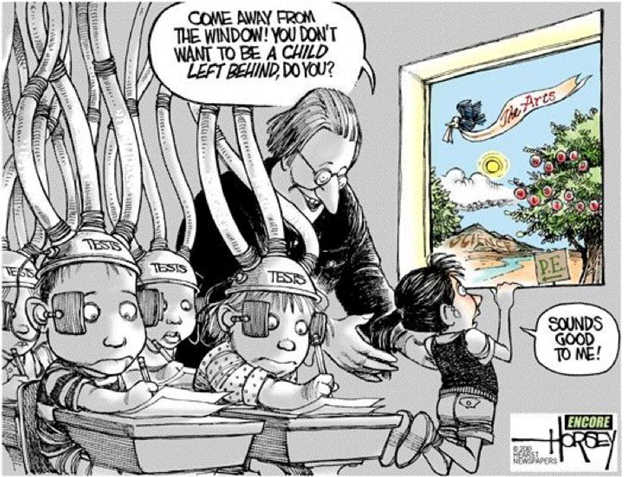
Another Alberta-based educator at The Love of Learning posted this. It reminded me of a Ken Robinson video The Educational Revolution…Why? Because Schools Kill Creativity posted by Gen Y Girl. The video is worth watching several times. The first time I watched the video several years ago an administrator informed me the message was a need to add layers of technology on top of what we are doing.

I am not a neo-Luddite. The original Luddites were not opposed to technology. They opposed potentially catastrophic outcomes blind, thoughtless implementation of technology might have on British society of the time. A message I gleaned was a positive correlation between ADHD/ADD diagnosis and an increase in various forms of imposed, standardized, high stakes testing.

The second message is statistical evidence the highest levels of creativity in school are at the kindergarten levels. After that, it is all down hill.

These are not technology issues, but simply change for the sake of change.

Technology is the artful use of the tools available to us.

Questions: What changes would you suggest for education to make it more child-friendly and child-focused? What can we do to increase the creativity for children in classrooms?

A bit of an American slant to it, but where do Canadian educational systems take their lead from? Is this what we want?

Two Wolves Inside Me Movie – Which Values Will You Feed?

A colleague passed this link on to me and asked I share it. It resonated as I recently posted Naming Values which is similar in theme.

I’m sure you’ve heard it before, but I couldn’t agree more; Life is merely a series of choices. Where you are now can all be linked back to every choice that you’ve made in your life to date. Every day we all make countless choices and each one counts. This is what this short movie is all about via Two Wolves Inside Me Movie.

Enjoy and share.

Human Being Instead of Human Doing

Many days I wonder about what other are doing, what causes them to do it, and what I can do to control their behaviours. I used the word do a lot in that first sentence. When I wonder that way, I become angry, frustrated, and hurt. I become a human doing instead of a human being. Being present and living each moment mindfully is part of this being.

Some words and an image to help us be today. Happy summer solstice.

The art of life isn’t controlling what happens, which is impossible; it’s using what happens.

~Gloria Steinem

Teachers as Storytellers

Think of the people we call teachers, not just in classrooms but in every facet of our lives. A quality they share is storytelling. They connect with our hearts and minds. We laugh, cry, yell, and carry on in every imaginable way with them. We remember them not because of what they taught us, but what they revealed about themselves and helped us discover about our self.

The best teachers are the best storytellers. We learn in the form of stories.

~Frank Smith

Five Steps to Destroy Public Education

Five Steps to Destroy Public Education.

Diane Ravitch is a real educational reformer in the US. I think parts of her message in this post is universal. I particularly like her comments about underfunding our schools and overcrowded classrooms.

It is just not the underfunding that starves the schools; it is the poor management and decision-making by the bureaucrats, technocrats, and oligarchs. What is the latest fad?

Overcrowding our classrooms silences the teachers. Do I even have time to lift my head and uplift students under those conditions?