Tag Archives: eloquent questions

Do Pigs Have Udders?

Part of educating for hope is “reading the world” in hopeful while living “in dynamic interrelationships” with others (Paulo Freire, Pedagogy of the Oppressed, p. 102). This means opening the world to eloquent questions without presupposed answers and without the threat of violence of any form. I used the quote in a recent book chapter I co-authored with a colleague from North Carolina. The book is to be published in late 2020 or early 2021. What does it mean to live in a world full of hope; a hope(ful) world.

My first day back from the retreat I posted about in Welcoming Differences and Gentle Rain I noticed the students were subdued. In the afternoon, I was alone, which was unusual. Without an adult and teaching three grades, it could be demanding. Other times, it provided interesting moments, and this turned into one of those moments.

I had contacted a substitute teacher I had used several years before and who was available again after completing a long term assignment for an ill teacher. As we talked about what was bothering me, the students told me they had not enjoyed the teacher. I was surprised, as he had seemed a good fit before. I asked for an example and they told me he had told them their conversation was inappropriate. This was unusual, as the students in this group were well-behaved and respectful. I asked them what the conversation was about and they told me, while completing some Science, one student asked “Do pigs have udders?” Apparently, this became a hotly debated topic and it was brought up again today.

I laughed. For me, it was funny and pointed to an irrevocable human truth: curiosity about the world we live in and eloquent questions leading to exploring the world and learning about it. We had serious fun as we talked about what udders were and their role in feeding offspring. I even phone Kathy, who was raised on a farm, and asked he. She was not sure, but thought it was a structural thing and pigs probably did not have it. We left it as an open question.

Simple question,

Emerging eloquently,

Not presupposing answers;

Fueling curiousity–

Energizing learning.

What does this mean?

Is it true?

Querying and questing;

Seeking to fill gaps;

Not with certitude;

New questions emerging.

With passing years,

Recalling that moment,

Smiling, chuckling;

Appreciating simple, provocative question–

Do pigs have udders?

As best as we can learn, they do and it was fun trying to figure it out. Adolescent children ask the darnedest things. Laughter is an antidote for difficult moments. Something I learned as a student teacher was a safe classroom allows children, youth, and probably adults to ask provocative questions with no preconceived answers. In the polarized world we live in, we have lost that assurance of safety and are reluctant to ask questions needing answers.

I will save you looking up the answer on the Internet. Pigs do not have udders. Udders are a reference to mammary glands on certain mammals and it has to do with their structure. I read a version of this poem for a group at a retreat in Wisconsin. As I finished, adults wanted to know the answer. I said I didn’t know and someone looked it up on the spot.

I don’t have a picture of a pig. Here is one of a bear I took in Waterton Lakes National Park. Bear and pigs are related, so it was as close as I could get.
One’s Story

I wrote this poem while I was at the retreat I mentioned in Companions. The retreat was long, tiring, and rewarding. Even though events of this nature can be stimulating, I also find I run up against blocks due to how tiring they can be. I mean tiring in a good way. We spend time in solitude, which is not something that is easy. When we were together, deep listening, another overlooked quality, was essential.

I wanted to share my experiecnce at the retreat here and questions that emerged. To write the poem, I let ideas percolate for a couple days. The word courage and heart are related. Courage comes from the French word coeur, meaning heart. The heart is the holding place for our truth and we often have to have the heart and courage to tell our story. Humans are the only beings capable of telling their story, flawed and essential to their being and becoming.

One’s courage;

Revealing one’s story,

So telling to tell,

Always emerging.

Narrating and sharing,

Telling one’s story;

Sharing to be heard,

Listening differently,

Listening deeply.

Words anew,

Illuminating, enlightening

Sharing sacred space;

Recognizing and loving.

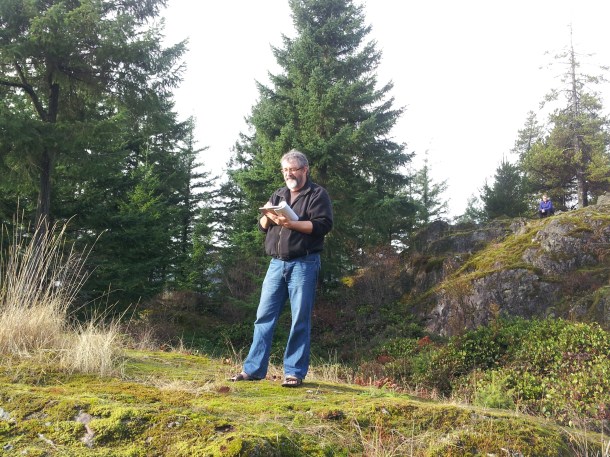
A colleague took this picture of me at the retreat. We spent a considerable amount of time on our own and in nature. It brings out the best in me.

Adventuring

When I write and post, I do not know where I go. Each step is its own process without rehearsal. Life is much the same, a process. We continuously transform: shedding cells, body parts atrophy, slow down, etc. Of course, children go in the other direction in some of these processes as they become quicker and more stable with time.

We often treat change as if it is something we can control. The truth is change always happens in overlooked and taken-for-granted ways. Living and writing are complex processes. The adventure is in the unpredictability of living and writing, not in unattainable certainty. We do not know what will emerge in the adventure.

Step at a time;

Moment by moment–

Without realizing,

Change happens.

Changing ever so gradually;

Gracefully–

Imperceptible,

Seeking no material reward.

This dancing,

Unrehearsable–

Hearing unheard music;

But, no sleight of hand.

Light radiating;

Illuminating this step–

This present,

A gift.

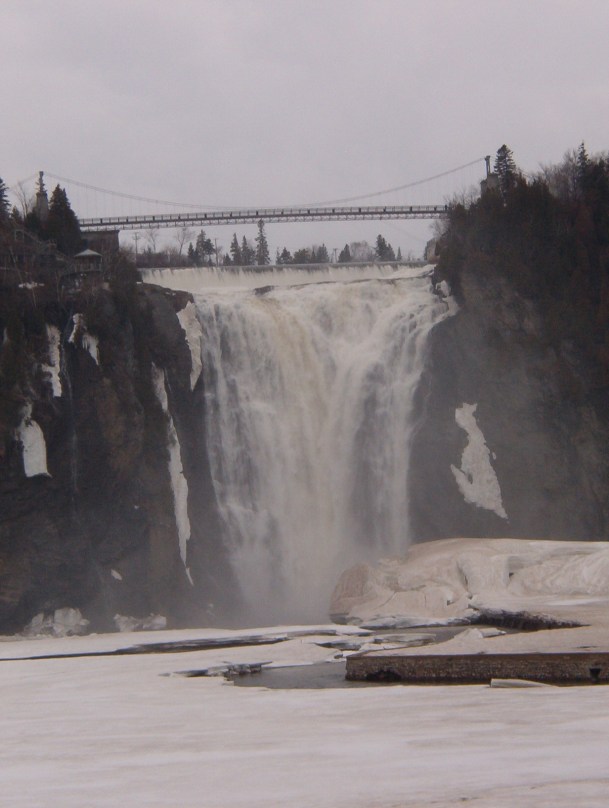
I took this picture in Quebec City several years ago. We saw Les Chutes de Montmorency during the summer, as well. What the picture does not reveal in summer or winter is a few hundred metres of the waterfalls the water appears calm and flows into the St. Lawrence River. I say calm, because we cannot see below the surface and know what is happening. Change acts this way. There is always something below the surface.

Life’s Calling

Originally, I called this life’s mission, but that seemed to neo-liberal and neo-conservative for my liking. I subscribe to life as a calling and vocation based on the writings of Thomas Merton and Parker Palmer. Vocation comes from the Latin meaning voice, so a calling and vocation gives each of us voice in living and has an essential spiritual aspect to it. What calls each of us animates and we respond in ethical and moral ways. I think we have lost much of this in our current world. Although John Dewey did not write from a spiritual context per se, he wrote about self-interest as words meaning the same thing. What interests me? Interest comes from the Latin esse, which also is the root of essence, which is related to spirit. What inspirits me?

I wrote the following poem after a professional development day. I found inconsistencies revealed in those days fascinating. They were uninspiring, exhausting, and counterproductive. They lack personal, responsible choice. Too often, adults are dependent on others to make their decisions, hence the concept of accountability overriding responsibility. It is hard to believe we think these adults can engage in educating children, youth, and adults in any meaninful ways. Our voices are repressed, suppressed, and oppressed.

At the end of that day, I wondered and reflected on the following questions: “Am I seeing this in a proper light? What can I do to further the process of learning as a role model for students and other adults?” Learning and teachng are relational processes between people and subject. Parker Palmer argues we put the subject of our learning in the middle of pedagogic conversations. In this way, we acknowledge each human present has a different perspective of the same subject.

For me, going to an event based on Parker Palmer’s work, a poetry workshop with David Whyte, an assessment workship, etc. were and are exciting. It animates. When I obtained my Master’s of Education and PhD, it was not to earn more money or move up some fictional career ladder. Education was and is essential. In the midst of a pandemic. I am exploring how we can return to the roots of educating for life, as opposed to schooling to produce a compliant and conforming workforce. I think the latter emerges from the former, rather than the other way around

Living fully,

Sharing fully,

(Ex)pressing one’s voice–

Singing one’s song.

Whetting wonder,

Planting seeds of awe,

Lighting fires–

(In)spiring to dance one’s dance.

Watering, feeding, nourishing,

Enriching, emboldening, becoming–

Embracing what brings life and joy–

(In)spiriting.

Turbulent Calmness

On June 29, I posted a similar poem and theme. I am not sure what led me to post two that shared the same title. It is likely, early in the school year, it feels chaotic. Early in a school year, there are moments of repreive in this feeling and, as the year gains momentum, they become more common. As one co-participant in my dissertation put it: “I learn to stand in the middle of the storm.”

The other inflluence was I took several courses in my PhD about leading in complex and chaotic times. Servant-leadership, mindful leadership, and transformational leadership are forms of leadership particularly effective in times. We focus on questions about what needs to be changed, how do we engage each person in change, and how does each person become a leader in their own right? These forms share common features: grounded in the present, ethically guided, there is foresight without being set in certainty, etc. Mixed in this was courses on the Tao of Leadership, Systems Leadership, Leadership and Justice, Dialogic Leadership, etc. When I re-entered the classroom each September, what I learned in my PhD founds its way in with me. How could I better serve each student? How could we transform and share our experiences into something nourishing each other’s lives? How could I make a difference for each student? How could they grow and become better leaders than me?

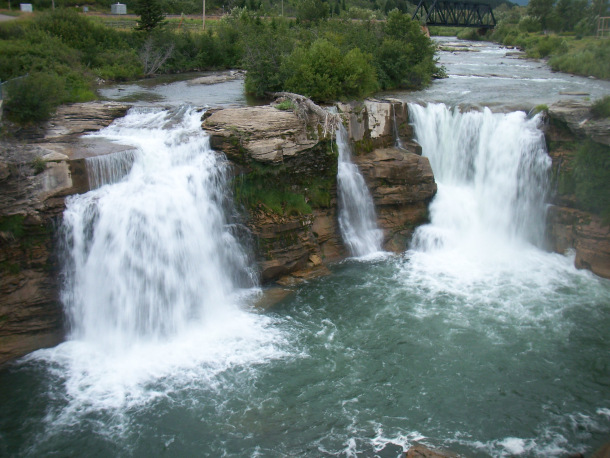
I took the pictures at Lundreck Falls as a reminder of how quickly nature can bring a sense of calm back even in the midst of what is initially chaotic. Within a short distance from the falls, the water pools and calms, at least on the surface. What goes on underneath the surface can remain chaotic and complex much like life, needing non-judgemental, humility, foresight, patience, and wisdom to navigate the unforseeable and unpredictable.


Needless to say, I wrote a poem about the challenges of remaining calm in the midst of the storm sometimes raging around me.

Growing awareness–

Standing still,

Humbling one’s self,

To gain foresight–

Insight;

Emerging clarity,

Wisdom.

Entering life’s stream–

Even calm waters,

Hiding shoals, rocks, currents,

In turbulence–

Dropping labels,

Ceasing unwarranted judgment,

Falling awake.

Unplanned, Orchestrated

As I approached the last year I taught, I wanted to experience the that and live it to the fullest with each students. At various times during the year, my resolve was tested. One day, due to illnesses and family situations, the number of students who attended was a handful. I set lesson plans aside, going  with the flow. It was an excellent choice. We enjoyed ourselves and it created a way to approach these situations, and teaching in general, throughout the year.

That day, students created stories as part of short animated films. At times, we were silent. Other times we shared and laughed. Throughout, we helped each other with new tools and I learned right along with them. Much like teaching art I did not come into the day with much knowledge about tools and techniques we used. Instead, it was very improvised and I told the students this right up front.

Several days later, I walked the river valley and reflected on how we experience unplanned moments and rewards that emerge. Alan Watts reminds me of the difference between faith and belief. The former allows me to go through life less anxious, with reduced expectations about the future. The latter needs us to shape a world to fit a belief system into and defend it. It is not that the future won’t arrive. It is I cannot anticipate the next moment, only living in the present moment and improvising to what emerges.

Life’s meaning–

A question teases–

To live into;

To thrive in;

What is my purpose?

Moments separating;

Connecting, dancing in paradox.

Each moment emerging;

Unplanned–

Yet, orchestrated.

Revealing meaning moment by moment.

Unmarked journeys–

Question,

Not answers–

Certain missteps–

Do I see around corners?

Over hills?

Accepting on faith,

Feeling, sensing, experiencing,

Not seeing.

A gentle hand,

Touching, guiding,

Each of life’s step,

Emerging in light,

And, shadow.

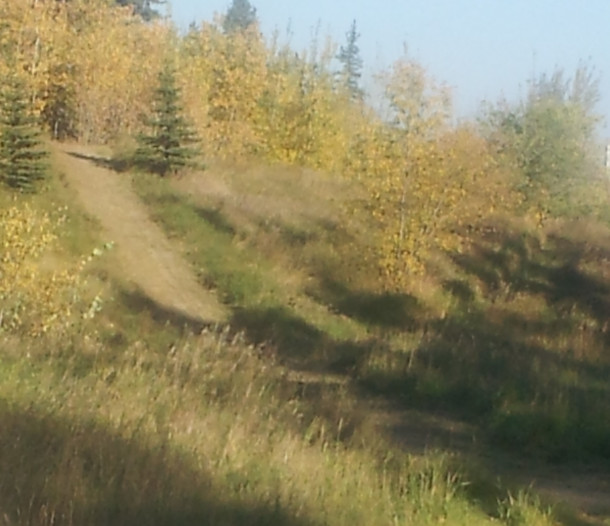
I took this picture during the walk. The path drew me to it, with its hill and curve at the top. I only saw what was immediately in front. Even then, it was limited by shadows and vegetation blocking my view.

On the Edge

When I wrote this poem, it was at a time I was unhappy going back into the classroom and teaching. I loved the students and looked forward to being with them. So much had changed in the little school I taught in with change imposed upon us, rather than negotiated with us. In my writing, I am beginning to look at what is essential to the spirit for each of us to flourish. What gives each of us hope? it will be different. What is certain is we each want to have a voice in what we are doing.

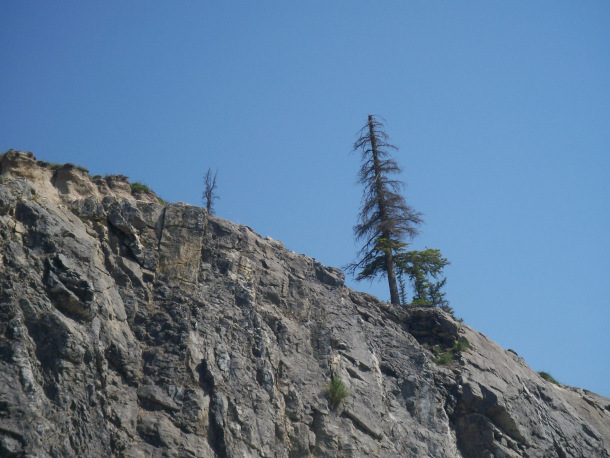
When I wrote the poem, I wrote from a negative place. Now, as I look at the image, the tree on the dge of the cliff fourished in its environment, which is rock with little soil. The tree is actually quite old. Our tour guide said about 300 years old. Despite its lack of size, it flourishes and that is what I failed to see in the last two years I taught. It begs the question: “what might I have done differently.” I was not very patient at times. Cornel West tells young people looking for change to be patient. Real, transformative, democratic, and sustainable change takes time and patience.

In being with each student and present to them, I found something other than gave me the impetus to teach for two more years and find ways to cope with the imposed change. One of the challenges I faced was what we did was so different than what other classrooms looked and felt like it was difficult to convince other educators what we did had merit. Teachers teach one grade at a time in isolation with children separated from families, like a workplace. We had a parent in the classroom each day to assist, many of the families knew each other, and I had a multi-grade classroom with 3 or 4 grades together. Children and youth attend school each day and homework is something we assign, because often there is not time to complete everything at school. Students attended our school 40-50% of the time on a set schedule, depending on grade level. I negotiated with parents the extra things to be done at home. Often, they were large culminating projects at the end of a unit. I taught and students learned what was necessary in class and had little homework. I did not teach all subjects in school. Parents taught Math, Health, and some Phys Ed at home. I went on home visits to support their teaching and make sure we were on track. I had no desks in my classroom. We sat at tables usually based on grade level, but, during complementary courses e.g. Art, Food Sciences, Programming, etc., students sat in mixed grade groups.

In short, we were on the margins, the edge of what was perceived as “normal’ school. Today, in the midst of a pandemic that sent children home to learn online, the relationships and support we had in our small community would have helped many families and teachers cope with the sudden and unpredictable change.

With each step,

Closer–

Be bold.

Balance precariously,

Hover over abyss

Be brave.

Instability and stability dancing–

To soundless music;

Be graceful.

Quieting one’s self;

Listening to soul’s–

Be poetic.

Between lines and stanzas–

 Wisdom emerges–

Be patient.

On the edge,

Sisters and brothers–

What calls you with passion?

I try to walk in the neighbourhood each day. When I do, I listen to music. Yesterday, I heard a song by Bela Fleck and Abigail Washburn, which fit with this poem and how I felt when I wrote it. In talking to one’s younger self, they use words like bold, love, bold, and fear. I use passion, which suggests suffering as a necessary piece to flourishing.

The Weighing

Jane Hirshfield wrote the following poem, speaking to hope and resilience. At the end of our rope, we find we have more to give than we realized. It is a sense “this to shall pass” and we can only live in the present moment, which is fleeting.

Hard times reveal fissures in our world and society. Look at who has been hardest hit by Covid-19: people of colour, elderly, poor, etc. We can then see the fissures and who is left out. This became clearer with George Floyd’s killing. It is not enough to question who is left out, but how these humans are left out, dehumanized in the process. Injustice calls us to take account of the life we live, the world we live in, and ask how do we make this better, for each human being we encounter. Injustice calls us to weigh how we speak and act towards one another and to transform who we are for the better.

There are no easy answers to large questions, despite what politicians, carnival barkers, and reality TV hosts would have us believe with their divisive language and actions. We can embrace that we have more in common than separates us. As Paulo Freire proposed, there is unity in difference beyond superficial multiculuralism.

The heart’s reasons
seen clearly,
even the hardest
will carry
its whip-marks and sadness
and must be forgiven.
As the drought-starved
eland forgives
the drought-starved lion
who finally takes her,
enters willingly then
the life she cannot refuse,
and is lion, is fed,
and does not remember the other.
So few grains of happiness
measured against all the dark
and still the scales balance.
The world asks of us
only the strength we have and we give it.
Then it asks more, and we give it.

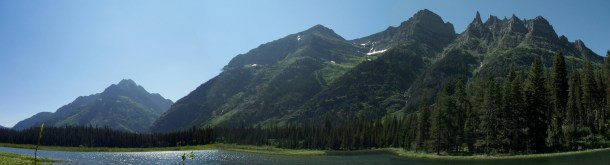
When I hike in wildnerness settings, I wonder what is around the next curve, over the horizon, on the other side of the mountain, below the surface, etc. I am unaware of so much. What is essential is I lift into critical consciousness what I can to better understand how I can make the world a better place and act on that as best as I can. I will likely never get to the other side of Kootenai Lake or the mountains on the far side, so I can only imagine what is there, a utopia of sorts. The same applies for the world we live in. The difference is we can incrementally get there, together.

As I am called to be a steward of the world, I am called to be a steward and servant in leading others. Without fully understanding where I am going, I am going there.

After I posted, I was listening to the radio and they played this song. It seemed appropriate.

Listening and Learning

I was going to press a wonderful post from Cheryl’s blog called Living in the Gap. Unfortunately, she does not have a press facility, so I did the next thing. I copied a paragraph from her post that I relate to:

“Am I ready to look at the part I play in the current reality, come out from the safety of the suburbs, and confront my own racism? To take a sober look at my own bias, privilege, and exclusionary practices. This is when I want to curl up like a pill bug and roll away, but this movement is not about me, it’s about listening, learning, and leaning into the race issues currently afflicting our country.”

We are in an unusual moment with the protests. They call us to stop and listen to one another in ways we may not be used to. They also call us to ask questions we have not asked in deep ways, such as “how do I confront my own prejudices? Am I even willing to confront them?” I use the word prejudice to open the space a bit more. It is not only about race. It is about gender, sexual orientation, class, etc.

Currently, I am co-writing an article for publication using Paulo Freire. Freire used critical theory and I paraphrase him here. He said prejudices are interwoven, arising from individual lived histories passed from one generation to another in unquestioned ways. It is listening to others without taking on a saviour role, without drowning their voices, and hearing them speak about their reality. They await opportunities to be raised into consciousness and critically questioned. How I understand this is through a Socratic lens where skepticism begins at home. How do I make the world better, more just, more democratic. Freire suggests it is a slow process. In his book, Pedagogy of Hope, he acknowledged using gender exclusive language in his seminal book, Pedagogy of the Oppressed, published 30 years earlier. He learned to use more inclusive language as he became critically aware of the harm done without it. It was a small and necessary step.

Freire argues we need to listen to one another, not denying difference. Instead, he calls on us to accept “unity in difference.” At our core, (in French coeur is heart and core) we are each human. Too often, we talk over each other and listen to defend entrenched positions. A key theme in Freire’s writing is human “unfinishedness,” always becoming. I reflect when I took-for-granted privilege and wonder how I might overcome this. It is not easy. It will not be finished. I understand my role, as an elder, as one of serving and listening. Leadership is serving, transforming, and mindful, rather than transactional and hierarchical.

Robert Greenleaf stated “the best test [of servant-leadership], and difficult to administer, is: do those being served grow as persons; do they become healthier, wiser, freer, more autonomous while being served: Since so many people seem afraid to grow, the true servantleader who brings it about is an extraordinary person.” If I look at the next generation and they offer me hope that there is better to come, perhaps I can take some solace in that. Without hope, we wither and flee from the scene, abdicating our responsiblity to one another.

I leave you with a video of Langston Hughes’ poem Mother to Son. If I expand the defintion of pedagogue to its broadest etymology, it is how elders interact with youth, allowing them to dream. Hope is not about a lack of obstacles. After all, no life is a crystal staircase and that is most evident for those on the margins of our societies, including in Canada with its history of residential schools and mistreatment of people of colour. It is, as Freire suggests, being willing to struggle and fight to overcome overt and covert injustices and inequities we encounter and witness. It is listening and testifying in those moments to offer a hand to those in need, regardless of race, gender, orientation, creed, and class without being dogmatic. How do we testify in each of those moments? It is not succumbing to historical amnesia and existential weariness.


Well, son, I’ll tell you:
Life for me ain’t been no crystal stair.
It’s had tacks in it,
And splinters,
And boards torn up,
And places with no carpet on the floor—
Bare.
But all the time
I’se been a-climbin’ on,
And reachin’ landin’s,
And turnin’ corners,
And sometimes goin’ in the dark
Where there ain’t been no light.
So boy, don’t you turn back.
Don’t you set down on the steps
’Cause you finds it’s kinder hard.
Don’t you fall now—
For I’se still goin’, honey,
I’se still climbin’,
And life for me ain’t been no crystal stair.

Angry Young Poet

In keeping with Why Do I Write Poetry, the following poem is one I wrote many at about the same time. This is the third time I visited the poem in terms of writing and editing. Several years ago and while explaining the importance of teaching poetry, a student asked if I wrote poetry in junior high school and I responded, “Yes!”. He asked me to share with them. I found them in a small lock box I keep at home and shared several with the class. We talked about the context I wrote the poem in. Even in Canada, I lived in the shadow of the Vietnam conflict and struggled with what that meant.

Sam Intrator suggested teachers expose adolescent students complex, existential questions of life as they move through those formative years. I wrote my poems in 1969. It was a time when identity was increasingly rooted in a global nature of the world, not just immediate community and family. War entered homes via television. Increasingly, I discovered my voice through poetry, expressing an abhorrence to institutional and government sanctioned killing. What set me apart from my peers, was I took no sides. Each was equally wrong in my mind, advancing their ideological stance. My teacher, Mr. McKenzie, an innovative English teacher, encouraged us to discover our voices.

I shared the following poem with my students. We talked about how metaphors of war are used commonly in various institutions and how I found this as troubling as the violence and trauma of war. That feeling re-emerged over the past months with describing dealing with Covid-19 in war-like terms and the troubling events of the past weeks where purported leaders feel it is OK to speak about human beings, not citizens, as an enemy and objects to be manipulated for financial gain based on the basest forms of self-interests. It is worse than the war as it takes on invisible and pervasive forms. It is a form of Social Darwinism where the strong survive, trampling on those further down what is understood as a food chain premised on unfettered oppression of other humans, including various forms of systemic violence. Consider billionaires, in the Covid-19 crisis, gained while those in most need lose what little support they had.

I contrast this with Jacinda Ardern‘s message as the Prime Minister of New Zealand. In The Atlantic, Uri Friedman describes her as an empathetic leader. What emerged in reading the article was we de-serve better leadership, mindful, transforming, serving, etc. focusing on people as humans, not objects.

Students asked me to share poems and I did, with the context within which I wrote them. Parents, who were in the classroom each day, asked about my candour. I responded “I am not about changing minds. I try to change how each student thinks about the world, to see under the surface, reveal a sordid underbelly, and revel in the wonderfulness of human life.” This is a hopeful message, and the leadership we need is evident e.g. Jesus, Buddha, Muhammed, Mary Wollenstonecroft, Anne Frank, Maya Angelou, Soujouner Truth, Rosa Parks, etc.

Win or Lose: What Difference Does it Make?

A game–

Darwin misunderstood,

No great thing to win.

War and it language!

Bells ringing hollow,

Men, women, children gone!

Woe! vanquished losers and winners;

Humans, vanquished in every sense–

Thriving on dividing.

Resenting conquerors,

Rebuilding ruins–

On countless graves.

Morally rudderless,

Blaming the fallen,

Beggaring humans.

Homes on streets,

Hollowing souls–

What war brings?

Innocence dying–

Prryhric victories,

What war brings?

Comrades fallen,

Enemies vanquished–

Proving nothing.

Will we learn?

I pray

For human survival.

I leave you with the following video and song. We listened to Harry Belafonte, and I still do, with his uplifting and hopeful message. We are in this together, not against one another, with each other.