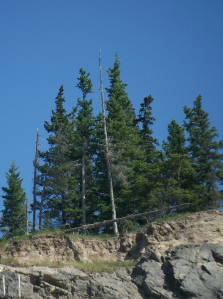
This tree stood all by itself on the crest surrounded by the pretty ones. What attracted me was it stood out from the crowd and thrived. I alluded to this in On the Edge. They were in the same area as we drove up to the Columbia Ice Fields in Jasper National Park. These trees do not just survive. They thrive in demanding conditions, sometimes for 100’s of years. There is little soil, water, and nourishment on the embankments, so they appear stunted. It thrives on the margins of its ecosystem. Perhaps, we find beauty in places we do not anticipate. We have to be ready for this or it will slip by.
In today’s environment, with calls for greater equity and social justice, it is not enough to ask people to survive with less than living wages, inadequate housing, little or no healthcare, etc. as if that is a major accomplishment. We must allow them to thrive as humans.
I took one class in special education in my B Ed. and another in my M Ed. I learned we have more in common than makes us different. Paulo Freire wrote of unity in diversity; John Dewey about communicating what we have in common to form community, and Parker Palmer about the paradox of living in community and with solitude. If we are more alike than different, we have a lot to communicate. It takes listening deeply, reflecting critically on one’s views (biases) of the world, and ethically transforming (moving beyond) the world, particularly that which is immediate to each of us. It is not enough to reform, but it may be a start to the process. It is becoming more and better, individually and collectively, in ways we cannot anticipate and can not be fully finished. There will always be good work to do, not matter how far we come.
On the margins;
Thriving–
Separate from the crowd.
Elements taking a toll;
World weighing heavy;
Thin, mottled.
Standing proud;
Reaching high–
Believing in something better.
Valuing who you are;
Individual, non-conformist–
Separate from the crowd.
Lonely, not alone;
Spacious, gracious solitude–
Revealing your own beauty.
Today, as I cruised Facebook, I found Parker Palmer posted Mary Oliver‘s poem The Summer Day. I love the closing lines: “Tell me, what is it you plan to do with your one wild and precious life?” It is a wild and precious life.
When I wrote this poem, it was at a time I was unhappy going back into the classroom and teaching. I loved the students and looked forward to being with them. So much had changed in the little school I taught in with change imposed upon us, rather than negotiated with us. In my writing, I am beginning to look at what is essential to the spirit for each of us to flourish. What gives each of us hope? it will be different. What is certain is we each want to have a voice in what we are doing.
When I wrote the poem, I wrote from a negative place. Now, as I look at the image, the tree on the dge of the cliff fourished in its environment, which is rock with little soil. The tree is actually quite old. Our tour guide said about 300 years old. Despite its lack of size, it flourishes and that is what I failed to see in the last two years I taught. It begs the question: “what might I have done differently.” I was not very patient at times. Cornel West tells young people looking for change to be patient. Real, transformative, democratic, and sustainable change takes time and patience.
In being with each student and present to them, I found something other than gave me the impetus to teach for two more years and find ways to cope with the imposed change. One of the challenges I faced was what we did was so different than what other classrooms looked and felt like it was difficult to convince other educators what we did had merit. Teachers teach one grade at a time in isolation with children separated from families, like a workplace. We had a parent in the classroom each day to assist, many of the families knew each other, and I had a multi-grade classroom with 3 or 4 grades together. Children and youth attend school each day and homework is something we assign, because often there is not time to complete everything at school. Students attended our school 40-50% of the time on a set schedule, depending on grade level. I negotiated with parents the extra things to be done at home. Often, they were large culminating projects at the end of a unit. I taught and students learned what was necessary in class and had little homework. I did not teach all subjects in school. Parents taught Math, Health, and some Phys Ed at home. I went on home visits to support their teaching and make sure we were on track. I had no desks in my classroom. We sat at tables usually based on grade level, but, during complementary courses e.g. Art, Food Sciences, Programming, etc., students sat in mixed grade groups.
In short, we were on the margins, the edge of what was perceived as “normal’ school. Today, in the midst of a pandemic that sent children home to learn online, the relationships and support we had in our small community would have helped many families and teachers cope with the sudden and unpredictable change.
With each step,
Closer–
Be bold.
Balance precariously,
Hover over abyss
Be brave.
Instability and stability dancing–
To soundless music;
Be graceful.
Quieting one’s self;
Listening to soul’s–
Be poetic.
Between lines and stanzas–
Wisdom emerges–
Be patient.
On the edge,
Sisters and brothers–
What calls you with passion?
I try to walk in the neighbourhood each day. When I do, I listen to music. Yesterday, I heard a song by Bela Fleck and Abigail Washburn, which fit with this poem and how I felt when I wrote it. In talking to one’s younger self, they use words like bold, love, bold, and fear. I use passion, which suggests suffering as a necessary piece to flourishing.
Jane Hirshfield wrote the following poem, speaking to hope and resilience. At the end of our rope, we find we have more to give than we realized. It is a sense “this to shall pass” and we can only live in the present moment, which is fleeting.
Hard times reveal fissures in our world and society. Look at who has been hardest hit by Covid-19: people of colour, elderly, poor, etc. We can then see the fissures and who is left out. This became clearer with George Floyd’s killing. It is not enough to question who is left out, but how these humans are left out, dehumanized in the process. Injustice calls us to take account of the life we live, the world we live in, and ask how do we make this better, for each human being we encounter. Injustice calls us to weigh how we speak and act towards one another and to transform who we are for the better.
There are no easy answers to large questions, despite what politicians, carnival barkers, and reality TV hosts would have us believe with their divisive language and actions. We can embrace that we have more in common than separates us. As Paulo Freire proposed, there is unity in difference beyond superficial multiculuralism.
The heart’s reasons
seen clearly,
even the hardest
will carry
its whip-marks and sadness
and must be forgiven.
As the drought-starved
eland forgives
the drought-starved lion
who finally takes her,
enters willingly then
the life she cannot refuse,
and is lion, is fed,
and does not remember the other.
So few grains of happiness
measured against all the dark
and still the scales balance.
The world asks of us
only the strength we have and we give it.
Then it asks more, and we give it.
When I hike in wildnerness settings, I wonder what is around the next curve, over the horizon, on the other side of the mountain, below the surface, etc. I am unaware of so much. What is essential is I lift into critical consciousness what I can to better understand how I can make the world a better place and act on that as best as I can. I will likely never get to the other side of Kootenai Lake or the mountains on the far side, so I can only imagine what is there, a utopia of sorts. The same applies for the world we live in. The difference is we can incrementally get there, together.
As I am called to be a steward of the world, I am called to be a steward and servant in leading others. Without fully understanding where I am going, I am going there.
After I posted, I was listening to the radio and they played this song. It seemed appropriate.
I was going to press a wonderful post from Cheryl’s blog called Living in the Gap. Unfortunately, she does not have a press facility, so I did the next thing. I copied a paragraph from her post that I relate to:
“Am I ready to look at the part I play in the current reality, come out from the safety of the suburbs, and confront my own racism? To take a sober look at my own bias, privilege, and exclusionary practices. This is when I want to curl up like a pill bug and roll away, but this movement is not about me, it’s about listening, learning, and leaning into the race issues currently afflicting our country.”
We are in an unusual moment with the protests. They call us to stop and listen to one another in ways we may not be used to. They also call us to ask questions we have not asked in deep ways, such as “how do I confront my own prejudices? Am I even willing to confront them?” I use the word prejudice to open the space a bit more. It is not only about race. It is about gender, sexual orientation, class, etc.
Currently, I am co-writing an article for publication using Paulo Freire. Freire used critical theory and I paraphrase him here. He said prejudices are interwoven, arising from individual lived histories passed from one generation to another in unquestioned ways. It is listening to others without taking on a saviour role, without drowning their voices, and hearing them speak about their reality. They await opportunities to be raised into consciousness and critically questioned. How I understand this is through a Socratic lens where skepticism begins at home. How do I make the world better, more just, more democratic. Freire suggests it is a slow process. In his book, Pedagogy of Hope, he acknowledged using gender exclusive language in his seminal book, Pedagogy of the Oppressed, published 30 years earlier. He learned to use more inclusive language as he became critically aware of the harm done without it. It was a small and necessary step.
Freire argues we need to listen to one another, not denying difference. Instead, he calls on us to accept “unity in difference.” At our core, (in French coeur is heart and core) we are each human. Too often, we talk over each other and listen to defend entrenched positions. A key theme in Freire’s writing is human “unfinishedness,” always becoming. I reflect when I took-for-granted privilege and wonder how I might overcome this. It is not easy. It will not be finished. I understand my role, as an elder, as one of serving and listening. Leadership is serving, transforming, and mindful, rather than transactional and hierarchical.
Robert Greenleaf stated “the best test [of servant-leadership], and difficult to administer, is: do those being served grow as persons; do they become healthier, wiser, freer, more autonomous while being served: Since so many people seem afraid to grow, the true servant–leader who brings it about is an extraordinary person.” If I look at the next generation and they offer me hope that there is better to come, perhaps I can take some solace in that. Without hope, we wither and flee from the scene, abdicating our responsiblity to one another.
I leave you with a video of Langston Hughes’ poem Mother to Son. If I expand the defintion of pedagogue to its broadest etymology, it is how elders interact with youth, allowing them to dream. Hope is not about a lack of obstacles. After all, no life is a crystal staircase and that is most evident for those on the margins of our societies, including in Canada with its history of residential schools and mistreatment of people of colour. It is, as Freire suggests, being willing to struggle and fight to overcome overt and covert injustices and inequities we encounter and witness. It is listening and testifying in those moments to offer a hand to those in need, regardless of race, gender, orientation, creed, and class without being dogmatic. How do we testify in each of those moments? It is not succumbing to historical amnesia and existential weariness.
In keeping with Why Do I Write Poetry, the following poem is one I wrote many at about the same time. This is the third time I visited the poem in terms of writing and editing. Several years ago and while explaining the importance of teaching poetry, a student asked if I wrote poetry in junior high school and I responded, “Yes!”. He asked me to share with them. I found them in a small lock box I keep at home and shared several with the class. We talked about the context I wrote the poem in. Even in Canada, I lived in the shadow of the Vietnam conflict and struggled with what that meant.
Sam Intrator suggested teachers expose adolescent students complex, existential questions of life as they move through those formative years. I wrote my poems in 1969. It was a time when identity was increasingly rooted in a global nature of the world, not just immediate community and family. War entered homes via television. Increasingly, I discovered my voice through poetry, expressing an abhorrence to institutional and government sanctioned killing. What set me apart from my peers, was I took no sides. Each was equally wrong in my mind, advancing their ideological stance. My teacher, Mr. McKenzie, an innovative English teacher, encouraged us to discover our voices.
I shared the following poem with my students. We talked about how metaphors of war are used commonly in various institutions and how I found this as troubling as the violence and trauma of war. That feeling re-emerged over the past months with describing dealing with Covid-19 in war-like terms and the troubling events of the past weeks where purported leaders feel it is OK to speak about human beings, not citizens, as an enemy and objects to be manipulated for financial gain based on the basest forms of self-interests. It is worse than the war as it takes on invisible and pervasive forms. It is a form of Social Darwinism where the strong survive, trampling on those further down what is understood as a food chain premised on unfettered oppression of other humans, including various forms of systemic violence. Consider billionaires, in the Covid-19 crisis, gained while those in most need lose what little support they had.
I contrast this with Jacinda Ardern‘s message as the Prime Minister of New Zealand. In The Atlantic, Uri Friedman describes her as an empathetic leader. What emerged in reading the article was we de-serve better leadership, mindful, transforming, serving, etc. focusing on people as humans, not objects.
Students asked me to share poems and I did, with the context within which I wrote them. Parents, who were in the classroom each day, asked about my candour. I responded “I am not about changing minds. I try to change how each student thinks about the world, to see under the surface, reveal a sordid underbelly, and revel in the wonderfulness of human life.” This is a hopeful message, and the leadership we need is evident e.g. Jesus, Buddha, Muhammed, Mary Wollenstonecroft, Anne Frank, Maya Angelou, Soujouner Truth, Rosa Parks, etc.
Win or Lose: What Difference Does it Make?
A game–
Darwin misunderstood,
No great thing to win.
War and it language!
Bells ringing hollow,
Men, women, children gone!
Woe! vanquished losers and winners;
Humans, vanquished in every sense–
Thriving on dividing.
Resenting conquerors,
Rebuilding ruins–
On countless graves.
Morally rudderless,
Blaming the fallen,
Beggaring humans.
Homes on streets,
Hollowing souls–
What war brings?
Innocence dying–
Prryhric victories,
What war brings?
Comrades fallen,
Enemies vanquished–
Proving nothing.
Will we learn?
I pray
For human survival.
I leave you with the following video and song. We listened to Harry Belafonte, and I still do, with his uplifting and hopeful message. We are in this together, not against one another, with each other.
Several years ago, I arrived home, after spending time in Spokane. I struggled in the first few days back and reflected on what was happening. Quite often, I resist routine and find it is hard work.
Rarely, are we alone in our travails. It is universal Real change, transformation is slow, purposeful, and patient process. Upon looking at pictures we took on our travels and for all of nature’s ability to sometimes erupt and change rapidly, most change is slow and transformational. For the most part, deep change, transforming, in nature is a great model to observe.
I wrote the following poem in response to those reflections.
Waiting,
Impatient–
Desiring more
Leaning into headwinds,
Transforming–
Slow, patient, with purpose
Lacking blueprint.
Journeying,
With one’s self–
With companions,
Breaking bread,.
Trusting–
Devoting,
Changing together.
Embracing,
No explaining,
Words unnecessary–
Smiling assurances.
Looking back,
Revealing worn paths–
Sharing,
Sheltering one another
Pressing ahead–
Certain in uncertainty.
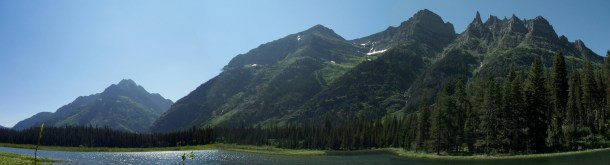
I took the picture on the way to Kootenai Lake in Glacier National Park. Even on a well worn path, there is a limited view of what is behind and ahead. As well, there are many things hidden along the path, there and invisible. There is always a trust in other people and in the path as I move ahead with purpose. Paradox exists in the feeling of certainty in an always uncertain world.
As I reflect on my blogging, I note a significant change in tone, voice, and content. When I began, I did it for the wrong reasons, driven from ego. Transformation is about one’s self.
Thich Nhat Hanh shared the following about the miracle of being alive:
“People usually consider walking on water or in thin air a miracle. But I think the real miracle is not to walk either on water or in thin air, but to walk on earth. Every day we are engaged in a miracle which we don’t even recognize: a blue sky, white clouds, green leaves, the black, curious eyes of a child—our own two eyes. All is a miracle.”
Transforming is not the same as change. Change is always happening, often running below the radar. When something or someone transforms, I bear witness to it or that human. I am pulled up short and take a second look, perhaps more. I become aware of the remarkable change, which is part of a larger, less visible cycle. I am aware of the remarkableness of the world and its inhabitants.
Experiencing metamorphosis is about seeing one’s life in its simplicity and ordinary elements, in the extraordinary. In this way, living is the miracle. Just being aware of what surrounds me and what I encounter is the mindfulness that makes life a miracle.
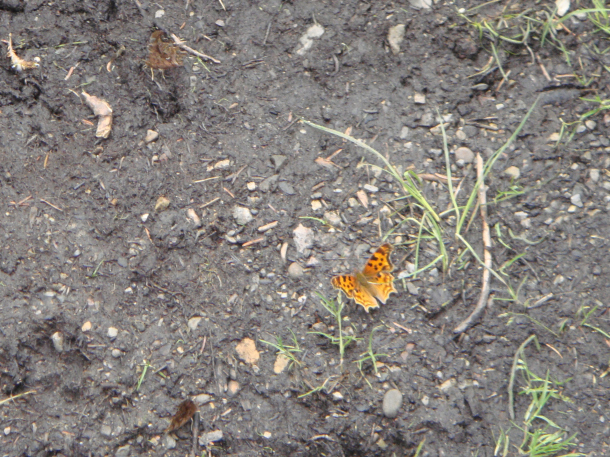
I took this picture of a butterfly. I was aware of its beauty and how it made life fuller.
Humans often set the sacred in opposition to the profane and mundane. In what we might consider of as less sophisticated or mystical traditions, the distinctions are less in evidence. The sacred and profane blend together and are readily experienced in the traditions and daily lives of people. Sophisticated has to do with wisdom (sophia, so who am I to judge what is wisdom in a world I am an outsider to? This stands out to me when I visit Indigenous sites in Alberta and beyond. In ways they are stewards of Nature in ways I cannot be as I do not understand my relationship to Nature in a proper way.
Archaeologists discovered evidence the site was on a migratory path for indigenous people, primarily the Niitsítapi (Blackfoot Confederacy), who used innovative ways to hunt plains bison at least 5500 years ago. A jump or ‘pishkun’ in Niitsítapi used drive lanes marked by rock cairns. The buffalo ran between the cairns and the last part of the drive lane sloped up, making the jump unnoticeable. The process required perfect human timing and was extremely dangerous.
Legend has it the name comes from an unfortunate incident when a young man wanted a closer view of the action. He waited at the base of the cliff. The hunt was successful and, when he was found, he sustained a broken skull and died.
Head-Smashed-In Buffalo Jump is at the confluence of three geological formations. The Rocky Mountains and Great Plains are well-known. The picture below shows the rise into the Porcupine Hills. Young Niitsítapi men transitioned to manhood through a vision quest and went to the hill in the foreground. The hill, with spiritual meaning to the Niitsítapi, does not have public access.
Journeying alone
Enter spiritual space
Questing for adulthood.
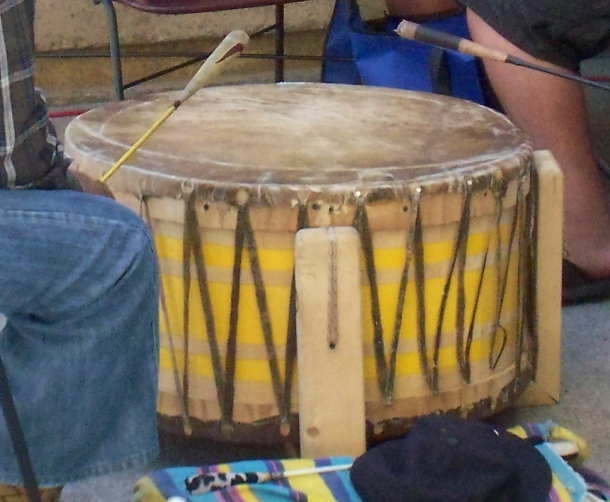
At Smashed-In-Buffalo-Jump’s interpreprative centre, we watched traditional dancing and heard traditional drumming and singing. The drum symbolizes Mother Earth’s heartbeat in Niitsítapi and other indigenous traditions.
Beating hearts gather
Singing, dancing, encircling
Joining as one with Her.
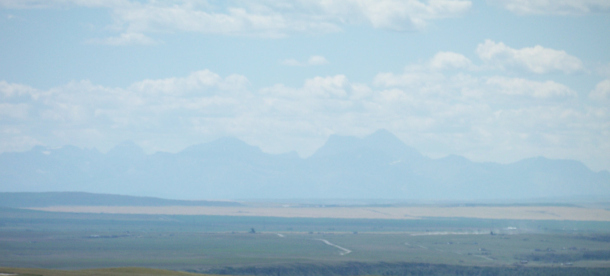
I took this picture as we turned towards Waterton. It was a hot, hazy day, blocking a view of the mountains.
The Niitsítapi meaning ‘original people,’ had their tradtional homes here. The Piikáni (North Piegan), a member of the confederacy, traveled to Waterton’s Blakiston Valley and gathered at Akaitapi (good campsite), providing food, water, and shelter. The area was also used by the Ktunaxa (Kootenay or Kootenai) who traveled from the west, through what is now the Crowsnest Pass.
hot, hazy beauty
shimmering above prairies
block distant bastions.
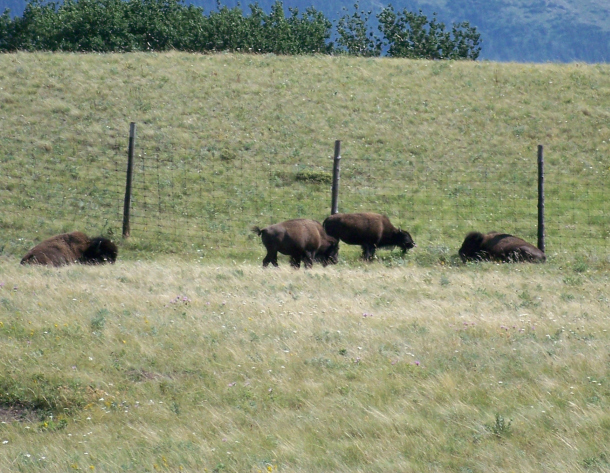
A small herd of bison live in a paddock at Waterton. At one time bison covered the Great Plains of North America. This was literal. People heard them long before they came into view and, when they were visible, it was a mass of brown and black that covered the prairies. Indigenous people used this animals as a ‘walking supermarket’ as almost all its body parts were harvested and usable.
Proud people’s icon
Plains symbol of abundance
Today’s sad sideshow.
We have attended a number of concerts with John Wort Hannam performing. He is from the part of Alberta I highlighted and has a beautiful song about the hills around the area. Enjoy.
Here is a wonderful quote from Abraham Joshua Heschel on how we should live life and, I think, view our neighbours in all their forms:
“Our goal should be to live life in radical amazemement [to] get up in the morning and look at the world in a way that takes nothing for granted. Everything is phenomenal; everything is incredible; never treat life casually. To be spiritual is to be amazed.”
I dip into my photographic archives and poems I wrote around them. Again, this is a trip to Waterton Lakes National Park. It is closed right now. It is interesting to revisit the images and remembrances they stir. It is a reminder of living life in radical amazement, taking nothing for granted.
During the trip, we hiked in an area where there were signs about the possible presence of grizzly bear. Its Latin name is Ursus arctos horribilis. The horrible is an apt description if you end up on the wrong side of one.
When I hike, I wonder what hides from my sight and is quiet as I pass. The dense underbrush path hides things from me, giving them a sense of security. The signs reminded me I am not alone, and our neighbours are not always human.
As luck had it, we saw bear that day. At first glance, this one had the right colouring for grizzly. A closer examination indicated it was missing the tell-tale hump on its back and the wider forehead of a grizzly and was a brown coloured black bear. Behaviour wise it was too close to humans, as it was right next to the road and a hotel. Grizzly are pretty reclusive neighbours.
This one was a black bear for sure. Its colour did not make identifying it a problem. As well, it was smaller. That suggests it was younger, probably born a year before we were there.
Even black bear are dangerous. I tell hockey players I coach about the bear rule to decide on what is appropriate language. I tell them, even with our friends, we don’t know what might trigger a negative (horrible) response. Bear attack about 1 out of 10 times they make contact with humans. We just don’t know which of the 10 times.
Hiking someone’s home
Treading warily, softly
Horribilis‘ habitat.
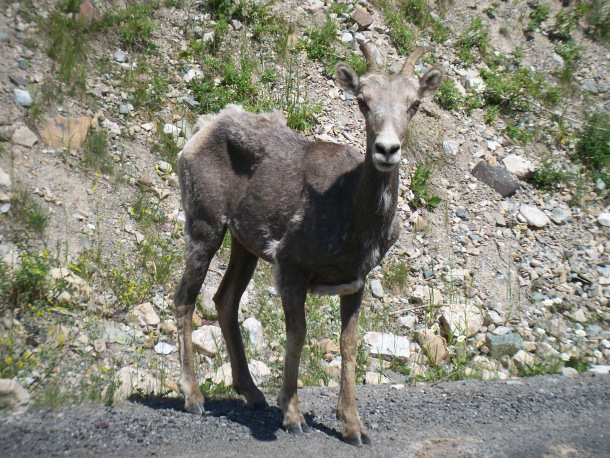
Not all our neighbours are fearsome. This mountain sheep posed for his picture.
I leave you with this poem about neighbours of various forms.
Regardless of where I am, I am in relationship with other humans and the world we share. It is easy to take these relationships for granted. Over the years, I discovered, children and youth embrace differences more readily than adults.
Through the use of satire, made up words, and unusual characters, Theodor Geisel, better known to us as Dr. Seuss, took a stand against bullies, hypocrites, and demagogues. In this way, I think his characters depict pluralism we live in. Yes, there is no Lorax, Yertle the Turtle, or Cat in the Hat, but we can learn to appreciate and defer to their beautiful differences. Even within differences, I find more similarities and common ground with others, a sense of community of humans.
We need this in the world we co-inhabit with other sentient and non-sentient beings. Too often, people who masquerade as leaders tell us to see difference as a problem, to exploit Nature, and to separate ourselves from our better angels. Perhaps our better angels are Thing 1 and Thing 2.
I retrieved the Thing 1 and Thing 2 image from Clip Art Mag.
I took this picture Sunday at the Japanese Friendship Garden. Even in the midst of an urban setting, like Phoenix, we discover spots where nature and humans co-exist in almost perfect harmony. In truth, we are never separate from nature and humans. It is only in our thoughts we are separate, somehow superior. When we are present and mindful, we recognize there are no boundaries.
Here are four of my favourite Dr. Seuss quotes:
Today you are You, that is truer than true.
There is no one alive who is Youer than You.
Don’t cry because it’s over. Smile because it happened.
Unless someone like you cares a whole awful lot, nothing is going to get better. It’s not.
So be sure when you step, step with care and great tact.
And remember that life’s A Great Balancing Act.
 In today’s environment, with calls for greater equity and social justice, it is not enough to ask people to survive with less than living wages, inadequate housing, little or no healthcare, etc. as if that is a major accomplishment. We must allow them to thrive as humans.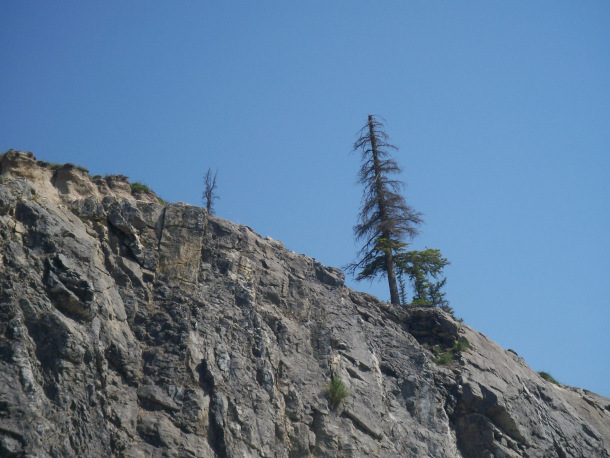






 Teacher as Transformer
