Tag Archives: Leadership. Servant-Leadership

What Do You Plan to Do with Your One Wild Life?

Mary Oliver wrote the beautiful poem The Summer Day. She ended the poem with a question: “what is it you plan to do with your one wild and precious life?” Actually, she included several questions, which are not answerable in any certain way. Life is unpredictable, but what we want to do with it echoes Hans-Georg Gadamer who wrote “desire beyond wanting.” To me, this suggests we each aspire, perhaps can aspire, to something beyond simply knowing and planning. There is more to life than we can plan and predict, yet we can hope.

I think, as important, the question is about vocation and what calls us forward and animates each of our spirits. Thomas Merton and Parker Palmer write about how vocation and voice relate to one another and are how we express who we are in life. Merton goes so far as to say some of us are perhaps destined to search without discovering what calls us.

I wonder, “have we lost this sense of spiritual purpose in the early part of the 21st Century?” We look out there, read the newspapers, follow 24/7 news, etc. and feel deep despair and hopelessness, perhaps even disinterest to follow what beckons. I don’t say this lightly. Two incidents led me to wonder about this. First, at a recent community engagement conference, I was struck by how much despair filled the room. Second, in a private conversation with a parent, they commented how a child was struggling with what exists beyond our individual life. The child is experiencing a sense of despair over this. In part, this is exacerbated because the parents are atheists and feel unable to give guidance in a spiritual way. Finding our voice and who we are is more than an instrumental process of work. It goes beyond to the spiritual essence of who each are and how that brings meaning to our lives and the world.

In the latter setting, I emphasized the idea that we conflate religion and spirituality. One can be deeply spiritual and non-religious and non-theist. One can be religious and theist without being spiritual. The essence of spirituality is to find what calls to me and respond with the qualities of life I want to find in the world. I don’t think those in short supply, but, if we listen to the media, we come away with a different view. At the heart of this, might be the great existential questions poets, like Mary Oliver, ask us.

Who made the world?

Who made the swan, and the black bear?

Who made the grasshopper?

This grasshopper, I mean-

the one who has flung herself out of the grass,

the one who is eating sugar out of my hand,

who is moving her jaws back and forth instead of up and down-

who is gazing around with her enormous and complicated eyes.

Now she lifts her pale forearms and thoroughly washes her face.

Now she snaps her wings open, and floats away.

I don’t know exactly what a prayer is.

I do know how to pay attention, how to fall down

into the grass, how to kneel down in the grass,

how to be idle and blessed, how to stroll through the fields,

which is what I have been doing all day.

Tell me, what else should I have done?

Doesn’t everything die at last, and too soon?

Tell me, what is it you plan to do

with your one wild and precious life?

I include a lovely reading by Mary Oliver of this poem.
A spiritual reflection on the Centenary of Thomas Merton – Part 1

via A spiritual reflection on the Centenary of Thomas Merton – Part 1

Bruce posts wonderful text, accompanied by exceptional images. This post caught my eye as I looked through Bruce’s blog. It is about Thomas Merton and his enduring work as a pacifist, activist and support of inter-faith dialogue.

I read Merton and book about his writings frequently. I grew up in the shadow of Vatican II, which promoted inter-faith dialogue and Merton, Brother David Steindel-Rast, Karen Armstrong, Thich Nhat Hanh, etc. attract me to their work.

I find them to be prophetic and mystical, often signaling challenges we will face long before they are evident to most of us. For example, Bruce included a wonderful quote from a letter Merton wrote to Rachel Carson after reading Silent Spring. Both offered prophetic views, as mystics, of a world to come and challenges we faced in the 1950’s.

I leave you with this quote from Thomas Merton and wish each of you the best. However, we each celebrate we need to share our love for each other and the world we share with each other.

The beginning of love
is the will to let those we love
be perfectly themselves,
the resolution not to twist them
to fit our own image.”
~Thomas Merton

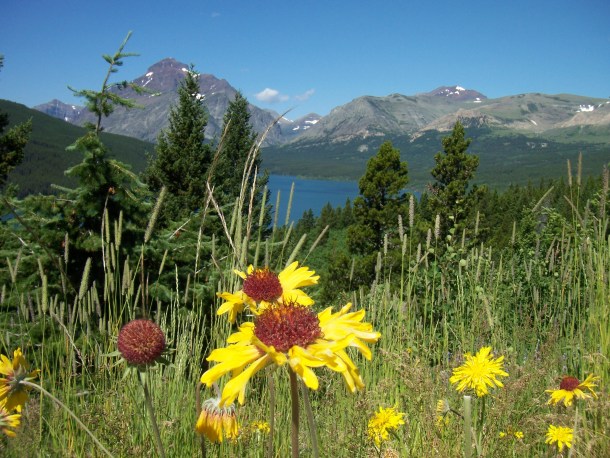
Daffodils, Lake, and Mountain in Glacier

I share this image often. Kathy took it in Glacier National Park. She shared it with me out of love and I share it with my love for the people who will see it and nature we are stewards of, echoing Wendell Berry when we say: We Do Not Inherit the Earth from Our Ancestors; We Borrow It from Our Children

The Other Kingdoms

In my recent reading, I came across this poem by Mary Oliver. I had not read it before, but found it spoke to me in deep ways.

The other day, on Facebook, I came across a Welsh saying: “Dwi wedi dod yn Γ΄l at fy nghoed.” It means returning to my senses/regaining mental equilibrium or more literally I returnto my trees. I understand this as coming back to my roots and being mindful and present for each sentient and non-sentient being I encounter. The word Druid means oak-knower and the Druids lived in harmony and oneness in nature.

Where do I feel most comfortable? The word comfort comes from com meaning surround and fort meaning strength. In other words, living mindfully in the world has ethical implications. In Greek, ethos means character and also how music influences morals, emotions, and behavior.

As I listen to each of the other kingdoms, what music do I hear? How does the music influence and inform who I am, what I say, and what I do? How am I aware of the music and sounds I hear in these kingdoms?

Consider the other kingdoms.Β  The
trees, for example, with their mellow-sounding
titles: oak, aspen, willow.
Or the snow, for which the peoples of the north
have dozens of words to describe its
different arrivals.Β  Or the creatures, with their
thick fur, their shy and wordless gaze.Β  Their
infallible sense of what their lives
are meant to be.Β  Thus the world
grows rich, grows wild, and you too,
grow rich, grow sweetly wild, as you too
were born to be.

I took this picture several years in Jasper National Park. Kathy and I had gone for an early drive and hike. We parked and took pictures. As I turned, I thought I saw something move and walked towards the movement. The cow elk sat and chewed her cud. She was aware of us and, as I approached, I heard the soft sounds she made in completing the digestive process.

We pointed her out to others and cautioned them to be careful and quiet as they approached her.Β  After all, we are strangers in those other kingdoms.


Look, the trees…..

via Look, the trees…..

I have been offline for the past week, as we moved into our new house, which is located on the same lot we lived on before. We still do not have Internet, so I go to a local coffee shop once a day and sometimes every other day to catch up. Purple Rays provided a wonderful post to get back in the groove.

When we bought our house 40 years ago, it came with two relatively large spruce trees in the front. Those remain in place as proud sentinels and, as Mary Oliver describes trees in to the new houses we build on the same lot, one for Kathy and I and the other our youngest son built.

We chose to stay and build for several reasons. First and foremost, it gave our son a chance to have his own house. Second, we enjoy the community we live in and have been part of the fabric of it for 40 plus years. It is an area of Edmonton that has tremendous stablity despite the rapid growth of the metro area. We have neighbours who have lived in this community longer than we have.

The house on the left is our house and the one on the right is our son’s house as the trees stand guard.


Behind your image…

via Behind your image…

Natalie‘s beautiful image and John O’Donohue‘s wonderful blessings serve as reminders that life is to be lived in extra-sensory ways. It is about the mystery we cannot see, touch, and feel about how a flower simply exists to be a flower..

When I have faith in more than what I experience and the mysteries of what that means in life, I feel free to live life and embrace the mysteries of living. Sometimes, it is the simplest forms that escape our attention. It reminds me of the following quote from Meister Eckhardt, which can mean more in a person’s than I can ever know.

β€œIf the only prayer you said was thank you, that would be enough.”

Thanking others as part of being alive and aware of their presence is a simple and profound prayer.

Take Sides

Source: Take Sides

The link is to a quote by Elie Wiesel, a Holocaust survivor and Nobel Peace Prize winner. He is not referring to taking sides over a game. Instead, he speaks to taking sides when we witness wrong-doing and immoral acts. His book Night is a worthwhile reading.

I remind other Christians Jesus reached out to those who were most in need, living on the margins of society. He ate with sinners and tax collectors and stood up against the Pharisees and scribes (Luke 15:1–4) and (Romans 3:23).

We each have to decide what we is immoral and moral. It is not upholding abstract laws and rules, but the spirit of doing what is proper. I did not use the word right or correct . When I do, I fall into a trap of checking a binary box of right or wrong. Instead, I ask “is this proper?” In French, this is a matter of comportment and conduct.

I think the last sentence in the quote are important, worthwhile repeating. It is worth spending time whiling and linger over the words and the depth of their meaning, from a person who suffered and witnessed unthinkable human tragedy perpretrated by other people. “Whereever men and women are persecuted because of their race, religion, or political views, that place must — at that moment — become the center of the universe.”

I am not a big believer in thinking about my legacy, whatever that might be, but I want to be remembered as someone who stood up and spoke out against the wrong done to other people.

Fluent

I am on the road the next two days so I am tired at the end of relatively long day. John O’ Donohue‘s poetry has a light feel to it, much like a small river that flows easily along its way.

He often wrote blessings and a blessing is something that catches us by surprise. It unfolds in surprising ways, never taking the same path twice. Like the river and, as expressed by Heraclitus in his quote: β€œNo man ever steps in the same river twice, for it’s not the same river and he’s not the same man.”

We cannot live the same moment twice, because we cannot return to it and, even if we could, we would not be the same person. We would return with an understanding of what it meant to step in the river in the first place.

The beauty of living is filled with the richness of uncertainty and complexity. The best we can expect is to be mindful of each moment as we live in it and as it unfolds.

I would love to live

Like a river flows,

Carried by the surprise

Of its own unfolding.

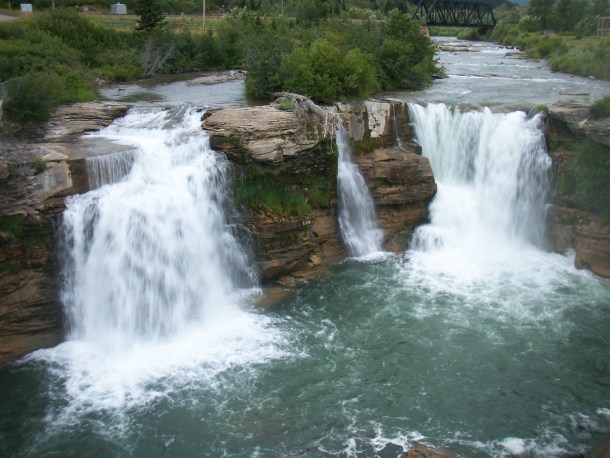
We took this picture several years at Lundbreck Falls. Today, I drove past them and, like me, the river has changed.

Merry Christmas Everyone

You already possess everything necessary to become great. source: Crow image: Eddie’s Image Collection editor’s note: this is a repost from ETH December 2015 β€œHappy Holiday Everyo…

Source: Merry Christmas Everyone

When I saw the picture and quote in this post, they reminded me how much we have in common with each other. Instead of a politics of fear and division, can we can live in peace and harmony as stewards who care for each other, the world, and the future generations we live that world to?

A Light Breather

Theodore Roethke wrote poems that attempted to connect the inner and outer worlds we inhabit simultaneously. While exploring the outer world, it is important we find quiet in the inner world. In those quiet moments, moving back and forth we find ourselves staying.

The metaphor comparing this movement to that of a snail challenges me to think deeply about what living and breathing mindfully is. What do I notice? And, who and what notices me? As I move, am I sensitive to the world that I move through? Or, do I walk heavily chasing those who which to join me away?

The spirit moves,
Yet stays:
Stirs as a blossom stirs,
Still wet from its bud-sheath,
Slowly unfolding,
Turning in the light with its tendrils;
Plays as a minnow plays,
Tethered to a limp weed, swinging,
Tail around, nosing in and out of the current,
Its shadows loose, a watery finger;
Moves, like the snail,
Still inward,
Taking and embracing its surroundings,
Never wishing itself away,
Unafraid of what it is,
A music in a hood,
A small thing,
Singing.

The Invitation

I am not familiar with Oriah Mountain Dreamer’s poetry, but, when I found this poem, it reached out and called me.

What questions do I ask myself, that I cannot answer. There is an eloquence in those questions that leads me to new questions, without knowing the answers. When I sense the world in one way or another, I am unable to sense it in any other way.

What if I live the wildness of life and I allow myself some abandon, not carelessness? I can dance with that wildness and not care about what others may think, hopefully making the world a better place.

When we open our hearts to the other, their standing in life is about who they are as a person rather than what identifies them: their job, their age, where they live, etc. When we open our hears to the other, it is an invitation to be human and humane with them.

It doesn’t interest me what you do for a living.

I want to know what you ache for and if you dare to dream of meeting your heart’s longing.

It doesn’t interest me how old you are.

I want to know if you will risk looking like a fool for love, for your dream, for the adventure of being alive.

It doesn’t interest me what planets are squaring your moon.

I want to know if you have touched the centre of your own sorrow, if you have been opened by life’s betrayals or have become shriveled and closed from fear of further pain.

I want to know if you can sit with pain, mine or your own, without moving to hide it, or fade it, or fix it.

I want to know if you can be with joy, mine or your own; if you can dance with wildness and let the ecstasy fill you to the tips of your fingers and toes without cautioning us to be careful, be realistic, remember the limitations of being human.

It doesn’t interest me if the story you are telling me is true.

I want to know if you can disappoint another to be true to yourself. If you can bear the accusation of betrayal and not betray your own soul.

I want to know if you can see beauty even when it is not pretty every day.

And if you can source your own life from its presence.

I want to know if you can live with failure, yours and mine, and still stand at the edge of the lake and shout to the silver of the full moon,

β€œYes!”

It doesn’t interest me to know where you live or how much money you have.

I want to know if you can get up after the night of grief and despair, weary and bruised to the bone and do what needs to be done to feed the children.

It doesn’t interest me who you know or how you came to be here.

I want to know if you will stand in the centre of the fire with me and not shrink back.

It doesn’t interest me where or what or with whom you have studied.

I want to know what sustains you from the inside when all else falls away.

I want to know if you can be alone with yourself and if you truly like the company you keep in the empty moments.