Tag Archives: Parker Palmer

Christmas Spirit Each Day

Theologian and civil rights activist, Howard Thurman shared the following poem in a sermon reminding me Christmas is not a one day event. It is part of the daily ceremony and ritual I should undertake. It reminds me some usurp Christmas as a neo-liberal, market agenda that changes a deeply spiritual event into profiteering.

“Where refugees seek deliverance that never comes,
And the heart consumes itself, if it would live,
Where little children age before their time,
And life wears down the edges of mind,
Where the old person sits with mind grown cold,
While bones and sinew, blood and cell, go slowly down to death,
Where fear companions each day’s life,
And Perfect Love seems long delayed.
CHRISTMAS IS WAITING TO BE BORN;
In you, in me, in all humankind.”

Jesus and his family were humble refugees from humble backgrounds. Regardless of material wealth, we each come from and return to humble backgrounds. In between, I can seek deliverance, age with grace, and retain a daily Christmas spirit. Without it, hearts harden, minds ossify, fear is a constant companion, and there is a lack courage (in French, coeur is part of the etymology of courage) to act and speak out against those who treat humans as chattel dealt with as objects. With a daily Christmas spirit, I engage in I-Thou relationships, without judging, qualifying, objectifying the other. Martin Buber proposed the key to creating society that is nourishing, empowering and healing for everyone lies in how we relate to one another.” 

It takes considerable effort to overcome the divisiveness we currently live with and listen, with open hearts, to others who share views of the world different than ours. In On the Brink of Everything, Parker Palmer describes how he felt anger towards others who voted differently than he did. By the time the book was published, he described how it was important to understand that people did so because they felt left behind in various ways.

Here is Healing Time by gospel and blues singer Ruthie Foster, which seems appropriate in today’s day and age. How do we heal and make whole?

Christmas 2024

This is the time of the year to have dreams of a more just and humane world. Dreams are the land of hope and Christmas is the perfect time to be a dreamer. This brings to my mind the lines from Imagine by John Lennon:

You may say I’m a dreamer
But I’m not the only one
I hope someday you’ll join us
And the world will be as one

Several years ago, I read an essay by Parker Palmer reminding me of the miracle of Christmas. As a child growing up in Northern Alberta, Christmas was a time of wonder. Christmas was not the neoliberal, market-driven affair of today. It was a time to re-member the deepest messages of the time of year.

Parker posted on Facebook about an experience in Nogales Mexico at a refuge for asylum seekers and pointed out Jesus was likely a person of colour born into the Jewish faith. In this sense, I understand Jesus’ birth as one transcending one particular faith.

Part of my academic journey this year was writing a potential chapter on nonviolent education. I read The Raft is Not the Shore, which was a conversation between Thich Nhat Hanh and Daniel Berrigan. They described how They, the Buddhist monk, engaged in communion and how the Jesuit priest reveled in learning more about Buddhism. In our polarized and divided world, this type ecumenism and communion (entering into intimate relationship with each other) with each other has fallen by the wayside.

I wrote the following poem several years ago and am drawn back to it. I hope it captures Christmas in a way that reaches out and touches what we share in common with each other: our humanness and journey seeking refuge at various times

Carpenter guiding,

Expectant mother riding,

Backs straight; heads high–

Donkey serving as regal carriage.

Seeking refuge in the night–

Giving birth in a stable,

Swathed and cradled in a manger,

Beasts welcoming the child.

Showering gifts upon us–

Returning each year,

Lighting the way–

Only asking, “Can you open your hearts?”

Source of strength and courage,

Our turn to humbly receive gifts,

Restocking spirits,

Rejuvenating souls.

For several years, Kathy and I attended concerts by Canadian singer and actor Tom Jackson. The proceeds went to support local food banks and we took something extra with us to share.

He sings a beautiful version of Huron Carole, which points to the ecumenical and communal nature of Christmas. It echoes Parker’s re-membering “the story, the music, the candlelight, the scent of pine, the silent night, the warm presence of family and friends.”

For me, Christmas is sharing time with family, friends, and expressing kindness to those who we don’t know. It is a 365 day process as opposed to a run up to a one day event.

Hope

“Hope” is the thing with feathers –

That perches in the soul –

And sings the tune without the words –

And never stops – at all –

And sweetest – in the Gale – is heard –

And sore must be the storm –

That could abash the little Bird

That kept so many warm –

I’ve heard it in the chillest land –

And on the strangest Sea –

Yet – never – in Extremity,

It asked a crumb – of me.

Emily Dickinson wrote this poem and, although hope is fragile, it has the potential to always be with each of us. Even in the most difficult and inclement times, hope can keep us warm.

More than at any other time in my life, I try to find hope particularly in the small everyday things. I might call those things banal. I often use the opening lines of the poem in writing, publishing, and presenting, which is related to hopeful and nonviolent pedagogy and can be found at Academia.

When I look closely and am mindful of my words and actions, I find seeds of hope in my life that make a change for those closest to me and, in turn, hope they and I nurture those seeds. As bell hooks and Thomas Merton wrote, we enter into communion to take us beyond words and speech. It is an intimate and loving way of being together, sharing, and communicating.

Today, I read Carrie Newcomer‘s Substack essay and the lyrics to her song Sanctuary. What do we do in moments of despair. In a conversation with her friend and mine Parker Palmer, she received the following advice. There are times we march and speak out. Other times, we seek sanctuary, gathering with those we love and respect to share our stories and encourage each other. The word courage comes from the French coeur, meaning heart. What we do is heartfelt as we share the hurt we feel with each other in moments of compassion, the sharing of what we love and the suffering as we look at how it might be overturned. We are not alone. We need to lean on each other and take appropriate action and speak appropriate words even to those we disagree with. Take heart and retain hope in trying times by looking for those people and things that give us hope on a daily basis.

I leave you with Sanctuary by Carrie Newcomer.

Have a Dream-Filled Christmas

It has been awhile since I posted.

This is the time of the year to have dreams of a more just and humane world. Dreams are the land of hope and Christmas is the perfect time to be a dreamer. This brings to my mind the lines from Imagine by John Lennon:

You may say I’m a dreamer
But I’m not the only one
I hope someday you’ll join us
And the world will be as one

Several years ago, I read an essay by Parker Palmer reminding me the miracle of Christmas. As a child growing up in Northern Alberta, Christmas was a time of wonder.

Parker posted on Facebook about an experience in Nogales Mexico at a refuge for asylum seekers and pointed out Jesus was likely a person of colour born into the Jewish faith. For me, Jesus’ birth is an ecumenical event.

I wrote the following poem several years ago and am drawn back to it. I hope it captures Christmas in a way that reaches out and touches what we share in common with each other: our humanness and journey seeking refuge at various times

Carpenter guiding,

Expectant mother riding,

Backs straight; heads held high–

Donkey serving as regal carriage.

Seeking refuge in the night–

Giving birth in a stable,

Swathed and cradled in a manger,

Beasts welcoming the child.

Showering gifts upon us–

Returning each year,

Lighting each way–

Only asking, “Can you open your hearts?”

Source of strength,

Our turn to humbly receive gifts,

Restocking spirits,

Rejuvenating souls.

For several years, Kathy and I attended concerts by Canadian singer and actor Tom Jackson. The proceeds went to support local food banks and we took something extra with us to share.

He sings a beautiful version of Huron Carole, which points to the ecumenical nature of Christmas, Christ’s Mass, echoing Parker’s (re)membering “the story, the music, the candlelight, the scent of pine, the silent night, the warm presence of family and friends.”

For me, it is food and opening a present on Christmas Eve. Food included French-Canadian tourtière (meat pie), which Kathy and I continue to share with our children and grandchildren.

Merry Christmas

It has been awhile since I posted.

The other day someone told me I was an idealist. I think they meant as a put down. I took it as a compliment. After all, many schools of philosophy and their philosophers are dreamers.

Somehow, having dreams of a more just and humane world is not realistic. It reminded me of what Christmas might mean to someone who is a dreamer and lines from Imagine by John Lennon:

You may say I’m a dreamer
But I’m not the only one
I hope someday you’ll join us
And the world will be as one

Several year ago, I read an essay by Parker Palmer that reminds me the miracle of Christmas. It reminded me how, as a child growing up in Northern Alberta, Christmas was a time of wonder I could not explain and try not to as an adult.

Parker posted on Facebook about an experience in Nogales Mexico at a refuge for asylum seekers. Asylum is another word for seeking refuge. He pointed out Jesus was likely a person of colour born into the Jewish faith. For me, his birth is an ecumenical event.

I wrote the following poem several years ago and am drawn back to it each year. I hope it captures Christmas in a way that reaches out and touches each of what we have in common: our humanness and we are a journey seeking refuge at various times

Carpenter guiding,

Expectant mother riding,

Backs straight; heads held high–

Donkey serving as regal carriage.

Seeking refuge in the night–

Giving birth in a stable,

Swathed and cradled in a manger,

Beasts welcoming the child.

Showering gifts upon us–

Returning each year,

Lighting each way–

Only asking, “Can you open your hearts?”

Source of strength,

Our turn to humbly receive gifts,

Restocking spirits,

Rejuvenating souls.

For several years, Kathy and I enjoyed Canadian singer and actor Tom Jackson.

He does a lovely rendition of Huron Carole, which I share below. Again, this points to an ecumenical nature of Christmas, Christ’s Mass, echoing Parker’s (re)membering “the story, the music, the candlelight, the scent of pine, the silent night, the warm presence of family and friends.”

For me, it is also food and opening a present on Christmas Eve. The food included traditional French-Canadian tourtière (meat pie), which Kathy and I continue to share with our children and grandchildren.

Merry Christmas

It has been a couple of weeks since I posted and offer this poem.

Today, I read a short piece written by Parker Palmer that reminds me the miracle of Christmas is in the incarnation of God in human form. His essay reminds me of how, as a child growing up in Northern Alberta, Christmas provided a sense of wonder I could not explain and try not to as a rational adult.

Parker also posted on Facebook an event he experienced last year in Nogales Mexico at a house for asylum seekers. Asylum seekers is another way of saying they were seeking refuge. He points out Jesus was likely a person of colour. I take it one step further and point out he was a Jew and born into that faith. His birth was an ecunemical event, not a Christian one.

Carpenter guiding the way,

Expectant mother riding,

Backs straight; heads held high–

Donkey serving as regal carriage.

Seeking refuge from the night–

Giving birth in a stable,

Swathed and cradled in a manger,

Beasts welcoming the child.

Showering gifts upon us–

Returning each year,

Lighting the way–

Only asking, “Can you open your hearts?”

Source of strength,

Our turn to humbly receive gifts,

Restocking spirits,

Rejuvenating souls.

Kathy and I enjoyed Canadian Indigenous singer and actor Tom Jackson. Most years, he tours at this time of year and helps food banks. In the midst of Covid, we each have to find ways to share with those in need.

He does a lovely rendition of Huron Carole, which I share below. Again, this points to an ecunemical nature of Christmas, Christ’s Mass, echoing Parker’s remembrance of “the story, the music, the candlelight, the scent of pine, the silent night, the warm presence of family and friends.” For me, it was also the food and opening a present on Christmas Eve. The food included traditional French-Canadian tourtière (meat pie), which Kathy and I continue to share with our children and grandchildren.

Being Alive

I originally wrote this on Bowen Island, attending an Art of Hosting retreat. It reminded me of the counter cultural nature of Parker Palmer’s writing and events focused on his work. It is about communicating and seeing others as fully human.

In today’s divided world, this seems countercultural. An essential element to hosting and dialogue is listening to others in respectful ways. It does not mean we agree with them. What it means is we are open and listen to hear how they experience living their life, guided by one’s conscience and sense of values that ground us. Values give each of us strength, anchoring us and letting us understand what is proper and improper.

When we invite people into conversation, listen deeply, and ask questions which shake our certainty about the world we turn inward and focus on what grounds us to respond to them and help heal a hurting world.

Perching pensively–

Holding pen tentatively;

Senses coming,

In the midst of nature’s beauty.

Awakening–

Becoming aware;

Listening deeply;

In the midst of sounds flowing.

Breeze caressing gently–

Sunlight bathing softly;

Basking in these moments,

Resting in peace.

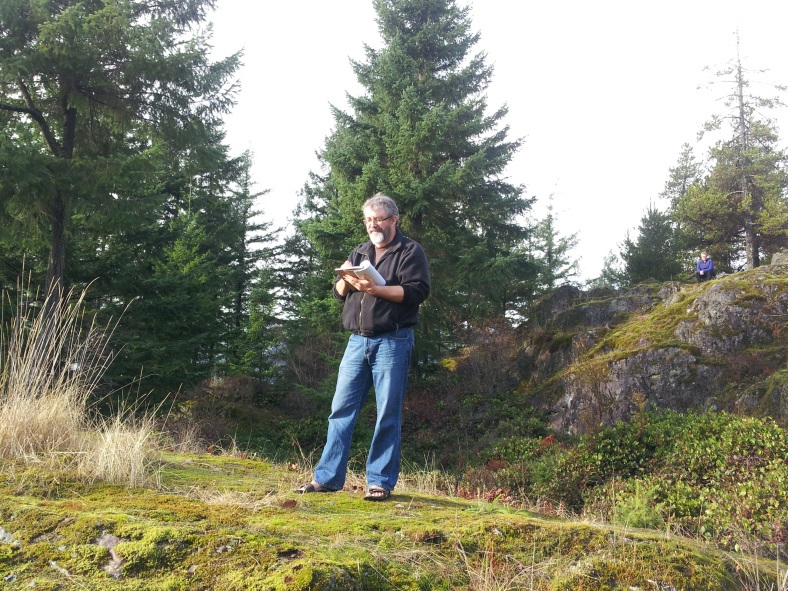
A colleague took this picture of me on top of Cates Hill on Bowen Island as I wrote and they were gracious enough to share it with me. It is spectacular with water and land in the panoramic view.

Gettin’ My Mojo Back

I looked at this poem a month ago and decided not to post it. As I listened to music today, a song came on called Getting My Mojo Back and felt it was time to post it.

I wrote this during a retreat on Bainsbridge Island based on the work of Parker Palmer. It was at a time I was wrestling with staying in teaching due to the politics. I felt I was not giving it my all and lacked confidence in my teaching.

During the retreat, I reflected and had candid conversations with others and concluded it was time to control what I could control. Interestingly, it was in the conversations with others that I had to choose to be all in really came to the forefront. I went back to my classroom, spent another 5 years teaching, and giving it my all.

I think, when we lose confidence, we do not realize it. It sneaks up on us, rather than being a cataclysmic shift. Recovering confidence is similar. It is done in small steps and realizing we are not alone in the moment.

I had to realize anger was born out of fear and loss. Once I acknowledged this, I was at ease with letting go and moving forward.

It just happens–

Letting go;

Speaking without anger–

Embracing one’s sadness;

For what is lost.

Staring into an abyss–

Sitting with unformed questions;

Terrifying darkness–

Sensing incompleteness,

Feeling uncertainty.

Taking stock–

Looking inwards;

Accepting extended hands–

Discarding baggage

Moving towards a place of light.

Mojo gaining momentum–

Emerging at its pace;

Creating healing space–

Living one’s own truth;

Living in each moment’s question.

I attended a John Lee Hooker concert in 1972 or 1973. I grew up listening to jazz, gospel, folk, and blues with traditional country, early rock and roll. I took it for granted that I attended a John Lee concert until an American, who shared a love for the blues, told me he never did. African-American performers toured in Canada on a regular basis at a time they did not have that same ease of movement in their own country.

When I used Langston Hughes’ poetry in my teaching, I remembered he wrote from a different understanding of what America was. This was an outgrowth of an awareness of my privilege as a white Canadian male.

From the Margins

When I traveled to attend events based on the writings of Parker Palmer, two gifts emerged. First, the settings chosen were beautiful and peaceful, with considerable access to being able to walk. Second, along with the time outside, there was considerable time to reflect in solitude and with those gathered. Part of the reflection, was to listen as one spoke and hear, as if for the first time, what one was/is saying.

I wrote the following poem after time reflecting on my pedagogic practices. I taught in a setting that required me to be present and I was falling short and, as a result, letting students, families, and myself down.

Over time and without realizing it, I had fallen into habits of just doing things the way I had before. I experienced a false sense of security in my teaching. This was something I promised I would not do when I entered teaching.

To teach, I felt I had be on the margins and be awake to each student and their particular needs, listening to what they and their families told me about them. The margins are what surround us. Too often, I wanted to be in the centre of things, where I was comfortable and the centre of things. I don’t learn much there.

sensing false security,

being the centre,

yet, margins surrounding–

paradox of one’s being.

standing out,

revealing blemishes,

making them obvious–

reveling in them.

finding comfort on the margins,

not hiding in the crowd,

reflecting one’s character–

stepping out and away with pride.

composing one’s humanness;

in deep concert with others,

sharing perfect imperfections–

enriching human moments.

This took some doing to edit the final poem, but here it is. I chose the picture, as it is a reminder that nature does not provide perfection. It provides perfection in imperfect patterns that emerge.

In nature, trees like the ones in the picture find a way to survive. Despite their lack of size, these trees are at least 100 years old and have survived, one might say thrived, living on the margins. They have a wonderful view from a precarious vantage point.

September

I realize this welcoming of September is a couple of days late.

When I walk in the river valley at this time of the year, the changes in nature become noticeable. Before I notice the colours changing, I smell the decay as leaves fall. This is noticeable if it rains, which it has been for the last week or so. It cools the evenings and nights, accelerating the pace of change.

The decay is a necessary part of nature. It is part of the cycle of birth, life, harvest, and rest essential to health. Parker Palmer writes beautifully about this in several places. Nature reminds us we need to prepare for rest in a meaningful way, gathering our whole self in the process. It is about eloquent questions. What have I birthed and nurtured during the spring and summer months that I harvest to help sustain me in the winter months? How am I letting my Spring and Summer ready me for Autumn and Winter?

Leaves tumbling,

Time for slumbering.

New colour vivifies,

Nature electrifies.

Summer falls,

Equinox calls.

Season to rest,

Reflect on harvest.