Tag Archives: Parker Palmer

A Book Lover’s Tag

via A BOOK LOVER’S TAG 

Diana passed on a tag and posed 13 questions to her followers with this re-blog. The best part of the her post was the John O’Donohue blessing about how our words make the invisible visible through our personal artistry and creativity.

  1. Do you have a favourite place to read? No, I read everywhere but in vehicles.
  2. Do you use bookmarks or random pieces of paper? I use both and more. I turn corners, highlight, and use sticky notes with notes.
  3. Do you eat or drink while you read? I drink tea, but rarely ever eat while I read.
  4. Do you listen to music or watch TV? There always seems to be music playing, but I find the TV distracting. Music fades into the background.
  5. Do you read one book or several at a time? I do both. I find reading one book helps me focus, but I cannot help reading more books.
  6. Do you prefer reading at home or elsewhere? There is a small coffee shop a few minutes from the house. The baristas and owners welcome me almost each day.
  7. Do you read silently or out loud? I read silently most of the time, but, when I read something of particular interest, I read it to Kathy. I enjoy reading to our grandson when we visit with him.
  8. Do you read ahead or skip about? I skip about. I like to read the index in a book and see who references are if it is a book I use for my writing. I cheat and read ahead in non-fiction.
  9. Do you break the spine or treat it like new? I buy many of my books used, so they come well used. If I get a new book, I mark it up inside, but treat it like new.
  10. Do you write in books? I mark them up with a felt marker and make notes for future reference. The exception is when I read non-fiction and poetry.
  11. What books are you reading now? I am reading The Company of Strangers by Parker Palmer.
  12. What is your childhood favourite book? I don’t have one, but I remember reading Little Golden Books and having them read to me as a special part of my early reading.
  13. What is your favourite book of all time? That is like choosing who my favourite child is. I think it depends on mood and time. I enjoy great poetry i.e. Mary Oliver and Wendell Berry. I read books about spirituality i.e. Parker Palmer. I read about education i.e. William Pinar, John Dewey, and Madeline Grumet. I read about philosophy i.e. Aristotle, Hannah Arendt, and Paul Ricoeur. My favourite fiction writers are John D. MacDonald and Paulo Coehlo.

 

Take a Knee

I begin this post with two points. First, I am not American. I spend time in the US and enjoy my time there. One thing I enjoy, and I shared with my students, is the way Americans respond to their National Anthem. Second, Canada, where I live, has social and historical skeletons in the closet i.e. residential schools.

My aim is not to pass judgment, but to cast a different light on what it means to take a knee. In a world that is increasingly secular, perhaps I lose my way in what it means to live in a spiritual way and it can mean many things to different people.

The image that comes to mind when I think of is people kneeling and standing at the foot of the cross of the crucified Jesus. We were not there, but we are told his friends, family members, and followers knelt and stood. It seems there was no one right way.

When Colin Kaepernick first took a knee, I thought of it as praying. The etymology of prayer is to ask earnestly, to beg, and to entreat. Prayer is asking someone i.e. God or something bigger i.e. Universe or a nation than I am to intercede in a concern to me.

To genuflect is to kneel, usually with one knee. It is an act of worship and respect. Parker Palmer wrote about fidelity as something other than mere loyalty. It is loyalty to an obligation, cause, and idea one holds dear.

Who or what one asks depends on one’s spiritual and religious background. What I understand is that there are no fixed answers when I take a knee and pray. I have to listen. Part of praying is silence, listening to what Parker Palmer calls my inner voice. It is only in moments of silence, whether kneeling, standing, or walking, that I hear that inner voice.

I pray in various ways and have since I was a child. When I enter a church, I find holy water, bow to the cross, and complete the sign of the cross. I stand. As I enter a pew I genuflect, taking a knee. I do so with two surgically repaired knees. At times before, during, and after service, I kneel, I pray, and I listen to what my heart says. Other times, I stand. During the Lord’s prayer, I stand and join hands with others asking God to intercede on each of our behalf. As I receive communion, I walk slowly and quietly, bowing my head as I accept the host.

For me, kneeling, standing, and walking quietly show my fidelity to a cause and purpose larger than me. In this case, it is plight of people and our shared humanity. I make a point of being quiet, because it is a time of thoughtful meditation and mindfulness of how the world and I are broken. I beseech someone or something larger than me to intercede and, as Parker Palmer says, to make whole the broken.


The Real Work

I was laid up for the last few days. I have allergies and this time of the year is always a challenge. I think I picked up a bug to give me a double-whammy. I slept a good part of Friday and Saturday and, on Sunday, was upright for most of the day.

I am not sure if I will post later. While sitting upright and not doing much else on Sunday, this Wendell Berry poem kept poking at me.

Living is paradoxical. Parker Palmer described how this creates tension in living. Just as we think everything is as it should be, something pokes at us and unsettles us, calling on us to begin our real work and commencing the real journey. Being mindful and attentive remind us to be still and look below the surface of what is happening.

It may be that when we no longer know what to do
we have come our real work,

and that when we no longer know which way to go
we have come to our real journey.

The mind that is not baffled is not employed.

The impeded stream is the one that sings.

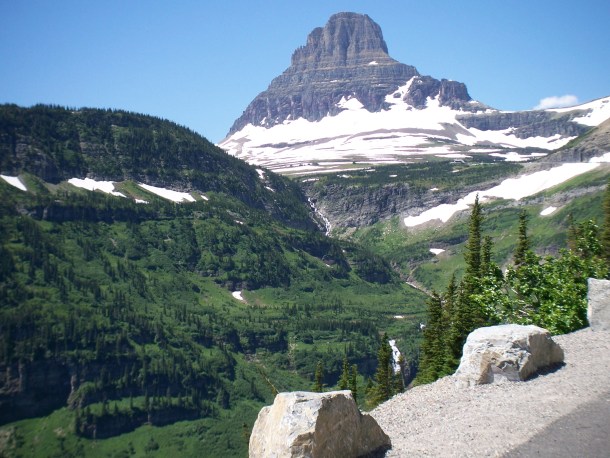
This is Athabasca Falls. The river upstream is quite wide and as it comes around the corner suddenly narrows. In Wendell Berry’s poem, it is impeded and creates a great force that carves out solid granite.

Driftwood

I am back. The retreat was enjoyable and tiring. Although it was called a retreat, it was different in the sense that it involved research, writing, and lots of conversation. I find retreats invigorating. They are not sit, listen, and try taking notes as a speaker blasts through their presentation.

Retreats have a conversational part. Parker Palmer counsels people at his retreats not to take notes. Instead, we spend time writing and conversing how we feel about various prompts. That was a purpose of this retreat. It is the Currere Exchange.

Currere is the etymological root of curriculum, meaning to run the course of one’s life. It is a subjective way of interpreting a planned curriculum in a school. Whether teachers understand it or not, they are doing this continuously. As one of my co-researchers told me we make decisions about what to teach and leave things out we really like.

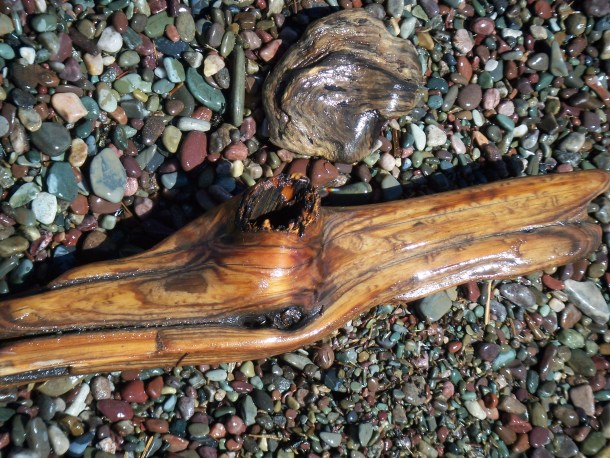
In a sense, currere is polishing a planned curriculum. It is a multi-faceted and complicated conversation between a person (re)membering their lived-experiences, aspire to a particular way of teaching in the future, and synthesize those two moments into the present. Each moment acts as a curriculum to inform the other, complicating one’s teaching in a dialogic way. Others enter the classroom and add to the complicated nature of the conversation, each adding their curriculum to the dialogue. It is like a piece of driftwood, being polished by the forces it comes in contact with.

My story being polished,

I (re)member and imagine;

Washed up on a new shore,

Who I am reflected anew.

I am a character in my story,

I pause a moment,

Noting lustre and matte,

Interpreting new meanings.

Soaking in the contours of living,

Experiencing new awakenings,

Running the course of my life,

Each new moment polishing me afresh.

Kathy took this picture in Waterton Lakes National Park.


Silver Star

When I looked for a poem, this one by William Stafford found me. Mountains appear to be immovable and unchangeable, yet as people do they do so without immediate notice. Yet, when we revisit them, we realize the changes that occurred.

In the case of teachers, Parker Palmer speaks about asking the question “who is the self who teaches?” We are each teachers in our own particular ways, so asking this question is essential. We often overlook this question in pursuit of easier to answer questions about the what, when, where, why, and how.

When we ask who we are, we explore the values that anchor us in living life. In times of crisis, those values guide us and help us through those tough times. Attending to them in mindful ways each day as a gardener would her/his garden grounds us in them in times of real need. They have spiritual meaning that come to life in living and expressing them daily through who we are as a human being.

If we serve our values well, “we will hear the world say, ‘Well done.'” The patience of living a good life, which in Aristotle‘s terms, is indefinable will be the reward. Like a mountain guiding us on our journey, the values we live and express guide us and others on a shared journey.

To be a mountain you have to climb alone

and accept all that rain and snow. You have to look

far away, when evening comes. If a forest

grows, you care; you stand there leaning against

the wind, waiting for someone with faith enough

to ask you to move. Great stones will tumble

against each other and gouge your sides. A storm

will live somewhere in your canyons hoarding its lightning.

If you are lucky, people will give you a dignified

name and bring crowds to admire how sturdy you are,

how long you can hold still for the camera. And some time,

they say, if you last long enough you will hear God;

a voice will roll down from the sky and all your patience

will be rewarded. The whole world will hear it: “Well done.”

Breath, You Invisible Poem

Rainer Maria Rilke compared a poem to living and who we are each becoming as a person. We each experience continuous and invisible interchange between who we are and the world beyond our seeing.

Parker Palmer compared this interchange to a Möbius strip and, when we place our fingers on the strip, we slide them in and out without lifting them. There is a rhythm to this movement, like a tide moving in and out from the beach continuously shifting the sands.

Each of our place in the cosmos is small, but I think essential to the cosmos. It is in the mindful interchange with the cosmos, being present to one another, imprinting ourself on the cosmos in a unique way that makes us each irreplaceable. We cannot see what that will mean, only experiencing it by being present and attentive to each breath we take.

Breath, you invisible poem!

A constant interchange between our clear being

and the world space beyond our seeing

in which I rhythmically become.

Solitary wave whose

gradual sea I am.

Of all possible seas you are parsimonious,

winning the cosmos, with me one gram

in it. How many realms of space have been

inside me already! The multiple wind

is like my son.

Air, do you know me? You are full of places

once mine. A uniquely smooth rind,

a leaf of my words among roundnesses.

The Archer’s Need to Win

To just be in the moment and be present to what one is doing takes us beyond the need to win and not lose. In the last line of this poem, Chuang Tzu reminds us that the need to win or not to lose drains the archer of his power.

Several years ago, we visited our son and his family. At the time, our grandson was about 5 months old. We went for dinner our last evening and, after I finished eating, I took him. I was in front of a mirrored wall. When he noticed there was a little boy in the mirror, our grandson played with that little boy for about 5-10 minutes, until he became tired. He had no other goal than to play and just be in that moment.

We lose that childlike way and those purely phenomenological moments of just being in the world. Remembering is being mindful and calling something to mind. When we do so, Parker Palmer wrote that to re-member is to make and keep one’s self whole.

When an archer is shooting for fun
He has all his skill.

If he shoots for a brass buckle
He is already nervous.

If he shoots for a prize of gold
He goes blind

Or sees two targets –
He is out of his mind.

His skill has not changed,
But the prize divides him.

He cares
He thinks more of winning
Than of shooting –
And the need to win
Drains him of power.

Active Life

I am reading The Active Life: A Spirituality of Work, Creativity, and Caring by Parker Palmer. Parker included a number of quotes from The Way Chuang Tzu by Thomas Merton, including this poem.

The poem reminds me of how I can misplace my priorities and they can overwhelm me. In the research I did for my dissertation, each teacher described how it was essential to step back from their practices and reflect. Each of them described how human relationships were at the heart of their teaching. How they each responded to their relationships was an expression of who they are as a person and teacher.

In the third stanza, Thomas Merton asked questions about people’s relationship with work. I think the first question is essential. Thich Nhat Hanh wrote about weeds as essential to a gardener’s work. When we lose ourselves in activity without time to pause and reflect on what it means to care for ourselves and others as we create, we lose ourselves as the poem points out. When we are attentive and mindful, we nurture the soul, beginning with our own.

If an expert does not have some problem to vex him,
he is unhappy!
If a philosopher’s teaching is never attacked, she pines
away!
If critics have no one on whom to exercise their spite,
they are unhappy.
All such people are prisoners in the world of objects.

He who wants followers, seeks political power.
She who wants reputation, holds an office.
The strong man looks for weights to lift.
The brave woman looks for an emergency in which she
can show bravery.
The swordsman wants a battle in which he can swing
his sword.
People past their prime prefer a dignified retirement,
in which they may seem profound.
People experienced in law seek difficult cases to extend
the application of the laws.
Liturgists and musicians like festivals in which they
parade their ceremonious talents.
The benevolent, the dutiful, are always looking for
chances to display virtue.

Where would the gardener be if there were no more
weeds?
What would become of business without a market of
fools?
Where would the masses be if there were no pretext
for getting jammed together and making noise?
What would become of labor if there were no superfluous objects to
be made?

Produce! Get results! Make money! Make friends!
Make changes!
Or you will die of despair!

Those who are caught in the machinery of power take no joy except
in activity and change–the whirring of the machine! Whenever an
occasion for action presents itself, they are compelled to act; they
cannot help themselves. They are inexorably moved, like the ma-
chine of which they are a part. Prisoners in the world of objects,
they have no choice but to submit to the demands of matter! They
are pressed down and crushed by external forces, fashion, the mar-
ket, events, public opinion. Never in a whole lifetime do they re-
cover their right mind! The active life! What a pity!”

Our Devotion to Transformation

In this poem, Alice Walker counselled us to think of life as a transforming event. Parker Palmer referred to the inner and outer movement as similar to a Möbius Strip with one side that is continuous.

We have to pause and be mindful, but it is not like we are separate from the world. We live in it and it lives in us. We act on it as it acts on us.

Living is about going beyond who we are. Trans means to go beyond. We are continuously moving beyond who we are at any given moment. It is inevitable and poetic. Living is poetry. We are always creating someone and something new, despite ourselves.

Poetry is leading us.

It never cares how we will

be held by lovers

or drive fast

or look good in the moment;

we are committed to movement

both inner and outer;

and devoted to transformation

and to change.

We Stand at the Edge of a True Wilderness

While I was on my sabbatical, I attended a retreat. One of the highlights was meeting Parker Palmer. The people from the Centre Courage and Renewal who organized the retreat use Parker’s teachings as the foundation for these retreats.

Like Parker’s written work, the retreat focused on rich conversation, reflecting and writing, and poetry. Some poets I was familiar with, but others I did not recall hearing before. One of the poets who fell into the latter category was Barbara Rohde.

This poem reminds me my life is a continuous entering wilderness. No one entered my wilderness before. I don’t have a path or map to show me the way. I walk alone in a sense, but I am not alone.

The etymology of companion is to break bread and share a meal with others we meet on a journey. As we meet each other and hear our music, we can sing it back to each other and share it like the bread we break together. It is in sharing we can overcome fear and anxiety that comes from feeling a sense of loneliness in our lives.

We can encourage and place courage in one another. Emmanuel Levinas capitalized Other to signify an unconditional responsiblity for others. It reminds me of the line in Spartacus where others stand and say, “I am Spartacus!” What would it mean to say “I am Muslim! I am Hispanic?” We look toward that great openness in awe of the freedom and responsbility before us.

We stand at the edge of a true wilderness.No one has entered it, nor worn a path for us.  There are no maps.

We look toward that great openness in awe of the freedom and possibility before us.  Yet there is also something in us that causes us to face the unknown territory cautiously and anxiously.

Now, in this place, we take time out of time to look back, to see where we have been and what we have been, to reflect on what we have learned thus far on our journey.

We gather together to remind each other to see our True north, and to encourage–to place courage in–one another.

When we leave this place, we must each find our true path.  We must walk alone.

But now and then we may meet.

When we meet, may we offer each other the bread of our being.

And oh, my brothers, and oh, my sisters, if you hear me plunging wildly, despairingly, through the thicket, call out to me.  Calm me.

And if you find me sleeping in the snow, awaken me, lest my heart to turn ice.

And if you hear my music, praising the mornings of the world, then in that other time, in the blackness of my night, sing it back to me.