Tag Archives: relationships

Soul’s Choice

I wrote this on a day when I had a new parent as the parent-helper in the classroom. She did a wonderful job and told me how much her child enjoyed our little corner of paradise. It was a dreary day and her comments warmed my heart.

Not every parent walked into the classroom ready to jump right in to being active and in a teaching role. I always kept an eye and ear turned towards those tables and times when I knew concepts were more challenging. Parents accepted my jumping in and, quite often, I just sat and listened. Parents brought skills and perspectives I lacked. I had a doctor down on his hands and knees teaching the Grade 8’s where the spleen was on the life-size body systems they were drawing. Or, an artist parent who taught the students how to do a particular art form. One grandmother brought her rock collection in each year for the Grade 3 Science unit. The junior high students always found a way to go and check it; some because it was new to them and others because they recalled the joy of it in Grade 3. The educational assistant led in our Food Science class, along with parents and students.

We are each called to do something in our lives. It is our vocation and provides us with a voice to share with the world.

Day breaks,

Cool and wet–

Greying one’s life.

If allowed,

Dampens one’s spirit;

Letting the dullening prevail.

Yet, glow emerge,

Warmth radiates,

Shared within community.

A communal spirit,

Exploring, discovering

Edges of others’ worlds.

I took this picture of Frank Slide in Alberta’s southwest corner. The slide that took place lasted about 100 seconds and about 110 million tonnes of Turtle Mountain covered part of the community of Frank. When I took this picture, it was a dreary day and I was not having any luck getting what I considered great shots. When I wrote the poem, I remembered the picture and it fit.

Unplanned, Orchestrated

As I approached the last year I taught, I wanted to experience the that and live it to the fullest with each students. At various times during the year, my resolve was tested. One day, due to illnesses and family situations, the number of students who attended was a handful. I set lesson plans aside, going  with the flow. It was an excellent choice. We enjoyed ourselves and it created a way to approach these situations, and teaching in general, throughout the year.

That day, students created stories as part of short animated films. At times, we were silent. Other times we shared and laughed. Throughout, we helped each other with new tools and I learned right along with them. Much like teaching art I did not come into the day with much knowledge about tools and techniques we used. Instead, it was very improvised and I told the students this right up front.

Several days later, I walked the river valley and reflected on how we experience unplanned moments and rewards that emerge. Alan Watts reminds me of the difference between faith and belief. The former allows me to go through life less anxious, with reduced expectations about the future. The latter needs us to shape a world to fit a belief system into and defend it. It is not that the future won’t arrive. It is I cannot anticipate the next moment, only living in the present moment and improvising to what emerges.

Life’s meaning–

A question teases–

To live into;

To thrive in;

What is my purpose?

Moments separating;

Connecting, dancing in paradox.

Each moment emerging;

Unplanned–

Yet, orchestrated.

Revealing meaning moment by moment.

Unmarked journeys–

Question,

Not answers–

Certain missteps–

Do I see around corners?

Over hills?

Accepting on faith,

Feeling, sensing, experiencing,

Not seeing.

A gentle hand,

Touching, guiding,

Each of life’s step,

Emerging in light,

And, shadow.

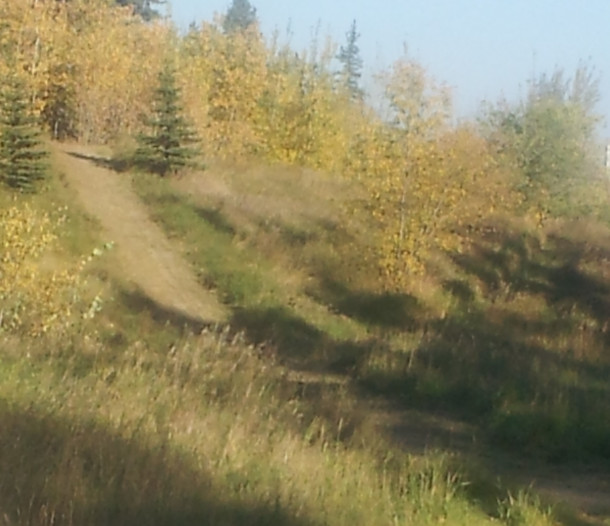
I took this picture during the walk. The path drew me to it, with its hill and curve at the top. I only saw what was immediately in front. Even then, it was limited by shadows and vegetation blocking my view.

Safe Haven

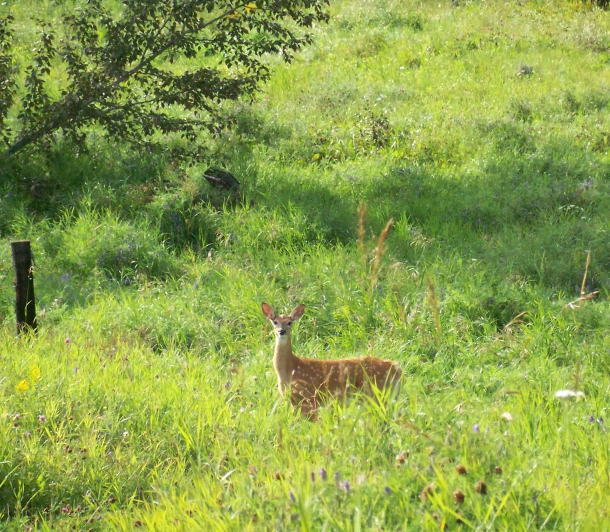
Several years ago, Kathy took this picture at the farm. She walked in from the road and the fields between the house and the road were overgrown. Regardless of whether a place is still physically inhabited or not, it is inhabited with memories, overflowing with meaning. In this sense, visitors abound.

We sat at the kitchen table, watching as various wildlife found safe haven in the midst of human dwelling. Both the wildlife and humans, shared and belonged to the space. As Kathy walked in that day, this beautiful doe looked up and posed to have her picture taken.

Spacious serenity,

Surrounding inhabitant,

Memories swimming–

Visible, invisible

(Re) appearing.

Home–

Soaring spirit,

Belonging, being, working, praying

Pausing, posingposes

Stewards of the sacred.


Surprises

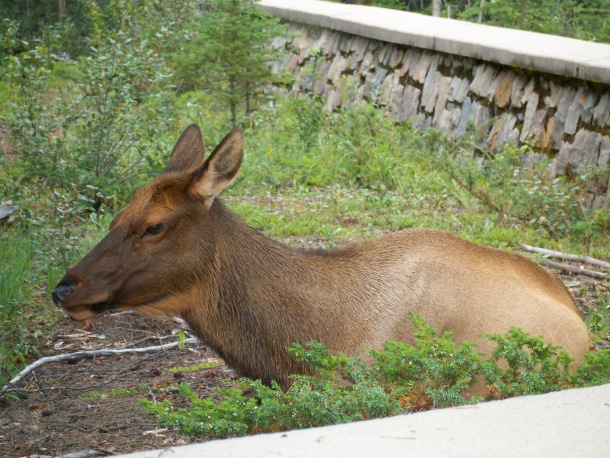
It was a perfect day. We wandered in Jasper National Park, enjoyed scenery, surprises and I was with my favourite person. We found the best at the end of the day. I posted a picture of a bull elk on Yellowstone 2005 . I took that picture from 15-20 metres. Kathy took this picture of a cow elk chewing her cud. She seemed aware of our presence. We were quiet and, as others joined us in a secluded area, she posed. The wall was about 1 metre thick wall and a similar height.

Earlier in the day, we hiked for a couple of hours in the Valley of Five Lakes, exploring some of the small lakes in the valley. We were able to get close to three of the lakes and took pictures. The other two did not have paths into them and were quite deep in the bush. Here are the three lakes we got close to. Each has its own personality, so to speak.

At one of the lakes, I forget which one we came across another visitor who posed for a picture.

And, I close the day with a poem:

In the end,

Day emerged as it began–

Arriving at trail’s head.

Rediscovering mountains,

Reflecting in clear lakes,–

Sharing personalities.

Adieu to blue skies,

Threatening clouds;

Delivering promise.

Welcoming the unexpected,

Unfolding patiently–

Like the day.

Beauty

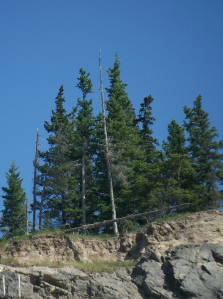
This tree stood all by itself on the crest surrounded by the pretty ones. What attracted me was it stood out from the crowd and thrived. I alluded to this in On the Edge. They were in the same area as we drove up to the Columbia Ice Fields in Jasper National Park. These trees do not just survive. They thrive in demanding conditions, sometimes for 100’s of years. There is little soil, water, and nourishment on the embankments, so they appear stunted. It thrives on the margins of its ecosystem. Perhaps, we find beauty in places we do not anticipate. We have to be ready for this or it will slip by.

In today’s environment, with calls for greater equity and social justice, it is not enough to ask people to survive with less than living wages, inadequate housing, little or no healthcare, etc. as if that is a major accomplishment. We must allow them to thrive as humans.

I took one class in special education in my B Ed. and another in my M Ed. I learned we have more in common than makes us different. Paulo Freire wrote of unity in diversity; John Dewey about communicating what we have in common to form community, and Parker Palmer about the paradox of living in community and with solitude. If we are more alike than different, we have a lot to communicate. It takes listening deeply, reflecting critically on one’s views (biases) of the world, and ethically transforming (moving beyond) the world, particularly that which is immediate to each of us. It is not enough to reform, but it may be a start to the process. It is becoming more and better, individually and collectively, in ways we cannot anticipate and can not be fully finished. There will always be good work to do, not matter how far we come.

On the margins;

Thriving–

Separate from the crowd.

Elements taking a toll;

World weighing heavy;

Thin, mottled.

Standing proud;

Reaching high–

Believing in something better.

Valuing who you are;

Individual, non-conformist–

Separate from the crowd.

Lonely, not alone;

Spacious, gracious solitude–

Revealing your own beauty.

Today, as I cruised Facebook, I found Parker Palmer posted Mary Oliver‘s poem The Summer Day. I love the closing lines: “Tell me, what is it you plan to do with your one wild and precious life?” It is a wild and precious life.


On the Edge

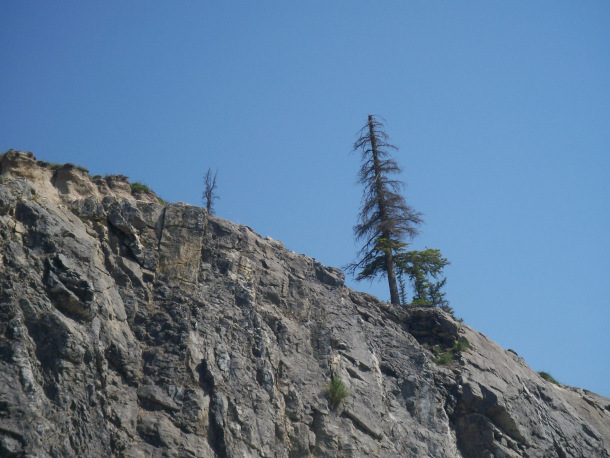
When I wrote this poem, it was at a time I was unhappy going back into the classroom and teaching. I loved the students and looked forward to being with them. So much had changed in the little school I taught in with change imposed upon us, rather than negotiated with us. In my writing, I am beginning to look at what is essential to the spirit for each of us to flourish. What gives each of us hope? it will be different. What is certain is we each want to have a voice in what we are doing.

When I wrote the poem, I wrote from a negative place. Now, as I look at the image, the tree on the dge of the cliff fourished in its environment, which is rock with little soil. The tree is actually quite old. Our tour guide said about 300 years old. Despite its lack of size, it flourishes and that is what I failed to see in the last two years I taught. It begs the question: “what might I have done differently.” I was not very patient at times. Cornel West tells young people looking for change to be patient. Real, transformative, democratic, and sustainable change takes time and patience.

In being with each student and present to them, I found something other than gave me the impetus to teach for two more years and find ways to cope with the imposed change. One of the challenges I faced was what we did was so different than what other classrooms looked and felt like it was difficult to convince other educators what we did had merit. Teachers teach one grade at a time in isolation with children separated from families, like a workplace. We had a parent in the classroom each day to assist, many of the families knew each other, and I had a multi-grade classroom with 3 or 4 grades together. Children and youth attend school each day and homework is something we assign, because often there is not time to complete everything at school. Students attended our school 40-50% of the time on a set schedule, depending on grade level. I negotiated with parents the extra things to be done at home. Often, they were large culminating projects at the end of a unit. I taught and students learned what was necessary in class and had little homework. I did not teach all subjects in school. Parents taught Math, Health, and some Phys Ed at home. I went on home visits to support their teaching and make sure we were on track. I had no desks in my classroom. We sat at tables usually based on grade level, but, during complementary courses e.g. Art, Food Sciences, Programming, etc., students sat in mixed grade groups.

In short, we were on the margins, the edge of what was perceived as “normal’ school. Today, in the midst of a pandemic that sent children home to learn online, the relationships and support we had in our small community would have helped many families and teachers cope with the sudden and unpredictable change.

With each step,

Closer–

Be bold.

Balance precariously,

Hover over abyss

Be brave.

Instability and stability dancing–

To soundless music;

Be graceful.

Quieting one’s self;

Listening to soul’s–

Be poetic.

Between lines and stanzas–

 Wisdom emerges–

Be patient.

On the edge,

Sisters and brothers–

What calls you with passion?

I try to walk in the neighbourhood each day. When I do, I listen to music. Yesterday, I heard a song by Bela Fleck and Abigail Washburn, which fit with this poem and how I felt when I wrote it. In talking to one’s younger self, they use words like bold, love, bold, and fear. I use passion, which suggests suffering as a necessary piece to flourishing.

The Weighing

Jane Hirshfield wrote the following poem, speaking to hope and resilience. At the end of our rope, we find we have more to give than we realized. It is a sense “this to shall pass” and we can only live in the present moment, which is fleeting.

Hard times reveal fissures in our world and society. Look at who has been hardest hit by Covid-19: people of colour, elderly, poor, etc. We can then see the fissures and who is left out. This became clearer with George Floyd’s killing. It is not enough to question who is left out, but how these humans are left out, dehumanized in the process. Injustice calls us to take account of the life we live, the world we live in, and ask how do we make this better, for each human being we encounter. Injustice calls us to weigh how we speak and act towards one another and to transform who we are for the better.

There are no easy answers to large questions, despite what politicians, carnival barkers, and reality TV hosts would have us believe with their divisive language and actions. We can embrace that we have more in common than separates us. As Paulo Freire proposed, there is unity in difference beyond superficial multiculuralism.

The heart’s reasons
seen clearly,
even the hardest
will carry
its whip-marks and sadness
and must be forgiven.
As the drought-starved
eland forgives
the drought-starved lion
who finally takes her,
enters willingly then
the life she cannot refuse,
and is lion, is fed,
and does not remember the other.
So few grains of happiness
measured against all the dark
and still the scales balance.
The world asks of us
only the strength we have and we give it.
Then it asks more, and we give it.

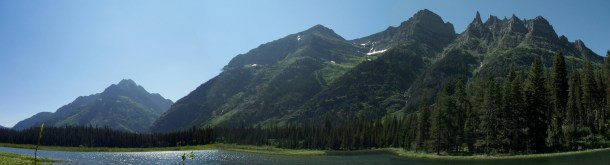
When I hike in wildnerness settings, I wonder what is around the next curve, over the horizon, on the other side of the mountain, below the surface, etc. I am unaware of so much. What is essential is I lift into critical consciousness what I can to better understand how I can make the world a better place and act on that as best as I can. I will likely never get to the other side of Kootenai Lake or the mountains on the far side, so I can only imagine what is there, a utopia of sorts. The same applies for the world we live in. The difference is we can incrementally get there, together.

As I am called to be a steward of the world, I am called to be a steward and servant in leading others. Without fully understanding where I am going, I am going there.

After I posted, I was listening to the radio and they played this song. It seemed appropriate.

Listening and Learning

I was going to press a wonderful post from Cheryl’s blog called Living in the Gap. Unfortunately, she does not have a press facility, so I did the next thing. I copied a paragraph from her post that I relate to:

“Am I ready to look at the part I play in the current reality, come out from the safety of the suburbs, and confront my own racism? To take a sober look at my own bias, privilege, and exclusionary practices. This is when I want to curl up like a pill bug and roll away, but this movement is not about me, it’s about listening, learning, and leaning into the race issues currently afflicting our country.”

We are in an unusual moment with the protests. They call us to stop and listen to one another in ways we may not be used to. They also call us to ask questions we have not asked in deep ways, such as “how do I confront my own prejudices? Am I even willing to confront them?” I use the word prejudice to open the space a bit more. It is not only about race. It is about gender, sexual orientation, class, etc.

Currently, I am co-writing an article for publication using Paulo Freire. Freire used critical theory and I paraphrase him here. He said prejudices are interwoven, arising from individual lived histories passed from one generation to another in unquestioned ways. It is listening to others without taking on a saviour role, without drowning their voices, and hearing them speak about their reality. They await opportunities to be raised into consciousness and critically questioned. How I understand this is through a Socratic lens where skepticism begins at home. How do I make the world better, more just, more democratic. Freire suggests it is a slow process. In his book, Pedagogy of Hope, he acknowledged using gender exclusive language in his seminal book, Pedagogy of the Oppressed, published 30 years earlier. He learned to use more inclusive language as he became critically aware of the harm done without it. It was a small and necessary step.

Freire argues we need to listen to one another, not denying difference. Instead, he calls on us to accept “unity in difference.” At our core, (in French coeur is heart and core) we are each human. Too often, we talk over each other and listen to defend entrenched positions. A key theme in Freire’s writing is human “unfinishedness,” always becoming. I reflect when I took-for-granted privilege and wonder how I might overcome this. It is not easy. It will not be finished. I understand my role, as an elder, as one of serving and listening. Leadership is serving, transforming, and mindful, rather than transactional and hierarchical.

Robert Greenleaf stated “the best test [of servant-leadership], and difficult to administer, is: do those being served grow as persons; do they become healthier, wiser, freer, more autonomous while being served: Since so many people seem afraid to grow, the true servantleader who brings it about is an extraordinary person.” If I look at the next generation and they offer me hope that there is better to come, perhaps I can take some solace in that. Without hope, we wither and flee from the scene, abdicating our responsiblity to one another.

I leave you with a video of Langston Hughes’ poem Mother to Son. If I expand the defintion of pedagogue to its broadest etymology, it is how elders interact with youth, allowing them to dream. Hope is not about a lack of obstacles. After all, no life is a crystal staircase and that is most evident for those on the margins of our societies, including in Canada with its history of residential schools and mistreatment of people of colour. It is, as Freire suggests, being willing to struggle and fight to overcome overt and covert injustices and inequities we encounter and witness. It is listening and testifying in those moments to offer a hand to those in need, regardless of race, gender, orientation, creed, and class without being dogmatic. How do we testify in each of those moments? It is not succumbing to historical amnesia and existential weariness.


Well, son, I’ll tell you:
Life for me ain’t been no crystal stair.
It’s had tacks in it,
And splinters,
And boards torn up,
And places with no carpet on the floor—
Bare.
But all the time
I’se been a-climbin’ on,
And reachin’ landin’s,
And turnin’ corners,
And sometimes goin’ in the dark
Where there ain’t been no light.
So boy, don’t you turn back.
Don’t you set down on the steps
’Cause you finds it’s kinder hard.
Don’t you fall now—
For I’se still goin’, honey,
I’se still climbin’,
And life for me ain’t been no crystal stair.

Why Do I Write Poetry

During a professinal development event, a presenter spoke about teaching poetry. To my knowledge, this person spent little time teaching, yet he was a supposed expert about all things teaching. In the course of his presentation, he expressed disdain for poetry. He claimed, without evidence, we teach poetry without explaining to students why we teach it.

In my teaching, I described reasons why I taught something, opening up learning to include what students considered important. This included questions about topics and content. Often, students began with a negative view of poetry. With time, we got over hurdles together. Without a collective effort, we do not overcome issues in life and learning. We end up with haiku written through rote formula:

Here are five syllables

And here I write seven more!

Are you happy now?

The presenter indicated, despite having written poetry, he was unsure why teachers taught poems written. I think there are good reasons, but I could be wrong.

Poetry calls me to choose words, paradoxically spare and spacious. Spareness is in the number of words; the fewer the better. The space allows the reader room to interpret. What did the poet mean? What senses are invoked through the word choice?

Instead of counting something, poetry asks me to explore life and understand quality is not evenly distributed. I have privileges, maleness, whiteness, education, that others do not have the eauitable access to.

Choosing words,

Caring about each–

Describing feelings,

Experiences never identical.

Revealing thickness in meaning,

Experiencing sameness different–

Bringing us together,

Bridging worlds.

I told students, who struggled with reading and writing, poetry was an alternative to express themselves. I used ee cummings, as a model, to overcome worries about grammar, spelling, and capitalization.

i dig ee cummings

no punctuation

no capitols

won’t worry about spellin either

no sweat

aint no problem

i write poetry

I enjoy poetry. I always have. I remember a poem, The Elevator, I memorized in Grade 4. I think it Walter de la Mare wrote it. My friend memorized a poem called Douglas Fir. His name was Douglas. When I enjoy who and what I teach, I bring enthusiasm to writing poetry.

Artists, including poets, are often at the forefront, addressing social issues. In our times this includes Maya Angelou, Thomas Merton, Wendell Berry, Adrienne Rich, Parker Palmer, Thich Nhat Hanh, etc. Sometimes, I do not think of these authors as poets. Each of them wrote/writes poetry helping to raise my awareness about issues.

Below are the wonderful and poetic words of Thich Nhat Hanh.

Peace in our heart

I close with a poem I wrote many years ago as a 15 year old in high school. I have never been a fan of what we call capitalism. What we have is predatory and is at the root of current political, economic, and social issues. Only a handful are admitted to the club.

Captains of Society

Captains of Society

Shallow, superficial, arrogant

Single ambition

Greatness in the eyes of others

Only those with resources can apply

The rest

Forgotten

Pay a high price, but…

It’s their fault

They own their misery.

A cheque to charity

Assuages my conscience

What about the despair?

Don’t care

I claim I do

Donations in badfaith,

It’s a tax receipt

I really claim, but…

Done on the backs of others

Get the staff to donate time

Not mine.

Increase taxes

Not mine!

No way!

It’s wrong!

Tax others!

What is work?

I create jobs

It’s a spectator sport

This work, which

I manage from afar.

Drive luxury wheels

Shout

Curse

What’s the hold up?

Who’s blocking my way?

The ‘75 Ford station wagon

Engine shot

Dead broke!

Is it their home?

 Throw a party

Drink

Eat

Be merry

No concern for homeless

A romantic notion this ‘hobo jungle’

Not my world

What’s wrong?

It’s not my fault

I gave at the office.

After all.

Throw money at problems

It might help

Don’t

Stop, see, care

If it really helps

Denying, refusing, unfeeling

I pay for a clear conscience

After all.

 The misery

In surround sound…

Is out of sight;

Out of mind

Collectively Eliminating Racisim

via Collectively Eliminating Racisim

This is a great post by Shobna. We each have a responsibility to our part, our small part. We can only change the world we are immediate with.

For me, Michelle Obama‘s quote points to Socrates: “An unexamined life is not worth living.” How often do I critically examine my actions, my words, my life? What privileges run below the surface and privilege me in my life? Where can I go without worry of being stopped and interrogated?

Martin Luther King Jr. and Thich Nhat Hanh remind me of the intertwined nature my life of as part of a larger garment of inter-being. What have I done to make the threads that link me to others stronger, healthier, and more whole?

Wendell Berry in his poem, Be Still in Haste, speaks to the need to pause. In each ensuing moment, I begin anew to set the world right. This moment is always the first.

How quietly I
begin again

from this moment
looking at the
clock, I start over

so much time has
passed, and is equaled
by whatever
split-second is present

from this
moment this moment
is the first.

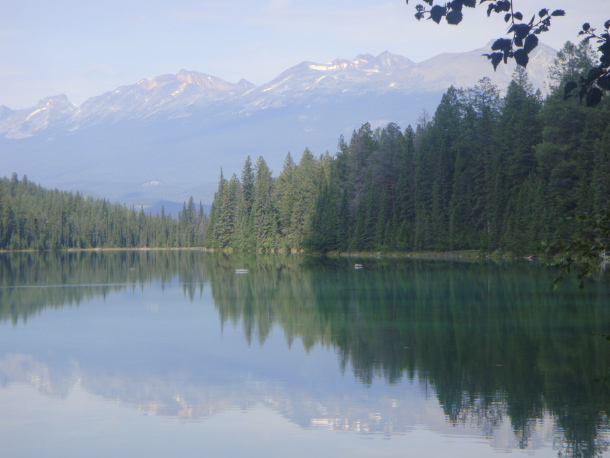
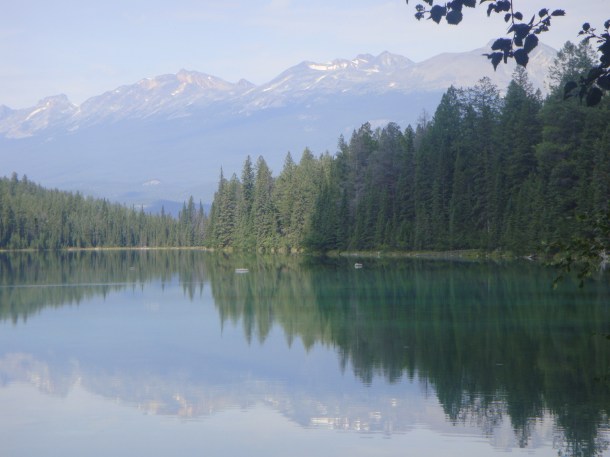
Find a place where you are comfortable and reflect on life. For me, it is a walk in nature. I took the following picture in Jasper National Park several years ago. I could sit on the edge of this lake, soaking in the majesty and reflecting on how I made life better in the next first moment.

DSC00379