Tag Archives: transformative education

Larry Cuban is a leading writer and researcher in school reform or I think a better way to phrase it is a lack of true reform. He points out several key points in this excellent article. His first paragraph about teachers working together daily is not prophetic as you will see in the article. It has been part of the educational reform lexicon for a several years, perhaps decades is a better word. Why do the ‘reforms’ with all their pat answers and revolving, recycled fads secret this away in the closet? I think they are afraid.


First, top down measures are not the order of the day. Second, schooling and learning (my added word) at all ages are complex systems and forged out of relationship not transactional activities. This nature does not invite top-down. It encourages community and collaboration. The leading thinkers he refers to part way through the article are a short but impressive list. I would add others who contribute in many ways i.e. Deb Meier, James Comer, and Nel Noddings come to mind. Finally, real communities actually are dysfunctional. It is what we do in those moments that leads us to collaboration. Joining hands around the camp fire is nice, but only superficially functional. Agree to disagree is sometimes the path.


I read another blog today and my conclusion is slow is sometimes the way forward.


We in Canada who think we are doing something better are wrong. We all need the same wake up calls, a new conversation, and a reimagining of schooling and learning. Note I did not say school. That is the brick and mortar that in some cases is passé.

larrycuban's avatarLarry Cuban on School Reform and Classroom Practice

Want to give a “no excuses” reformer a stroke? Suggest that teachers working together on a daily basis have a better shot at improving teaching and learning than the highly marketed structural changes of standards-based testing and accountability, Common Core standards, more charter schools, and evaluating educator performance through student scores.

Too many reform-driven policymakers high on the rhetoric of these current reforms ignore how much improvement in teaching and learning can occur when  teachers work collectively in their classrooms and schools to improve their content knowledge and teaching skills aimed at common district goals.

For many years, teachers, administrators, researchers, and a sprinkling of policymakers have concentrated on both traditional and innovative professional development and learning communities to build teachers’ capacities in knowledge of subject and teaching skills to improve instruction in schools and districts. Such school-based efforts converge on the teacher simply because within the complex system of…

View original post 1,209 more words
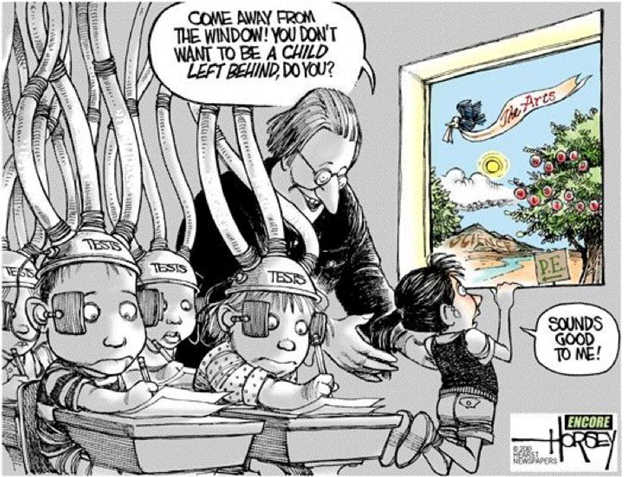
Cartoon Time along with an Ivon Rant

Another Alberta-based educator at The Love of Learning posted this. It reminded me of a Ken Robinson video The Educational Revolution…Why? Because Schools Kill Creativity posted by Gen Y Girl. The video is worth watching several times. The first time I watched the video several years ago an administrator informed me the message was a need to add layers of technology on top of what we are doing.

I am not a neo-Luddite. The original Luddites were not opposed to technology. They opposed potentially catastrophic outcomes blind, thoughtless implementation of technology might have on British society of the time. A message I gleaned was a positive correlation between ADHD/ADD diagnosis and an increase in various forms of imposed, standardized, high stakes testing.

The second message is statistical evidence the highest levels of creativity in school are at the kindergarten levels. After that, it is all down hill.

These are not technology issues, but simply change for the sake of change.

Technology is the artful use of the tools available to us.

Questions: What changes would you suggest for education to make it more child-friendly and child-focused? What can we do to increase the creativity for children in classrooms?

A bit of an American slant to it, but where do Canadian educational systems take their lead from? Is this what we want?

Teachers as Storytellers

Think of the people we call teachers, not just in classrooms but in every facet of our lives. A quality they share is storytelling. They connect with our hearts and minds. We laugh, cry, yell, and carry on in every imaginable way with them. We remember them not because of what they taught us, but what they revealed about themselves and helped us discover about our self.

The best teachers are the best storytellers. We learn in the form of stories.

~Frank Smith

Five Steps to Destroy Public Education

Five Steps to Destroy Public Education.

Diane Ravitch is a real educational reformer in the US. I think parts of her message in this post is universal. I particularly like her comments about underfunding our schools and overcrowded classrooms.

It is just not the underfunding that starves the schools; it is the poor management and decision-making by the bureaucrats, technocrats, and oligarchs. What is the latest fad?

Overcrowding our classrooms silences the teachers. Do I even have time to lift my head and uplift students under those conditions?

pedagogy of the oppressed by Paulo Freire

I read pedagogy of the oppressed by Paulo Freire during my undergraduate experience and return to it as a source of reflection and when I write. Similar to Parker Palmer, Paulo Freire left an indelible mark on my life’s practice. Education is an uplifting, liberating experience which shines light on each step Antonio Machado described: “Wanderer, your footsteps are the road, and nothing more; wanderer, there is no road, the road is made by walking.” Freire’ s contention was everyone can act as an agent in their learning thus freeing them and transforming the world they live in.

Freire used the Portuguese word conscientização which “refers to learning to perceive social, political, and economic contradictions and to take action against the oppressive elements of reality” (17).   Humans become mindful of and present in the world and act to transform it. Freire used a banking metaphor and described traditional education where  knowledge is deposited into students. Teachers and the system act oppressively in determining what is important to learn. Freire felt education uplifted people and their learning. “Liberation is a praxis: the action and reflection of men and women upon their world in order to transform it” (p. 60).  Learning occurs when  compliance and conformity are rejected in favour of dialogue based on love which allows each human to name their world and what is of value in it. The student is a teacher and student; the teacher both student and teacher.

Questions: What can we do to truly bring a new pedagogical structure into our schools and communities of learning? What function would school play in this pedagogical structure? What is dialogue based on love?  What role do educators and communities play in liberation education?

Recommendation: I love the book. It is a challenging, but I return to it often and find something new each time. Today, I became aware of the following: “Concepts such as unity, organization, and struggle are immediately labeled as dangerous. … These concepts are dangerous—to the oppressors” (p. 122). What does this mean in supposedly modern, liberated, and affluent societies?

A second point was the similar language used by Freire and Martin Buber. There is a shared understanding of respectful dialogue using the words I and Thou to describe the uplifting, liberating, loving dialogic process.

Freire, P. (1993). pedagogy of the oppressed. (M. B. Ramos, Trans.).  New York: Continuum.

Words for Teachers and Learners at Heart

This fell into my world yesterday and I thought it might be a good share. It is certainly something to reflect on as we begin each day in our various roles of learning and teaching.

A Blog Experiment

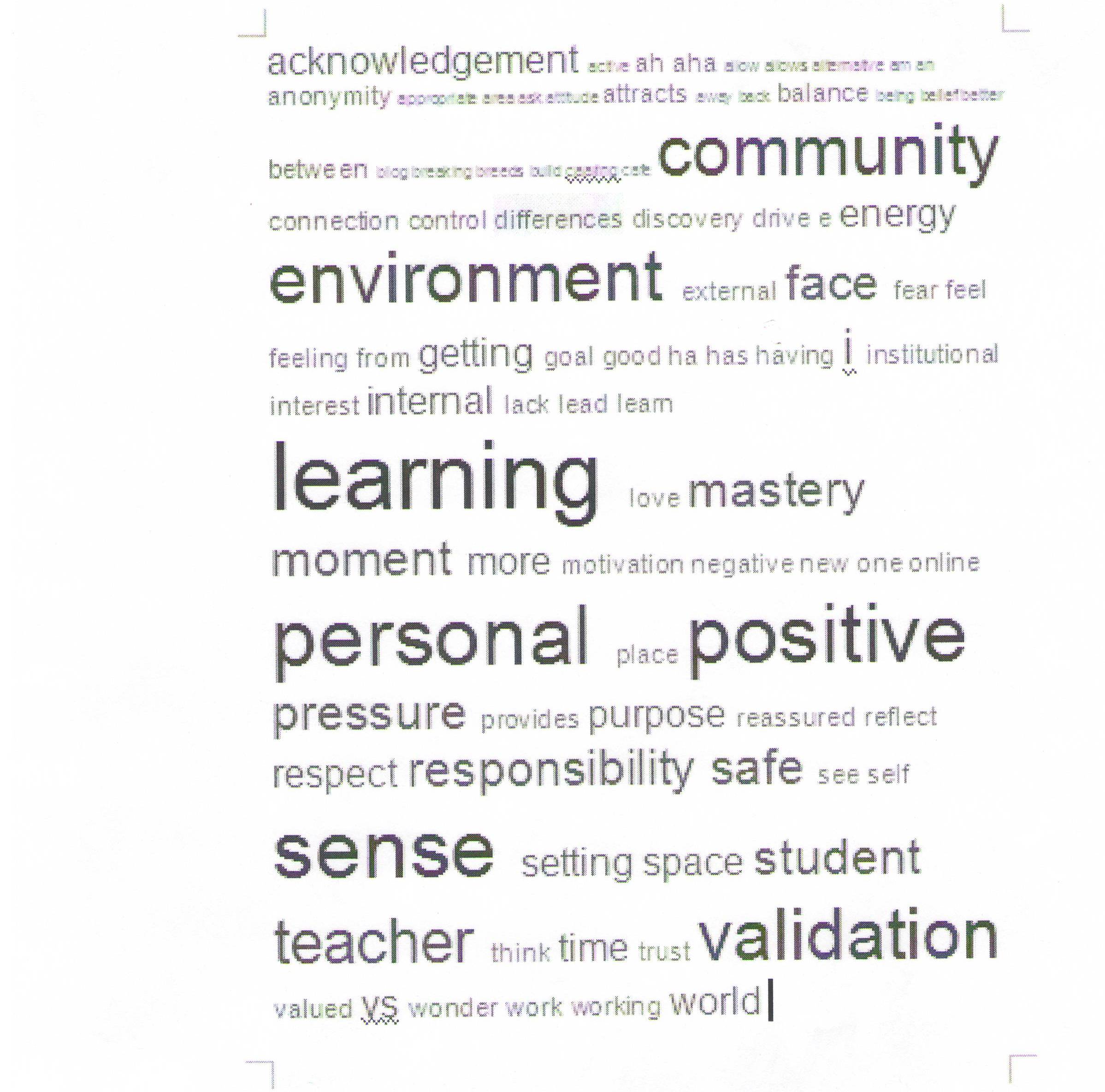
I am using software called NVivo. Essentially, I use it to organize and summarize qualitative data. One cool feature is the ability to create a word cloud. I am experimenting with that feature and using the image facility on my laptop. I summarized some World Cafe events we held in February and March. The results were simply outstanding. The only fly in the ointment was I had to scan the picture and lost the colour.

The overarching question we created our conversation around was: “What engages us in learning?

February 4, 2012

Think of a time that you feel was a high point in your learning. This would have been a time you felt most alive, effective, and engaged in the learning process. Describe how you felt. What made this possible?

February 18, 2012

“Without being humble, describe what you value most about yourself. How does this contribute to the experience of learning for you? What setting does this seem to flourish best in? What would attract you to that setting?”

March 3, 2012

What encourages us to continue learning and see learning as important in our lives?

Questions emerged. I thought the most interesting was an absence in the data. What about teacher expertise in subject area or technical knowledge? It could be these are unstated but assumed necessary. Or it could be that the relational aspect, the art of teaching, is so important to this group of people the technical and subject knowledge is secondary.  What do others think about this?

Whales Forever

This is not about whales per se. Several years ago, my Grade 8 class struggled with the simple machines unit in Science. I proposed an alternative assessment route. Instead of writing a test, they could apply their learning and build a complex machine. They were all over it, but I had to come up with something and began a search of the Internet. I found an idea called Whales Forever and modified it to fit my needs. It has been a success ever since.

1. Whales become stranded on beaches around the world and Whales Forever is concerned with the survival rate of beached whales. This environmental organization rescues whales and returns them to open water quickly so they will not perish. Whales Forever announced a contest for Grade 8 students to create a prototype machine which would safely lift a stranded whale onto a hover craft so it could be transported back to open water as it receives medical treatment.

2. Students design and build a machine which with a minimum mechanical advantage (MA) of 4. The machine consists of at least two simple machines. Mechanical advantage is calculated output force divided by the input force.

3. The machine will lift the whale a height of 10 cm and lower it 5 cm onto the simulated hovercraft. The whale is simulated by a resealable plastic bag filled with marbles or sand. Students can hand position the ‘whale’ in a harness which is part of the system to begin the lifting process.

4. Students sketch exploratory labelled diagrams of their chosen design including measurements indicating critical components i.e. simple machines used, gears, and drive trains. They provide mechanical advantage calculations.

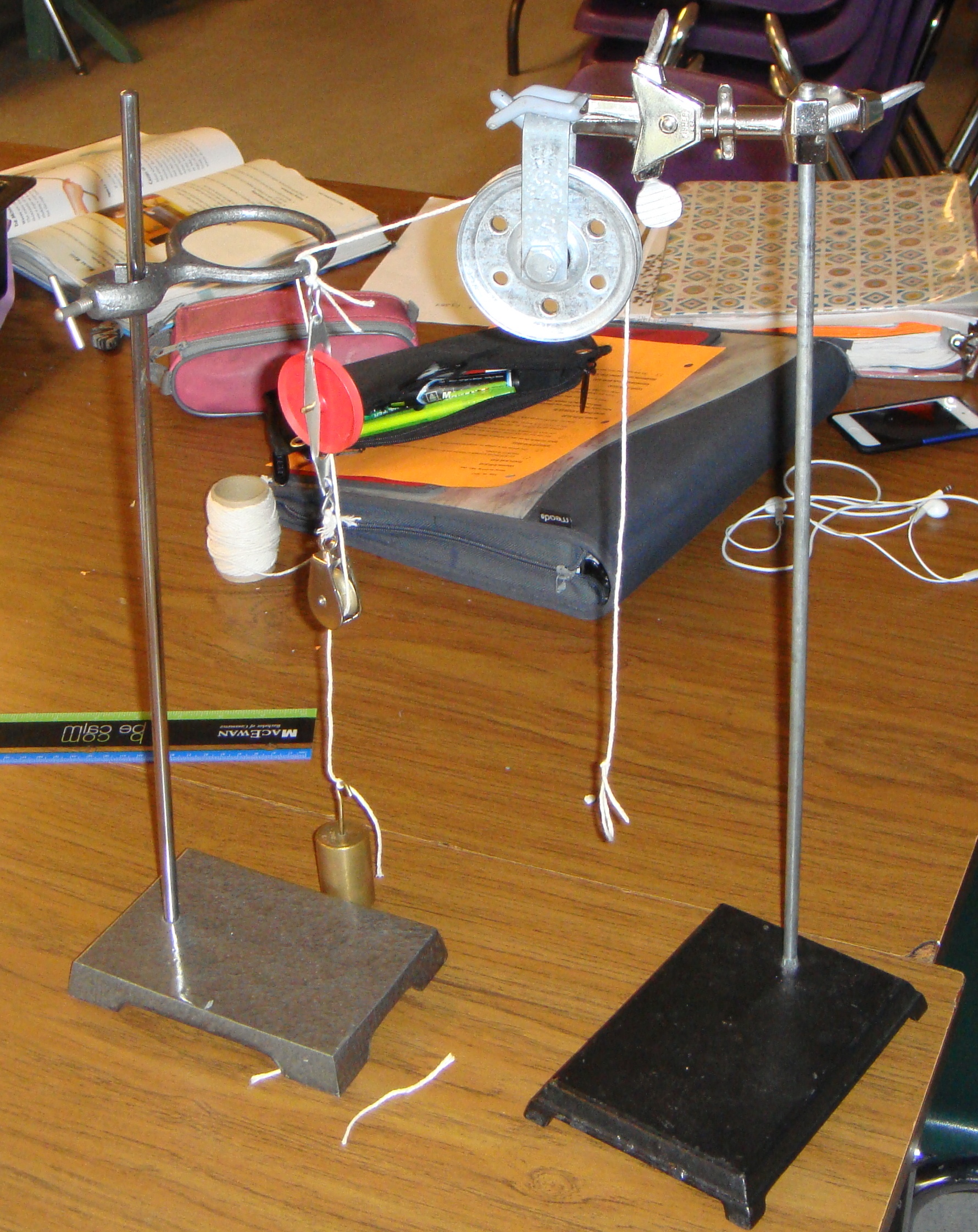
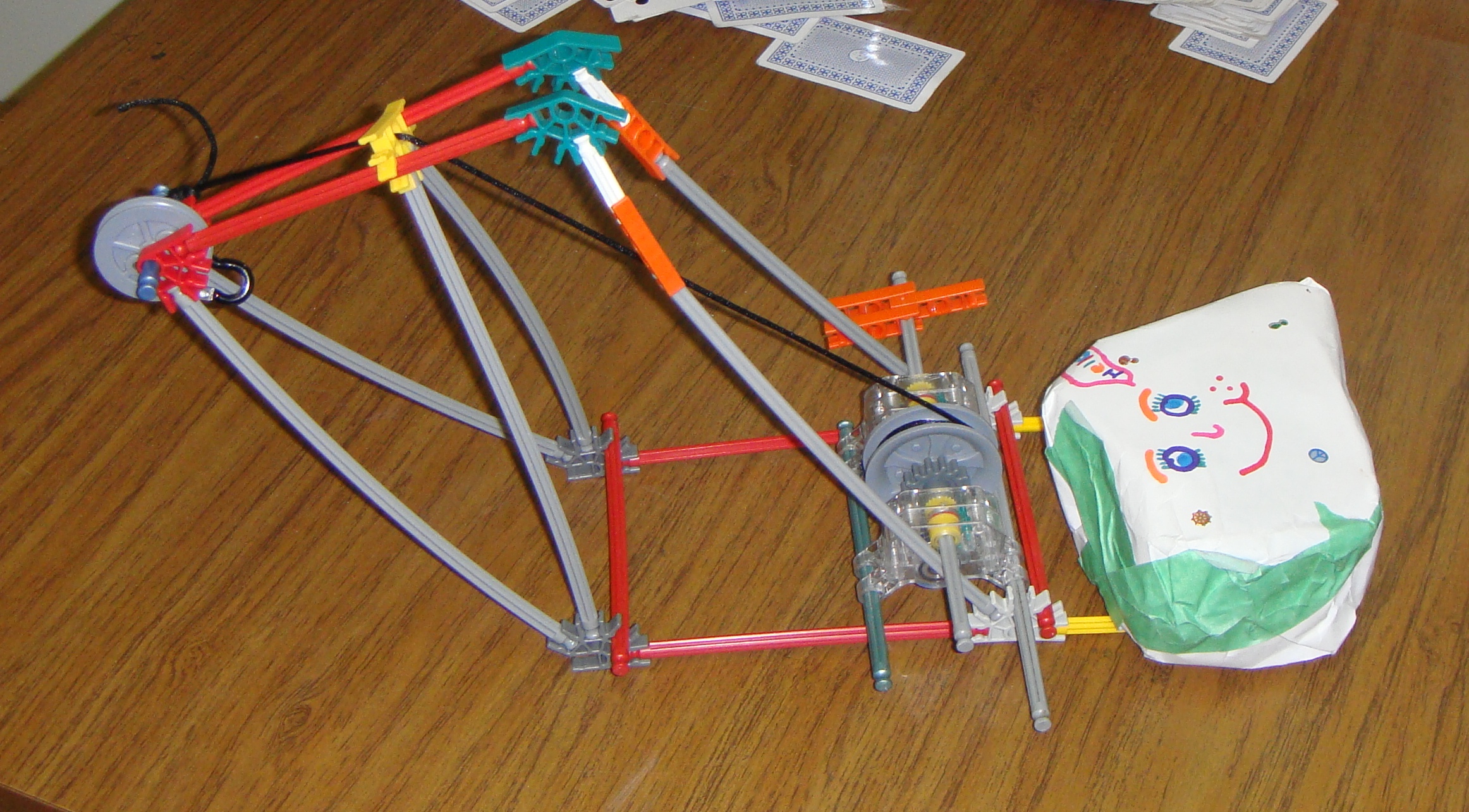
5. Students use available materials i.e. desks, stools, tables, retort stands. Last year, a student used a Meccano set and this year students used K’Nex. They are not allowed to use a motorized system. They use planes, levers, pulleys, screws, wheel and axles, and perhaps a wedge.

6. Students give a written reflection outlining the strengths and weaknesses of their design including written suggestions for improvement.

7. Students make a 4 minute presentation to the board of directors of Whales Forever.

I use a rubric and assess the design including diagrams, the effectiveness of the prototype, the reflection, and the presentation.

Here are some examples of this year’s products.

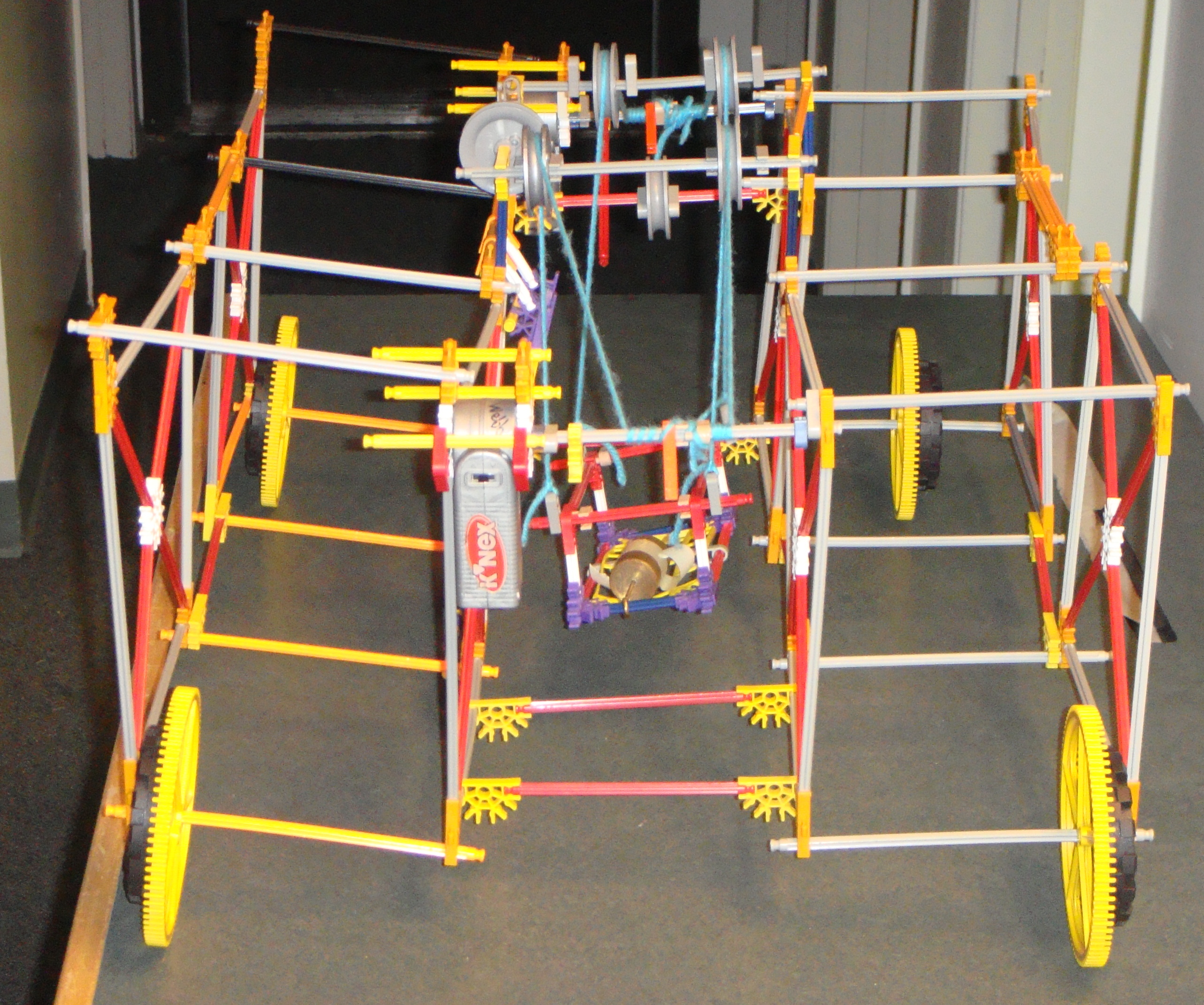
Whale Saver constructed from K’Nex. You can see the harness on this one. It had a mechanical advantage of about 15. The one challenge with the K’Nex is hooking up the scale. It took some maneuvering.

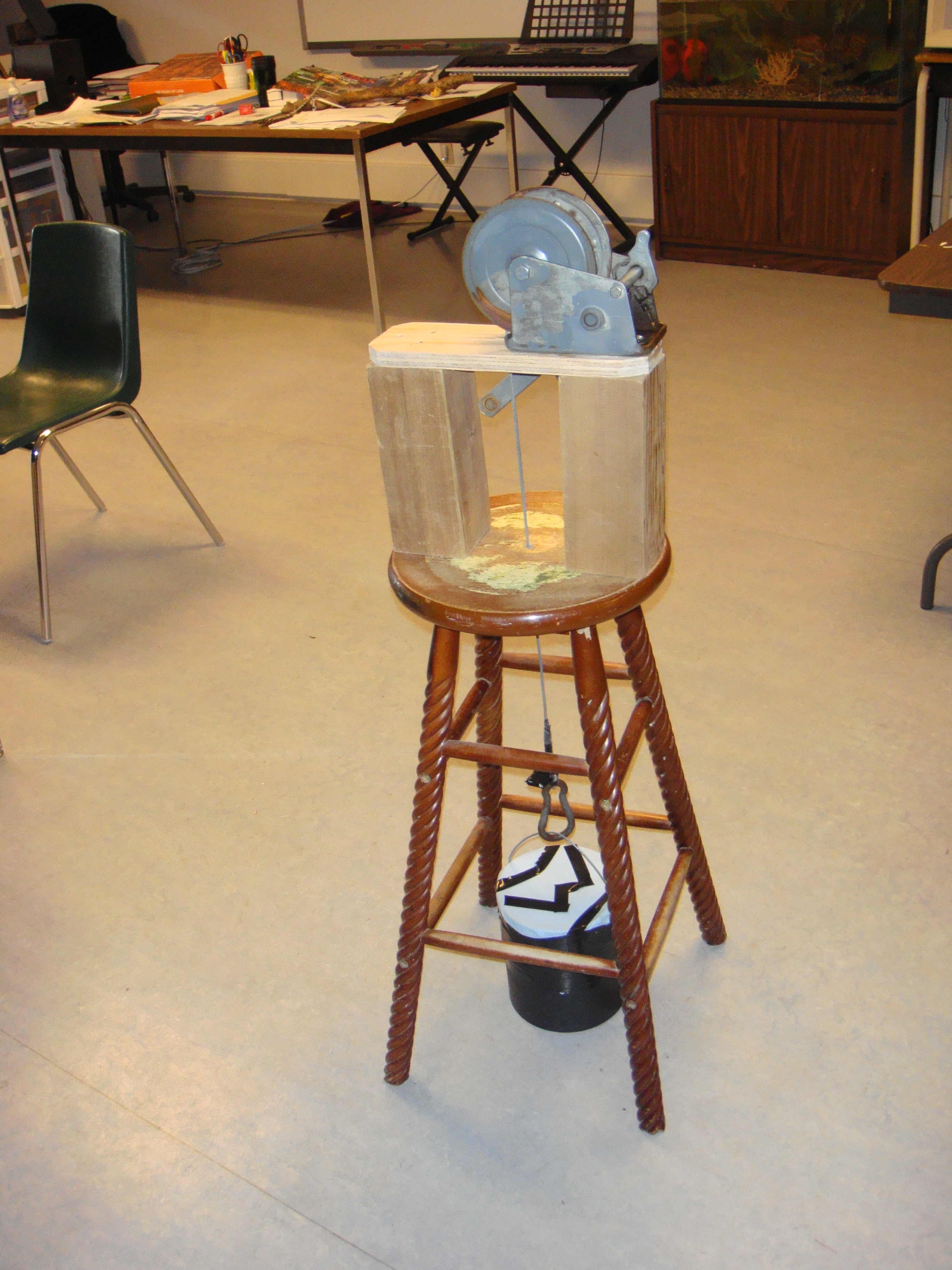
This one was homemade. It had a mechanical advantage of 20.

These students used materials from the classroom primarily. It had a mechanical advantage of about 8 or 9.

This was another K’Nex design. The thing on the right is a rock wrapped in paper with a face on it. The rock countered the weight of the whale as it was lifted. This machine had a mechanical advantage of about 10.

Blueberries | Jamie Vollmer

Blueberries | Jamie Vollmer.

This is worth reading. It fell into one of my email boxes this morning. In theory, I agree with the idea that we cannot, as teachers, return our students like Mr. Vollmer could return his blueberries. Fundamentally though, there is still a problem. In the province of Alberta. there are over 25% of students who will not finish high school. Those are the ones who leave our schools. What about those who do not leave and finish? There are still some amongst them who are on the margins and school has not served well. The 25% is an average.What about students who live in First Nation communities, in the inner city, or face any number of other life issues?

Education needs an overhaul. There is a genuine need for a different conversation and not sticking our heads in the sand. Please take a few minutes to read.

Diane Ravitch is a leading American educator. Although what happens south of the border is not important to us, this article poses a great question. Who is advantaged; those with resources or those without resources? Servant-leadership, which is lost in education, asks the leader to serve those around him or her and help them grow. That focus increases for the most disadvantaged. When will politicians, bureaucrats, and technocrats allow teachers in the classroom to become leaders who serve students and the community?

dianeravitch's avatarDiane Ravitch's blog

Mitt Romney launched his foray into education by visiting the Universal Bluford charter school in West Philadelphia, an impoverished, largely African-American neighborhood. He went to tout his plan for vouchers and charters as the new civil rights crusade of our era.

While there, thinking he was in friendly territory, he made some unfortunate remarks. First, he asserted that class size wasn’t important. That is no doubt the advice he had received from his advisors, who like to claim that having a “great teacher” is far more important than class size reduction. Then, he advised his listeners that one of the keys to education success is to be a child of a two-parent family. He got called out on both comments.

A music teacher rebuked him on the class size issue, saying: “I can’t think of any teacher in the whole time I’ve been teaching, over 10 years — 13 years —…

View original post 292 more words