Tag Archives: writing

A Grateful Haiku

via A Grateful Haiku

What are each grateful for at this time? We live in unusual times. As I go through my daily routine, I read articles and posts about how this is a time to rethink what we value and what we are each grateful for in our lives.

Tanya wrote a haiku about the symbiotic relationship between a monarch butterfly in its larval stage and milkweed. I often overlook how nature provides a sense of harmony I have to look deeper to see. When I look past the monarch butterfly’s beauty to its larval form I understand it exists by taking bites out of the milkweed flower’s beauty.

In that vein, when I read the comments, I realized it was “dueling haiku” between Tanya and Stephen. I appreciated what lay beneath the surface of the post and was grateful for their poetry skills. After all it is National Poetry Month.

Thich Nhat Hanh reminds me to find the extraordinary, I look past and beneath the surface of the visible to uncover hidden beauty. Yesterday, it snowed and was cold, below 0 Fahrenheit (about 20 degrees Celsius), and there was beauty. I took this picture of a tree in our front yard with the clear sky in the background. If it had been January, not the end of March, it might have been easier to see beauty. I remind myself we need this snow to melt and add to a needed water table so we might grow and harvest later in the year.

Front Yard with Fresh Snow March 31, 2020

I recently wrote about challenges of being unable to teach in a university setting. At my age, the doors appear closed. As I reflected and wrote, I realized my days, as a teacher in some formal way, might be over. Quite frankly, we do not value the wisdom elders have to offer. Emerging from this sense of frustration and despair was a sense something else was calling me: to write in various ways. This is a form of teaching perhaps and a gift I had not been grateful enough to have.

Yesterday, a colleague and I were advised we were accepted to write a peer-reviewed article for a special edition of a journal. This is asecond peer-reviewed article in several months that has been accepted. For that, I am grateful. In being grateful, I need to look past how things appear superficially and re-cogize there is more I am becoming.

I leave you with this beautiful video from the late Israel Kamakawiwo`Ole or IZ as he was known.
The Gift of Presence

via The Gift of Presence

Wendell Berry is one of my favourite poets. In her post, Shobna uses part of a poem, Our Real Work, to point a need to be present. Gary Snyder wrote a book called The Real Work devoted to similar subject matter.

In the rush of “normal” life, I often overlook what that means and what calls to me to step into a healing moment; to make me whole and pause to listen to what the “impeded stream” sings to me. For Shobna, gardening is a quiet moment to listen to the “impeded stream.”

Today, as I checked Facebook, Parker Palmer posted another Berry poem: The Peace of Wild Things. Here, we are called to, in times we do not have a frame of reference for, to turn to poets to help find paths forward. In various ways, they remind us to each look for what keeps us moving , especially in times of turmoil and despair. When I hike and find my path blocked, I pause, look, and listen. In life, I find ways to move ahead, embrace uncertainty, and recognize I am walking my own path, as Antonio Machado would remind me, but I am not alone.

As Shobna points out, I only have to look and I “see that kindness is more visible these days.” Health care workers, farmers, grocery store employees, and many others, often strangers, stand in the breach to help. If these are to recall Dickens, the best and worst of times, what makes them the best is to pause, when my path is blocked, to find what calls us and ask we each ask ourselves what calls us.

One of the things I take for granted is music. It is part of my love of poetry. In particular, lyrics pull me to them. I am fortunate to listen to a small community-based and funded radio station, CKUA, and have it on non-stop. To say it is eclectic is an understatement. They do play top-40, but it is often from years and decades ago.

In keeping with my love of music, I leave you with two videos. The first by Jimmy Buffet got me through tough times years ago. It reminds me who I am and live that way. I have always been a person who walked to the beat of my own drummer and am a bit of a pirate, regardless of age.


The second is one I used to listen to with my mother years ago. It is a gospel song written and performed by Gene McLellan, a Canadian, called Put Your Hand in the Hand of the Man Who Stills the Water. Now, my mother and I did not always agree on music, but we had some serious overlaps such as Gene McLellan, the Beatles, Elvis (if she did not have to watch), etc.


Bodhisattva Prayer for Humanity

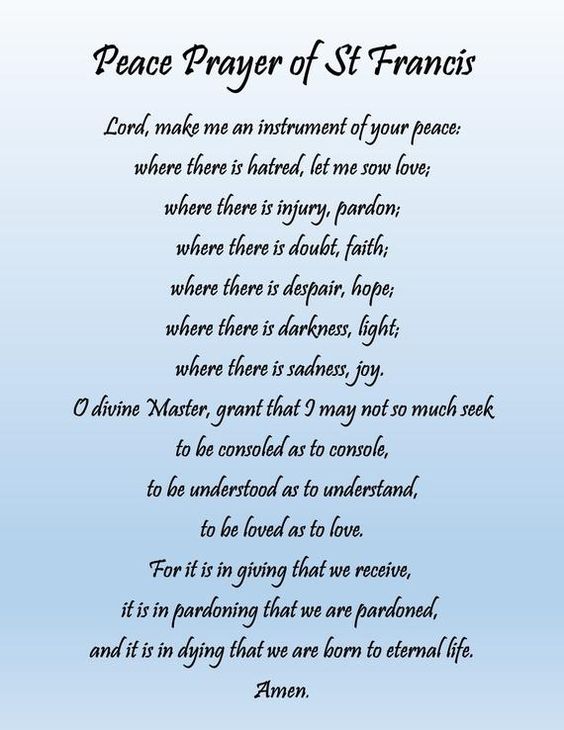
In my post one step, then another, I concluded with The Prayer of St. Francis, which is a significant part of my life and of my family.

Recently, I came across this prayer and understand the Dalai Lama recites it daily. I found several links between the two prayers. I serve as a guide, bridge between the our lives and those in need. There are many metaphors in this prayer for me to take the shape of as I move through the world. Even if I cannot reach others physically, perhaps I can be a lamp from a distance as to help guide them in a moment of darkness.

Perhaps it is only in a kind word and acknowledging of the other who is present as we pass each other in a store. Kindness can be in short supply and in moments such as the one we are presently in a smile and greeting may make all the difference.

As I watched the news last night, they interviewed people who were setting up local help initiatives for seniors, donating food that might go to waste from a restaurant, and setting up a small food bank on the walk in front of their house. It is in moments such as this we become a lamp in darkness, a vase of plenty, and a tree of miracles.

Too often, we think (over-think) that miracles happen out there with some divine impulse. Maybe it is in the ordinary we discover the extraordinary.

“May I be a guard for those who need protection
A guide for those on the path
A boat, a raft, a bridge for those who wish to cross the flood
May I be a lamp in the darkness
A resting place for the weary
A healing medicine for all who are sick
A vase of plenty, a tree of miracles
And for the boundless multitudes of living beings
May I bring sustenance and awakening
Enduring like the earth and sky
Until all beings are freed from sorrow
And all are awakened.”

The other day, I heard Lean on Me by Bill Withers. It has this prayer’s message. Withers wrote the song as a call to others to lean on one another during challenging times. This form of love is agape, a love of one another as human beings, as opposed to a romantic love per se. But, romantic love that survives to become a pragmatic love (from the Greek pragma) takes on the agape more than romantic with time and seasoning.

one step, then another

via one step, then another

We live in challenging times and I do not mean just because of the corona virus. I think a world defined by others in ways that make it incomprehensible for each of us is part of that challenge. I find it easy to critique the neo-liberal agenda many of our politicians, technocrats, bureaucrats, plutocrats, etc. have fashioned. The questions I return to is what do I control and how can I live my life in ways that reflect courage, faith, and hope.

Carrie uses those last words in her post one step, then another. She called her blog Lead Our Lives, which is appropriate for these days and for each we will live moving forward moment by moment. I counsel hockey players, students, and many others the only things we control are what we control. I cannot control what other people do and this calls on me to lead my life and not someone else’s.

The first lines in Carrie’s post are from Thomas Merton, who I use often. To close, Carrie uses  Howard Thurman, reminding me in silence I hear my heart whisper how to find strength from weakness, courage from fear, and hope from despair. Perhaps, I discover, in those moments, peace; perhaps it discovers me.

The movement of hope to despair echoes the Prayer of St. Francis, which has been with me throughout my life. I offer you those words to guide you in moments of silence.

Take care, be well, and discover the opportunities amidst the challenges of each moment.

Prayer of St. Francis

I retrieved the image from Pinterest.

On Langston Hughes – Black History Month Tribute to a Great Poet

via On Langston Hughes – Black History Month Tribute to a Great Poet

Melba posted a wonderful poem, Mother to Son, written by legendary African-American poet, Langston Hughes.

I used Langston Hughes’s poetry in our poetry unit each year. The metaphor of life as a staircase, sometimes smooth and other times unevern, seemed to fit junior high students. My students responded to it well.

Another aspect of including his work and Maya Angelou‘s poetry was around the issue of civil rights. In Grade 7, we read the book The Cay, by Theodore Taylor who dedicated it to Martin Luther King shortly after he was assassinated, about the relationship of a young white boy and an elderly black man to discuss what being well-educated meant. I included my mother’s line, which was “who would you rather be lost in the wilderness, someone who read about it or an indigenous person, with no schooling, who lived it?”

In Grade 8, we exoplored civil rights through the lens of heros. I let students choose, but some struggled with this choice. Knowing my students well, I introduced them to Jackie Robinson, Willie O’Ree, and Wilma Rudolph, if they were interested in sports. Others, who came from religious families, I encouraged them to consider Martin Luther King  and Mother Teresa. If they were interested in people who stood for the rights of the oppressed, but might not be considered a religious person we talked about Nelson Mandela and Mahatama Gandhi. Regardless, I found, when I tapped into who each student was, colour, ethnicity, and gender dissolved and wonderful projects emerged.

Another Hughes’s poem we read was Dream Deferred, is sprinked with questions from beginning to end:

What happens to a dream deferred?
Does it dry up
Like a raisin in the sun?
Or fester like a sore–
And then run?
Does it stink like rotten meat?
Or crust and sugar over–
like a syrupy sweet?
Maybe it just sags
like a heavy load.
Or does it explode?

Here, is a video of the poem read by the poet.

What Do You Plan to Do with Your One Wild Life?

Mary Oliver wrote the beautiful poem The Summer Day. She ended the poem with a question: “what is it you plan to do with your one wild and precious life?” Actually, she included several questions, which are not answerable in any certain way. Life is unpredictable, but what we want to do with it echoes Hans-Georg Gadamer who wrote “desire beyond wanting.” To me, this suggests we each aspire, perhaps can aspire, to something beyond simply knowing and planning. There is more to life than we can plan and predict, yet we can hope.

I think, as important, the question is about vocation and what calls us forward and animates each of our spirits. Thomas Merton and Parker Palmer write about how vocation and voice relate to one another and are how we express who we are in life. Merton goes so far as to say some of us are perhaps destined to search without discovering what calls us.

I wonder, “have we lost this sense of spiritual purpose in the early part of the 21st Century?” We look out there, read the newspapers, follow 24/7 news, etc. and feel deep despair and hopelessness, perhaps even disinterest to follow what beckons. I don’t say this lightly. Two incidents led me to wonder about this. First, at a recent community engagement conference, I was struck by how much despair filled the room. Second, in a private conversation with a parent, they commented how a child was struggling with what exists beyond our individual life. The child is experiencing a sense of despair over this. In part, this is exacerbated because the parents are atheists and feel unable to give guidance in a spiritual way. Finding our voice and who we are is more than an instrumental process of work. It goes beyond to the spiritual essence of who each are and how that brings meaning to our lives and the world.

In the latter setting, I emphasized the idea that we conflate religion and spirituality. One can be deeply spiritual and non-religious and non-theist. One can be religious and theist without being spiritual. The essence of spirituality is to find what calls to me and respond with the qualities of life I want to find in the world. I don’t think those in short supply, but, if we listen to the media, we come away with a different view. At the heart of this, might be the great existential questions poets, like Mary Oliver, ask us.

Who made the world?

Who made the swan, and the black bear?

Who made the grasshopper?

This grasshopper, I mean-

the one who has flung herself out of the grass,

the one who is eating sugar out of my hand,

who is moving her jaws back and forth instead of up and down-

who is gazing around with her enormous and complicated eyes.

Now she lifts her pale forearms and thoroughly washes her face.

Now she snaps her wings open, and floats away.

I don’t know exactly what a prayer is.

I do know how to pay attention, how to fall down

into the grass, how to kneel down in the grass,

how to be idle and blessed, how to stroll through the fields,

which is what I have been doing all day.

Tell me, what else should I have done?

Doesn’t everything die at last, and too soon?

Tell me, what is it you plan to do

with your one wild and precious life?

I include a lovely reading by Mary Oliver of this poem.

My Ojibwa prayer.

via My Ojibwa prayer.

John shares a beautiful prayer and a wonderful segue into a New Year. Many Indigenous peoples, like the Ojibwa (Anishinaabe and Saulteaux) cherished Mother Earth in their spirituality. Also in his post, there is a cover of John Lennon‘s Imagine.

When I read the prayer, I consider what questions arise from the various words and lines John shares. What if each human being prayed for peace? What would this mean? What if we questioned how much an acre of land is worth in human life, lives of other creatures, and destruction to land ? What if we each reflected on sacred places we seek refuge in, whether they are in some remote spot, a city park, or our backyard garden? What do those places mean to each of us? What is the cost to us if they disappear?

John’s words remind me of a story Leo Tolstoy wrote, How Much Land Does a Man Need? The main character Pahom consumed with greed makes a bargain with the devil to acquire as much land by walking around and returning to the starting point by the time the sun sets. As it turns out, Pahom’s greed gets in the way and he fails, giving up his soul and life in exchange for a grave that constitutes the amount of land he needs in his life.

100_4758

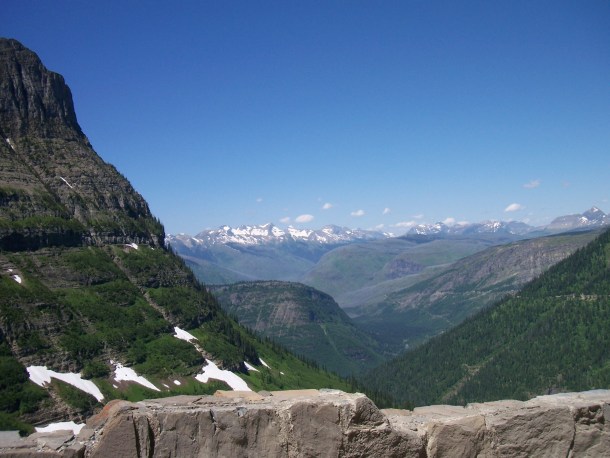
Kathy took this picture from the one of the overviews on the Road to the Sun in Glacier National Park.

There is not a flower that opens, not a seed that falls into the ground, and not an ear of
wheat that nods on the end of its stalk in the wind that does not preach and proclaim the
greatness and the mercy of God to the whole world. There is not an act of kindness or
generosity, not an act of sacrifice done, or a word of peace and gentleness spoken . . .
that does not sing hymns to God.

Thomas Merton, The Seven Storey Mountain (1948)

Winter Nights

Despite the title, this is a Christmas poem. I wrote it several years ago about the joy and anticipation I felt, as a child, at this time of year. This was embedded in family and community rituals I experienced growing up. In a consumptive and materialistic world, some of this has been lost. What I do is hold onto the memories.

We lived in an old house and it was often very cold. In the evenings, my mother and three older brothers went across the street to the church for evening mass. This was part of the rite of passage for me. In junior high, I joined them.

Many evenings, I sat by the heavily frosted window to watch my mother and brothers return. Some of those evenings were clear, the sky filled with stars, and sometimes the Northern Lights were part of Nature’s light show.

Breathlessly awaiting,

Through frosted window peering

Small children–

Soaking it in.

Heavens rippling–

Lights undulating;

A celebratory fury

An indisputable guide.

An old house speaking;

Nature answering–

The heavens crackling

Sweet symphonic music.

Earth’s floor–

Blanketed in white

Celestial colours shimmering

Capturing young eyes.

A vivid winter scene,

A sensual, sensory palette,

Reminding–

Christ’s Mass draws near.

I took this picture at the farm this past weekend. The sun goes down early here at this time of the year. They had just had fresh snow, with about 8-10 inches falling in one day, so the scene was still quite untouched.

somehow at peace

via somehow at peace

Matthew writes beautiful poetry and this poem is not exception. Somehow, I find myself going against the grain and moving upstream, searching for and finding peace. Perhaps, it finds me.

Mary Oliver wrote a book, Upstream, speaking of the poet’s need to move against life’s currents to find words and express themeslves. I find questions in poetry, sometimes explicitly formed. Other times, they hide and wait to be lifted up as I imagine what the poet asks. Perhaps, a poet’s task is to guide me as I move upstream.

I wonder what would it be like to take the poet’s sensibility into the world? In a world filled with busyness and distractions, I find that challenging. Yet, I find poetry and poetry-like prose spaces where peace emerges through the poet’s words and expressions of the unexpressible. How can I imagine the words in concrete ways?


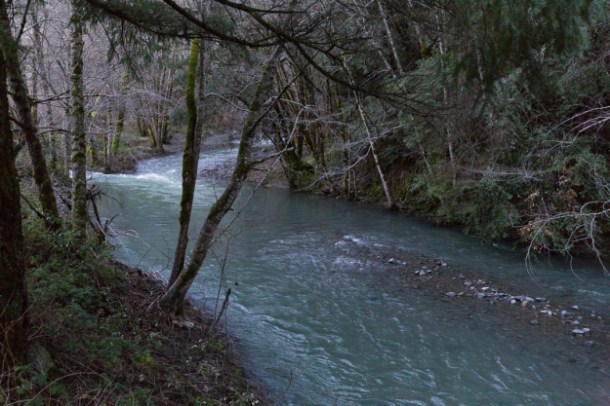
I took this picture as we travelled through the mountains about 1.5 years ago. The river is relatively calm and peaceful, but to move upstream against the current would be hard work, looking to be expressed. The word express means to force something out, usually against pressure.

The Other Kingdoms

In my recent reading, I came across this poem by Mary Oliver. I had not read it before, but found it spoke to me in deep ways.

The other day, on Facebook, I came across a Welsh saying: “Dwi wedi dod yn ôl at fy nghoed.” It means returning to my senses/regaining mental equilibrium or more literally I returnto my trees. I understand this as coming back to my roots and being mindful and present for each sentient and non-sentient being I encounter. The word Druid means oak-knower and the Druids lived in harmony and oneness in nature.

Where do I feel most comfortable? The word comfort comes from com meaning surround and fort meaning strength. In other words, living mindfully in the world has ethical implications. In Greek, ethos means character and also how music influences morals, emotions, and behavior.

As I listen to each of the other kingdoms, what music do I hear? How does the music influence and inform who I am, what I say, and what I do? How am I aware of the music and sounds I hear in these kingdoms?

Consider the other kingdoms.  The
trees, for example, with their mellow-sounding
titles: oak, aspen, willow.
Or the snow, for which the peoples of the north
have dozens of words to describe its
different arrivals.  Or the creatures, with their
thick fur, their shy and wordless gaze.  Their
infallible sense of what their lives
are meant to be.  Thus the world
grows rich, grows wild, and you too,
grow rich, grow sweetly wild, as you too
were born to be.

I took this picture several years in Jasper National Park. Kathy and I had gone for an early drive and hike. We parked and took pictures. As I turned, I thought I saw something move and walked towards the movement. The cow elk sat and chewed her cud. She was aware of us and, as I approached, I heard the soft sounds she made in completing the digestive process.

We pointed her out to others and cautioned them to be careful and quiet as they approached her.  After all, we are strangers in those other kingdoms.