Monthly Archives: March 2014

Awareness Knowing Itself

I just met Danna Faulds poetry. I used this poem as it has a sabbath quality to it. The words suggest stillness and non-reaching that mesh together. The real me is living inside stillness and non-reaching. Letting go affords  opportunities to locate myself in the effortless that emerges.

Settle in the here and now.
Reach down into the center
where the world is not spinning
and drink this holy peace.

Feel relief flood into every
cell. Nothing to do. Nothing
to be but what you are already.
Nothing to receive but what
flows effortlessly from the
mystery into form.

Nothing to run from or run
toward. Just this breath,
awareness knowing itself as
embodiment. Just this breath,
awareness waking up to truth.

The eyes are useless, when the heart is blind.

I recently found this blog. I am not sure why I missed it for so long, because it is well followed. The messages are simple and to the point like this one about opening our hearts which allows our eyes to see differently. The message is profound and similar to Proust’s quote about seeing with new eyes as we find new shores.

Read it Loud's avatarA Small Act Of Kindness Can Bring Smile On Million Faces

image

View original post

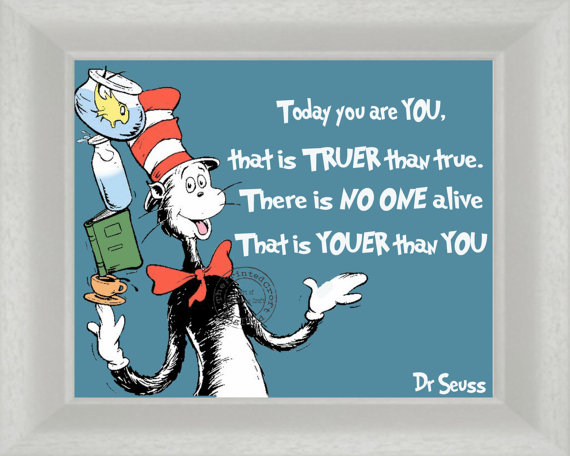
Today you are you, that is truer than true…

Dr. Seuss had a way with words that just make sense. I only recently came across a biography that suggested a purpose behind his writing was to help children be more socially just. It seems there is a message in there for adults.

Otrazhenie's avatarOtrazhenie

Cat3

“Be yourself; everyone else is already taken.”

? Oscar Wilde ?

😉

THE END

View original post

i thank You God for this most amazing

e. e. cummings was a poet who loved playing with language and its rules. We see this where he makes up words and excludes capitalization except for two words.

Poetry allows me to explore the world in new ways such as watching for the leaping greenly of trees and all those things which are yes. It is in the cracks that appear in poetry that light shines through.

i thank You God for most this amazing
day: for the leaping greenly spirits of trees
and a blue true dream of sky; and for everything
which is natural which is infinite which is yes

(i who have died am alive again today,
and this is the sun’s birthday; this is the birth
day of life and of love and wings: and of the gay
great happening illimitably earth)

how should tasting touching hearing seeing
breathing any–lifted from the no
of all nothing–human merely being
doubt unimaginable You?

(now the ears of my ears awake and
now the eyes of my eyes are opened)

Rumi About Today

Rumi is one of my favourite writers. His words resonate through the centuries and offer thoughtful insight and inspiration in the 21st Century. When we open our sails and catch the wind, life is much simpler and rewarding.

I Hope…

I Hope…

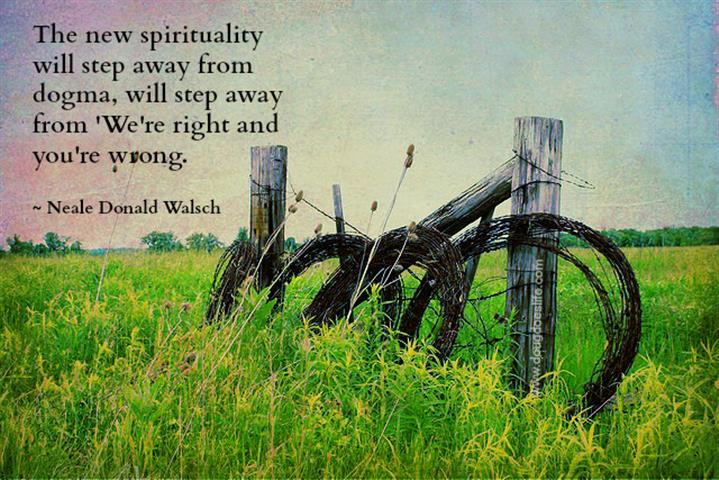
We need a spirituality that binds all humans together with their universe. Religion comes from the Latin ligio which means to bind together. In this sense, a new spirituality would bind us together and accept the differences that are so exquisitely revealed.

johnkurth.com's avatarDoug Does Life

old fence

View original post

Coyote

As I read this weekend, I found Peter Blue Cloud poem. Blue Cloud subtly describes an interconnectedness quite, often overlooked in daily life, that exists in the universe. When we step away from life’s busyness and impersonality and move slowly, gracefully and intimately we explore and connect in the world instead of being outside it.

Indigenous cultures, through tricksters, understand the world as a space humans live in. Coyote is a trickster in many North American aboriginal stories. Through coyote, Peter Blue Cloud reminded me I live in the world and not outside it or beside it. I made whole in this relationship.

Ecologically and ideally, classrooms, students, and teachers are nodes on vast interconnected webs across time and space. Seen this way, education is a reverent, holy space binding us together as it holds stories across cultures and generations. We hear the voices of all, particularly those who live on the margins.

by starlight hush of wind the owl’s voice,

the campfire embers glowing inner universe

by firelight smoke curls weaving faint the voices,

coyote voices faint the pain and smell the pitch,

fire, I sing you stars,

fire, I breath obsidian

& again the owl’s shadow voice leans back

into times past

slinging firs fire,

brittle spine bent bowed toward the fire,

voices low to murmur a child whimper,

deer fat sucked upon to gentle dreaming,

the mother her song the night cradles,

child, the owl, too, has young,

tiny hears and warmth of down,

& old man coughing guttural spit to fire,

young people giggle beneath hide fondlings,

soon to sleep,

again coyote voices drown the mind in a loneliness

of deep respect in love of those who camp

just up the hill,

& tiny crystals of tears spatter the dust,

my people,

legs cannot every carry me back to you,

soul that holds you

forever.

SILENT MUSIC

I spent a weekend a couple of years ago at a weekend retreat. There was some talking allowed, but it was generally not much more than a whisper. At the end I was surprised to hear my voice and how loud it sounded to me at that moment. The silence of the weekend showed me, as Simon suggests here, that stillness is a space where our soul opens up. That message is central to the writing of Parker Palmer and Thomas Merton. It seems at odds with the busyness and cacophony of our early 21st Century. Each morning I spend time in our small chapel meditating. It began with a struggle to achieve 30 minutes. Now, I walk out and realize I was there closer to an hour most days. Silence is an exquisite space to begin my day.

a success unexpected in common hours…

Thoreau had it right. We need to keep moving towards what we think makes a better world and a better life. Those two things are not mutually exclusive, but require a meditative stance the busyness of the world does not always allow. So, we must seize it even when the busyness is oppressive.

This is what you shall do

This is not a poem, but Walt Whitman used poetic language and deep meditative thought it qualifies. He used  language in ways that are politically incorrect today, but provided considerable insight into what it might mean to be a servant-leader and live in the world that way.

I become part of the world and it is embodied in me in such remarkable ways as I learn from the world. I think that is the counsel that this passage provides for me and asks of me.

“This is what you shall do: love the earth and the sun and the animals, despise riches, give alms to everyone that asks, stand up for the stupid and crazy, devote your income and labor to others, hate tyrants, argue not concerning god, have patience and indulgence toward the people, take off your hat to nothing known or unknown or to any man or number of men, go freely with powerful uneducated persons with the young and the mother of families, read these leaves in the open air every season in every year of your life, re-examine all you have been told at school or church or in any book, dismiss whatever insults your own soul and your very flesh shall be a great poem and have the richest fluency not only in its words but the silent lines of its lips and face and between the lashes of your eyes and in every motion and joint of your body…”