Monthly Archives: August 2014

Dancing With Your Skeletons

Dancing With Your Skeletons.

Yesterday, I made a short presentation about mindfulness in daily life at a small church 2 hours west of Edmonton. The pastor spoke about lightening our burden and not carrying the weight of the world in our backpacks. It is important to lighten the load.

Dyan makes  a similar point using the metaphors of dancing with skeletons. The Marianne Williamson provided a more Jungian approach in the quote about shadows.

There are reasons we are called and given voice in our lives. Sometimes, we do not see the reasons easily and we need to examine the weight in our backpack, dance with our skeletons, and know our shadow side. Being mindful is about knowing what to discard, what to retain, and making sense of it as we take the next step. I spent 20 years teaching and it was challenging at times, but I know those challenges were worthwhile and meant something. I was not always sure of the meaning, but I danced with the tunes being played in the shadows and my skeletons learned to dance as they came out of the closet.
Untitled (Where are you going)

We flew across Canada today, returning from holidays. We spent time in nature and exploring historical roots in Nova Scotia, Prince Edward Island, New Brunswick, and Maine but is nice to be going home.

We discussed that this is the first time we went on an extended holiday in many years. We spent over two weeks on the road and it is tiring. The days we stayed put and did not move from one place to another allowed us to recoup.

This poem reminded me of home’s importance. When we stop and take a moment to see the place we call home through new eyes, we see and feel its heart, the rhythm of what home means. Peter Levitt concluded it is in extraordinary moments  we find the place closest to our hearts.

I am reading James Hillman and he suggested we sometimes limit our thinking about the heart to a physiological pump. The heart serves a greater purpose in that we find our purpose within it and have courage to follow those purposes. It is being in the moment we find courage and confidence to feel at home in each moment. The heart is a rhythmic source for our moment-to-moment journeying. We are always going somewhere and it is important to be at home wherever we end up.

Where you are going

and the place you stay

come to the same thing.

What you long for

and what you have left behind

are as useless as your name.

Just one time, walk out

into the field and look

at that towering oak—

an acorn still beating at its heart.

Turning A Bad Day Into A Good Day

Turning A Bad Day Into A Good Day

We can probably add many other favourite activities which help lift us out of the doldrums. For me, it would be a walk in nature. The point is to think about what brings us joy and let that transform the day and our attitude for the day.

Tina Del Buono's avatarPractical Practice Management A Division of Top Practices

il_fullxfull_Fotor

There are times when our day goes from good to bad.  Possibly from an interaction with another person or a disappointment in an expectation.

Whatever caused the dark cloud to appear, it is important to realize that there are things you can do to make it disappear.  The last thing that you should allow is for your day to be ruined by someone or some event.

If you have never been to the Tiny Buddha website, I suggest you take a look.  It is full of uplifting articles and information.  I always find something that lifts my spirit when I read their posts.

I came across an article titled 10 ways to turn a bad day into a good day in 10 minutes or less it has some great ideas to try when your day isn’t going right or if you just need a pick me up.

Here are a…

View original post 84 more words

At the center of the Universe dwells the Great Spirit

We do not leave separate from the world and universe. We are firmly embedded in and it is in language we create separation. Not only are we embedded in the universe. It is embedded in us. We close our eyes and find ourselves.

Lou's avatarZen Flash


“The first peace, which is the most important, is that which comes within the souls of people when they realize their relationship, their oneness with the Universe and all its powers, and that at the center of the Universe dwells the Great Spirit, and that center is really everywhere, it is within each of us.”

~Black Elk

Tao & Zen

View original post

O Captain! My Captain!

The character John Keating, played by Robin Williams, used this Walt Whitman poem to set the stage for much of the movie, Dead Poet’s Society.

I do not dispute the original writing of the poem might literally be about the captain’s death and today it pays homage to Robin Williams. The movie did deal with the difficult issue of suicide. Having said this, I think it is important to consider a figurative meaning about teaching which was Keating’s profession in the movie so ably brought to life by Robin Williams.

I critiqued the movie from a teacher’s perspective while completing my Master’s degree. I spoke about the passion teaching brought into my life. I extend this to anything we choose to do. When we lose the spirit and voice that a vocation offers each of us, it is figuratively and literally a death, as well.

I recall using Parker Palmer’s quote about vocation and voice coming from the Latin vocere. Voice gives us life. Robin William’s portrayal of John Keating spoke deeply to me about holding true to the purposes we are called to in life.

                         But O heart! heart! heart!
                            O the bleeding drops of red,
                               Where on the deck my Captain lies,
                                  Fallen cold and dead.
O Captain! my Captain! rise up and hear the bells;
Rise up—for you the flag is flung—for you the bugle trills,
For you bouquets and ribbon’d wreaths—for you the shores a-crowding,
For you they call, the swaying mass, their eager faces turning;
                         Here Captain! dear father!
                            This arm beneath your head!
                               It is some dream that on the deck,
                                 You’ve fallen cold and dead.
My Captain does not answer, his lips are pale and still,
My father does not feel my arm, he has no pulse nor will,
The ship is anchor’d safe and sound, its voyage closed and done,
From fearful trip the victor ship comes in with object won;
                         Exult O shores, and ring O bells!
                            But I with mournful tread,
                               Walk the deck my Captain lies,
                                  Fallen cold and dead.

What the Soul Needs Now

Rumi’s poetry shines through the centuries with continuing wisdom. When we take time and while over the things emerging and appearing in the quietness of each moment, we gain so much more. Nature offers so much for us to consider. It is a place of warming, of continuous change, dancing, and mystery. It is not a mystery to solve but a mystery to live.

IdealisticRebel's avataridealisticrebel

One Human Gesture

You have a source inside you, a cool spring that sometimes stops flowing, frozen

or clogged with silt. A voice says, ” Consider the situation more deeply, my friend.”

Such advice is not idle. It is immediate  companionship with a soul artist like David,

who works iron until it melts and he can shape it. Spirit is the art of making what’s

blocked start moving again. When your body dies, give it to the death angel,

Israfil. If your heart feels numb and metallic, walk out into the sun, or whatever

the mystery is that makes your inner spring well up. There was once a sage who felt

this flow moving inside him. As he walked the garden that

was being restored with

spring water, he gave names to aspects of the vital dance he was doing: the animal’s

hungry agility and the connoisseur’s intelligent choice.

Blessings…

View original post 50 more words

Losing Myself

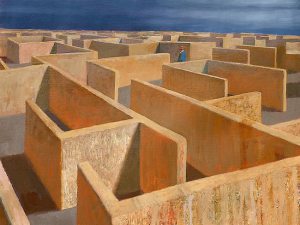
Words do not mean the same thing to each person. We often use words interchangeably as if they are synonymous with each other. An example is school and education. Education is a process of leading children and eventually letting go. School is a place. It comes from an Italian word having to do with leisure. It is hard to find our way through the labyrinth and convey the meanings we want in our communication. Sometimes it is the unspoken, the body-language, and the tone which help immensely.

Paul F. Lenzi's avatarPoesy plus Polemics

"Labyrinth" Painting by Jeffrey Smart From theaustralian.com.au “Labyrinth”
Painting by Jeffrey Smart
From theaustralian.com.au

what if my words
the turned paths of their penstrokes
create the labyrinth

View original post

Daily Reflection and Peace

Daily Reflection and Peace.

We face an important challenge with mindful practice. The article linked above addresses this challenge with questions. Questions are fundamental to being challenged. When I am challenged, I ask questions. I question what is happening and what is making me feel a particular way.

When I read many articles about mindfulness, I find the articles miss the key underlying aspect of mindfulness, being present in the world in ways that improve one’s life and in that improvement the world is continuously becoming a better place. It is not about a corporate bottom line in the way we understand a corporate bottom line. I guess the bottom line is harder to measure. I cann0t apply a number to it, report it to shareholders, and make a banker satisfied. What I can do is ask, “Did I make the world a better place in some way by becoming a better person?”

Can you imagine if 7 billion plus people worked on making the world a better place through their living? That might be a number that is unmeasurable, but that is OK. It would be so big it would not need to be reported. Its quality would speak for itself.

Smart Trust

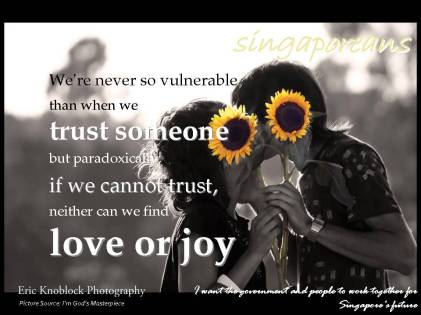
At the heart of every good relationship, those that endure, is trust. There is always something about that person or this group that makes us feel wanted and supported. This sense is evident early in the relationship and don’t seem to falter over time. Without real trust based on knowing that person or these people, eventually the relationship falters and we are left with dust.

Otrazhenie's avatarOtrazhenie

From http://thehearttruths.com

At different times in our lives and in different situations, most of us tend to look at our personal relationships, our teams, our organizations, and our governments through one of two sets of glasses: “blind trust” (naivete) or “distrust” (suspicion). At times, we may even go back and forth between the two.

These glasses have been created by a number of factors, including the way our parents and grandparents may have seen the world, the experiences we’ve had in our personal and professional lives, the people we interact with, the things we read, the things we watch, and the things we listen to. However, most of us don’t even realize that we have these glasses on.

Only as we understand how we’re seeing the world now can we truly appreciate the difference a new pair of glasses can make.

From http://quotes-pictures.vidzshare.net/

The reality is that there is a…

View original post 705 more words

The plain fact is…

This is a beautiful sentiment. Mindfulness is becoming the next big corporate thing. It is important that it does and does so in making the world a better place with more peacemakers, healers, restorers, storytellers, and lovers of every shape and form. When we measure success with these qualities, rather than making money and the material things we can own, the world becomes a better place. James Hillman suggested we put numbers on things that can only be described incompletely.

radiatingblossom's avatarRadiating Blossom ~ Flowers & Words

“The plain fact is that the planet does not need more ‘successful’ people.  But it does desperately need more peacemakers, healers, restorers, storytellers, and lovers of every shape and form.  It needs people who live well in their places.  It needs people of moral courage willing to fight to make the world habitable and humane.  And these needs have little to do with success as our culture has defined it.” ~ David Orr

View original post