Monthly Archives: October 2014

Letting Go

Letting Go.

The closing paragraph in the article linked speaks about the journey we are and the letting go that is required in the earthly part of the journey. There is a spiritual essence to our journey, one that takes us amongst the stars.

Parker Palmer writes extensively about spending time with our self in the quietness and silence of solitude. Here, we listen to what is being said to us by our spirit. We explore the depth and nature of who we are in relationship to the world. We let go of the busyness that surrounds even briefly feeling rested in the effort.

Joyce Sutphen shared the poem How to Listen. She describes the letting go listening requires.

Tilt your head slightly to one side and lift
your eyebrows expectantly. Ask questions.

Delve into the subject at hand or let
things come randomly. Don’t expect answers.

Forget everything you’ve ever done.
Make no comparisons. Simply listen.

Listen with your eyes, as if the story
you are hearing is happening right now.

Listen without blinking, as if a move
might frighten the truth away forever.

Don’t attempt to copy anything down.
Don’t bring a camera or a recorder.

This is your chance to listen carefully.
Your whole life might depend on what you hear.

quotation: Henry David Thoreau (above morality by points)

quotation: Henry David Thoreau (above morality by points).

Thoreau provided great insights in living off the grid long before we thought seriously about that idea. Living life based on a checklist of moral behaviour is nearly impossible. Living a life that we are good at is a growing experience.

We cultivate our lives like farmers and gardeners when we pay attention to our work, our living. It is in the moment that we realize and recognize the ethical needs. Certainly, there are rules to live by i.e. The Ten Commandments and The Three Universal Truths of Buddhism. When we live life and include those rules and truths, it is in living that we become who we are. It is in living we become good for something.

The Road Less Travelled….

The Road Less Travelled…..

“Once suffering is completely accepted, it ceases in a sense to be suffering” M. Scott Peck

The link provides a short summary of Peck’s wonderful work in “The Road Less Traveled.” His thinking ranks with James Hillman in examining spiritual growth as an essential aspect of living. Living is the continuous unfolding of character, who we are, and it is not predictable hence a title similar to Robert Frost’s The Road not Taken.

Life is not easy, although at times it can be. It is always about accepting responsibility for decisions we make as adults. Taking time and pausing at the junctions of decisions requires discipline and mindfulness that many struggle to find in a busy world. In those moments, when we pause, listen closely to our spirit, we build new disciplines that help us overcome the busyness to some extent. It is not perfect, but it is in imperfections we travel the road less traveled.

“Your daily life is your temple and your religion…”(Khalil Gibran)

“Your daily life is your temple and your religion…”(Khalil Gibran).

The quote from Kahlil Gibran is a wonderful reminder that daily life when attended to and tended to is our temple and religion. Do we choose to make daily life sacred? That is a question with no answer, because one is always being negotiated in living our lives in the moment.

The word religion shares the root with ligaments and suggests religion not as a divisive institution, but a way of living that binds us together in our humanness, humanity, and humaneness. We are more alike than we are different although we lose sight of that.

an ordinary day

an ordinary day.

Bert offers insight into the paradox we live with “the experiencer is the experience(d). While we are experiencing life, others, and the world, we are being experienced by life, others, and the world. We leave our imprint as we are imprinted in these mutual and reciprocal experiences.

Is it an ordinary day? More likely it is an extra-ordinary day. The extra is when we are able to experience each moment as it is, the present and transient now. Each experience is fluid and never returns fully even in retrospect. It becomes part of fictional person we are. Fictional and myth are parts of the reality we live, another paradox. Who we are is a character continuously being written and edited in the living and experiencing we encounter.

Lingering in happiness

Mary Oliver is one of my favourite poets and I try not to miss too many opportunities to share her work. She has such a way of revealing the extra-ordinary in ordinary events. Those events have deeper meaning that sometimes escapes our view when we do not ask questions that allow us to dig deeper.

drbillwooten's avatarDr Bill Wooten

“After rain after many days without rain,
it stays cool, private and cleansed, under the trees,
and the dampness there, married now to gravity,
falls branch to branch, leaf to leaf, down to the ground
where it will disappear — but not, of course, vanish
except to our eyes. The roots of the oaks will have their share,
and the white threads of the grasses, and the cushion of moss;
a few drops, round as pearls, will enter the mole’s tunnel;
and soon so many small stones, buried for a thousand years,
will feel themselves being touched.”

~ Mary Oliver

IMG_8780pano

View original post

Capturing The Moment — Papilio multicaudata Butterfly

Capturing The Moment — Papilio multicaudata Butterfly.

The image and the short verse in the link are spectacular. Martin Buber wrote complex prose which was poetic. His central point in his seminal work I and Thou was we become who we are in relationship with ourselves, others, and the world. He has a beautiful section about our relationship with trees. In our relationships, we become unique. We are not duplicates of anyone else.

We are who we are because of our relationships, the impact they have on us, and the sense we make of them. Sometimes, more often than not I imagine, the relationships go unnoticed and are taken-for-granted just as our uniqueness is. We become whats in the world rather than a particular who in the world. We might even fall victim to seeing ourselves as whats, as products, rather than that unique person who is only expressed in our particular whoness.

In a world driven by standardization and conformity to standards, it is difficult to find one’s voice and express one’s self through that voice.

The Shadow Element

This is a wonderful short verse which expresses the need for relationships with others and the world.

Accept Yourself

Accept Yourself.

In a highly materialistic and competitive world, it is hard sometimes to accept who we are. My reading and writing has taken me on a detour through this as I explore what teaching means to teachers in their forming identities. There is an essential part of who we are that often goes unexplored. We often reduce to what we do, how we do it, and why we do it, but rarely let the who be revealed.

It is almost Seuss-like with the question “Who is the who that teaches or lives this life?” When we slow down and move from moment to moment, it allows us to speak to our self and listen more deeply. This conversation is a rich and deep requiring stillness and mindfulness that the busyness of daily life often prohibits. When we slow down, we touch the essential spirit of who we are without completely knowing the answer. The questions we ask open space for living and creativity.

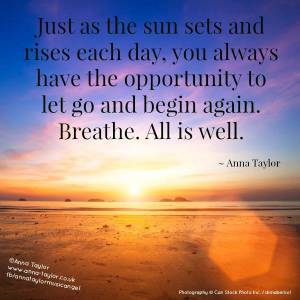
The sun will rise again!

Breathe. Al is well. There is not much else to say as we allow each moment to flow into the next realizing the transience of living.

purpleraysblog's avatarPurplerays

10432139_739477009421492_1952887222754074542_n
Photo credit: https://www.facebook.com/annataylormusicangel

“Just as the sun sets and rises each day, you always have the opportunity to let go and begin again.
Breathe. All is well.”
– Anna Taylor

View original post