Category Archives: Education

Freedom to choose

Between stimulus and response there is a space. In that space there is our power to choose our response. In our response lies our growth and freedom. ~Viktor Frankl Sometimes we make decisions in t…

Source: Freedom to choose

Viktor Frankl was a psychiatrist and neurologist who developed a school of psychiatry called logotherapy which is the search for meaning in life. He used his experiences as a Holocaust survivor to help inform his findings.

Humans choose their responses and seek life’s meaning. When we lose our meaning in life, we drift, feeling rudderless and without mooring. What keeps us grounded is the choices we make in life and the meaning we find in life. For example, becoming a teacher, a farmer, a parent, etc. gives life purpose and calls us to take action.

We express who we are through responding to the continuous calling, the vocation, that we find through various meaningful roles. When and if we find our life’s meaning, it allows us to make a difference in the world, for other sentient beings, and for the non-sentient elements of the world. We care for all aspects of the world and feel connected to it

Thomas Merton suggested some humans find there calling and others search throughout life, unable to find it. Perhaps, it is they do not hear what calls them and are unable to respond. Mindfulness and silence open spaces to hear the calls that give our lives meaning and make living meaningful.
lunes – Good morning everyone!!!

Are you ready for the start of another week?    My wonderful friend Mollie ( co-minister at the Baptist church in a community near here), has been  happily posting in a shared file we have .. IR…

Source: lunes – Good morning everyone!!!

This is a great link. I love the unique take on See No Evil, Hear No Evil, and Speak No Evil. When we speak words of kindness and act in kind ways towards others, we accomplish so much more. It takes time, but it is worth the wait.

As a teacher, I love to hear from students. They surprise me sometimes, as I do not remember them. However, they take the time to come over in an airport, a crowded grocery store, and a parking lot in a distant town. It reminds me that it takes time for those words and actions to resonate across time.

When we speak and act kindly, those words and acts resonate beyond the immediate moment and place we co-inhabit. It is a reminder of the impression we leave on the world when we take care.

Patience: Darkness and light, conscious and unconscious

Night after night, darkness enters the face of the lily which, lightly, closes its five walls around itself, and its purse of honey, and its fragrance, and is content to stand there in the garden, …

Source: Patience: Darkness and light, conscious and unconscious

The link includes a lovely picture of lily accompanied by a Mary Oliver poem, The Lily. The poem reminds me of the passage from Luke describing the lilies and wild flower, just being and growing.

Nature is what it is. There is a mindfulness in its creation and how it dresses. The lilies wait in their splendor for us to notice them and realize how they are always present. Nature and lilies teach us. To paraphrase Confucius, they open the door and we enter when we are ready.

Lingering in Happiness

Mary Oliver writes mystical and magical poetry. The words, the silences, and the images invoke and evoke something deep within my spirit. The etymologies of invoke and evoke, along with vocation, is “to call” in a ministering sense.

For me, teaching was/is a calling. I am still becoming a teacher. I reflect on what I experienced and arrive at new understandings about what those experience means. Emmanuel Levinas described an event as something that transcends time and place.

In that sense, becoming a teacher is an event as it continues to happen in many ways. Not only am I making sense of what that means and who I am, others do, as well. Even who I am becoming is an intersubjective event that shared with others.

Similar to the rain drops that slowly fall and nourish the oak, becoming some one is something that takes time. The drops and memories may disappear, but not vanish. They leave traces in the tree that grows and the person who is always becoming.

After rain after many days without rain,
it stays cool, private and cleansed, under the trees,
and the dampness there, married now to gravity,
falls branch to branch, leaf to leaf, down to the ground
where it will disappear – but not, of course, vanish
except to our eyes. The roots of the oaks will have their share,
and the white threads of the grasses, and the cushion of moss;
a few drops, round as pearls, will enter the mole’s tunnel;
and soon so many small stones, buried for a thousand years,
will feel themselves being touched.

Capturing Life’s Precious Moments

Yesterday at work I was given the privilege to escort an elderly gentleman from one of our treatment rooms to the waiting room where his sweet wife was waiting patiently for him.  The couple’…

Source: Capturing Life’s Precious Moments

Whatever our job, it should inspire us in extraordinary ways. Tina‘s post makes that point so well.

Thich Nhat Hanh reminds us that we find the extraordinary in the ordinary. When we pause, enjoy the moment, and our mindful, we share what is important to us with others. We make the world a better place.

When I taught, I loved being in the classroom with students and sharing with them in many ways. What I found important was that, when I enjoyed what I was doing, they enjoyed it, as well. One student told his mother that he could not understand why he enjoyed Social Studies that year as he had not before. She answered, “When the teacher is enthusiastic and lets you sense that, that is what happens.”


Roofless School

a dictionary of true mirages bird songs instead of geometry plus a clock with no hands many very magic felt pens words like primrose or rainbow painted on a huge whiteboard come into the roofless S…

Source: Roofless School

John Dewey suggested education is not preparation for life, but life itself. The poem, Roofless School, extends that metaphor to poetry.

Poets sit under the sky and experience the world in the most complete ways, but their poetry is subject to diverse interpretations. When I go back and read a poem, I find new meanings.

Each time we experience the world, we experience something new. Regardless of how familiar it seems to be, an experience can only be experienced once, in the moment I experience it. We re-experience the experience retrospectively and find new meanings in a new, reflective experience.

When I taught, I tried to begin each day fresh. It was not erasing the past, but I realized how the past informed my relationships with students, curriculum, and digital technology in the present moment. In those moments, being mindful and sensitive was paramount.

Walker

Antonio Machado reminds us that the path we follow is both made anew when we walk it and that once we step we can no longer go back.

We can look back and see where we came from, but that is a distorted image and, the further we move away from that point in time, the more distorted the memories we recall. We can reflect upon those moments and steps in a caring way that takes place only after the step.

It is in mindful walking that we make the path. There is an awareness and senstivity that only happens in the very moment we exist in, the present. Our presence is important in that moment as we step and live at that point on our path of life.

The mindfulness of our steps is important when we realize we lead others in their steps. They cannot walk the identitical path to our path, but the way we compose ourselves is a model for how they might live.

Walker, your footsteps

are the road, and nothing more.

Walker, there is no road,

the road is made by walking.

Walking you make the road,

and turning to look behind

you see the path you never

again will step upon.

Walker, there is no road,

only foam trails on the sea.

Even in Temples

Deng Ming-Dao writes how silence has sound. When I meditate, the sounds I hear strike me. Leonard Cohen’s quote echos that with “There is a crack in everything. That’s how the light gets in.”

Our senses cannot be totally shut off. We feel, hear, see, smell, taste, etc. even when we do not realize it. It is in the moments of quiet or darkness that we see sounds and light are always there. When we are mindful and attentive to our activities and senses, what we did not sense is there. It is in the mindful and meditative moments that the world–its allness–are there for us to soak in.

I told my students that much of the meaning to be found in poetry came in the pauses and silences between words, lines, and stanzas. Poetry touches our souls in those silences. When we pause and soak in the poetry, including the silences it shares with us, the meaning comes to life, only to change the next time we read the lines. In this sense, poetry, like life, is about living its meaning, sensing that is fleeting, incomplete, and fluid.

Even in temples
Where residents vow never to talk,
And silence is worshiped,
There is sound.
There are songs.
There is poetry.

Memories incarnated,
Lifetimes pulled through a thousand minds,
Cadences bearing time,
Rhymes connecting life,
Stanzas stacked like the generations.

Those who follow Tao write poetry.
Read poetry.
Live poetry.
And enter Tao through its lines.

nature is never finished. – robert smithson

out walking with the kinders we happened upon a white swan happy and in between seasons. the same as us.

Source: nature is never finished. – robert smithson

When I saw the title of Beth‘s post and read her poem, I thought what a profound moment. Nature has many stories to tell us and many ways of telling them that leave a mystery in each story. We are always between the moments and seasons that desribe the beauty of nature and who we are becoming.

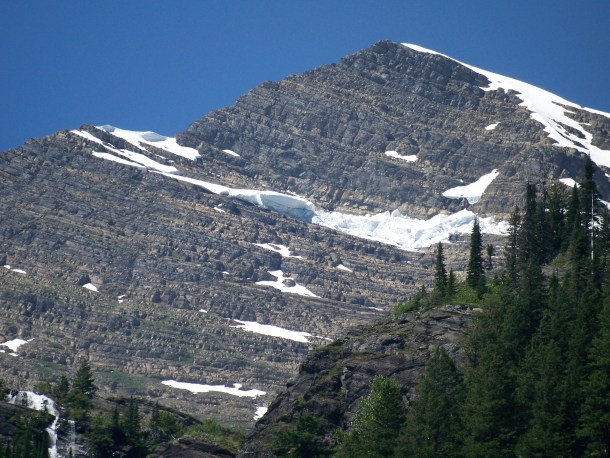
Several years ago, I took a picture of a mountain face. I did not have any idea why I took. It just spoke to me, like the swan in Beth’s poem. I used the picture in a presentation about eco-ethics, after I read an article about geologists who use the striations of a mountain to allow it to tell them its story, knowing it can never be completely told.

When I look at that picture, the mountain tells an even less complete story. The mystery in the story is what draws me back to the picture and maybe is what drew me, without knowing that, when I took the picture.

Mountain's Layers

Smart Cookie

Richard Schiffman counsels that when we are hunting for something, whether it is a cookie or wisdom, it is harder to find it. What we look for can sometimes be right there in front of us, but, in looking for it, we cannot find it. In fact, what we are looking for can end up in the most unexpected places: in a jar in Tennessee.

It is in mindful, sensitive being in the present moment that what we look for finds us. When we apply this to leadership and education, it is about listening to the world and others.

What we each seek is unique to each of us. When we tell the stories and speak the poems about what we seek, we do so finding the words that suit our stories and our poems. Leaders sense this and offer others space to find the words for their stories and poems. In finding and choosing our paths and our words, we can become the smart cookies we seek.

The fortune that you seek is in another cookie,

was my fortune. So I’ll be equally frank—the wisdom

that you covet is in another poem. The life that you desire

is in a different universe. The cookie you are craving

is in another jar. The jar is buried somewhere in Tennessee.

Don’t even think of searching for it. If you found that jar,

everything would go kerflooey for a thousand miles around.

It is the jar of your fate in an alternate reality. Don’t even

think of living that life. Don’t even think of eating that cookie.

Be a smart cookie—eat what’s on your plate, not in some jar

in Tennessee. That’s my wisdom for today, though I know

it’s not what you were looking for.