Category Archives: Education

9/11

“Where was I on September 11, 2001 as the planes hit the towers?” This is a question many of us of a certain age revisit each year to mark this date.

I was in my car driving to school when the news broke. It seemed surreal like H. G. Wells’ War of the Worlds must have. When I got to school, I found a TV, and we watched it in the classroom. I asked the students, the parent of the day, and educational assistant if they had friends or relatives in the US. About 3/4 of the group raised their hands. Our family has roots in the US with relatives and friends living there. Both my post-graduate degrees are from American schools and we spend a considerable amount of time in the US.

The play Come From Away is about people in Newfoundland opening homes and lives to over 7000 people who were on diverted flights.

On September 10, 2001, who would have thought it would happen the following day? Who could predict the consequences of the act of a handful of men that day and the lasting impact on lives? But, it did impact us in a 6 degrees of separation way. I did not know anyone in the planes or towers, but I know at least two others who knew someone on the flights. In today’s world,  interconnectedness is real and vivid.

Emblazoned in infamy,

Seared into minds–

Surreal and nightmarish.

Senseless and tragic,

Touching one–

Touching all.

Sharing grief,

Never fully healing–

Holding memories.

Loved ones gone,

Never forgotten–

Shedding tears.

In recent days, we have a Blues channel on to listen to music. Today, I heard this song by Bonnie Raitt and it touched me on this day. We missed seeing her several years ago as the tickets sold out before I got there.

The song raises a question for me: “How can learn we are more alike as humans than different?”

Speaking One’s Truth

I wrote this as I was making decisions about continuing to teach. There had been considerable upheaval as new administrators arrived and left, families left, and a friend and colleague retired. I found myself constantly in the midst of a storm with little or no control in how things might move forward. At a retreat in Oakland, I spent considerable time reflecting and journaling about the issue at hand, so this was not intended to be a poem and it took a year to write itself.

What I wrote was a summary of the past year and the struggle to ways to create in my teaching and be more present to my students. What I lacked was confidence in who I was and what I was enacting as a teacher, the performativity and improvisation essential to my teaching. I planned a lot in my teaching, but the depth of planning allowed me to improvise in ways that a lack of planning could not.

In The Book of Joy, The Dalai Lama and Desmond Tutu discuss how loss and fear lead to anger. What is important is during challenging times to try to be aware of what gives us meaning and hope in life. Although I would love to teach and be part of educating the next generation of teachers, I find it easier to accept that is not happening, focusing energies on writing and teaching in a new way. If the situation arose to teach and educate the next generation of teachers, I would consider it. What it is not doing is defining who I am and my life.

It’s emerging,

Happening–

Letting go;

Speaking with love–

Accepting the lost.

Sitting with questions,

Accepting uncertainty, incompleteness–

Taking stock;

Gazing inwards–

Feeling humbling hope.

Accepting extended hands,

Discarding baggage–

Walking forwards;

Living my truth;

Questing in each moment.

I took this picture in Arizona in March. It was the last of five I took. Each day, as I walked back, the cactus had bloomed one or two more flowers. The cactus and its flowers exist just to be a cactus and its flowers, beautifying the world. They remind me, even in harsh conditions, plants and animals flourish in their time.

As I was writing, Curtis Mayfield’s Move On Up played. It is appropriate. As we face challenges, we move on up and achieve, albeit an unpredictable, something.

Do Pigs Have Udders?

Part of educating for hope is “reading the world” in hopeful while living “in dynamic interrelationships” with others (Paulo Freire, Pedagogy of the Oppressed, p. 102). This means opening the world to eloquent questions without presupposed answers and without the threat of violence of any form. I used the quote in a recent book chapter I co-authored with a colleague from North Carolina. The book is to be published in late 2020 or early 2021. What does it mean to live in a world full of hope; a hope(ful) world.

My first day back from the retreat I posted about in Welcoming Differences and Gentle Rain I noticed the students were subdued. In the afternoon, I was alone, which was unusual. Without an adult and teaching three grades, it could be demanding. Other times, it provided interesting moments, and this turned into one of those moments.

I had contacted a substitute teacher I had used several years before and who was available again after completing a long term assignment for an ill teacher. As we talked about what was bothering me, the students told me they had not enjoyed the teacher. I was surprised, as he had seemed a good fit before. I asked for an example and they told me he had told them their conversation was inappropriate. This was unusual, as the students in this group were well-behaved and respectful. I asked them what the conversation was about and they told me, while completing some Science, one student asked “Do pigs have udders?” Apparently, this became a hotly debated topic and it was brought up again today.

I laughed. For me, it was funny and pointed to an irrevocable human truth: curiosity about the world we live in and eloquent questions leading to exploring the world and learning about it. We had serious fun as we talked about what udders were and their role in feeding offspring. I even phone Kathy, who was raised on a farm, and asked he. She was not sure, but thought it was a structural thing and pigs probably did not have it. We left it as an open question.

Simple question,

Emerging eloquently,

Not presupposing answers;

Fueling curiousity–

Energizing learning.

What does this mean?

Is it true?

Querying and questing;

Seeking to fill gaps;

Not with certitude;

New questions emerging.

With passing years,

Recalling that moment,

Smiling, chuckling;

Appreciating simple, provocative question–

Do pigs have udders?

As best as we can learn, they do and it was fun trying to figure it out. Adolescent children ask the darnedest things. Laughter is an antidote for difficult moments. Something I learned as a student teacher was a safe classroom allows children, youth, and probably adults to ask provocative questions with no preconceived answers. In the polarized world we live in, we have lost that assurance of safety and are reluctant to ask questions needing answers.

I will save you looking up the answer on the Internet. Pigs do not have udders. Udders are a reference to mammary glands on certain mammals and it has to do with their structure. I read a version of this poem for a group at a retreat in Wisconsin. As I finished, adults wanted to know the answer. I said I didn’t know and someone looked it up on the spot.

I don’t have a picture of a pig. Here is one of a bear I took in Waterton Lakes National Park. Bear and pigs are related, so it was as close as I could get.

One’s Story

I wrote this poem while I was at the retreat I mentioned in Companions. The retreat was long, tiring, and rewarding. Even though events of this nature can be stimulating, I also find I run up against blocks due to how tiring they can be. I mean tiring in a good way. We spend time in solitude, which is not something that is easy. When we were together, deep listening, another overlooked quality, was essential.

I wanted to share my experiecnce at the retreat here and questions that emerged. To write the poem, I let ideas percolate for a couple days. The word courage and heart are related. Courage comes from the French word coeur, meaning heart. The heart is the holding place for our truth and we often have to have the heart and courage to tell our story. Humans are the only beings capable of telling their story, flawed and essential to their being and becoming.

One’s courage;

Revealing one’s story,

So telling to tell,

Always emerging.

Narrating and sharing,

Telling one’s story;

Sharing to be heard,

Listening differently,

Listening deeply.

Words anew,

Illuminating, enlightening

Sharing sacred space;

Recognizing and loving.

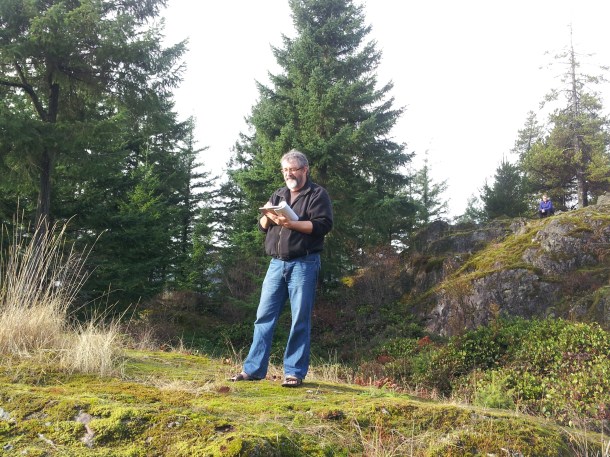
A colleague took this picture of me at the retreat. We spent a considerable amount of time on our own and in nature. It brings out the best in me.

Adventuring

When I write and post, I do not know where I go. Each step is its own process without rehearsal. Life is much the same, a process. We continuously transform: shedding cells, body parts atrophy, slow down, etc. Of course, children go in the other direction in some of these processes as they become quicker and more stable with time.

We often treat change as if it is something we can control. The truth is change always happens in overlooked and taken-for-granted ways. Living and writing are complex processes. The adventure is in the unpredictability of living and writing, not in unattainable certainty. We do not know what will emerge in the adventure.

Step at a time;

Moment by moment–

Without realizing,

Change happens.

Changing ever so gradually;

Gracefully–

Imperceptible,

Seeking no material reward.

This dancing,

Unrehearsable–

Hearing unheard music;

But, no sleight of hand.

Light radiating;

Illuminating this step–

This present,

A gift.

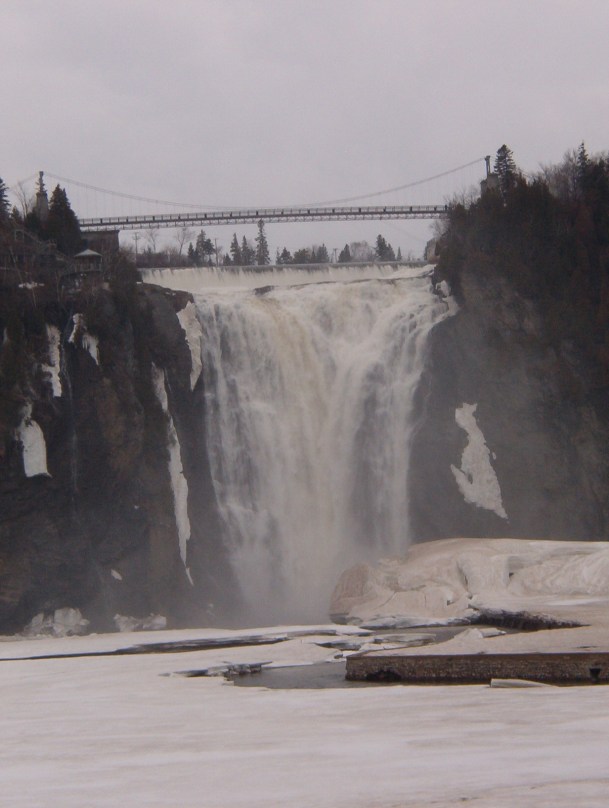
I took this picture in Quebec City several years ago. We saw Les Chutes de Montmorency during the summer, as well. What the picture does not reveal in summer or winter is a few hundred metres of the waterfalls the water appears calm and flows into the St. Lawrence River. I say calm, because we cannot see below the surface and know what is happening. Change acts this way. There is always something below the surface.

Life’s Calling

Originally, I called this life’s mission, but that seemed to neo-liberal and neo-conservative for my liking. I subscribe to life as a calling and vocation based on the writings of Thomas Merton and Parker Palmer. Vocation comes from the Latin meaning voice, so a calling and vocation gives each of us voice in living and has an essential spiritual aspect to it. What calls each of us animates and we respond in ethical and moral ways. I think we have lost much of this in our current world. Although John Dewey did not write from a spiritual context per se, he wrote about self-interest as words meaning the same thing. What interests me? Interest comes from the Latin esse, which also is the root of essence, which is related to spirit. What inspirits me?

I wrote the following poem after a professional development day. I found inconsistencies revealed in those days fascinating. They were uninspiring, exhausting, and counterproductive. They lack personal, responsible choice. Too often, adults are dependent on others to make their decisions, hence the concept of accountability overriding responsibility. It is hard to believe we think these adults can engage in educating children, youth, and adults in any meaninful ways. Our voices are repressed, suppressed, and oppressed.

At the end of that day, I wondered and reflected on the following questions: “Am I seeing this in a proper light? What can I do to further the process of learning as a role model for students and other adults?” Learning and teachng are relational processes between people and subject. Parker Palmer argues we put the subject of our learning in the middle of pedagogic conversations. In this way, we acknowledge each human present has a different perspective of the same subject.

For me, going to an event based on Parker Palmer’s work, a poetry workshop with David Whyte, an assessment workship, etc. were and are exciting. It animates. When I obtained my Master’s of Education and PhD, it was not to earn more money or move up some fictional career ladder. Education was and is essential. In the midst of a pandemic. I am exploring how we can return to the roots of educating for life, as opposed to schooling to produce a compliant and conforming workforce. I think the latter emerges from the former, rather than the other way around

Living fully,

Sharing fully,

(Ex)pressing one’s voice–

Singing one’s song.

Whetting wonder,

Planting seeds of awe,

Lighting fires–

(In)spiring to dance one’s dance.

Watering, feeding, nourishing,

Enriching, emboldening, becoming–

Embracing what brings life and joy–

(In)spiriting.

Civil Conversation Circles

In a world with a shortage of civil discourse, we have reduced talking to talking at people. There is a binary process where we say yes or no, turn on or off, incude or exclude people. This leads to thinking in limited ways about choices we face. In fact, I think we end up dependent on those we perceive to be in charge to make decisions on our behalf. This is happening in education as we try to figure out how to get students back in class. As I listen to politicians, educationalists, teachers, parents, etc., what impresses me is we have limited our choices to re-opening schools completly, often without adequate resources and human capacity. or some form of remote learning, as if these are the only two choices. Other choices e.g. home school seem to be excluded, understood as marginal.

Quite a few years, I introduced daily conversation circles. We used them to clarify from my perspective, Also, students shared what they wanted. At the beginning of the school year, each student introduced themselves. It seems small, but this often goes unattended in groups, regardless of where they exist. In my experience, each student, humans in general, want a voice in their learning and work; a voice often cancelled.

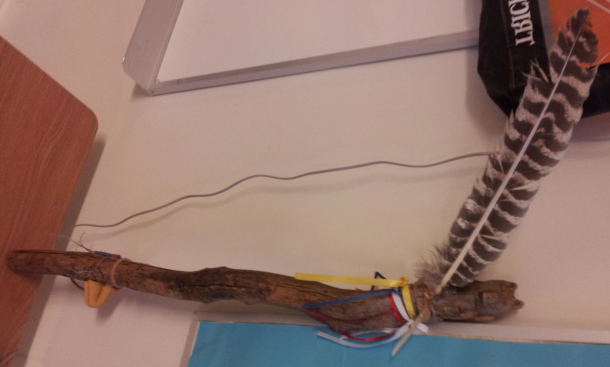
In our conversation circles, we used a ‘talking stick.’ The person with the ‘talking stick’ is the speaker and others listen. The ‘talking stick’ was a gift from a parent who was a member of a First Nation. It had some traditional meaning attached to its design. In an era of digital technologies, the talking stick reinforces a civilty of face-to-face conversation which we increasingly need in our world.

In our small school, parents played an integral role, including and not limited to meaningful teaching in the classroom, teaching complementary courses, teaching at home, etc. I shared about our small school in a post called Soul’s Choice, so won’t add more here. My experience and research suggests, after Kindergarten, parents and teachers are somehow on a different team. But, as one teacher proposed, “We share something; the love of a child.” In bringing children back together, we need to hear from two essential voices, often excluded from the conversation about teaching, parents and teachers.

The following is a poem that rattled around for a few days. It might be a bit rought around the edges, but I thought it needed to see the light of day.

Reducing to binary,

Simplifying choice–

0 or 1,

Silencing others.

Inserting ‘and’ in conversations,

Accepting ambiguity–

Listening with one’s heart,

(In)forming community.

Embracing each child,

Loving without conditions–

Parent and teacher raison d’être,

Centring our calling.

Educating,

Sharing purpose–

Making whole,

Caring and healing together.

The picture is the talking stick, which I still have. The following is a short description of the symbolism of the talking stick. The wood is driftwood which came from a local lake and reflects nature’s contributions to conversation circles. Someone carved a bear head into the top of the stick. In some traditions, the bear symbolizes courage, freedom, and power. The feather is from a hawk. Hawks are visionary and guide the person. The coloured ribbons represent the four directions in the circle. The parent attached a medicine bag. The medicine bag heals, guides and protects, and has materials or objects of value to its carrier.

Focusing on the Essential

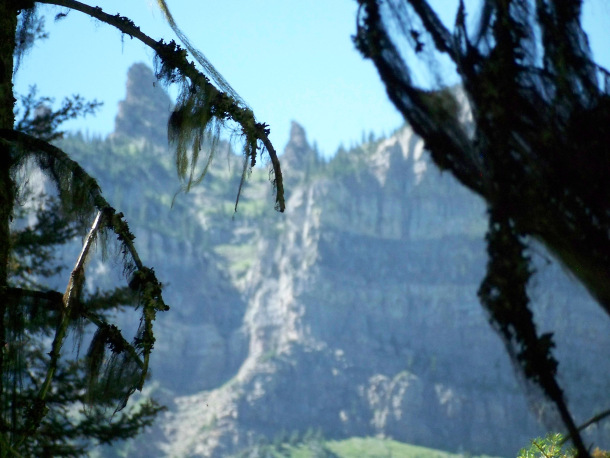
I took this picture in the summer of 2012. I sometimes keep blurry phots to remind me to try bring and keep things in focus. They remind me life is not always in sharp focus and there are times to step back, pause, and reflect. I think this is essential amidst multiple crises we are experiening: health, economic, and social justice. The health crisis accentuated and made more visible the social and economic fault lines in the world, including in so-called advanced countries. These inequities include the wars, hunger, Amazonian deforestation, accelerating climate change, etc.

It is essential to keep our eye not on the outcome to correct the injustices, inequities, and lack of democracy in the world, but on the processes that will overcome those phenomena. John Lewis in Across that Bridge: A Vision for Change and the Future of America stated

“You are a light. You are the light. Never let anyone—any person or any force—dampen, dim or diminish your light. Study the path of others to make your way easier and more abundant. Lean toward the whispers of your own heart, discover the universal truth, and follow its dictates. […] Release the need to hate, to harbor division, and the enticement of revenge. Release all bitterness. Hold only love, only peace in your heart, knowing that the battle of good to overcome evil is already won. Choose confrontation wisely, but when it is your time don’t be afraid to stand up, speak up, and speak out against injustice. And if you follow your truth down the road to peace and the affirmation of love, if you shine like a beacon for all to see, then the poetry of all the great dreamers and philosophers is yours to manifest in a nation, a world community, and a Beloved Community that is finally at peace with itself.”

The title could read any country in the world and the world itself. In focusing each of our light, we can gradually transform the world, making it better, more just, more equitable, and more democratic; a beloved community.

One’s spirit wearies;

One’s travails weighing heavy–

From within,

A voice calling.

Seeking peace;

Turning inward–

Posing prayerfully,

Listening for wisdom.

Paying homage;

Celebrating–

Carving paths through wilderness,

Cherishing one another.

Appreciating difference in unity;

Opening hearts to one another–

Reaching outstretched hands,

Grateful for common humanity.

I leave you with the video of the reading of the poem Invictus by Tybre Faw. What gives me hope is there are young people like this who are the light.


The Establishment

I wrote this poem when I was in high school, so some 50 years ago about the time I wrote Angry Young Poet. I updated both poems several years ago, but the underlying theme was evident in the orginals and I tried to keep that in mind in editing.

I found both poems as part of handwritten notes I dug through one weeked while Kathy was away. What struck me was how little things change. In fact, I might argue things are more entrenched than ever; the rich got richer and the poor poorer. One only has to consider the enormous wealth being accumlated by billionaires during the multiple crises we are experiencing.

Multiple crises, health, economic, and social justice, might give us room to re-imagine the world we want for our children and grandchildren. Instead, I am afraid we are more entrenched in our binary positions. Despite this, I hold out hope, not optimism and positivity, that we can begin the process of transforming the world to make it more democratic, socially just, and equitable. Part of my writing is revisiting an article I published in 2012 called Rocky River: Building a Learning Organization to re-imagine how we might educate children, youth, and adults. I begin re-imagining with a simple shift in language and call those engaged in teaching and learning educands a word Paulo Freire used in Pedagogy of Hope: Revisiting Pedagogy of the Oppressed.

More broadly, we can apply the learning organization’s principles to other institutions. Peter Senge cautioned it is hard work and takes time. Unlike other revolutionaries, Freire stated incremental change, based on dialogue between humans, was essential to transforming the world. Although Senge does not draw on Freire’s dialogic model, he suggests dialogue, with deep and caring listening, is at the heart of transforming institutions.

They know best for the rest–

Indoctrinating,

Not transforming,

Recalling non-existent good old days.

In disagreeing–

Simply wrong-headedness,

Daring to rebel:

Who are we to question?

Having it made–

Hunting and gathering,

Material wealth signaling success,

Repress, suppress, oppress.

Depending them to know best.

Maintaining existing order,

Demanding blind loyalty,

Failing to practice what preach.

I re-worded the poem again. I see how little changed in 50 years. Without a picture, I thought of which blues musician might best convey my message. I immediately thought of Nina Simone, who sings with edge. When I play her songs for undergrads, those with backgrounds of privilege demonstrate a visible level of discomfort.


Time to Rest

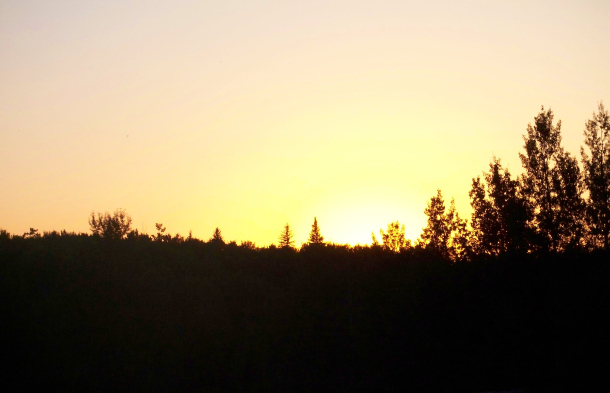
Kathy took this picture on a trip out to the farm several years ago. Her and others spent the day cleaning up the farmhouse and, as they finished, the sun made an appearance. It had been a gloomy day.

Sometimes, we feel this way in whatever we do as much as we might love it and feel called to it. I remember days in the classroom when I felt I inhabited a gloomy world. I love teaching and learning. They are parts of what make me whole and I think, to paraphrase Parker Palmer, make us each larger than life. When we love doing something or being in a particular relationships, we find voice and those things are inseparable from who we each are. On those gloomy days, it is essential to remind myself to be mindful and give thanks for the sunlight that shines into my life.

Fleetingly framed,

Golden skyline on horizon,

Invisble hand painting.

Thankful moment,

Golden light awash,

Bringing end to day.