Category Archives: Leadership

On Wiesel’s Night

Several years before I retired from teaching, a family approached me and asked me to tutor their child. Usually, I don’t tutor. Too often, it is about prepping for a test and is too rote for me.

After talking with the family and student, I agreed. The student was behind in some courses and wanted to be ready to transition from home schooling to attending high school full-time.

I helped her mostly in Math and Language Arts. I approach Language Arts through a cross subject method. I choose a novel and prepare a novel study. The students demonstrate comprehension, writing, grammatical, and other skills, instead of drill and kill method.

We discussed several possible choices for a novel study and decided on Elie Wiesel‘s Night, which is an autobiographical narrative of his time as a teenager in Nazi concentration camps with his family. I warned the student it was a tough read, but she insisted on the book. I asked her to read only assigned chapters and keep a journal.

The next week, she asked a question and confessed she read the whole book in one sitting. She asked if was OK to cry when doing a novel study. I said it was. We adapted and went through the book in a different way.

What I learned from that experience, is as hard as we try, as parents and teachers, there are things we cannot prepare children for in advance. This poem by Thomas E. Thornton, who was a teacher, echoed those sentiments. The poem is hard to read, but he wanted to impress upon students an appreciation for the horrors and violence of war.

I cannot teach this book.  Instead,

I drop copies on their desks,

like bombs on sleeping towns,

and let them read.  So do I, again.

The stench rises from the page

and chokes my throat.

The ghosts of burning babies

haunt my eyes.

And that bouncing baton,

that pointer of Death,

stabs me in the heart

as it sends his mother

to the blackening sky.

Nothing is destroyed

the laws of science say,

only changed.

The millions transformed into

precious smoke ride the wind

to fill our lungs and hearts

with their cries.

No, I cannot teach this book.

I simply want the words

to burn their comfortable souls

and leave them scarred for life.
 

A Vision

I am preparing to go to Miami of Ohio to attend a writing retreat. It is a curriculum theory called currere, which is the root word for curriculum and is an infinitive verb meaning to run the course of one’s life.

Currere overlaps with the methodology, hermeneutic phenomenology I used in my writing my dissertation. The two are reflective, explore one’s lived-experiences, and interpret them as data . After a person reflects on a lived-experience, they imagine how it might inform their teaching. They create a vision of the past and future in a way to create a vision for the present.

William Pinar compared this process to photographs that gain clarity as they develop. I had not used the method, but referenced Dr. Pinar’s work and he was on my dissertation committee.

Part of the process of preparing has been to use the method of currere. As I wrote, read, and reflected this Wendell Berry poem came into my view. Even though I am not teaching, I wanted to create a vision of what the wisdom might be like. As a young teacher, I can envision having used the process as a way to survive, to be still, enrich my teaching and student learning, and creating a memory native to my teaching. As Wendell Berry says, it was a paradisal dream. Hard work never is. It is its own reward.

If we will have the wisdom to survive,

to stand like slow-growing trees

on a ruined place, renewing, enriching it,

if we make our seasons welcome here,

asking not too much of earth or heaven,

then a long time after we are dead

the lives our lives prepare will live

here, their houses strongly placed

upon the valley sides, fields and gardens

rich in the windows. The river will run

clear, as we will never know it,

and over it, birdsong like a canopy.

On the levels of the hills will be

green meadows, stock bells in noon shade.

On the steeps where greed and ignorance

            cut down

the old forest, an old forest will stand,

its rich leaf-fall drifting its roots.

The veins of forgotten springs will have

            opened..

Families will be singing in their fields.

In the voices they will hear a music

risen out of the ground. They will take

nothing from the ground they will not

            return,

whatever the grief at parting. Memory,

native to this valley, will spread over it

like a grove, and memory will grow

into a legend, legend into song, song

into sacrament. The abundance of this

            place,

the songs of its people and its birds,

will be health and wisdom and indwelling

light. This is no paradisal dream.

Its hardship is its possibilities.

Silver Star

When I looked for a poem, this one by William Stafford found me. Mountains appear to be immovable and unchangeable, yet as people do they do so without immediate notice. Yet, when we revisit them, we realize the changes that occurred.

In the case of teachers, Parker Palmer speaks about asking the question “who is the self who teaches?” We are each teachers in our own particular ways, so asking this question is essential. We often overlook this question in pursuit of easier to answer questions about the what, when, where, why, and how.

When we ask who we are, we explore the values that anchor us in living life. In times of crisis, those values guide us and help us through those tough times. Attending to them in mindful ways each day as a gardener would her/his garden grounds us in them in times of real need. They have spiritual meaning that come to life in living and expressing them daily through who we are as a human being.

If we serve our values well, “we will hear the world say, ‘Well done.'” The patience of living a good life, which in Aristotle‘s terms, is indefinable will be the reward. Like a mountain guiding us on our journey, the values we live and express guide us and others on a shared journey.

To be a mountain you have to climb alone

and accept all that rain and snow. You have to look

far away, when evening comes. If a forest

grows, you care; you stand there leaning against

the wind, waiting for someone with faith enough

to ask you to move. Great stones will tumble

against each other and gouge your sides. A storm

will live somewhere in your canyons hoarding its lightning.

If you are lucky, people will give you a dignified

name and bring crowds to admire how sturdy you are,

how long you can hold still for the camera. And some time,

they say, if you last long enough you will hear God;

a voice will roll down from the sky and all your patience

will be rewarded. The whole world will hear it: “Well done.”

How do I listen?

When I began to look for a poem today, I chose one by Hafiz. It reminds me of the following Buddhist proverb:

How do I listen? The question is eloquent, as it does not have a fixed and expected answer. It suggests being present and mindful as another person speaks and as the universe speaks to me. Hafiz counsels me to treat what the other says as a gift to be cherished as the last words of a Master.

It is when I listen that the teacher appears. I am ready for the teachings of the Other. Emmanuel Levinas capitalized other to point out an unconditional responsibility for the Other. How I listen reveres the Other, who is my teacher in that moment.

How

Do I

Listen to Others?

As if everyone were my Master

Speaking to me

His

Cherished

Last

Words.


From “The Rock Will Wear Away”

Today on the way home, we stopped the Okotoks Erratic or Big Rock. In the Blackfoot language, it is Okotok, which means rock. It weighs about 16, 500 tonnes (18, 000 tons), is about 41 by 18 metres (135 by 60) feet wide, and is about 9 metres high (30 feet).

During the Pleistocene Era between 12, 000 and 17, ooo years, a glacier dropped the big rock in what is now prairie just below the foothills and Rocky Mountains. There are two rocks and on the flat of the prairie they seem erratic and out-of-place. The size of the rocks speaks to the power of nature.

I have a question about this rock. How big was it when the glacier dropped it in its place?

Holly Near is a singer-songwriter. The following is a short excerpt from one of her songs. As she proposes, the rock appears stronger than water. But, is it?

Humans and water are resilient, they come back time and again. Our fragility makes us vulnerable, but, at the same time, provides durability. Like water slowly eroding a large rock down into smaller and smaller bits, humans, through their mindful and collective efforts, can bring about dramatic change to the world.

Can we be like drops of water falling on the stone

Splashing, breaking, disbursing in air

Weaker than the stone by far but be aware

That as time goes by the rock will wear away

And the water comes again

Mindful

Today’s post is short. I was hooded today and the poem that ran through my mind was Mindful by Mary Oliver. This is the ultimate poem for me on a day like today. There is always something that can more or less kill me with delight.

Several speakers today reminded us that it is not the extraordinary we are looking for, but the ordinary that propels us into the extraordinary. Being mindful and attentive in and to the world is an essential element in being propelled.

Everyday
I see or hear
something
that more or less

kills me
with delight,
that leaves me
like a needle

in the haystack
of light.
It was what I was born for —
to look, to listen,

to lose myself
inside this soft world —
to instruct myself
over and over

in joy,
and acclamation.
Nor am I talking
about the exceptional,

the fearful, the dreadful,
the very extravagant —
but of the ordinary,
the common, the very drab,

the daily presentations.
Oh, good scholar,
I say to myself,
how can you help

but grow wise
with such teachings
as these —
the untrimmable light

of the world,
the ocean’s shine,
the prayers that are made
out of grass?

The Contract: A Word from the Led

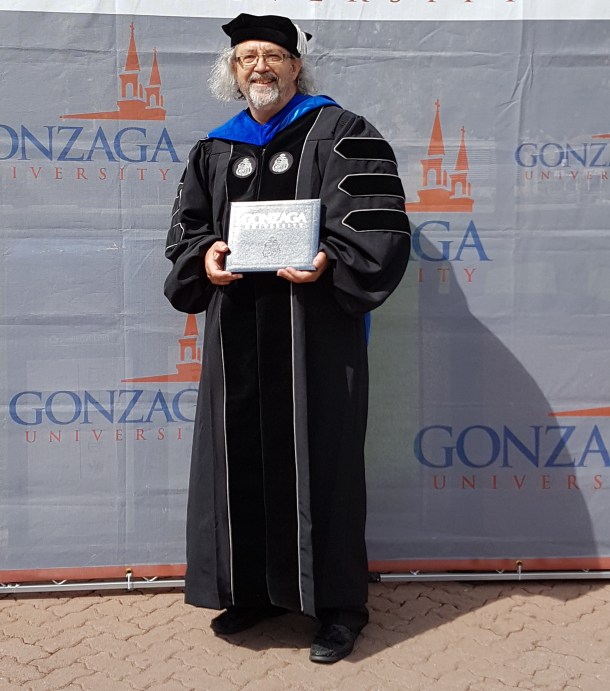
William Ayot wrote this poem as a reminder to those who aspire to lead that there are people who are led. This weekend is important to me as I am being “hooded” for my PhD in the Philosophy of Leadership Studies.

In my dissertation, I argued teachers are leaders. To educate means to lead out of childhood and youth in a caring way. Pedagogy is to lead children. The leading teachers undertake is serving and transforming the world they inhabit, preparing a new generation for the unknown beyond the walls of the classroom and the moment.

I understand teaching as a vocation and calling that gives me voice. It is expressing who I am at the very core of my being and becoming. It was a dream I pursued for years and shared with others. Hannah Arendt said action transforms the world in ways we cannot anticipate and know. Unlike work and labour action transcends time and space. Teaching was never work for me and it was always voluntary.

As a PhD in the field of leadership it is essential to recall this as I move forward and become involved in teacher education at the university level, working with teachers, and writing about the leading teachers undertake. Andragogy is leading adults.

And in the end we follow them –
not because we are paid,
not because we might see some advantage,
not because of the things they have accomplished,
not even because of the dreams they dream
but simply because of who they are:
the man, the woman, the leader, the boss,
standing up there when the wave hits the rock,
passing out faith and confidence like life jackets,
knowing the currents, holding the doubts,
imagining the delights and terrors of every landfall;
captain, pirate, and parent by turns,
the bearer of our countless hopes and expectations.
We give them our trust. We give them our effort.
What we ask in return is that they stay true.

Fluent

I am on the road the next two days so I am tired at the end of relatively long day. John O’ Donohue‘s poetry has a light feel to it, much like a small river that flows easily along its way.

He often wrote blessings and a blessing is something that catches us by surprise. It unfolds in surprising ways, never taking the same path twice. Like the river and, as expressed by Heraclitus in his quote: “No man ever steps in the same river twice, for it’s not the same river and he’s not the same man.”

We cannot live the same moment twice, because we cannot return to it and, even if we could, we would not be the same person. We would return with an understanding of what it meant to step in the river in the first place.

The beauty of living is filled with the richness of uncertainty and complexity. The best we can expect is to be mindful of each moment as we live in it and as it unfolds.

I would love to live

Like a river flows,

Carried by the surprise

Of its own unfolding.

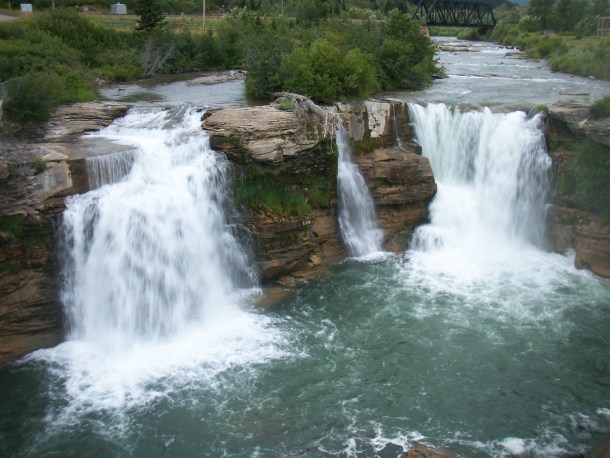
We took this picture several years at Lundbreck Falls. Today, I drove past them and, like me, the river has changed.

For the Children

Gary Snyder wrote this beautiful poem about children being adult’s saving grace in the world. What is new fascinates and they wonder about the newness. For a small child, most of what they encounter is new and calls out to the child to explore and wonder over it.

There is zen and mystical quality to the poem with a reference to meeting in peace somewhere in the future. The essential part of peace is staying together, learning the flowers, and going lightly.

It is not learning about flowers, but learning flowers and going lightly, which I think will take a different way of teaching. This is not a new way of teaching. Instead, it is more likely we have forgotten it, being together and living gently in a world that only has so much to offer us.

The rising hills, the slopes,
of statistics
lie before us,
the steep climb
of everything, going up,
up, as we all
go down.

In the next century
or the one beyond that,
they say,
are valleys, pastures,
we can meet there in peace
if we make it.

To climb these coming crests
one word to you, to
you and your children:

stay together
learn the flowers
go light.

“Natural objects should be sought and seen as they are, not to suit observers, but respectfully as if they were divine beings.” — Goethe

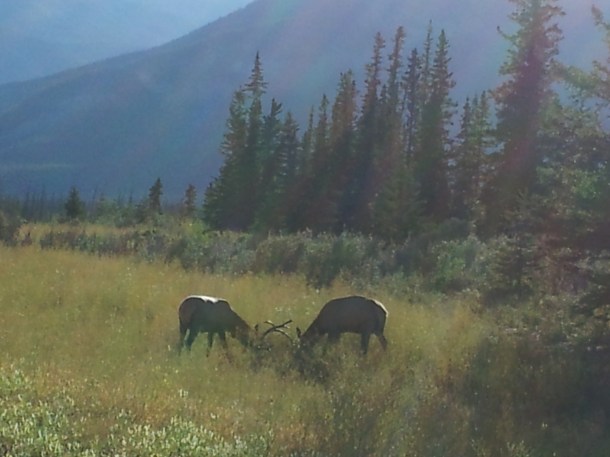
I took this picture several years ago as I drove through Jasper National Park. It was late August before the rutting began, but the bulls were trying to assert dominance. Despite this, people ran into the ditch and talking loudly. I kept my distance and got some great shots from about 100 feet away. As Gary Snyder counseled, I went light.

There was a time I would reject those

Ibn ‘Arabi wrote “My religion is love. Whichever the route love’s caravan shall take, That shall be the path of my faith.” He speaks of a journey and shared path.

I recalled the statement attributed to the German Lutheran pastor Martin Niemöller:

First they came for the Socialists, and I did not speak out—
Because I was not a Socialist.

Then they came for the Trade Unionists, and I did not speak out—
Because I was not a Trade Unionist.

Then they came for the Jews, and I did not speak out—
Because I was not a Jew.

Then they came for me—and there was no one left to speak for me.

When we reject others because of ethnicity, religion, skin colour, politics, gender, etc, we lose sight of what makes us human, our common humanity. This humanity is deeper than any of the markers we have that identify and group us.

Shunryu Suzuki compared mindfulness to a compassionate space that expands and contracts depending on the needs of the moment and the people we share that space. When we reach out to others, we acknowledge we are pilgrims on a shared journey where we speak for and on behalf of each other.

There was a time I would reject those
who were not my faith.
But now, my heart has grown capable
of taking on all forms.
It is a pasture for gazelles,
An abbey for monks.
A table for the Torah.
Kaaba for the pilgrim.
My religion is love.
Whichever the route love’s caravan shall take,
That shall be the path of my faith.

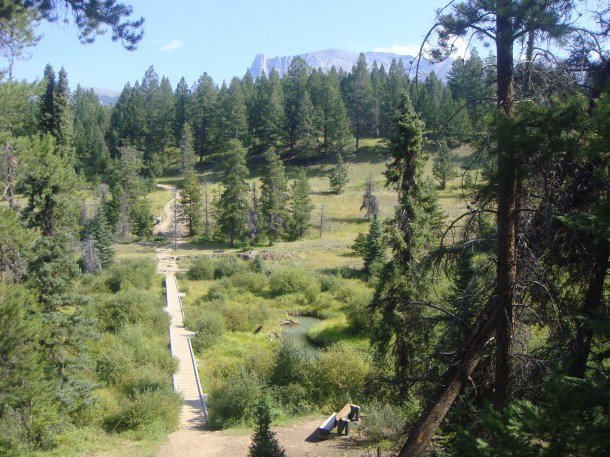
I took this picture in Jasper National Park. Kathy and I walked for several hours on this path just enjoying being there.