Category Archives: Poetry

One Bourbon

via One Bourbon

Matthew posted this poem in response to my pressing of an earlier post. I included a video by John Lee Hooker of a song called One Bourbon, One Scotch, One Beer.

Matthew wrote a poem that embraces how a blues singer might go about writing a song. I find blues songs are never complete. I listen to one version of a song, even by the same performer, to find it is slightly different. Sometimes it is quite different.

Although he is not a blues singer per se, I enjoy Jimmy Buffett, as well. He does a Lord Buckley song called God’s Own Drunk. It is funny, charming, and Buffet does his version as a kind of talking blues.

I tried several times to upload the video, but failed. I held my mouth just right and it did not work. Here, is the link to God’s Own Drunk.


The Spring Paradox

I am in Spokane now,  reading, writing, and preparing for two presentations at the end of the month. It is unseasonable here, but it is at home, too. Rain and snow go with the low temperatures.

I wrote this about the paradox we experience in spring. It is a time of rejuvenation and resurrection, literally and figuratively, yet it is not always easy to see, unless I watch closely. Each day, as I walk, I see signs that contradict each other: sullen skies, a glacial wind, flowers showing, and robins gathered to feed.

Leaden, sullen rain-heavy skies,

The wind glacial;

Absent a lover’s warm touch,

With precision, it cuts through cloth,

Touches skin with icy fingers.

Have faith the calendar counsels

Nature speaks in other ways;

Daffodils reach through the earth,

Robins find food washed up on the sidewalk,

I hear spring is here.

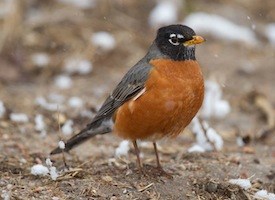
I took this picture of the first robin I saw last spring. There was still snow. The robin posed for me, more interested in finding food than fearing me.

Where Words Fails

via Where Words Fail

Thank you to Misifusa for this wonderful post.

I have not posted for some time. This seemed like a good way to begin again, afresh. When I was growing up, we listened to a wide variety of music, including Nat King Cole, Louis Armstrong, and Ella Fitzgerald. I thought it was the norm and grew into a die-hard blues fan, attending concerts by Willie Dixon, John Lee Hooker, and King Biscuit when they traveled to Canada.

As an adult, I saw BB King, John Mayall, Etta James, Ruthie Foster, Taj Mahal, The Blind Boys of Alabama, and others. An American friend told me this was not the norm in the US. He did not have the same opportunities to see these performers as I did or, if he did, it was long after they were in their primes.

The Hans Christian Anderson quote fits well “where words fail, music speaks”. Music breaks down barriers without realizing they are coming down. As a Canadian, I had freedoms I took-for-granted, like the music I listened to and the concerts I attended. When I taught, I played a wide variety of music each morning. It ranged from the blues to jazz to country to folk to old rock and to more contemporary music. Students enjoyed it and it surprised them when they heard me play old Johnny Cash, the blues, and rock-a-billy.

Music is colour-blind or, better yet, music is blind to colour.

I like this particular John Lee Hooker song, which I first heard in the early 1970’s. George Thorogood plays it in most of his concerts in tribute to John Lee. Enjoy.


Merry Christmas

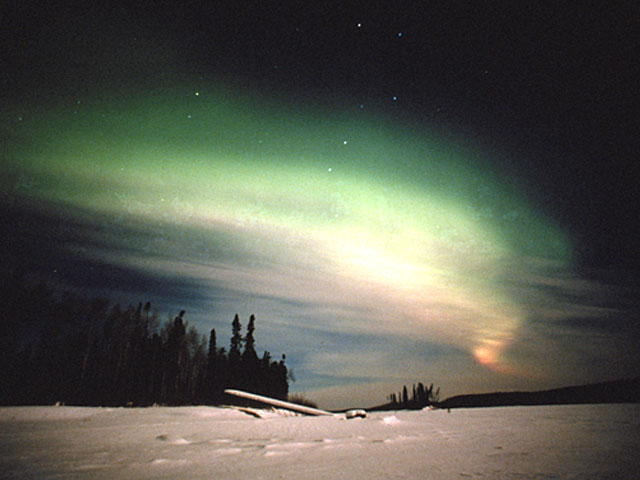
I wrote this poem several years ago about the magic provided by the Northern Lights (Aurora Borealis) and Christmas. What message was in those celestial colours and sounds? As a child, I thought the sky talked to me and told me a creation story.

I grew up in Northern Alberta and Christmas was a special time. I recall cold winter nights. I mean they were cold–almost minus 40 at night. Our windows upstairs were almost completely frosted over. On moonlit nights, the light kept me awake or that is what I told others.

During Advent, my mom and older brothers walked across the street for evening Mass. The younger ones, including me, went to bed. I did not fall asleep right away and would watch out the window for them to come home. I thought no one saw me, but my Mom would come up and tell me to go to bed.

At that time of year, I recall is the Northern Lights and how you could hear them as well as see them light up the sky as they danced across the sky. We don’t see them very often in Edmonton with the urban light.

When we spend time at the farm at Christmas, we hear and see them again. On cold nights we hear the train (about a mile away) and it sounds like it is coming through the house.

Small children–

Breathlessly awaiting,

Peering through frosted window

Soaking it in.

Heavens rippling–

Lights undulating;

A celebratory fury

An indisputable guide.

This old house speaks;

Nature answers–

Heavens crackle

Sweet symphonic sounds shimmering.

Earth’s floor–

Blanketed in white

Celestial colours speaking

Capturing young senses.

A vivid winter scene,

A sensual, sensory palette,

Reminding us–

Christ’s Mass is here.

pic_wonder_northern_lights_lg

Wildness

via Wildness

Michele‘s post reminded me of poems by two of my favourite poets.

Environmentalists refer to Wendell Berry and Mary Oliver‘s poems. An educated guess is that Henry David Thoreau, who Michele quotes, informed their writing.

Wendell Berry wrote in moments of despair he “comes into the peace of wild things who do not tax their lives with forethought.”

Mary Oliver ends Summer Day with the following question: “Tell me, what is it you plan to do/ with your one wild and precious life?” Paradoxically, the question is an answer to her eloquent questions about who created nature.

Nature has a way of being and providing us with lessons for life. It is in meditative moments, when we just are, we grow to understand what that can mean. We grow and value what is essential not to us, but to those who come after us.

“We do not inherit the world from our ancestors, but borrow it from our children.”

A Book Lover’s Tag

via A BOOK LOVER’S TAG 

Diana passed on a tag and posed 13 questions to her followers with this re-blog. The best part of the her post was the John O’Donohue blessing about how our words make the invisible visible through our personal artistry and creativity.

  1. Do you have a favourite place to read? No, I read everywhere but in vehicles.
  2. Do you use bookmarks or random pieces of paper? I use both and more. I turn corners, highlight, and use sticky notes with notes.
  3. Do you eat or drink while you read? I drink tea, but rarely ever eat while I read.
  4. Do you listen to music or watch TV? There always seems to be music playing, but I find the TV distracting. Music fades into the background.
  5. Do you read one book or several at a time? I do both. I find reading one book helps me focus, but I cannot help reading more books.
  6. Do you prefer reading at home or elsewhere? There is a small coffee shop a few minutes from the house. The baristas and owners welcome me almost each day.
  7. Do you read silently or out loud? I read silently most of the time, but, when I read something of particular interest, I read it to Kathy. I enjoy reading to our grandson when we visit with him.
  8. Do you read ahead or skip about? I skip about. I like to read the index in a book and see who references are if it is a book I use for my writing. I cheat and read ahead in non-fiction.
  9. Do you break the spine or treat it like new? I buy many of my books used, so they come well used. If I get a new book, I mark it up inside, but treat it like new.
  10. Do you write in books? I mark them up with a felt marker and make notes for future reference. The exception is when I read non-fiction and poetry.
  11. What books are you reading now? I am reading The Company of Strangers by Parker Palmer.
  12. What is your childhood favourite book? I don’t have one, but I remember reading Little Golden Books and having them read to me as a special part of my early reading.
  13. What is your favourite book of all time? That is like choosing who my favourite child is. I think it depends on mood and time. I enjoy great poetry i.e. Mary Oliver and Wendell Berry. I read books about spirituality i.e. Parker Palmer. I read about education i.e. William Pinar, John Dewey, and Madeline Grumet. I read about philosophy i.e. Aristotle, Hannah Arendt, and Paul Ricoeur. My favourite fiction writers are John D. MacDonald and Paulo Coehlo.


How Quotes Enoble Us

via How Quotations Ennoble Us

I love quotes. They make me reflect about meanings that are not clear. They raise eloquent questions that have no pat answers. They inspire me. Balroop provided three quotes that underscore these points.

Poetry is like quotes and I find many quotes from poems and poets. There are spaces between words, lines, and stanzas I can stand in and wonder.

I leave you with quotes that inspire me to think deeply and ask questions about the meaning of my life.

The first two are from Mary Oliver.

“Tell me, what is it you plan to do with your one wild and precious life?”

“Said the river: imagine everything you can imagine, then keep on going.”

The following is from Wendell Berry.

When despair for the world grows in me
and I wake in the night at the least sound…
I come into the peace of wild things
who do not tax their lives with forethought
of grief. I come into the presence of still water.
And I feel above me the day-blind stars
waiting with their light. For a time
I rest in the grace of the world, and am free.


Love says, there is a way..

Source: Love says, there is a way..

Karen‘s post included quote from two of my favourite poets: Hafiz and Rumi. Love is the essential idea behind the quotes.

The second Hafiz quote says fear is the cheapest room in the house. As we lift each other up with our love, we expand the rooms in the house we can each live in. Loving each other is a gift and a serving of each other. It can make people and the world whole again.

Joining the Circus

Yesterday, this poem by Mark Nepo found me. I was checking some emails and a site I subscribe to had this poem on it.

For the first time in 30 years, I will not teach and/or learn in formal way this fall. It crept up on me. Yes, I want to teach. I prefer that to joining a circus. In a sense, I am joining the circus. The theme of the poem is how to deal with ups and downs in life. I applied at several universities and received one interview, but came up short.

My challenge is what will we I do in lieu of teaching in some conventional way? As Nepo says, I ready to kiss anything as I hover like a mystical molecule between one stage and another. Like the dozen beginners, I am learning how to juggle and have to begin somewhere.

Each day, I focus on reading and writing and hope to publish in academic journals.  A colleague suggested I write and shed a different light on teaching. As well, I may take some of my poetry and bundle it together in a book. Perhaps, my smile will be so magical I will asked to teach something I did not expect.

I just saw a handwritten note from

Galileo. He was under house arrest

for believing we’re not the center of

everything. Now behind me, in the park,

a dozen beginners, of all ages, learning how

to juggle. We have to start somewhere. The

young man who’s so magical at this is asked

to instruct. He smiles, “You have to keep

trying. Just not the same thing.” Earlier,

I leaned over a letter from Lincoln to a

dead soldier’s mother. This, just weeks

after losing Susan’s mother, sweet

Eleanor. I keep saying her name to

strangers. You see, we all have to

juggle joy and sorrow. Not to do it

well—we always drop something—but

when the up and down of life are

leaving one hand and not yet land-

ing in the other, then we glow, like

a mystical molecule hovering between

birth and death, ready to kiss anything.
 

The Great Paradox

As a teacher, I wonder how we keep children safe from themselves and, at the same time, not curbing their innate curiosity and imagination.

Pablo Picasso said “Every child is born an artist. The challenge is to remain an artist after you grow up.”

Albert Einstein stated “Imagination is everything. It is the preview of life’s coming attractions.

I am less concise, so I wrote a poem.

Born curious and imaginative,

Children do not have to be taught.

Yes, they can hurt themselves,

Ah, they need guides to walk with them,

Without inflicting greater harm.

The challenge lies in a question:

How do I guide them, without damaging them?

‘Tis a great paradox.