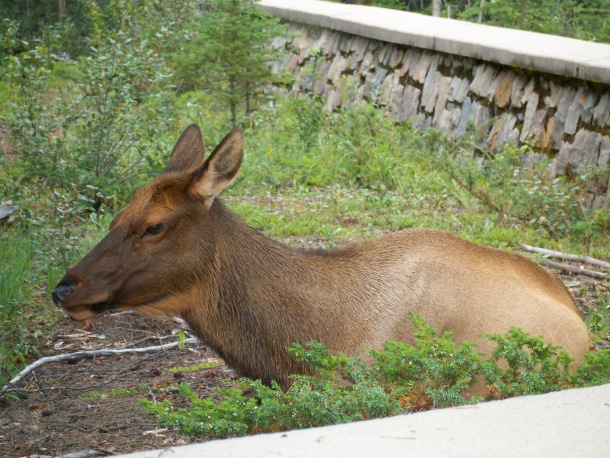
It was a perfect day. We wandered in Jasper National Park, enjoyed scenery, surprises and I was with my favourite person. We found the best at the end of the day. I posted a picture of a bull elk on Yellowstone 2005 . I took that picture from 15-20 metres. Kathy took this picture of a cow elk chewing her cud. She seemed aware of our presence. We were quiet and, as others joined us in a secluded area, she posed. The wall was about 1 metre thick wall and a similar height.
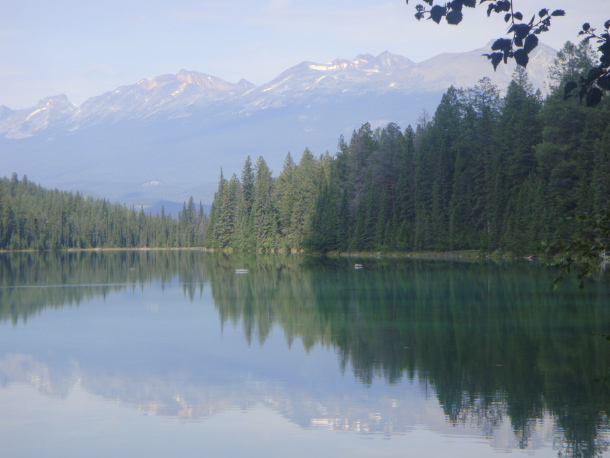
Earlier in the day, we hiked for a couple of hours in the Valley of Five Lakes, exploring some of the small lakes in the valley. We were able to get close to three of the lakes and took pictures. The other two did not have paths into them and were quite deep in the bush. Here are the three lakes we got close to. Each has its own personality, so to speak.
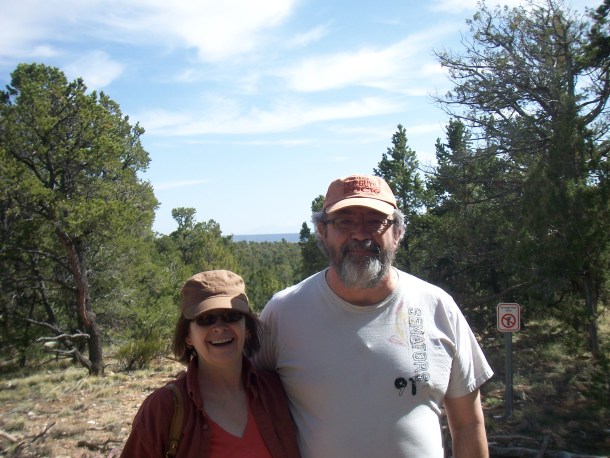
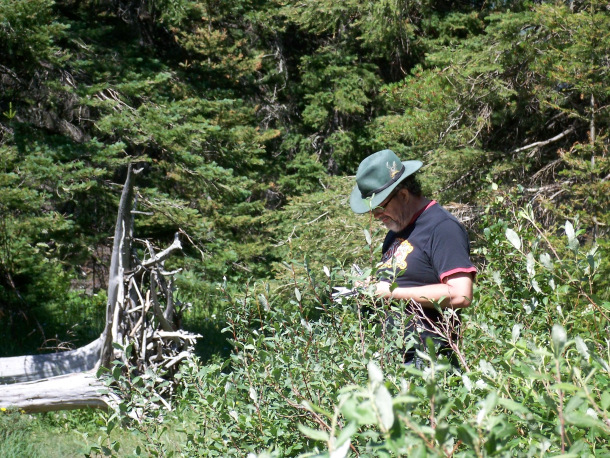
At one of the lakes, I forget which one we came across another visitor who posed for a picture.
I was going to press a wonderful post from Cheryl’s blog called Living in the Gap. Unfortunately, she does not have a press facility, so I did the next thing. I copied a paragraph from her post that I relate to:
“Am I ready to look at the part I play in the current reality, come out from the safety of the suburbs, and confront my own racism? To take a sober look at my own bias, privilege, and exclusionary practices. This is when I want to curl up like a pill bug and roll away, but this movement is not about me, it’s about listening, learning, and leaning into the race issues currently afflicting our country.”
We are in an unusual moment with the protests. They call us to stop and listen to one another in ways we may not be used to. They also call us to ask questions we have not asked in deep ways, such as “how do I confront my own prejudices? Am I even willing to confront them?” I use the word prejudice to open the space a bit more. It is not only about race. It is about gender, sexual orientation, class, etc.
Currently, I am co-writing an article for publication using Paulo Freire. Freire used critical theory and I paraphrase him here. He said prejudices are interwoven, arising from individual lived histories passed from one generation to another in unquestioned ways. It is listening to others without taking on a saviour role, without drowning their voices, and hearing them speak about their reality. They await opportunities to be raised into consciousness and critically questioned. How I understand this is through a Socratic lens where skepticism begins at home. How do I make the world better, more just, more democratic. Freire suggests it is a slow process. In his book, Pedagogy of Hope, he acknowledged using gender exclusive language in his seminal book, Pedagogy of the Oppressed, published 30 years earlier. He learned to use more inclusive language as he became critically aware of the harm done without it. It was a small and necessary step.
Freire argues we need to listen to one another, not denying difference. Instead, he calls on us to accept “unity in difference.” At our core, (in French coeur is heart and core) we are each human. Too often, we talk over each other and listen to defend entrenched positions. A key theme in Freire’s writing is human “unfinishedness,” always becoming. I reflect when I took-for-granted privilege and wonder how I might overcome this. It is not easy. It will not be finished. I understand my role, as an elder, as one of serving and listening. Leadership is serving, transforming, and mindful, rather than transactional and hierarchical.
Robert Greenleaf stated “the best test [of servant-leadership], and difficult to administer, is: do those being served grow as persons; do they become healthier, wiser, freer, more autonomous while being served: Since so many people seem afraid to grow, the true servant–leader who brings it about is an extraordinary person.” If I look at the next generation and they offer me hope that there is better to come, perhaps I can take some solace in that. Without hope, we wither and flee from the scene, abdicating our responsiblity to one another.
I leave you with a video of Langston Hughes’ poem Mother to Son. If I expand the defintion of pedagogue to its broadest etymology, it is how elders interact with youth, allowing them to dream. Hope is not about a lack of obstacles. After all, no life is a crystal staircase and that is most evident for those on the margins of our societies, including in Canada with its history of residential schools and mistreatment of people of colour. It is, as Freire suggests, being willing to struggle and fight to overcome overt and covert injustices and inequities we encounter and witness. It is listening and testifying in those moments to offer a hand to those in need, regardless of race, gender, orientation, creed, and class without being dogmatic. How do we testify in each of those moments? It is not succumbing to historical amnesia and existential weariness.
Several years ago, I arrived home, after spending time in Spokane. I struggled in the first few days back and reflected on what was happening. Quite often, I resist routine and find it is hard work.
Rarely, are we alone in our travails. It is universal Real change, transformation is slow, purposeful, and patient process. Upon looking at pictures we took on our travels and for all of nature’s ability to sometimes erupt and change rapidly, most change is slow and transformational. For the most part, deep change, transforming, in nature is a great model to observe.
I wrote the following poem in response to those reflections.
Waiting,
Impatient–
Desiring more
Leaning into headwinds,
Transforming–
Slow, patient, with purpose
Lacking blueprint.
Journeying,
With one’s self–
With companions,
Breaking bread,.
Trusting–
Devoting,
Changing together.
Embracing,
No explaining,
Words unnecessary–
Smiling assurances.
Looking back,
Revealing worn paths–
Sharing,
Sheltering one another
Pressing ahead–
Certain in uncertainty.
I took the picture on the way to Kootenai Lake in Glacier National Park. Even on a well worn path, there is a limited view of what is behind and ahead. As well, there are many things hidden along the path, there and invisible. There is always a trust in other people and in the path as I move ahead with purpose. Paradox exists in the feeling of certainty in an always uncertain world.
I did post this March 19, 2020 at One Step, Then Another, but it is special. Kathy and I celebrate our anniversary today and this was a reading at our wedding. Initially, the priest was reluctant. I think he saw the disappointment and let us use it.
When I heard the organ, I stood, literally shaking I was so nervous. I turned, looked at Kathy and her Dad, and stopped shaking. What was meant to be was meant to be.
Regardless of one’s relationship with others, intimate or distant, these are words to guide how we accept the Other, as Emmanuel Levinas said. This way lifts the Other to a human subject in an I-Thou relationship, rather than as an object and it.
Lord make me an instrument of your peace,
Where there is hatred let me sow love.
Where there is injury, pardon.
Where there is doubt, faith.
Where there is despair, hope.
Where there is darkness, light.
And where there is sadness, joy.
O divine master grant that I may
Not so much seek to be consoled as to console;
To be understood as to understand;
To be loved as to love
For it is in giving that we receive-
And it’s in pardoning that we are pardoned.
And it’s in dying that we are born to eternal life.
Amen.
We took this at the Grand Canyon several years ago.
For me, creativity and energy emerge in quiet moments. Kathy took this picture in Glacier National Park. I paused to scribble. We only saw a handful of people on the walk in and out. For me, Nature gives me room breath and refresh.
Pausing, reflecting
Fortifying one’s spirit
Soaking in Nature.
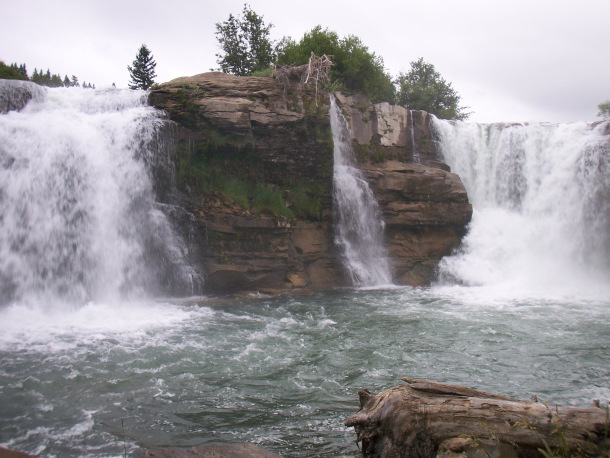
Even though I enjoy quiet and solitude in Nature, I am drawn to its loudness. I love waterfalls, their power and what is not readily visible remind how much of life is a mystery. Whenever we travel, we stop and hike into various waterfalls. What is ironic is I have a fear of heights, which limits my ability to get close. On the other hand, Kathy is part mountain goat, so we get wonderful pictures.
Now and then, I get a chance to get closer and, on this trip, Cameron Falls offered me an opportunity to do just that.
In Waterton Lakes National Parks, I had to keep my distance as the drop off on the overview was too much for me. The result is an overload that drains me of energy. This is a view of Blakiston Falls, which are bridal falls. In case there is any doubt, Kathy took the picture. Below, I express gratitude to see through another’s eyes.
As part of my PhD, the university required I take two ethics courses. In 2012, I took an ethics class. A central theme in the course was the role eudaimonia plays in one’s life. We often translate eudaimonia as being happiness. It is more than being happy in the moment, as that is fleeting. Instead, Aristotle expanded on it to mean human flourishing and even blessedness, which occurs even in moments of distress.
When we think of eudaimonia in that way, it opens up opportunites to reflect on how we experience flourishing. In my case, it is the human relationships, a love of sports, hockey specifically, and writing, particularly poetry. I began to write poetry again, not because I felt at ease with the world, rather because I was unhappy at the time. It was opening up my heart in ways to allow this unhappiness to be dealt with one in ways to help me flourish.
Writing haiku is one poetic form I enjoy. Part of writing them is fun I had teaching how to write them. Students challenged me to write a haiku on the spot. I always began with an idea usually, but not allows, about nature. I got three lines down and then went back to select better words and focus on the syllables.
Students seemed to engage differently as they saw me enjoying writing haiku. Adults sometimes complained. For example parents and administrators questioned teaching poetry. I responded with it is good to write poetry as we learn how to select and use language in precise ways, plus it is fun. They did not always get it. Students did.
Here are a couple of examples that come to mind. It is not that we write as much as it is a process of writing and being written.
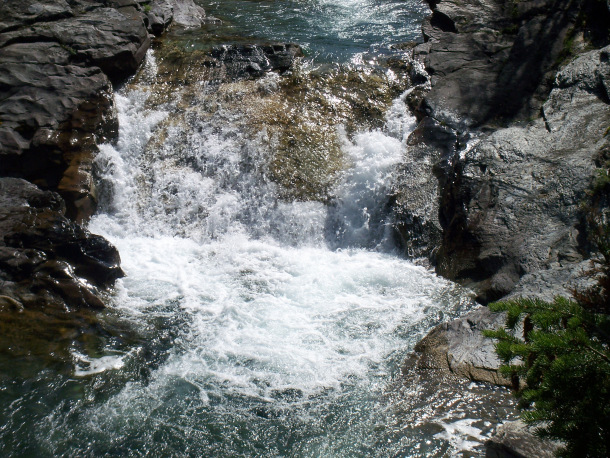
coursing cool current
tearing over life’s rocks
crossing to healing
Language and words bridge one’s private struggles and and make it visible and public. I strugled with these haiku. I think I need more practice. I hope they make sense.
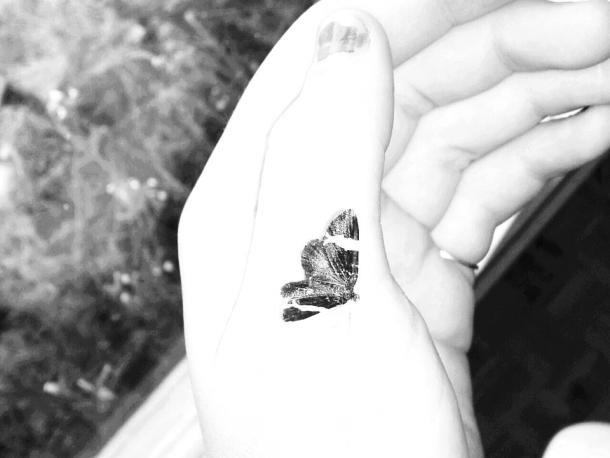
Several years ago, a student took these pictures. It is a beautiful example of how we are part of Nature and have to learn our role within as we unify with it. In becoming one with Nature, we experience Nature as a vital piece belonging to a larger fabric of community. We move into a role of stewards, rather than a user and discarder.
In these unifying moments, we experience Nature’s richness and transform. With increasing awarenss and mindfulness, we can experience belonging to, in, and with Nature, rather than outsiders who exploit, use, and discard. The butterfly and each of us become intimate partners in Nature’s dance.
A result of these pictures is the accompanying haiku.
Resting on journeys
Alighting in this moment
Sharing time and space as one.
The student took a second picture from a different angle and in black and white. This led me to a second haiku.
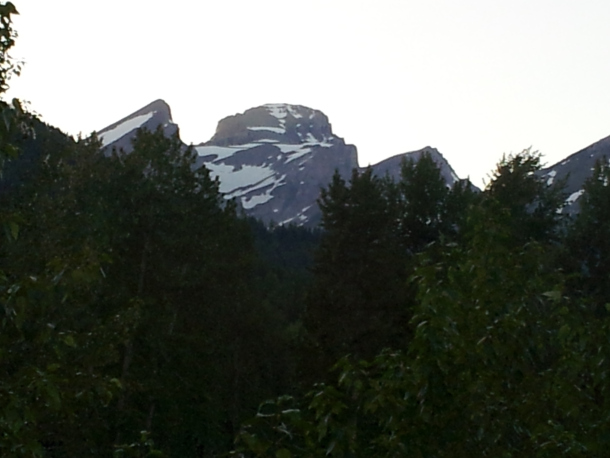
Regardless of where we travel, we are always in a different ecology. In the mountains, I see how they reach into the sky and how they impact the sky my view. Quite often, I see this change as it is different than what I see at home. Change happens regardless and, when I am out of what I understand as “normal,” change appears different. For me, this is noticeable as the sun sets
Fingers reach the sky
Colours mingle with others
Day merges into night.
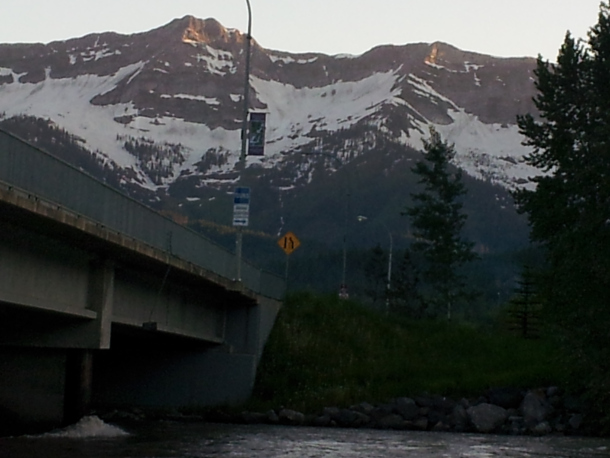
I took this picture several years ago on our way to Spokane. As we walked by the river, the sun set. It was a bit overcast and gray, so the colours blended together more than I am used to.
We walked and came around a back street getting another view of the mountains.
last colours dancing
this day slipping away
dark curtain sliding in place.
Rich palette in hand
Desert sky as a canvas
Nature painting masterpieces.
In early March, Kathy and I were in Phoenix. I walk every day and this was my last walk of the day. As I walked, I walked into the sunset and the sky lit up with vivid colours. I suspect being in a desert setting had something to do with it. It is hard to believe we were in a large urban setting.
I always try to remember Nature is all around me. Take care and stay well.
Regardless of where I am, I am in relationship with other humans and the world we share. It is easy to take these relationships for granted. Over the years, I discovered, children and youth embrace differences more readily than adults.
Through the use of satire, made up words, and unusual characters, Theodor Geisel, better known to us as Dr. Seuss, took a stand against bullies, hypocrites, and demagogues. In this way, I think his characters depict pluralism we live in. Yes, there is no Lorax, Yertle the Turtle, or Cat in the Hat, but we can learn to appreciate and defer to their beautiful differences. Even within differences, I find more similarities and common ground with others, a sense of community of humans.
We need this in the world we co-inhabit with other sentient and non-sentient beings. Too often, people who masquerade as leaders tell us to see difference as a problem, to exploit Nature, and to separate ourselves from our better angels. Perhaps our better angels are Thing 1 and Thing 2.
I retrieved the Thing 1 and Thing 2 image from Clip Art Mag.
I took this picture Sunday at the Japanese Friendship Garden. Even in the midst of an urban setting, like Phoenix, we discover spots where nature and humans co-exist in almost perfect harmony. In truth, we are never separate from nature and humans. It is only in our thoughts we are separate, somehow superior. When we are present and mindful, we recognize there are no boundaries.
Here are four of my favourite Dr. Seuss quotes:
Today you are You, that is truer than true.
There is no one alive who is Youer than You.
Don’t cry because it’s over. Smile because it happened.
Unless someone like you cares a whole awful lot, nothing is going to get better. It’s not.
So be sure when you step, step with care and great tact.
And remember that life’s A Great Balancing Act.
I began to write my first sentence to introduce the poem I intended to post and realized the prose had a poetic quality. I have been fussing since writing Autumn Promises about a lack of inspiration.
Inspiration is not something we chase. Instead, it emerges. I am reading Deeper than Words by Brother David Steindl-Rast. He refers to Jung’s concept of synchronicity. There are moments things emerge from nowhere with no real explanation.
The last few weeks I spent ruminating over where I am going. I am not teaching in a classroom and teaching is calling for me, deeply spirtual and inspiriting for me. When I talk to colleagues and others, they think I would be a good fit for college and university education faculties, but there is little happening and little on the horizon.
As a result, I considers how I reshape, without certainty and chasing, where I go next. The result is a Youtube channel and a Facebook Page with an introductory video about mindfulness in daily life. In various forms, I wrote about this topic in my PhD course work, presented on it, and facilitated retreats and workshops.
I posted the video below. If you have feedback on content, delivery, and directions for this project, please let me know.








 ivonprefontaine
 Teacher as Transformer
