Longing for the Mountains of Solitude

Kathy and I enjoy driving to and through the mountains. Where Kathy grew up, the Rockies are visible in the distance. We try to make a trip once a year, but have not this past year, with my finishing the dissertation. I say “a trip” as we have access to several routes.

Today, I came across this poem by Za Paltrül Rinpoche. I could not find a link to the poet, but the words spoke to me. Although I am terrified of heights, mountains invite me to find ways to safely explore them, finding peace and solitude in safe ways.

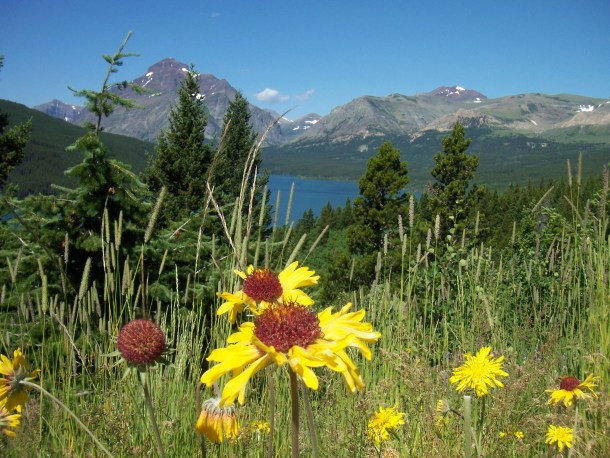
Kathy took this picture on the Going to the Sun Highway in Glacier National Park in Montana.
This is Mount Robson, BC. It is the highest point in the Canadian Rockies at almost 4, 000 metres (almost 13, 000). Due to its height, the top is not always visible. I took this picture on one of our many trips past Mount Robson. It is one of those views that never disappoints. One year we walked along Robson River for several kilometres.

Fooled in samsara town—

the endless cycle of countless chores,

preoccupations of a delusory world—

this boy’s mind longs for mountains of solitude.

Hassled by monastery life—

the hustle of duties and communal dues,

pursuits of pointless distraction—

This boy’s mind longs for mountains of solitude.

Whomever I look at, I see at death’s threshold;

whatever I think on, I sense denial of dying,

grasping at the deathless; in this courtyard of death,

this boy’s mind longs for mountains of solitude.

Whomever I meet with manifests clinging and repulsion;

whomever I talk to brings deception and lies;

faced by companions without virtuous conduct,

this boy’s mind longs for mountains of solitude.

Behold, beings in the three realms are fooled by afflictions;

the beings of the six realms are led astray;

delusion engenders the birth of suffering for all;

this boy’s mind longs for mountains of solitude.

By the blessings of the undeceiving guru and the [Three] Jewels,

may I attain and persevere in solitude;

by the force of a place of seclusion,

may I attain a mystic’s isolation

of body, speech, and mind.

May I be blessed by the mountains of solitude.

Today

Today is a dreary, cold, and wet day. In contrast, we experienced warm, dry weather for most of the last week. It is spring in Alberta and the weather changes on a regular basis.

I tried my hand at writing a poem again and this was the result.

Today, spoke in dreary tones,

The cold a knife;

Snow and rain danced together,

The sun hid itself away.

The world soaked with dampness,

It spoke not inviting words;

There were no paths to walk,

Instead, it was a day of solitude.

My inner world lightened,

Where the sun found its way;

Words arose from that source,

They find their way to this page.

The Archer’s Need to Win

To just be in the moment and be present to what one is doing takes us beyond the need to win and not lose. In the last line of this poem, Chuang Tzu reminds us that the need to win or not to lose drains the archer of his power.

Several years ago, we visited our son and his family. At the time, our grandson was about 5 months old. We went for dinner our last evening and, after I finished eating, I took him. I was in front of a mirrored wall. When he noticed there was a little boy in the mirror, our grandson played with that little boy for about 5-10 minutes, until he became tired. He had no other goal than to play and just be in that moment.

We lose that childlike way and those purely phenomenological moments of just being in the world. Remembering is being mindful and calling something to mind. When we do so, Parker Palmer wrote that to re-member is to make and keep one’s self whole.

When an archer is shooting for fun
He has all his skill.

If he shoots for a brass buckle
He is already nervous.

If he shoots for a prize of gold
He goes blind

Or sees two targets –
He is out of his mind.

His skill has not changed,
But the prize divides him.

He cares
He thinks more of winning
Than of shooting –
And the need to win
Drains him of power.

A Gift

Hans-Georg Gadamer described eloquent questions, as questions that do not have pre-supposed answers. Eloquent questions become and bound dialogue.

I used eloquent questions in my dissertation to explore how teachers experience using curriculum. Instead of arriving as a prescribed text with fixed answers, curriculum transforms into questions. Each student’s and teacher’s lived-experiences transform into questions held gently so as not to injure. The word transform means to go beyond the existing form and through the gift of dialogue and eloquent questions we can.

Denise Levertov‘s poem is about holding other’s questions as if they are fragile and are the answers to one’s own questions. Questions are gifts. When we watch a child open a gift, the joy is in watching them turn the gift to explore it from different angles. After all, differences make a difference.

Just when you seem to yourself
nothing but a flimsy web
of questions, you are given
the questions of others to hold
in the emptiness of your hands,
songbird eggs that can still hatch
if you keep them warm,
butterflies opening and closing themselves
in your cupped palms, trusting you not to injure
their scintillant fur, their dust.
You are given the questions of others
as if they were answers
to all you ask. Yes, perhaps
this gift is your answer.

Periphery

Last summer, I attended a retreat in Wisconsin. Each morning, I went for a walk on the wonderful paths they had at the retreat centre. One morning, I felt I was being watched. I tried to only use my peripheral vision and not change my pace and gait.

After the rabbit slipped into the underbrush,  I wondered what else I might miss in the hubbub of daily living. When I returned to the retreat centre, I jotted thoughts down and this is the result, several months later.

On my morning walk,

A slight movement on my periphery

I am being watched.

I move my eyes;

I try keeping my pace

I don’t.

I see it,

A rabbit

I am not on its periphery.

As it slips away,

I wonder

What do I miss in what I call living?

Haiku

Hanshan wrote this Haiku. I enjoy reading and writing Haiku. A poem’s meaning is usually shrouded in mystery, but Haiku even more so.  There is so much left to the imagination.

I turn off the light —

my heart a precipice

before the moon

I have not written a Haiku for a while, but decided to take a run at it. Mine is less abstract.

Words separate spaces

overflowing and alluring

Flooding my senses

Two Kinds of Intelligence

Rumi‘s words remind me, as a teacher, that my teaching is more than just providing information for students to learn in a rote way for recall on a test.  If what children and adults learn does not have meaning to them, it becomes “yellow or stagnates.”

On the last day I taught, my students gave me a card and gift, but it was the words they offered that meant the most. They told me it was not learning from an official curriculum, but the “other things” that would mean the most to them in later years.

Curriculum comes from the Latin currere and means “running a course” and relates to living one’s life. In running the course and living one’s life, the other tablet comes to life. It is who and what that are close to our hearts that mean the most. As we live life, we discover what that means in sometimes surprising ways.

It is what we reflect upon and are mindful of, reflecting who we are, that brings the greatest joy to our running and recounting the course of our lives.

There are two kinds of intelligence: one acquired,
as a child in school memorizes facts and concepts
from books and from what the teacher says,
collecting information from the traditional sciences
as well as from the new sciences.

With such intelligence you rise in the world.
You get ranked ahead or behind others
in regard to your competence in retaining
information. You stroll with this intelligence
in and out of fields of knowledge, getting always more
marks on your preserving tablets.

There is another kind of tablet, one
already completed and preserved inside you.
A spring overflowing its springbox. A freshness
in the center of the chest. This other intelligence
does not turn yellow or stagnate. It’s fluid,
and it doesn’t move from outside to inside
through conduits of plumbing-learning.

This second knowing is a fountainhead
from within you, moving out.


I look into your eyes and see the universe not yet born.. &.. Gözlerinin içine bakıyorum ve henüz doğmamış kainatı görüyorum. – Rumi

Source: I look into your eyes and see the universe not yet born.. &.. Gözlerinin içine bakıyorum ve henüz doğmamış kainatı görüyorum. – Rumi

Rumi had a wonderful way with words that touched the soul. Semra Polat shared two quotes in this post. When I read them, I easily understand as speaking about another person who means the world to me. As well, Rumi might have spoken about God, as a divine entity I experience by looking into the majesty of what God created.

In each moment, I witness what was created. I come to imagine the universe not yet born as I look into God’s eyes. In those moment, I am mindful and attentive to who and what I encounter and experience.

Part 2, Sonnet X

Rilke wrote romantic and philosophic poetry was ahead its time. In a time, when our tools are often taken-for-granted appendages, it is essential to take time and recall the mysteries of life. I think he reminds us that the systems we create act as a machine, too.

When we take time and meditate over living, we find those extraordinary moments lifted from the ordinary. To live in proper relationship with our world and each other, is to (re)member there are always things we cannot understand.

Remember comes from the Latin, meaning call to mind and mindful. John Dewey proposed the word mind was a verb. It is a way of caring and tending to the world much like a gardener takes time to care for their garden.

The Machine endangers all we have made.

We allow it to rule instead of obey.

To build a house, cut the stone sharp and fast:
the carver’s hand takes too long to feel its way.

The Machine never hesitates, or we might escape
and its factories subside into silence.
It thinks it’s alive and does everything better.
With equal resolve it creates and destroys.

But life holds mystery for us yet. In a hundred places
we can still sense the source: a play of pure powers
that — when you feel it — brings you to your knees.

There are yet words that come near the unsayable,
and, from crumbling stones, a new music
to make a sacred dwelling in a place we cannot own.

A Bee

When I taught poetry, I included haiku and writing them overlapped with our Social Studies curriculum. Bashō was a traditional Japanese poets in a Social Studies unit. As well, I asked students to draw pictures to add richness to their poetry.

Several parents and one administrator questioned the value of writing haiku. I told them it was finding the right word to express one’s self. That was enough for most adults, but the administrator and one parent did not get it. What is ironic is both make their living speaking publicly and I think writing haiku might be helpful.

I chose this haiku, because quite often we struggle to give up things we do not do well and seek the comfort of safe places. In this case, the bee is comfortable in the peony and is reluctant to leave.

Usually, the students enjoyed writing poetry and understood the benefits. Several students used poetry to keep notes in other classes. The students were concerned about the 5-7-5 syllable pattern than actually writing poetry. I told them to get their broad ideas down, find new words, and massage the pattern into place. They took their time and learned how to use a syllabus in the process.

How reluctantly

the bee emerges from deep

within the peony