Tag Archives: Educational Leadership

Life’s Purpose

Professional development days at school leave me wanting so much more. It is a pretense of doing something, but is busyness personified. I am left tired, unsatisfied, and with a bit of headache. I just want a choice. What fuels my spirit?

Day’s end arrives,

Quiet seeks me out–

Busyness dissipates;

A frenetic pace abates–

No hurry,

No frantic pursuit of something;

Whatever that thing might be

Remains uncertain…

Unclear,

Lost in a mist

Focus a little off–

I remain unsatisfied

Until, I wonder aloud:

What is life’s purpose?

Or is life its own purpose.

That Space, That Silence

It has been another long day. I am not always a politically correct person in the way some want. I struggle to say what the dominant group of the moment wants everyone to say. A reason we have polarization in the world is we want others to agree with us sometimes without giving reasons for it to happen. I might agree, but what about those who are not present?

That invisible space between us–

Between our truths

Sacred ground

Till it gently.

That silence you hear–

Almost imperceptible;

It is reverent

Hold it gently.

That space,

That silence,

Emerge magically

No recipe needed.

That space,

That silence,

Easily chased away–

Shhh…

Tuned In and Fired Up

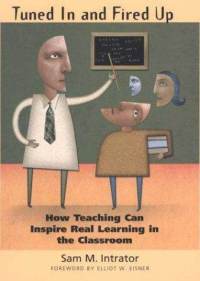
I mentioned this book in Culture of Peace and Angry Young Poet. It was worth a read. I start with a haiku which emerged from the book.


Who stretches the teacher?

Journey into their essence

Reveal the learner.

I read Tuned In and Fired Up by Sam Intrator for two reasons: as a teacher and as a graduate student preparing for the dissertation process. Sam contributes to the work of the Centre for Courage and Renewal which based on Parker Palmer’s writings and thinking.

The book is enjoyable, informative, and motivating. Teachers need to take time and pause, reflect upon, and recall the reasons they were called to teaching. There are alchemical moments of discovery we artfully use and define teacher, students, and subject. It is surreal and its magic can never be underestimated as the three blends into a single whole and respects individual integrity.

Part of the magic in this book is Mr. Quinn, the teacher. He took risks and students tuned in and fired up to his genuine presence. Parker Palmer, in The Courage to Teach, suggested “teaching is always done at the most dangerous intersection of personal and private life” (p. 18). Mr. Quinn’s teaching was learning and realized he could wrong. The magical aspect takes a teacher onto the boundary and, then, into uncharted waters. Good teachers take that risk and students sense it.

Towards the end Sam cited William Ayers: “Since teaching is always a search for better teaching, I am still in a fundamental sense becoming a teacher. I am stretching, searching, and reaching toward teaching” (p. 134). This is a virtuous cycle of learning-teaching-learning to infinity.

Sam leaves the reader with an incredible list of those things teachers can reflect upon and use according to their setting. Many are well-known: cultivate rapport with students, compete tenaciously for their attention, and spark their desire to create. Others were ones I felt were lesser known: embrace your role as a performer, tap into their senses, and acknowledge boring. That last one is challenging. At the adolescent level, treat them like they are becoming adults.
Questions: A concern expressed by Sam was a need for genuine collaboration. What practices do you use in your workplace or learning that foster collaboration between adults? If you teach, what ways do you include students?

Recommendation: I loved the book and let me leave you with just two ways. It was easy to read without losing meaning. Sam used simplexity and achieved his aims. Second, he left a thorough recipe without the quantities. I need to figure those out with students and subject.

Intrator, S. M. (2003). Tune in and fired up: How teaching can inspire real learning in the classroom. New Haven, CT: Yale University Press.

Palmer, P. J. (2007). The courage to teach: Exploring the inner landscape of a teacher’s life. San Francisco: Jossey-Bass.


Larry Cuban is a leading writer and researcher in school reform or I think a better way to phrase it is a lack of true reform. He points out several key points in this excellent article. His first paragraph about teachers working together daily is not prophetic as you will see in the article. It has been part of the educational reform lexicon for a several years, perhaps decades is a better word. Why do the ‘reforms’ with all their pat answers and revolving, recycled fads secret this away in the closet? I think they are afraid.


First, top down measures are not the order of the day. Second, schooling and learning (my added word) at all ages are complex systems and forged out of relationship not transactional activities. This nature does not invite top-down. It encourages community and collaboration. The leading thinkers he refers to part way through the article are a short but impressive list. I would add others who contribute in many ways i.e. Deb Meier, James Comer, and Nel Noddings come to mind. Finally, real communities actually are dysfunctional. It is what we do in those moments that leads us to collaboration. Joining hands around the camp fire is nice, but only superficially functional. Agree to disagree is sometimes the path.


I read another blog today and my conclusion is slow is sometimes the way forward.


We in Canada who think we are doing something better are wrong. We all need the same wake up calls, a new conversation, and a reimagining of schooling and learning. Note I did not say school. That is the brick and mortar that in some cases is passé.

larrycuban's avatarLarry Cuban on School Reform and Classroom Practice

Want to give a “no excuses” reformer a stroke? Suggest that teachers working together on a daily basis have a better shot at improving teaching and learning than the highly marketed structural changes of standards-based testing and accountability, Common Core standards, more charter schools, and evaluating educator performance through student scores.

Too many reform-driven policymakers high on the rhetoric of these current reforms ignore how much improvement in teaching and learning can occur when  teachers work collectively in their classrooms and schools to improve their content knowledge and teaching skills aimed at common district goals.

For many years, teachers, administrators, researchers, and a sprinkling of policymakers have concentrated on both traditional and innovative professional development and learning communities to build teachers’ capacities in knowledge of subject and teaching skills to improve instruction in schools and districts. Such school-based efforts converge on the teacher simply because within the complex system of…

View original post 1,209 more words

Cartoon Time along with an Ivon Rant

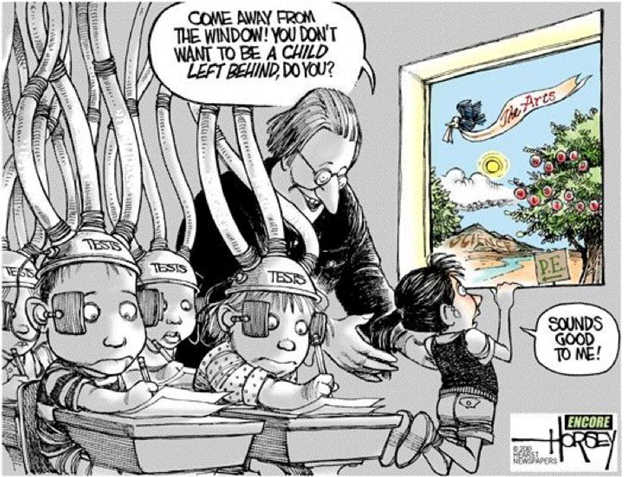
Another Alberta-based educator at The Love of Learning posted this. It reminded me of a Ken Robinson video The Educational Revolution…Why? Because Schools Kill Creativity posted by Gen Y Girl. The video is worth watching several times. The first time I watched the video several years ago an administrator informed me the message was a need to add layers of technology on top of what we are doing.

I am not a neo-Luddite. The original Luddites were not opposed to technology. They opposed potentially catastrophic outcomes blind, thoughtless implementation of technology might have on British society of the time. A message I gleaned was a positive correlation between ADHD/ADD diagnosis and an increase in various forms of imposed, standardized, high stakes testing.

The second message is statistical evidence the highest levels of creativity in school are at the kindergarten levels. After that, it is all down hill.

These are not technology issues, but simply change for the sake of change.

Technology is the artful use of the tools available to us.

Questions: What changes would you suggest for education to make it more child-friendly and child-focused? What can we do to increase the creativity for children in classrooms?

A bit of an American slant to it, but where do Canadian educational systems take their lead from? Is this what we want?

Five Steps to Destroy Public Education

Five Steps to Destroy Public Education.

Diane Ravitch is a real educational reformer in the US. I think parts of her message in this post is universal. I particularly like her comments about underfunding our schools and overcrowded classrooms.

It is just not the underfunding that starves the schools; it is the poor management and decision-making by the bureaucrats, technocrats, and oligarchs. What is the latest fad?

Overcrowding our classrooms silences the teachers. Do I even have time to lift my head and uplift students under those conditions?

pedagogy of the oppressed by Paulo Freire

I read pedagogy of the oppressed by Paulo Freire during my undergraduate experience and return to it as a source of reflection and when I write. Similar to Parker Palmer, Paulo Freire left an indelible mark on my life’s practice. Education is an uplifting, liberating experience which shines light on each step Antonio Machado described: “Wanderer, your footsteps are the road, and nothing more; wanderer, there is no road, the road is made by walking.” Freire’ s contention was everyone can act as an agent in their learning thus freeing them and transforming the world they live in.

Freire used the Portuguese word conscientização which “refers to learning to perceive social, political, and economic contradictions and to take action against the oppressive elements of reality” (17).   Humans become mindful of and present in the world and act to transform it. Freire used a banking metaphor and described traditional education where  knowledge is deposited into students. Teachers and the system act oppressively in determining what is important to learn. Freire felt education uplifted people and their learning. “Liberation is a praxis: the action and reflection of men and women upon their world in order to transform it” (p. 60).  Learning occurs when  compliance and conformity are rejected in favour of dialogue based on love which allows each human to name their world and what is of value in it. The student is a teacher and student; the teacher both student and teacher.

Questions: What can we do to truly bring a new pedagogical structure into our schools and communities of learning? What function would school play in this pedagogical structure? What is dialogue based on love?  What role do educators and communities play in liberation education?

Recommendation: I love the book. It is a challenging, but I return to it often and find something new each time. Today, I became aware of the following: “Concepts such as unity, organization, and struggle are immediately labeled as dangerous. … These concepts are dangerous—to the oppressors” (p. 122). What does this mean in supposedly modern, liberated, and affluent societies?

A second point was the similar language used by Freire and Martin Buber. There is a shared understanding of respectful dialogue using the words I and Thou to describe the uplifting, liberating, loving dialogic process.

Freire, P. (1993). pedagogy of the oppressed. (M. B. Ramos, Trans.).  New York: Continuum.

leading and learning: Lets value individual creative teachers.

leading and learning: Lets value individual creative teachers..

This is a rather lengthy article written by a New Zealand based educator. I think it fits with a previous reblog of video featuring Sir Ken Robinson called The Educational Revolution: Why Schools Kill Creativity.

Read, watch, and weep. A lack of creativity and resulting innovation is killing public education with sameness. Let us all do it one way is the current creed. What can we do about it? It is high time we invited a new conversation to emerge.

Fragmentation

Fragmentation.

This is an interesting, albeit American-based view of the charter system and the overall fragmentation issue of public education. I am not an advocate of reform. That tends to tinker at the edges. I advocate transformation. This requires new conversations at the grassroots. What does public education mean to you, your family, and the community you live in?

Words for Teachers and Learners at Heart

This fell into my world yesterday and I thought it might be a good share. It is certainly something to reflect on as we begin each day in our various roles of learning and teaching.