Tag Archives: Mindful Practice

A Simpler Life

Kathy and I are doing some house cleaning and it is interesting what we find.

Kathy looked through some papers we had stored and found poetry I wrote in 1969, in Grade 10. There are things that are consistent in life and one of them is seeking moments of solitude and silence, which I wrote about in this poem. I took liberties and edited the poem, orginally called The Simple Life.

It is good to be alone at times,

Sheltered by comforting trees,

The wind singing a song,

Here, I experience freedom and peace,

For the moment, worries set aside.

Minnows dart at the water’s edge,

Dancing between light and shadows,

Seemingly, without a care,

There, they experience home’s safety;

Its primal call.

Here, this is me,

I experience a simpler life;

An unseen hand beckons me,

I wave to this simpler life,

Enjoying it each time I return.
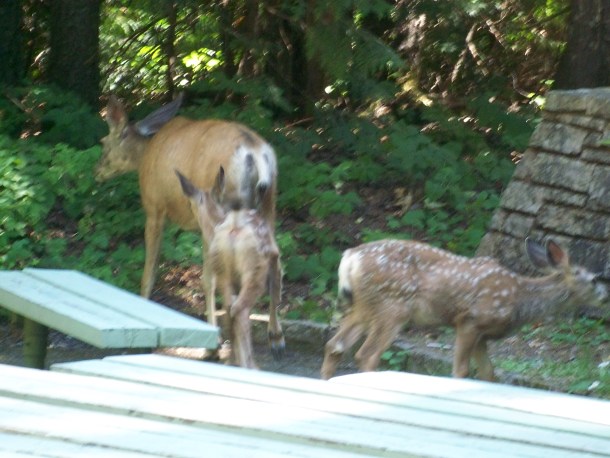
I took this picture in Waterton Lake National Park several years ago. I came around a corner and there was a doe and two fawn. I could have touched the one fawn it was so close, but it was separated from its mother. I stood as still as possible, moving slowly to get the camera ready. The mother whistled to the one fawn and waited until the young one found its way over to her, back to the safety of where it belonged.

Doors

The other night, we watched a re-run of the Montana episode of Parts Unknown hosted by the late Anthony Bourdain. I enjoy watching the series and this episdoe about Montana drew to it as we have visited Montana several times.

Bourdain ate with a poet I had not heard of before: Jim Harrison. He spoke about being part of nature and how he feels small under the big sky of Montana. I looked him up and felt I should have heard of him before. He was a celebrated and well-published poet.

I chose this poem as it speaks to how we create binary choices in a complex world and universe filled with a myriad of choices that we follow depending on the spirit. For example, we often think we have to separate the economy and the environment.

The etymology of economy is from the Greek, oikos, meaning household and suggests keeping a good house. We only have to think about animals and how they do not soil their living quarters to understand how economy and ecology are related.

Harrison created wonderful imagery about the sky being a door never closed, but the sun and moon are not doorknobs. He lived in Montana for years where the sky is big and stretches on, as does the land.

I had to look up Dersu Uzala. It was a movie made about a man who lived his life integrated with nature and the universe, who dies when he moves inside.

I’m trying to create an option for all
these doors in life. You’re inside
or out, outside or in. Of late, doors
have failed us more than the two-party system
or marriages comprising only one person.
We’ve been fooled into thousands of dualisms
which the Buddha says is a bad idea.
Nature has portals rather than doors.
There are two vast cottonwoods near a creek
and when I walk between them I shiver.
Winding through my field of seventy-seven
large white pine stumps from about 1903
I take various paths depending on spirit.
The sky is a door never closed to us.
The sun and moon aren’t doorknobs.
Dersu Uzala slept outside for forty-five years.
When he finally moved inside he died.

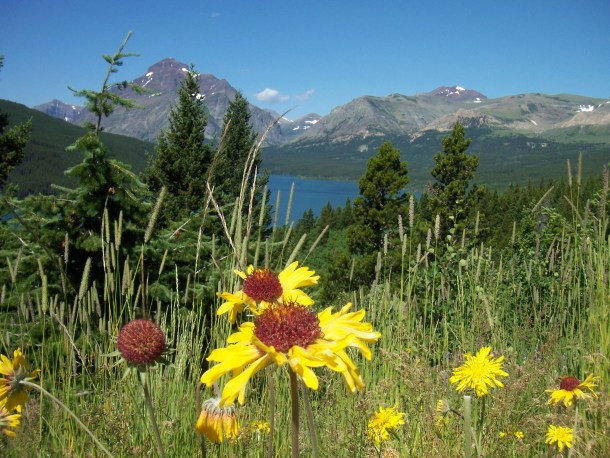
I took this picture several years ago as I looked from Alberta towards Montana across the field, with fresh bales of hay in the forefront and the mountains and sky forming the backdrop.

What Have I Learned so Far?

I enjoy Mary Oliver and questions she asks in her poems. Living is a question, as I am uncertain what will happen, even in the next second, and how I will respond/react.

How we each live is the answer to a Mary Oliver question from The Summer Day: Tell me, what is it you plan to do with your one wild and precious life? Do I sow seeds of kindness? Do I somehow make the world a better place, without understanding what that means in advance, perhaps ever?

As I rise from meditation and prayer, I do I move in a mindful way, more attentive to my words and acts. Meditation and prayer help make the world holy, more whole as I attend to it. We each live Living in our particular concrete and real world of human relationships with each other and the world.

Meditation is old and honorable, so why should I
not sit, every morning of my life, on the hillside,
looking into the shining world? Because, properly
attended to, delight, as well as havoc, is suggestion.
Can one be passionate about the just, the
ideal, the sublime, and the holy, and yet commit
to no labor in its cause? I don’t think so.

All summations have a beginning, all effect has a
story, all kindness begins with the sown seed.
Thought buds toward radiance. The gospel of
light is the crossroads of — indolence, or action.

Be ignited, or be gone.

From The Irony of American History

Although Reinhold Niebuhr his book The Irony of American History, I think it speaks to each person’s and each collective’s history.

As I read this and his autobiography, I wondered what it means to be a refugee, to seek refuge, and be an immigrant. My family traces its roots in Canada to the mid 1600’s and Kathy traces her’s to the latter part of the 1700’s. On both sides of our family, our ancestors could not expect what was to come for them and us.

Parker Palmer and Allan Watts speak of faith, which allows each of us to step into the future, without understanding what that brings. My ancestors, coming from France, did not know the risks and opportunities that lay ahead. They had faith in what was to come, without knowing what was to come.

What is to come in my life is emerging through the lives of each person that follows. Thich Nhat Hanh writes we are an amalgam of our ancestors. We are individuals that emerge within a collective that is both present and absent in our daily lives. Who we are is a result of product of virtue and love we receive from others. Who we are is not accomplished alone. It is an act of compassion and faith; an act of forgiveness that we will do what is proper.

Nothing that is worth doing can be achieved in our lifetime; therefore we must be saved by hope.
Nothing which is true or beautiful or good makes complete sense in any immediate context of history; therefore we must be saved by faith.
Nothing we do, however virtuous, can be accomplished alone; therefore we must be saved by love.
No virtuous act is quite as virtuous from the standpoint of our friend or foe as it is from our standpoint. Therefore we must be saved by the final form of love which is forgiveness.

Nature’s Melody

I have not written a poem for a while. I try to journal each day.  I started this poem about 10 days ago, left it for a few days, and came back to it today. I feel rusty in the writing, but it is a beginning.

When I walk, I listen, subscribing to the idea sound completes itself in in-between spaces. Without spaces, sound lacks rhythm and melody. When I am mindful, I recognize a particular sound. Also, I can recognize unfamiliar sounds in those spaces.

Nature’s voice is always in melody,

She raises and lowers it effortlessly.

Spring breezes filled with rustling and whispering,

Shrill winter storms shrieking and whistling.

Soft showers murmuring in gentle ways,

Thunderous storms that shake and amaze.

It is in pauses melody is completed,

It is in silence sound is fulfilled.

Several years, we were in Jasper National Park and saw this cow elk. She was quiet and did not move. We were there for a few minutes before we noticed her. There were others who arrived before us and had not seen her. It was in the silence and calm we noticed her.

The Prayer of St. Francis

Today, is our anniversary. We recited the Prayer of St. Francis at our wedding and have it displayed on a small and simple plaque. It reminds me of what it means to be human, in relationship with another person, and in relationship with God.

When I was in Spokane, I printed a copy and put it on the wall of the small room I stayed in. I refer to the room as my monastic cell and the Prayer of St. Francis seems a fitting complement to any monastic cell.

During challenging moments, I recite parts of the prayer to bring me peace and be present in the world.

Lord, make me an instrument of your peace:
where there is hatred, let me sow love;
where there is injury, pardon;
where there is doubt, faith;
where there is despair, hope;
where there is darkness, light;
where there is sadness, joy.

O divine Master, grant that I may not so much seek
to be consoled as to console,
to be understood as to understand,
to be loved as to love.
For it is in giving that we receive,
it is in pardoning that we are pardoned,
and it is in dying that we are born to eternal life.
Amen.

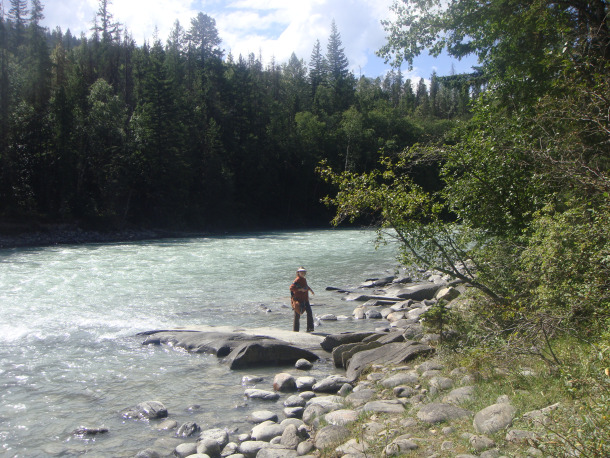
The picture is one I took several years ago of Kathy standing above a set of waterfalls close to the headwaters of the Fraser River.

Leap of Faith

via Quote: Mary Oliver

Mary Oliver is one of my favourite poets. Even when she writes lines in declaratory ways, there is a profound question being asked.

In this wonderful quote shared on Rethinking Life the question is what happens next. Even under the best and most controlled of circumstances, we do not know what will happen in the next moment.

Living is a leap of faith filled with mystery we can embrace. When we believe we control the next moment, the next instance, we fall short. Mindfulness can help us embrace the mystery. Being grounded in each ensuing moment is the only place we can be.

Merry Christmas

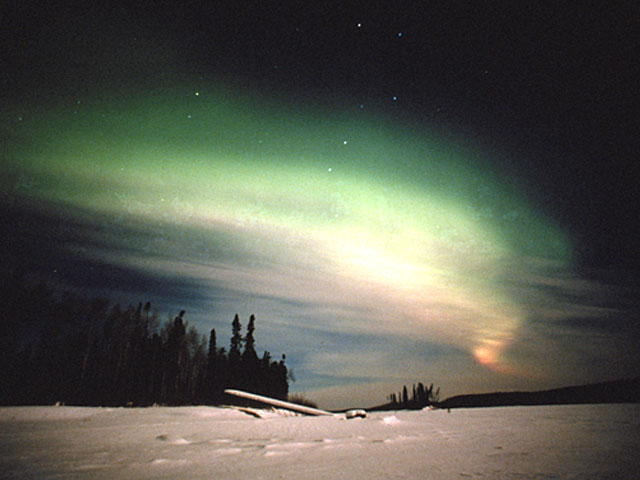
I wrote this poem several years ago about the magic provided by the Northern Lights (Aurora Borealis) and Christmas. What message was in those celestial colours and sounds? As a child, I thought the sky talked to me and told me a creation story.

I grew up in Northern Alberta and Christmas was a special time. I recall cold winter nights. I mean they were cold–almost minus 40 at night. Our windows upstairs were almost completely frosted over. On moonlit nights, the light kept me awake or that is what I told others.

During Advent, my mom and older brothers walked across the street for evening Mass. The younger ones, including me, went to bed. I did not fall asleep right away and would watch out the window for them to come home. I thought no one saw me, but my Mom would come up and tell me to go to bed.

At that time of year, I recall is the Northern Lights and how you could hear them as well as see them light up the sky as they danced across the sky. We don’t see them very often in Edmonton with the urban light.

When we spend time at the farm at Christmas, we hear and see them again. On cold nights we hear the train (about a mile away) and it sounds like it is coming through the house.

Small children–

Breathlessly awaiting,

Peering through frosted window

Soaking it in.

Heavens rippling–

Lights undulating;

A celebratory fury

An indisputable guide.

This old house speaks;

Nature answers–

Heavens crackle

Sweet symphonic sounds shimmering.

Earth’s floor–

Blanketed in white

Celestial colours speaking

Capturing young senses.

A vivid winter scene,

A sensual, sensory palette,

Reminding us–

Christ’s Mass is here.

pic_wonder_northern_lights_lg

Wildness

via Wildness

Michele‘s post reminded me of poems by two of my favourite poets.

Environmentalists refer to Wendell Berry and Mary Oliver‘s poems. An educated guess is that Henry David Thoreau, who Michele quotes, informed their writing.

Wendell Berry wrote in moments of despair he “comes into the peace of wild things who do not tax their lives with forethought.”

Mary Oliver ends Summer Day with the following question: “Tell me, what is it you plan to do/ with your one wild and precious life?” Paradoxically, the question is an answer to her eloquent questions about who created nature.

Nature has a way of being and providing us with lessons for life. It is in meditative moments, when we just are, we grow to understand what that can mean. We grow and value what is essential not to us, but to those who come after us.

“We do not inherit the world from our ancestors, but borrow it from our children.”

Love says, there is a way..

Source: Love says, there is a way..

Karen‘s post included quote from two of my favourite poets: Hafiz and Rumi. Love is the essential idea behind the quotes.

The second Hafiz quote says fear is the cheapest room in the house. As we lift each other up with our love, we expand the rooms in the house we can each live in. Loving each other is a gift and a serving of each other. It can make people and the world whole again.