Tag Archives: Mindful Practice

Why Do I Write Poetry

During a professinal development event, a presenter spoke about teaching poetry. To my knowledge, this person spent little time teaching, yet he was a supposed expert about all things teaching. In the course of his presentation, he expressed disdain for poetry. He claimed, without evidence, we teach poetry without explaining to students why we teach it.

In my teaching, I described reasons why I taught something, opening up learning to include what students considered important. This included questions about topics and content. Often, students began with a negative view of poetry. With time, we got over hurdles together. Without a collective effort, we do not overcome issues in life and learning. We end up with haiku written through rote formula:

Here are five syllables

And here I write seven more!

Are you happy now?

The presenter indicated, despite having written poetry, he was unsure why teachers taught poems written. I think there are good reasons, but I could be wrong.

Poetry calls me to choose words, paradoxically spare and spacious. Spareness is in the number of words; the fewer the better. The space allows the reader room to interpret. What did the poet mean? What senses are invoked through the word choice?

Instead of counting something, poetry asks me to explore life and understand quality is not evenly distributed. I have privileges, maleness, whiteness, education, that others do not have the eauitable access to.

Choosing words,

Caring about each–

Describing feelings,

Experiences never identical.

Revealing thickness in meaning,

Experiencing sameness different–

Bringing us together,

Bridging worlds.

I told students, who struggled with reading and writing, poetry was an alternative to express themselves. I used ee cummings, as a model, to overcome worries about grammar, spelling, and capitalization.

i dig ee cummings

no punctuation

no capitols

won’t worry about spellin either

no sweat

aint no problem

i write poetry

I enjoy poetry. I always have. I remember a poem, The Elevator, I memorized in Grade 4. I think it Walter de la Mare wrote it. My friend memorized a poem called Douglas Fir. His name was Douglas. When I enjoy who and what I teach, I bring enthusiasm to writing poetry.

Artists, including poets, are often at the forefront, addressing social issues. In our times this includes Maya Angelou, Thomas Merton, Wendell Berry, Adrienne Rich, Parker Palmer, Thich Nhat Hanh, etc. Sometimes, I do not think of these authors as poets. Each of them wrote/writes poetry helping to raise my awareness about issues.

Below are the wonderful and poetic words of Thich Nhat Hanh.

Peace in our heart

I close with a poem I wrote many years ago as a 15 year old in high school. I have never been a fan of what we call capitalism. What we have is predatory and is at the root of current political, economic, and social issues. Only a handful are admitted to the club.

Captains of Society

Captains of Society

Shallow, superficial, arrogant

Single ambition

Greatness in the eyes of others

Only those with resources can apply

The rest

Forgotten

Pay a high price, but…

It’s their fault

They own their misery.

A cheque to charity

Assuages my conscience

What about the despair?

Don’t care

I claim I do

Donations in badfaith,

It’s a tax receipt

I really claim, but…

Done on the backs of others

Get the staff to donate time

Not mine.

Increase taxes

Not mine!

No way!

It’s wrong!

Tax others!

What is work?

I create jobs

It’s a spectator sport

This work, which

I manage from afar.

Drive luxury wheels

Shout

Curse

What’s the hold up?

Who’s blocking my way?

The ‘75 Ford station wagon

Engine shot

Dead broke!

Is it their home?

 Throw a party

Drink

Eat

Be merry

No concern for homeless

A romantic notion this ‘hobo jungle’

Not my world

What’s wrong?

It’s not my fault

I gave at the office.

After all.

Throw money at problems

It might help

Don’t

Stop, see, care

If it really helps

Denying, refusing, unfeeling

I pay for a clear conscience

After all.

 The misery

In surround sound…

Is out of sight;

Out of mind

Transforming

Several years ago, I arrived home, after spending time in Spokane. I struggled in the first few days back and reflected on what was happening. Quite often, I resist routine and find it is hard work.

Rarely, are we alone in our travails. It is universal Real change, transformation is slow, purposeful, and patient process. Upon looking at pictures we took on our travels and for all of nature’s ability to sometimes erupt and change rapidly, most change is slow and transformational. For the most part, deep change, transforming, in nature is a great model to observe.

I wrote the following poem in response to those reflections.

Waiting,

Impatient–

Desiring more

Leaning into headwinds,

Transforming–

Slow, patient, with purpose

Lacking blueprint.

Journeying,

With one’s self–

With companions,

Breaking bread,.

Trusting–

Devoting,

Changing together.

Embracing,

No explaining,

Words unnecessary–

Smiling assurances.

Looking back,

Revealing worn paths–

Sharing,

Sheltering one another

Pressing ahead–

Certain in uncertainty.

I took the picture on the way to Kootenai Lake in Glacier National Park. Even on a well worn path, there is a limited view of what is behind and ahead. As well, there are many things hidden along the path, there and invisible. There is always a trust in other people and in the path as I move ahead with purpose. Paradox exists in the feeling of certainty in an always uncertain world.

On some mornings and evenings, I observe the sun rising/setting with the moon in the sky. Several years ago, early in the school year this occured. I began haiku class with poems describing phenomena we often take for granted. I emphasized poetry  often emerges from what is overlooked.

Great poets have a way of lifting extraordinary phenomena into fuller view for us. I modeled this with shared from Pablo Neruda, Mary Oliver, Wendell Berry, etc. I try to write poetry in a similar way.

Greeting and adieu

Sharing the sky together,

Guiding one’s journey.

I took this picture as I approached Waterton Lakes National Park enroute to Spokane. It was a beautiful evening with just a wisp of cloud below the rising moon. It was as if Nature decided a needed two guides on my trip.

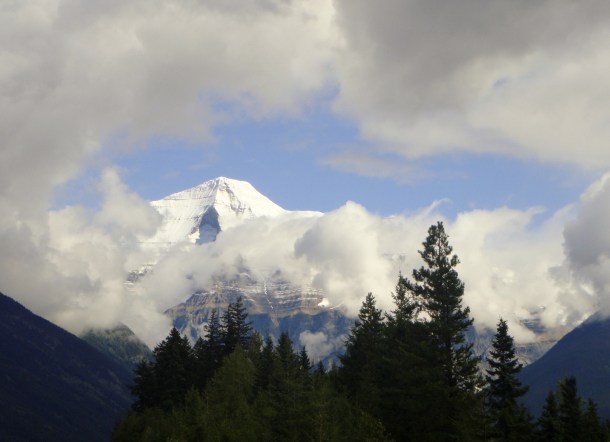
On many trips, I pass mountains, which, even when I stopped, I did not grasp their majesty. It is as if they have their own language and ways of being.

Clouds surrounding,

Momentarily crowning,

In regal splendour.

I take many pictures of Mount Robson as I drive from Edmonton to parts of British Columbia. Even with clouds, it has a majesty about it.


.


Prayer of St. Francis

I did post this March 19, 2020 at One Step, Then Another, but it is special. Kathy and I celebrate our anniversary today and this was a reading at our wedding. Initially, the priest was reluctant. I think he saw the disappointment and let us use it.

When I heard the organ, I stood, literally shaking I was so nervous. I turned, looked at Kathy and her Dad, and stopped shaking. What was meant to be was meant to be.

Regardless of one’s relationship with others, intimate or distant, these are words to guide how we accept the Other, as Emmanuel Levinas said. This way lifts the Other to a human subject in an I-Thou relationship, rather than as an object and it.

Lord make me an instrument of your peace,
Where there is hatred let me sow love.
Where there is injury, pardon.
Where there is doubt, faith.
Where there is despair, hope.
Where there is darkness, light.
And where there is sadness, joy.
O divine master grant that I may
Not so much seek to be consoled as to console;
To be understood as to understand;
To be loved as to love
For it is in giving that we receive-
And it’s in pardoning that we are pardoned.
And it’s in dying that we are born to eternal life.
Amen.
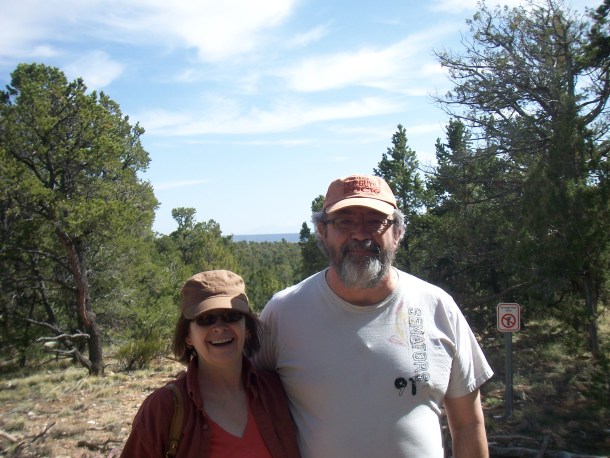
We took this at the Grand Canyon several years ago.

Metamorphosis

As I reflect on my blogging, I note a significant change in tone, voice, and content. When I began, I did it for the wrong reasons, driven from ego. Transformation is about one’s self.

Thich Nhat Hanh shared the following about the miracle of being alive:

“People usually consider walking on water or in thin air a miracle. But I think the real miracle is not to walk either on water or in thin air, but to walk on earth. Every day we are engaged in a miracle which we don’t even recognize: a blue sky, white clouds, green leaves, the black, curious eyes of a child—our own two eyes. All is a miracle.”

Transforming is not the same as change. Change is always happening, often running below the radar. When something or someone transforms, I bear witness to it or that human. I am pulled up short and take a second look, perhaps more. I become aware of the remarkable change, which is part of a larger, less visible cycle. I am aware of the remarkableness of the world and its inhabitants.

Experiencing metamorphosis is about seeing one’s life in its simplicity and ordinary elements, in the extraordinary. In this way, living is the miracle. Just being aware of what surrounds me and what I encounter is the mindfulness that makes life a miracle.

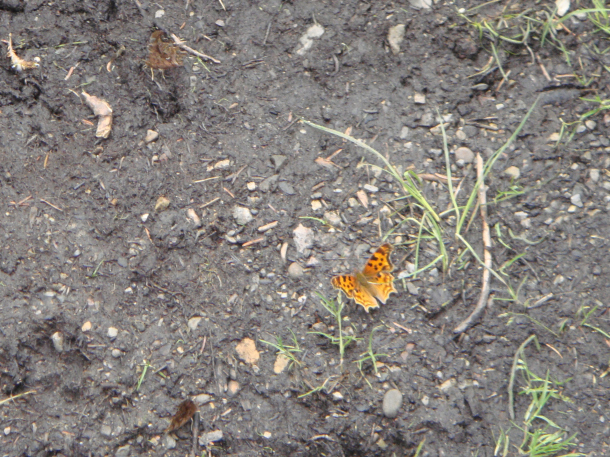
I took this picture of a butterfly. I was aware of its beauty and how it made life fuller.

Merely changing,

Occupies my idle mind.

Denying, silencing–

Another self.

Questioning–

One’s inner terrain.

Who is this self?

What life is this self living?

Maturing,

Emerging,

A chrysalis–

Thoughtful gift.

Flourishing beyond rhetoric,

Journeying with others,

Appreciating–

Valorizing.

Driftwood’s Wisdom

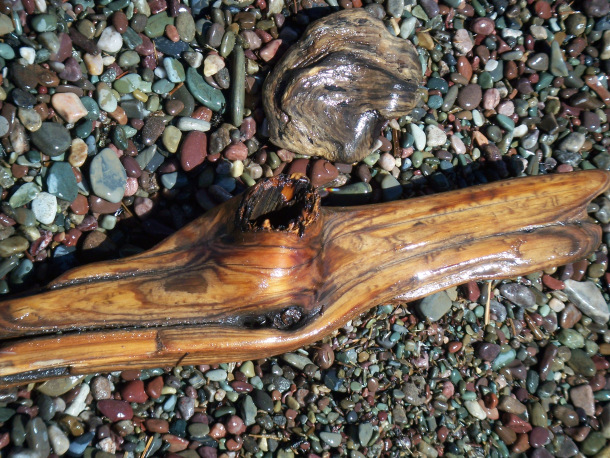
Kathy took this picture as we walked along Waterton Lake. She thought it might inspire. That evening, I scribbled ideas into my journal about wisdom and its sources. I enjoyed listening to stories told by our parents, grandparents, and other elders I come in contact with. Now, the shoe is on the other foot and I am the elder.

Washed up flotsam,

Polished to glassy sheen

Revealed beauty.

If I apply this natural process, to humans, we gradually polish ourselves and soften the rough edges. At least, we can hope.

Polishing waves hone

Glimmering wisdom emerges

Softening rough edges.

Life As a Panorama

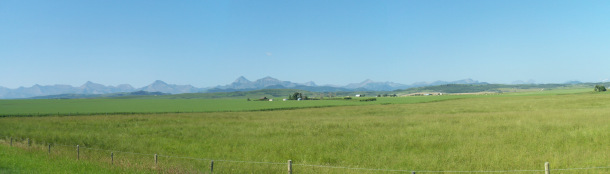
Kathy took these panoramic pictures as we drove to Waterton. I wonder how I make sense of life without a more complete picture and the haze fades, revealing a complete and panoramic view. Even at that, life’s complexity shrouds the mystery, as there is too much to take in.

As a still shot,

Life–

Emerges by image by image,

Parsed, fitting my definition.

As a broad view,

Life–

Evidencing no visible pattern,

Full, rich, ineffable.

As a quilt,

Weaving—

One stitch into the next,

Ragged, seamless paradox.

As community member,

Retaining one’s self—

Binding together,

Adhering disparate parts into one.

Pensive Pirate

For me, creativity and energy emerge in quiet moments. Kathy took this picture in Glacier National Park. I paused to scribble. We only saw a handful of people on the walk in and out.  For me, Nature gives me room breath and refresh.

Pausing, reflecting

Fortifying one’s spirit

Soaking in Nature.

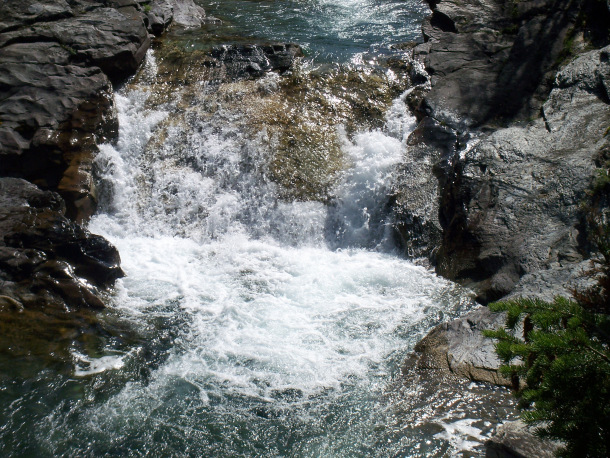
Even though I enjoy quiet and solitude in Nature, I am drawn to its loudness. I love waterfalls, their power and what is not readily visible remind how much of life is a mystery. Whenever we travel, we stop and hike into various waterfalls. What is ironic is I have a fear of heights, which limits my ability to get close. On the other hand, Kathy is part mountain goat, so we get wonderful pictures.

Now and then, I get a chance to get closer and, on this trip, Cameron Falls offered me an opportunity to do just that.

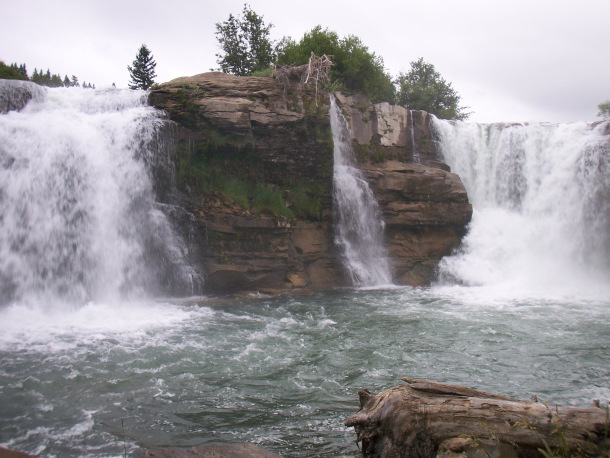
In Waterton Lakes National Parks, I had to keep my distance as the drop off on the overview was too much for me. The result is an overload that drains me of energy. This is a view of Blakiston Falls, which are bridal falls. In case there is any doubt, Kathy took the picture. Below, I express gratitude to see through another’s eyes.

Revealing beauty

Viewing through another’s eyes

Nature’s abundance.

Weaving the Sacred

Humans often set the sacred in opposition to the profane and mundane. In what we might consider of as less sophisticated or mystical traditions, the distinctions are less in evidence. The sacred and profane blend together and are readily experienced in the traditions and daily lives of people. Sophisticated has to do with wisdom (sophia, so who am I to judge what is wisdom in a world I am an outsider to? This stands out to me when I visit Indigenous sites in Alberta and beyond. In ways they are stewards of Nature in ways I cannot be as I do not understand my relationship to Nature in a proper way.

On our way to Waterton, we went to Head-Smashed-In Buffalo Jump Interpretive Centre. It is a UNESCO World Heritage Site.

Archaeologists discovered evidence the site was on a migratory path for indigenous people, primarily the Niitsítapi (Blackfoot Confederacy), who used innovative ways to hunt plains bison at least 5500 years ago. A jump or ‘pishkun’ in Niitsítapi used drive lanes marked by rock cairns. The buffalo ran between the cairns and the last part of the drive lane sloped up, making the jump unnoticeable. The process required perfect human timing and was extremely dangerous.

Legend has it the name comes from an unfortunate incident when a young man wanted a closer view of the action. He waited at the base of the cliff. The hunt was successful and, when he was found, he sustained a broken skull and died.

Head-Smashed-In Buffalo Jump is at the confluence of three geological formations. The Rocky Mountains and Great Plains are well-known. The picture below shows the rise into the Porcupine Hills. Young Niitsítapi men transitioned to manhood through a vision quest and went to the hill in the foreground. The hill, with spiritual meaning to the Niitsítapi, does not have public access.

Journeying alone

Enter spiritual space

Questing for adulthood.

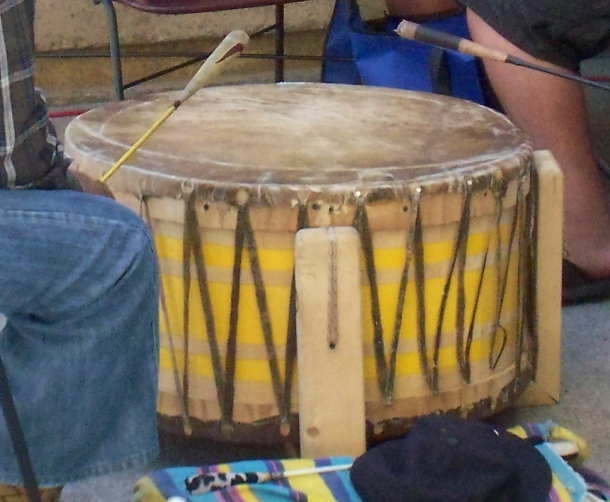
At Smashed-In-Buffalo-Jump’s interpreprative centre, we watched traditional dancing and heard traditional drumming and singing. The drum symbolizes Mother Earth’s heartbeat in Niitsítapi and other indigenous traditions.

Beating hearts gather

Singing, dancing, encircling

Joining as one with Her.

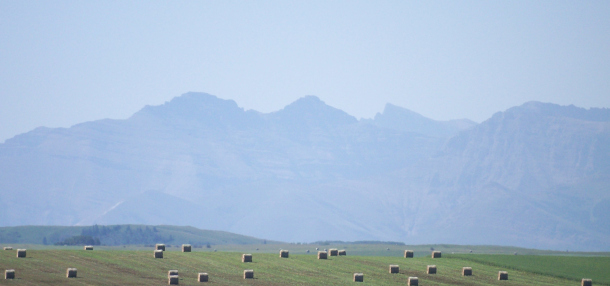
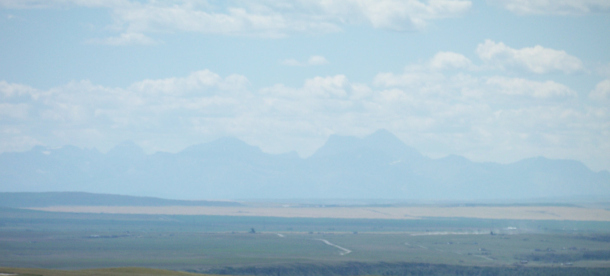
I took this picture as we turned towards Waterton. It was a hot, hazy day, blocking a view of the mountains.

The Niitsítapi meaning ‘original people,’ had their tradtional homes here. The Piikáni (North Piegan), a member of the confederacy, traveled to Waterton’s Blakiston Valley and gathered at Akaitapi (good campsite), providing food, water, and shelter. The area was also used by the Ktunaxa (Kootenay or Kootenai) who traveled from the west, through what is now the Crowsnest Pass.

hot, hazy beauty

shimmering above prairies

block distant bastions.

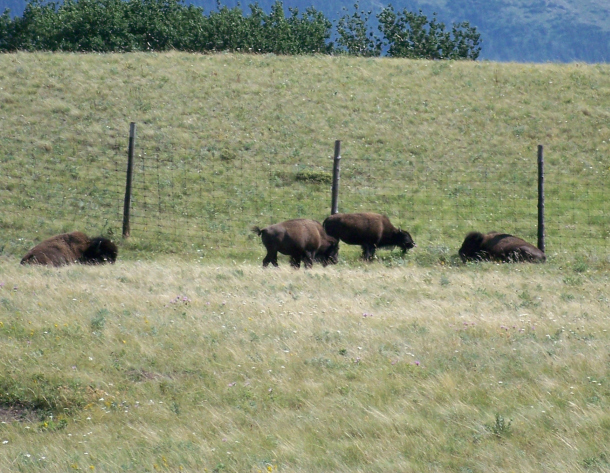
A small herd of bison live in a paddock at Waterton. At one time bison covered the Great Plains of North America. This was literal. People heard them long before they came into view and, when they were visible, it was a mass of brown and black that covered the prairies. Indigenous people used this animals as a ‘walking supermarket’ as almost all its body parts were harvested and usable.

Proud people’s icon

Plains symbol of abundance

Today’s sad sideshow.

We have attended a number of concerts with John Wort Hannam performing. He is from the part of Alberta I highlighted and has a beautiful song about the hills around the area. Enjoy.

Refreshing Pauses

I need to recharge my emotional, spiritual, cognitive, and physical batteries. In a conversation with a colleague in Spokane, we talked about how we were on the go constantly, busy and, when we got to Spokane we slowed down. I fall into a trap of busyness, which brings about a sense of dis-ease. Regardless of how much time I spent in Spokane, I soon realized I fell into a different rhythm of life, one of ease.

Thomas Merton and Thich Nhat Hanh wrote about an active life, one full of busyness, leaving humans depleted. The result is I need times where stress and busyness is reduced to be more present and aware of the life I live. For me, time used to read and write provide necessary breaks.

“Love is our true destiny. We do not find the meaning of life by ourselves alone – we find it with another.” (Thomas Merton)

“We have to learn to live our life as a human being deeply. We need to live each breath deeply so that we have peace, joy and freedom as we breathe.” (Thich Nhat Hanh)

I wrote this poem about a need to recharge batteries, about being present for others, returning hopefully a better person. It is also about finding deeper meaning in my life not always readily visible as I rush around. Black Elk‘s (Heȟáka Sápa) quote inspired the poem, reminding me much of living is recurring in a circle.

Heart opens quietly,

Listen deeply,

Worth waiting.

Lingering in solitude’s support,

Sheltering in its comfort,

Inviting me in.

Not escaping,

Circling back renewed,

Wholeness restored.

Community beckoning

Refreshing pause,

Recurring alchemy of both revitaling.