Tag Archives: nature

The Summer Day

I could have entitled this post calling, vocation, voice, etc. Mary Oliver shares what it means to be called and how we respond to this call through our particular life. Voice and vocation share etymology and come from the Latin verb to call: vocare.

Mary Oliver captures the essence of a calling with a metaphor of a grasshopper, which has its role to play and expresses herself in how she fulfills this role. This poem reminds me of Matthew‘s verse about the lily of the field and how God provides for each plant and animal. We each have a role and place in a complex way of being and we each respond according to how we interpret what that might mean.

The first three lines and the last two, as questions, speak to me. I am never certain of what life holds for me. Life emerges as eloquent questions that are open and not foreclosed by easy answers, yet emerge from the first three questions. I ask eloquent questions without predetermined answers. They inform my dialogue with the world and with others.

Since completing my dissertation, the last question has become part of my thinking about the themes. It was not in the dissertation, but is essential to experiencing and understanding teaching as a calling, which holds deep spiritual meaning.

I posted my dissertation on Academia and an executive summary on Medium.

Who made the world?

Who made the swan, and the black bear?

Who made the grasshopper?

This grasshopper, I mean-

the one who has flung herself out of the grass,

the one who is eating sugar out of my hand,

who is moving her jaws back and forth instead of up and down-

who is gazing around with her enormous and complicated eyes.

Now she lifts her pale forearms and thoroughly washes her face.

Now she snaps her wings open, and floats away.

I don’t know exactly what a prayer is.

I do know how to pay attention, how to fall down

into the grass, how to kneel down in the grass,

how to be idle and blessed, how to stroll through the fields,

which is what I have been doing all day.

Tell me, what else should I have done?

Doesn’t everything die at last, and too soon?

Tell me, what is it you plan to do

with your one wild and precious life?
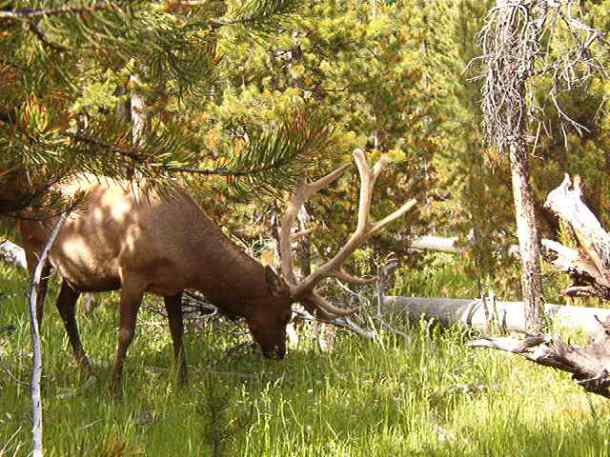
 

I took this picture in Yellowstone several years ago. I was about 25-30 feet (8-10 metres) away from this wonderful animal. He knew I was there, but seemed unconcerned. We were both living our lives.
The Prayer of St. Francis

Today, is our anniversary. We recited the Prayer of St. Francis at our wedding and have it displayed on a small and simple plaque. It reminds me of what it means to be human, in relationship with another person, and in relationship with God.

When I was in Spokane, I printed a copy and put it on the wall of the small room I stayed in. I refer to the room as my monastic cell and the Prayer of St. Francis seems a fitting complement to any monastic cell.

During challenging moments, I recite parts of the prayer to bring me peace and be present in the world.

Lord, make me an instrument of your peace:
where there is hatred, let me sow love;
where there is injury, pardon;
where there is doubt, faith;
where there is despair, hope;
where there is darkness, light;
where there is sadness, joy.

O divine Master, grant that I may not so much seek
to be consoled as to console,
to be understood as to understand,
to be loved as to love.
For it is in giving that we receive,
it is in pardoning that we are pardoned,
and it is in dying that we are born to eternal life.
Amen.

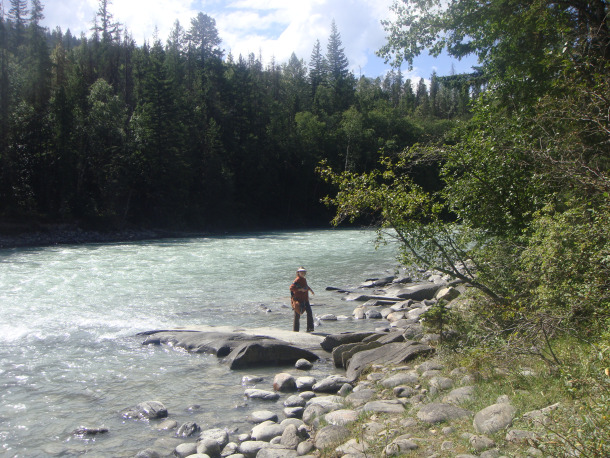
The picture is one I took several years ago of Kathy standing above a set of waterfalls close to the headwaters of the Fraser River.

The Spring Paradox

I am in Spokane now,  reading, writing, and preparing for two presentations at the end of the month. It is unseasonable here, but it is at home, too. Rain and snow go with the low temperatures.

I wrote this about the paradox we experience in spring. It is a time of rejuvenation and resurrection, literally and figuratively, yet it is not always easy to see, unless I watch closely. Each day, as I walk, I see signs that contradict each other: sullen skies, a glacial wind, flowers showing, and robins gathered to feed.

Leaden, sullen rain-heavy skies,

The wind glacial;

Absent a lover’s warm touch,

With precision, it cuts through cloth,

Touches skin with icy fingers.

Have faith the calendar counsels

Nature speaks in other ways;

Daffodils reach through the earth,

Robins find food washed up on the sidewalk,

I hear spring is here.

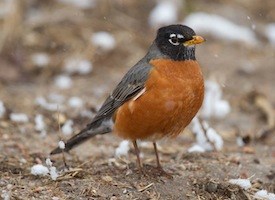
I took this picture of the first robin I saw last spring. There was still snow. The robin posed for me, more interested in finding food than fearing me.

Merry Christmas

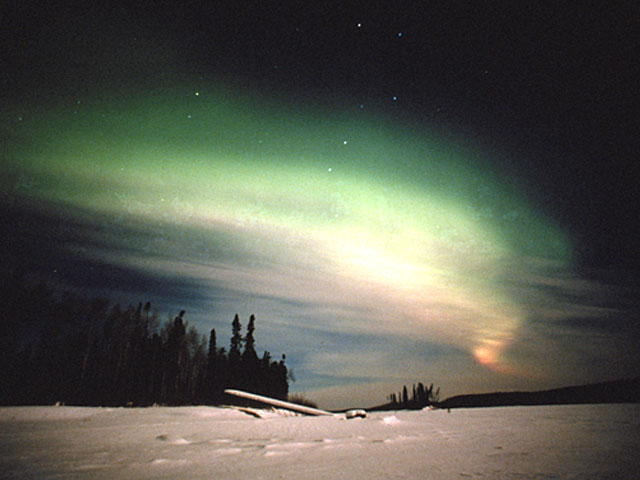
I wrote this poem several years ago about the magic provided by the Northern Lights (Aurora Borealis) and Christmas. What message was in those celestial colours and sounds? As a child, I thought the sky talked to me and told me a creation story.

I grew up in Northern Alberta and Christmas was a special time. I recall cold winter nights. I mean they were cold–almost minus 40 at night. Our windows upstairs were almost completely frosted over. On moonlit nights, the light kept me awake or that is what I told others.

During Advent, my mom and older brothers walked across the street for evening Mass. The younger ones, including me, went to bed. I did not fall asleep right away and would watch out the window for them to come home. I thought no one saw me, but my Mom would come up and tell me to go to bed.

At that time of year, I recall is the Northern Lights and how you could hear them as well as see them light up the sky as they danced across the sky. We don’t see them very often in Edmonton with the urban light.

When we spend time at the farm at Christmas, we hear and see them again. On cold nights we hear the train (about a mile away) and it sounds like it is coming through the house.

Small children–

Breathlessly awaiting,

Peering through frosted window

Soaking it in.

Heavens rippling–

Lights undulating;

A celebratory fury

An indisputable guide.

This old house speaks;

Nature answers–

Heavens crackle

Sweet symphonic sounds shimmering.

Earth’s floor–

Blanketed in white

Celestial colours speaking

Capturing young senses.

A vivid winter scene,

A sensual, sensory palette,

Reminding us–

Christ’s Mass is here.

pic_wonder_northern_lights_lg

Wildness

via Wildness

Michele‘s post reminded me of poems by two of my favourite poets.

Environmentalists refer to Wendell Berry and Mary Oliver‘s poems. An educated guess is that Henry David Thoreau, who Michele quotes, informed their writing.

Wendell Berry wrote in moments of despair he “comes into the peace of wild things who do not tax their lives with forethought.”

Mary Oliver ends Summer Day with the following question: “Tell me, what is it you plan to do/ with your one wild and precious life?” Paradoxically, the question is an answer to her eloquent questions about who created nature.

Nature has a way of being and providing us with lessons for life. It is in meditative moments, when we just are, we grow to understand what that can mean. We grow and value what is essential not to us, but to those who come after us.

“We do not inherit the world from our ancestors, but borrow it from our children.”

Fairmont Hot Springs

When we visited Fairmont Hot Springs, I walked each morning and we went below the hot springs one evening for a short hike. On the walks and hikes, I took pictures.

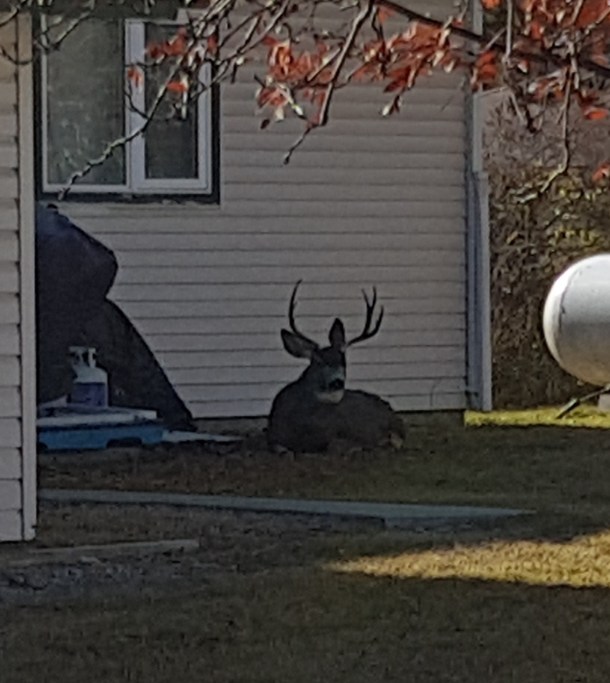
On Sunday, we went to church. As we came out, this buck posed for pictures. He was in the shade so I cropped the picture and, as a result, it is a bit blurry.

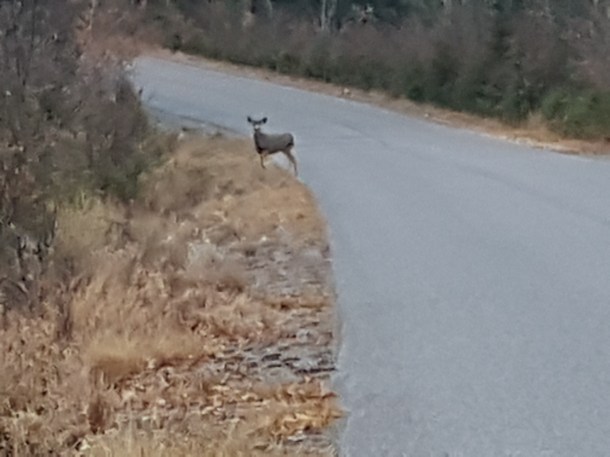
I walked each morning and afternoon. This doe crossed the road about the time the sun was coming up each morning. She kept an eye on me, just to make sure.

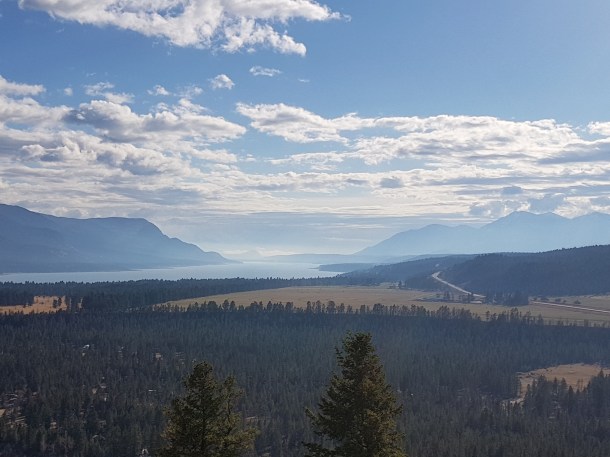
Just outside Fairmont is Columbia Lake, which is the head waters of the Columbia River. The lake appears to have a mist over it most of the time.

When I walked in the morning, I took this picture as it was becoming daylight. The mist was much heavier at this time of the day than it was during the day.

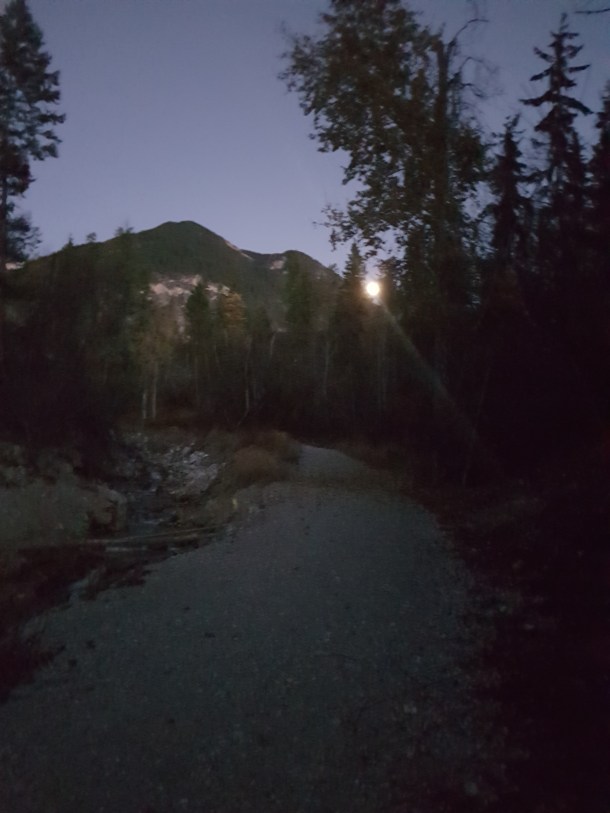
Several evenings we went to the hot springs. On one of the evenings, we walked below the springs and found a path to a small creek. The moon was just rising from behind the mountains.

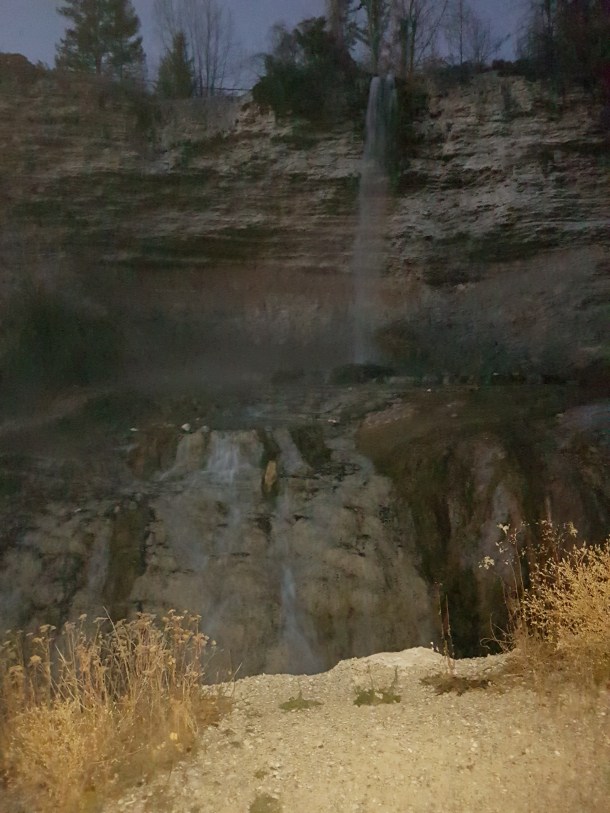
A small water fall flows into the creek. The volume increases when they release water from the swimming pool to clean it. I took the picture without any flash. I don’t know if it is the rocks, the time of day, or some other reason that allowed the picture to appear so well-lit.

Mountains and Water

I was on the road today, driving through part of Alberta I do not spend much time. I drove to Fairmont Hot Springs, which is in British Columbia. To get there, we came via Banff National Park. The normal route west usually takes me through south of Banff and Jasper National Park.

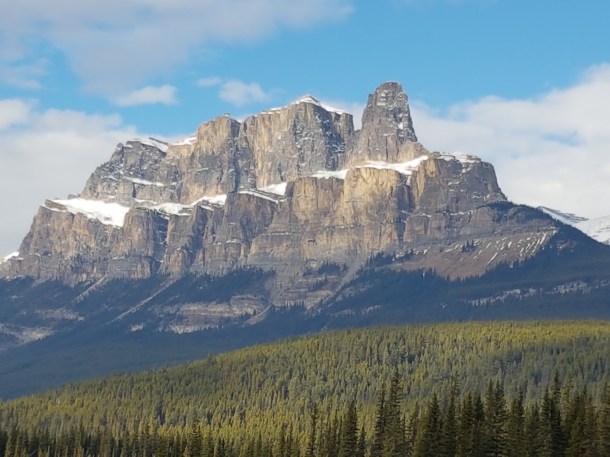
It was a beautiful day and two mountains stood out against the sky with clouds in behind them. I am not sure of their names, because of a lack of knowledge of the area. It was in the Mount Norquay area, but I thought Norquay was further to the north.

This might be Mount Norquay. It seemed to be the mountain that stood out and was the focus of the pullouts, but I don’t know the area well enough to be certain.

These palisades are just off to the side of the mountain above.

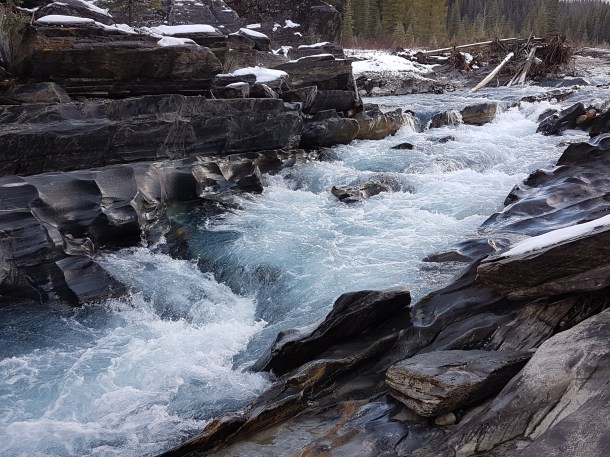
This is just above Numa Falls in Kootenay National Park in British Columbia. The mountain parks on the British Columbia side are not as well-developed as the ones on the Alberta side. I use the word developed in a relative way, as none of the parks have significant commercial development. We were not able to get any closer to the falls as the bridge is out and the gorge has no direct access.

Below, is a video of the falls from YouTube. I don’t see a bridge in the video, but the gorge is inaccessible.


Pointers to Non-Duality

I am back to post. I am reading and writing. I am working to intersect hermeneutic phenomenology, which I used as my research methodology for my dissertation and the method of currere. The latter is an autobiographical method, in part, based on existential philosophy to explore curriculum through one’s lived-experience. As well, it uses Freudian psychoanalytic theory as part of its foundations. It is this latter aspect I am contrasting with hermeneutic phenomenology as both are interpretive methods.

I moved to radical hermeneutics, linking it with my writing. What I found is there is an overlap with poetry and non-duality.

Bill Pinar developed the method of currere and used Zen philosophy as a third leg for the method. The voice in hermeneutics is poetic, seeking to understand the world in non-dualistic ways and subvert binary thinking.  As I looked for a poem, I found this one by Wu Hsin.

When I am mindful and present to the world in its past, present, and future moments the text I live comes to life with new meaning.

Just as the honey is not sweetness,

The words of Wu Hsin are not

The truth.

However, time spent with these words is like

The aftermath of rain.

In due course, a sprouting of

Understanding will occur and

Will bear fruit at a pace

Outside of one’s control.

The Meeting

A couple of weeks ago I was out for one of my daily walks. We live in neighbourhood that is well inside the city, so what happened was a surprise. A deer was on one of the lawns. It saw me, but by the time I had my cell phone and camera out is was two blocks away. Just the same, it was an unexpected moment to bethoroughly enjoyed.

The deer’s unexpected appearance reminded me of what Thich Nhat Hanh says about the ordinary being part of the extraordinary. We just have to remain open.

When I am quiet,

When I just am,

Openings appear;

Something shows itself.

In those ordinary moments,

Miracles appear,

Making the moment (extra)ordinary,

The enjoyment exceeds itself.

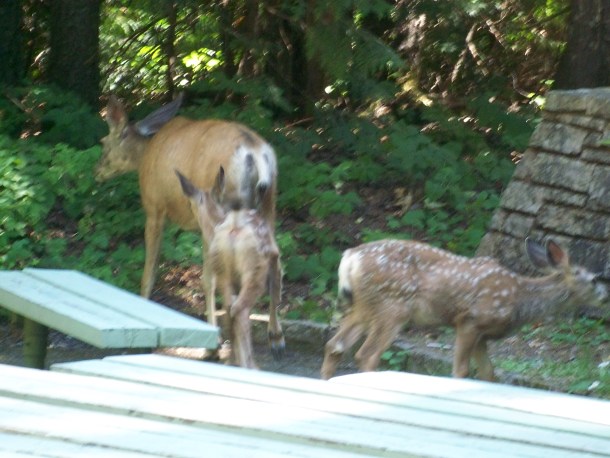
We took this picture in Waterton Lakes National Park. I walked around a corner and one of the young ones was within arm’s length, but separated from the doe. I stayed still, until mother and child reunited.

To Read a Poem…To Write a Poem

This poem rattled around in my mind and body for the last few days. I did not write it out in rough form, so this is it.

To read a poem;

That is to breath in the world,

Meditating on that world

(Re)membering a fleeting moment–

A moment my whole body experienced;

The smell of pine forest

The distant white-topped mountain

Rocks disturbing a river’s flows

The touch of a gentle breeze,

Cooling a sun-burnt face.

To write a poem;

Breathing out,

A lived-experience,

Giving words to a fleeting moment–

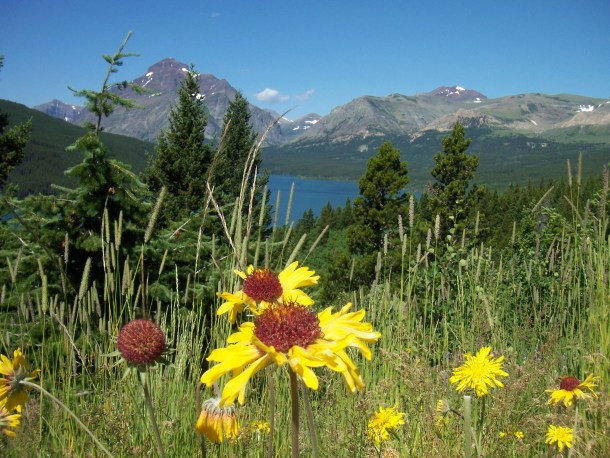
Flowers gesturing towards mountains,

Trees caressed by mountain wind,

Nature’s fragrances arise from the valley

A silence encroaching upon my mediation.