I am headed to New Zealand to present at an International Peace Conference and have been thinking of resistance so needed today. Music, poetry, and art play a significant role in resisting violence, including that imposed by governments and other institutions that are supposed to protect.
One of the first albums I bought was The Freewheelin’ Bob Dylan. I was about 16-years old and I still have the album. It is iconic with songs like Blowin’ In the Wind (melody based on a spiritual called No More Auction Block), Masters of War, A Hard Rain’s a-Gonna Fall, Oxford Town about resistance to desegregation in the American South, and Talkin’ World War III Blues. Dylan covered Lead Belly’s version of I Shall Be Free.
Talkin’ World War III Blues is my favourite song on the album. Dylan was at his best in the spontaneity of the song and it fits with the talking blues genre. In I Shall Be Free, he sings about making love to Elizabeth Taylor. Even in the early 60’s a was a way to avoid the reality that hung over the world was to turn to popular culture as a distraction from the threats of nuclear war.
About the same time, I wrote a poem in school. I know Mr. P. writes poetry is hard to imagine for my students. The poem was about the tragedy of war and it stole lives in absolute ways whether through death or through the physical and psychic damage done to those who were forced into service in a war they did not understand. Many of those who died or were left deeply scarred with the trauma of war were from the African American population, which was about 12% of the American population at the time. Their deaths alone represented about 25% of the casualties, so statistically overrepresented. The personal narratives within their families and communities can not be quantified.
I borrow a bell hooks’ quote for my title. Educating is offering a gift of hope, reminding me of a Mary Oliver poem about sorrow: “It took me years to understand that this, too, was a gift.” I learned teaching did not guarantee learning. A student needs to trust a teacher and the hope offered today may take years to realize if ever. The teacher, me, missed the mark and did not go back to understand what that meant
Michelle visits my blog from time to time and what she shares complements my posts. It has been awhile since I posted, so her recent visit led me to look at her posts again. I do regardless of intent to post. The Jane Goodall quote reminds me of one by Elie Wiesel: “The opposite of love is not hate, it’s indifference.” Apathy and indifference are synonyms, so the words are somewhat interchangeable.
Hope has been a frequent part of my recent scholarship and emerges from my life. The Prayer of St. Francis was a reading at our wedding and I have a simple plaque to remind me of what it means in my life. I turn to it in moments where doubt and despair find their way into my life to recite “Lord, make me an instrument of your peace … Where there is despair, hope.”
School can be an unhappy place for many students. In some schools, 60-80% of students are labeled as unwilling and/or unable to learn. When this happens, students lose hope, they become cyphers, and are erased or treated as disposable. Consider the language we direct at others in terms of illegal immigrants, illegal aliens, collateral damage, etc. as if humans are somehow illegal or, as casualties of war, are just a byproduct of being in the wrong place at the wrong time. It is an indictment of those who hold power and the “pathologies of power” (Paul Farmer) that exist in this world. Farmer wrote about his experiences treating Haitians with AIDS, including many women who contracted the disease due to macho posturing of men in a hierarchical society.
The rest of the Prayer of St. Francis is appropriate to reflect upon in considering offering love instead of hate, joy instead of sadness, and being instruments of peace to overcome the indifference and apathy that appears in the language of power and its pathologies. I am an imperfect person who hardly qualifies as a great Christian or Catholic, but the words of the Peace Prayer resonate for me in today’s day to offer hope to others through educating.
In my presentations and articles, I often share Emily Dickinson‘s poem as she reminds me how fragile hope can be. To be accepted, it needs to be offered repeatedly as an authentic gift.
Theologian and civil rights activist, Howard Thurman shared the following poem in a sermon reminding me Christmas is not a one day event. It is part of the daily ceremony and ritual I should undertake. It reminds me some usurp Christmas as a neo-liberal, market agenda that changes a deeply spiritual event into profiteering.
“Where refugees seek deliverance that never comes, And the heart consumes itself, if it would live, Where little children age before their time, And life wears down the edges of mind, Where the old person sits with mind grown cold, While bones and sinew, blood and cell, go slowly down to death, Where fear companions each day’s life, And Perfect Love seems long delayed. CHRISTMAS IS WAITING TO BE BORN; In you, in me, in all humankind.”
Jesus and his family were humble refugees from humble backgrounds. Regardless of material wealth, we each come from and return to humble backgrounds. In between, I can seek deliverance, age with grace, and retain a daily Christmas spirit. Without it, hearts harden, minds ossify, fear is a constant companion, and there is a lack courage (in French, coeur is part of the etymology of courage) to act and speak out against those who treat humans as chattel dealt with as objects. With a daily Christmas spirit, I engage in I-Thou relationships, without judging, qualifying, objectifying the other. Martin Buber proposed “the key to creating society that is nourishing, empowering and healing for everyone lies in how we relate to one another.”
It takes considerable effort to overcome the divisiveness we currently live with and listen, with open hearts, to others who share views of the world different than ours. In On the Brink of Everything, Parker Palmer describes how he felt anger towards others who voted differently than he did. By the time the book was published, he described how it was important to understand that people did so because they felt left behind in various ways.
Here is Healing Time by gospel and blues singer Ruthie Foster, which seems appropriate in today’s day and age. How do we heal and make whole?
The recent killing of the CEO of United Health Insurance reflected the violence (himsa) we find ourselves embedded in. I refuse to condone violence in any form. What flies under the radar is the daily violence humans are subjected to when they are denied healthcare, when it is delayed. Hannah Arendt introduced us to the term “the banality of evil”, which underscores both forms of violence, although the former is more obvious than the latter. Schools and teachers can play a vital role in educating children, youth, and adults in ways that help them unearth the roots of violence.
For the past 2-3 years, I focused on re-imagining teacher education as an andragogy of hope and nonviolence. A third pillar is dialogue and civil discourse. One objective is to have a manageable endeavor for teachers from the moment aspiring teachers enter schools of education to the end of their careers. The second is to move away from what Paulo Freire referred to as a banking model of education where information is deposited in students to a dialogic form with teachers and students engaging as teachers and learners. When I enter K-12 classrooms, I observe how little has changed in our schools and this conditions education students the banking model. It is embraced by those who decide how schools and teaching function.
Currently, teachers experience top-down mandates reflecting a neo-liberal , market-driven, top-down process set down by politicians, bureaucrats, technocrats, and autocrats. Those in ivory towers design schools where competing for marks, individual rankings, and accreditation are the focus as opposed to considering the collective good and forming of character. Fortunately, good teachers do grow to explore, navigate, and discover ways to overcome top-down and politically motivated mandates.
Schools limit the ability to think critically and discern what systemic issues exist that prevent real change from occurring. It is easier to allow unfounded, unwarranted conspiracy theories, instead of considering other potential causes that require this critical thinking and discernment. For example, global warming likely has more to do with increased illnesses and syndromes than vaccines. Global warming means we have to make committed and transform how we each live and living collectively. Conspiracy theories carry no such weight. Critical thinking gives way to accepting opinions largely based on opinions. Dialogue gives way to supposed free speech.
Anyone who undertakes a challenge of this magnitude faces inertia of immovable forces. Having said this, it reminds me that Margaret Mead said: “Never doubt that a small group of thoughtful, committed [humans] can change the world; indeed, it’s the only thing that ever has.” The change we seek calls for the volition and will to press forward, express one’s self in a human and humane way, and make those changes in the face of opposition and resistance. What we need to avoid is acts of violence as acceptable to achieve our goals. This lowers and debases those who seek humane ways forward to the level of those who excuse the systemic violence and oppression that permeates us.
The word humane is essential to this re-imagining as much of the violence is associated with inequity and oppression. Growing up in the 1960’s and 70’s, my mother, hardly a Marxist or social democrat, used to tell us “the rich get richer and the poor get poorer” and we should be grateful for what we had, as many others had less. It is also essential to speak out and advocate for a world where it is unacceptable to put material wealth before human life and the life of the planet.
Poverty and oppression are forms of violence that exist as a products of the banality of evil and the system that promotes it. Gustavo Gutiérrez argued “the poor are a by-product of the system in which we live and for which we are responsible. They are marginalized by our social and cultural world. They are the oppressed, exploited proletariat, robbed of the fruit of their labor and despoiled of their humanity. Hence the poverty of the poor is not a call to generous relief action, but a demand that we go and build a different social order.” Part of a different social order is educating teachers and, in turn, teachers educating themselves to create a humane, equitable social order.
This was a challenging post to write with many edits. It is different than other posts, however it is consistent with my recent presenting, writing, and publishing. When I received a PhD, I did not anticipate traveling this route, but one thing led to another and here I am. It is “the path less traveled” as Robert Frost suggests.
I leave with a Wendell Berry poem: Manifesto: The Mad Farmer Liberation Front
Love the quick profit, the annual raise, vacation with pay. Want more of everything ready-made. Be afraid to know your neighbors and to die. And you will have a window in your head. Not even your future will be a mystery any more. Your mind will be punched in a card and shut away in a little drawer. When they want you to buy something they will call you. When they want you to die for profit they will let you know.
So, friends, every day do something that won’t compute. Love the Lord. Love the world. Work for nothing. Take all that you have and be poor. Love someone who does not deserve it. Denounce the government and embrace the flag. Hope to live in that free republic for which it stands. Give your approval to all you cannot understand. Praise ignorance, for what man has not encountered he has not destroyed.
Ask the questions that have no answers. Invest in the millenium. Plant sequoias. Say that your main crop is the forest that you did not plant, that you will not live to harvest. Say that the leaves are harvested when they have rotted into the mold. Call that profit. Prophesy such returns.
Put your faith in the two inches of humus that will build under the trees every thousand years. Listen to carrion – put your ear close, and hear the faint chattering of the songs that are to come. Expect the end of the world. Laugh. Laughter is immeasurable. Be joyful though you have considered all the facts. So long as women do not go cheap for power, please women more than men. Ask yourself: Will this satisfy a woman satisfied to bear a child? Will this disturb the sleep of a woman near to giving birth?
Go with your love to the fields. Lie down in the shade. Rest your head in her lap. Swear allegiance to what is nighest your thoughts. As soon as the generals and the politicos can predict the motions of your mind, lose it. Leave it as a sign to mark the false trail, the way you didn’t go. Be like the fox who makes more tracks than necessary, some in the wrong direction. Practice resurrection.
And a Bob Dylan video, a song I forgot about until this morning. He reminds me conspiracy theories, and a need to address violence and its underlying causes have been with us for a long time.
This is the time of the year to have dreams of a more just and humane world. Dreams are the land of hope and Christmas is the perfect time to be a dreamer. This brings to my mind the lines from Imagine by John Lennon:
You may say I’m a dreamer But I’m not the only one I hope someday you’ll join us And the world will be as one
Several years ago, I read an essay by Parker Palmer reminding me of the miracle of Christmas. As a child growing up in Northern Alberta, Christmas was a time of wonder. Christmas was not the neoliberal, market-driven affair of today. It was a time to re-member the deepest messages of the time of year.
Parker posted on Facebook about an experience in Nogales Mexico at a refuge for asylum seekers and pointed out Jesus was likely a person of colour born into the Jewish faith. In this sense, I understand Jesus’ birth as one transcending one particular faith.
Part of my academic journey this year was writing a potential chapter on nonviolent education. I read The Raft is Not the Shore, which was a conversation between Thich Nhat Hanh and Daniel Berrigan. They described how They, the Buddhist monk, engaged in communion and how the Jesuit priest reveled in learning more about Buddhism. In our polarized and divided world, this type ecumenism and communion (entering into intimate relationship with each other) with each other has fallen by the wayside.
I wrote the following poem several years ago and am drawn back to it. I hope it captures Christmas in a way that reaches out and touches what we share in common with each other: our humanness and journey seeking refuge at various times
Carpenter guiding,
Expectant mother riding,
Backs straight; heads high–
Donkey serving as regal carriage.
Seeking refuge in the night–
Giving birth in a stable,
Swathed and cradled in a manger,
Beasts welcoming the child.
Showering gifts upon us–
Returning each year,
Lighting the way–
Only asking, “Can you open your hearts?”
Source of strength and courage,
Our turn to humbly receive gifts,
Restocking spirits,
Rejuvenating souls.
For several years, Kathy and I attended concerts by Canadian singer and actor Tom Jackson. The proceeds went to support local food banks and we took something extra with us to share.
He sings a beautiful version of Huron Carole, which points to the ecumenical and communal nature of Christmas. It echoes Parker’s re-membering “the story, the music, the candlelight, the scent of pine, the silent night, the warm presence of family and friends.”
For me, Christmas is sharing time with family, friends, and expressing kindness to those who we don’t know. It is a 365 day process as opposed to a run up to a one day event.
Emily Dickinson wrote this poem and, although hope is fragile, it has the potential to always be with each of us. Even in the most difficult and inclement times, hope can keep us warm.
More than at any other time in my life, I try to find hope particularly in the small everyday things. I might call those things banal. I often use the opening lines of the poem in writing, publishing, and presenting, which is related to hopeful and nonviolent pedagogy and can be found at Academia.
When I look closely and am mindful of my words and actions, I find seeds of hope in my life that make a change for those closest to me and, in turn, hope they and I nurture those seeds. As bell hooks and Thomas Merton wrote, we enter into communion to take us beyond words and speech. It is an intimate and loving way of being together, sharing, and communicating.
Today, I read Carrie Newcomer‘s Substack essay and the lyrics to her song Sanctuary. What do we do in moments of despair. In a conversation with her friend and mine Parker Palmer, she received the following advice. There are times we march and speak out. Other times, we seek sanctuary, gathering with those we love and respect to share our stories and encourage each other. The word courage comes from the French coeur, meaning heart. What we do is heartfelt as we share the hurt we feel with each other in moments of compassion, the sharing of what we love and the suffering as we look at how it might be overturned. We are not alone. We need to lean on each other and take appropriate action and speak appropriate words even to those we disagree with. Take heart and retain hope in trying times by looking for those people and things that give us hope on a daily basis.
This is the time of the year to have dreams of a more just and humane world. Dreams are the land of hope and Christmas is the perfect time to be a dreamer. This brings to my mind the lines from Imagine by John Lennon:
You may say I’m a dreamer But I’m not the only one I hope someday you’ll join us And the world will be as one
Several years ago, I read an essay by Parker Palmer reminding me the miracle of Christmas. As a child growing up in Northern Alberta, Christmas was a time of wonder.
Parker posted on Facebook about an experience in Nogales Mexico at a refuge for asylum seekers and pointed out Jesus was likely a person of colour born into the Jewish faith. For me, Jesus’ birth is an ecumenical event.
I wrote the following poem several years ago and am drawn back to it. I hope it captures Christmas in a way that reaches out and touches what we share in common with each other: our humanness and journey seeking refuge at various times
Carpenter guiding,
Expectant mother riding,
Backs straight; heads held high–
Donkey serving as regal carriage.
Seeking refuge in the night–
Giving birth in a stable,
Swathed and cradled in a manger,
Beasts welcoming the child.
Showering gifts upon us–
Returning each year,
Lighting each way–
Only asking, “Can you open your hearts?”
Source of strength,
Our turn to humbly receive gifts,
Restocking spirits,
Rejuvenating souls.
For several years, Kathy and I attended concerts by Canadian singer and actor Tom Jackson. The proceeds went to support local food banks and we took something extra with us to share.
He sings a beautiful version of Huron Carole, which points to the ecumenical nature of Christmas, Christ’s Mass, echoing Parker’s (re)membering “the story, the music, the candlelight, the scent of pine, the silent night, the warm presence of family and friends.”
For me, it is food and opening a present on Christmas Eve. Food included French-Canadian tourtière (meat pie), which Kathy and I continue to share with our children and grandchildren.
It took a few days to post this. Michele shared a line from Invitation by Mary Oliver as a reminder we are each invited to linger in the natural world and its mysteries. When we do this, we experience the potential for a sense of wonder and awe to take hold. We move past curiosity and just being in the world, feeling we are each an integral part of the fabric of nature and the universe.
We are not world travellers, but take time to explore our backyard and a little beyond in the US and Mexico. When we travel, we hike and experience nature’s wonder. What is remarkable is how fortunate I am to witness some of this in my daily life. Years ago, as we prepared to go to church, I stepped out on the porch. About 5 metres from me a cow moose grazed on willows. She ate and glanced at me from time to time, seemingly unthreatened. Another time, as I travelled home, I saw an eagle perched on a deer carcass, likely the victim of a passing vehicle, on the edge of the forest. In both cases, I watched in wonder without taking pictures. Those remembrances are fresh and vividly imprinted on me as if they were yesterday, not 30-40 years ago.
I took the picture below in Yellowstone. We stopped and I walked about 50 metres to find access to enter the ditch rather than going down a steep embankment to avoid alarming the animal. I carefully and quietly walked to within 5-10 metres. The bull elk remained aware of me and the other person and continued to graze. I took 2-3 pictures. The one below is in a digital frame and appears every few minutes during the day.
Here, is the poem by Mary Oliver reminding me I am invited into this sense of wonder. The invitation calls on me to take care, be patient, and just be in the presence of other-than-human beings. As the poet tells me, I linger in the presence rather than rush away. I thrill in the willingness of this wonderful being to let me share nature with it.
Oh do you have time to linger for just a little while out of your busy
and very important day for the goldfinches that have gathered in a field of thistles
for a musical battle, to see who can sing the highest note, or the lowest,
or the most expressive of mirth, or the most tender? Their strong, blunt beaks drink the air
as they strive melodiously not for your sake and not for mine
and not for the sake of winning but for sheer delight and gratitude – believe us, they say, it is a serious thing
just to be alive on this fresh morning in the broken world. I beg of you,
do not walk by without pausing to attend to this rather ridiculous performance.
It could mean something. It could mean everything. It could be what Rilke meant, when he wrote: You must change your life.
It has been awhile since I lasted posted. This wonderful post by Purple Rays came through my feed and it was an opportunity to share it and get re-started.
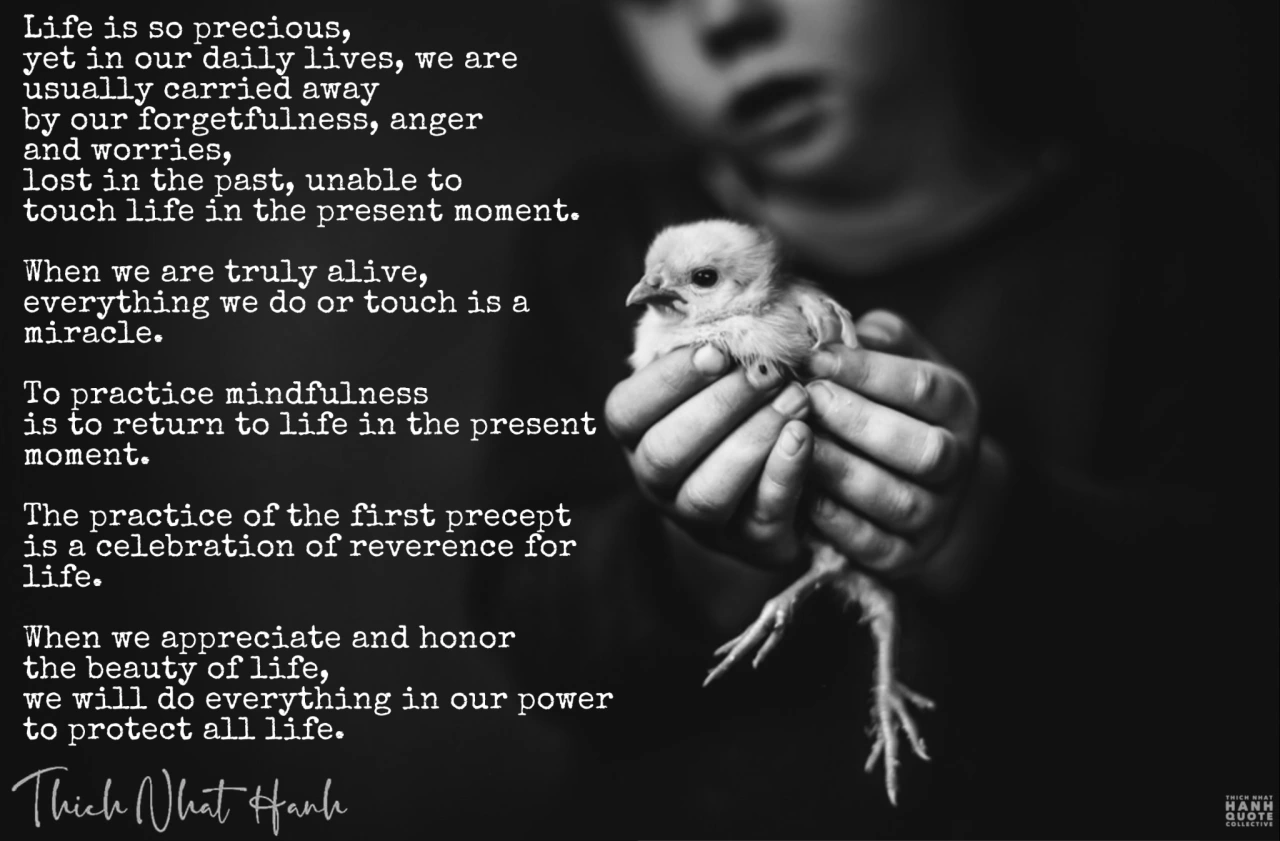
Although the quote is one from Mahatma Gandhi, it reminds me of many by Thich Nhat Hanh. Sometimes, I get busy and forget to pause and take in the world as it is in all its radiant beauty. Or, I forget to be grateful for what I have in life. To be mindful and aware of what brings me gratitude is important. It includes a long-term marriage, children who grew up and found their way, completing a PhD, publishing peer-reviewed articles and poetry, etc. Or, it is as simple as the small, perhaps tiny is a better word, garden in the backyard. It is not there to save money. I planted it to provide fresh tomatoes, basil, and strawberries, along with Kathy’s heritage rhubarb plant. Most mornings, I get check to see what is ripe and ready, I water, and notice the flowers that bring pollinators to the yard. It is less about the big accomplishments and more about the small things that go unnoticed in the shadows of those supposedly bigger and better accomplishments. Thich Nhat Hanh has a lovely quote reminding me to stay in the present , to be mindful of and appreciate everything I do or touch as a miracle.
For those who follow my blog, you may know I love Mary Oliver and her poetry. There is a mystical quality to it. Mystical is taking in the world and life in a subjective way, as a living subject. Rather than as objects to be probed, measured, and analyzed, we explore them and we use poetic terms to describe. Mary Oliver does this in The Summer Day, where she describes how a grasshopper captures her attention. She attends to it and minds its actions and ways of just being in the world–just being a grasshopper. I love the questions Mary Oliver asks in her poetry.
Who made the world?
Who made the swan, and the black bear?
Who made the grasshopper?
This grasshopper, I mean—
the one who has flung herself out of the grass,
the one who is eating sugar out of my hand,
who is moving her jaws back and forth instead of up and down—
who is gazing around with her enormous and complicated eyes.
Now she lifts her pale forearms and thoroughly washes her face.
Now she snaps her wings open, and floats away.
I don’t know exactly what a prayer is.
I do know how to pay attention, how to fall down
into the grass, how to kneel down in the grass,
how to be idle and blessed, how to stroll through the fields, which is what I have been doing all day.
2022 was an eventful year in terms of writing and publishing. It was also surprising as I the two published pieces, a book chapter and a peer-reviewed article, were about hope and had a spiritual component to them. I think hope is a phenomenon we each want in our lives. Those who have followed the blog for a while may recall that The Peace Prayer of St. Francis is an important part of my family’s life. We recite it at various ceremonies when we come together and Kathy and I have a small plaque my mother gave us many years ago.
The line that resonates most with me is “where there is despair hope.” I used the line in the introduction of a book chapter I co-authored. It commemorated the centenary of Paulo Freire‘s birth. Many would associate him with critical pedagogy and his seminal book, Pedagogy of the Oppressed. Later in life, he revisited many of the themes from this book in one called Pedagogy of Hope, which we used as our primary reference. Without hope, we are left with little. We are left with despair.
For me, Emily Dickinson describes the spiritual and paradoxical essence of hope in the following poem:
“Hope” is the thing with feathers –
That perches in the soul –
And sings the tune without the words –
And never stops – at all –
And sweetest – in the Gale – is heard –
And sore must be the storm –
That could abash the little Bird
That kept so many warm –
I’ve heard it in the chillest land –
And on the strangest Sea –
Yet – never – in Extremity,
It asked a crumb – of me.
Hope is spiritual in that what we each hope for can animate our spirit and make our lives more complete. We hear it song most clearly in moments of silence and stillness as we turn inward to listen to the tune without words. Hope is paradoxical as it is fragile and exists in the Gale and storm that makes it sore. We have to be alert to the challenges we face in bringing hope to life. Perhaps it is best expressed in moments where it intersects with the hopes of others who we come in contact with.
My taste in music tends to the eclectic and non-mainstream. Several years ago, I heard Michael Franti on a small radio station (they still exist) I listen to and loved his messages. His songs embody hope, the role the heart plays in it, the reality of hard times, and how we need others to live with hope.
Several years ago, we travelled to Jasper National Park and went on a day tour. As we passed the trees in this picture, the guide told us the tall one was about 300 years old. Due to the difficult conditions, the tree did not realize its fullest height. Despite the challenges, it still grew. Its growth is like hope.



 ivonprefontaine
 Teacher as Transformer