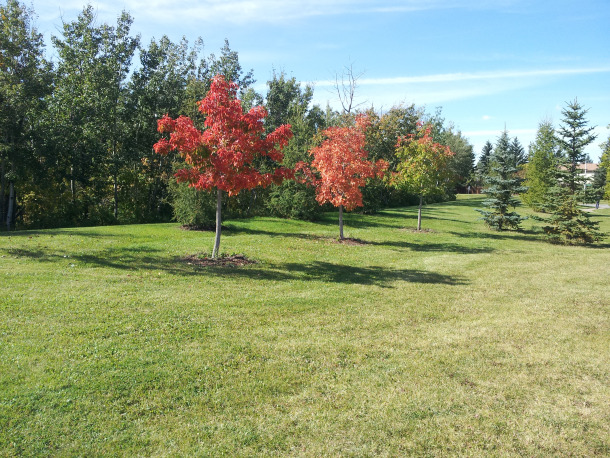
I wrote this poem and took this picture while attending a mindfulness retreat several years ago. The picture was taken in the early fall on a beautiful day as the sun warmed, the breeze cooled, and colours changed. When I sit in meditation or practice yoga, mindfulness reminds me I am one part of a much larger scheme. There is a lot acting on me that goes unnoticed and taken-for-granted. It is in mindfulness I remember to be humble and grateful for the small part I do play in the world.
On June 29, I posted a similar poem and theme. I am not sure what led me to post two that shared the same title. It is likely, early in the school year, it feels chaotic. Early in a school year, there are moments of repreive in this feeling and, as the year gains momentum, they become more common. As one co-participant in my dissertation put it: “I learn to stand in the middle of the storm.”
The other inflluence was I took several courses in my PhD about leading in complex and chaotic times. Servant-leadership, mindful leadership, and transformational leadership are forms of leadership particularly effective in times. We focus on questions about what needs to be changed, how do we engage each person in change, and how does each person become a leader in their own right? These forms share common features: grounded in the present, ethically guided, there is foresight without being set in certainty, etc. Mixed in this was courses on the Tao of Leadership, Systems Leadership, Leadership and Justice, Dialogic Leadership, etc. When I re-entered the classroom each September, what I learned in my PhD founds its way in with me. How could I better serve each student? How could we transform and share our experiences into something nourishing each other’s lives? How could I make a difference for each student? How could they grow and become better leaders than me?
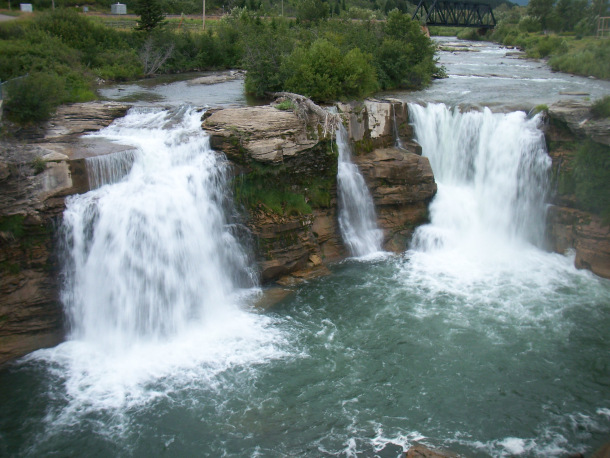
I took the pictures at Lundreck Falls as a reminder of how quickly nature can bring a sense of calm back even in the midst of what is initially chaotic. Within a short distance from the falls, the water pools and calms, at least on the surface. What goes on underneath the surface can remain chaotic and complex much like life, needing non-judgemental, humility, foresight, patience, and wisdom to navigate the unforseeable and unpredictable.
Needless to say, I wrote a poem about the challenges of remaining calm in the midst of the storm sometimes raging around me.
Towards the end of my teaching, I found it challenging to stay positive. Administrators, who spent little time talking and listening to what we did, often imposed their arbitrary decisions oblivious to possible consequences. Having said this, and with time to reflect, I did little to bridge differences. I went back to my classroom, shut my door, and taught. In teaching, the extraordinary emerged.
I bracket extra to draw attention to the ordinary. Thich Nhat Hanh writes about how (extra)ordinary emerges, not as a miracle, out of the overlooked and ordinary we experience. I appreciate this more today than I did those last years of teaching. Barry Lopez says the opposite of love is not hate. It is indifference, an uncaring attitude towards other humans and objects in our presence. It begs questions: “What calls me? What am I mindful of in my life that needs my fullest attention? Who and what am I a steward of?” Today, this understanding (in)forms me when I encounter challenging moments. For example, struggling to find my way into a higher ed classroom I see this as an opportunity to write and read.
Sometimes. I tend to create negative narratives rather than let each moment live itself fully and be aware of as much as I can be of it. This is hard, but grows easier as I set aside dis-ease. Parker Palmer reminds me, when I do something that is not calling me and I am not responding to the call in a full throated way, I do violence to my life and that of others. He speaks about how we conflate lonliness with solitude. The former is problematic and the latter a paradoxical need alongside a need to live in community and share with others. It is in moments of solitude the (extra)ordinary can emerge from the ordinary
Unlike loneliness,
Alone is (in)different,
Solitude appreciates,
Providing solace.
Gift of silence;
Growing whole–
Energizing spirit–
Ordinary in (extra)ordinary;
(Re)memembering one’s life.
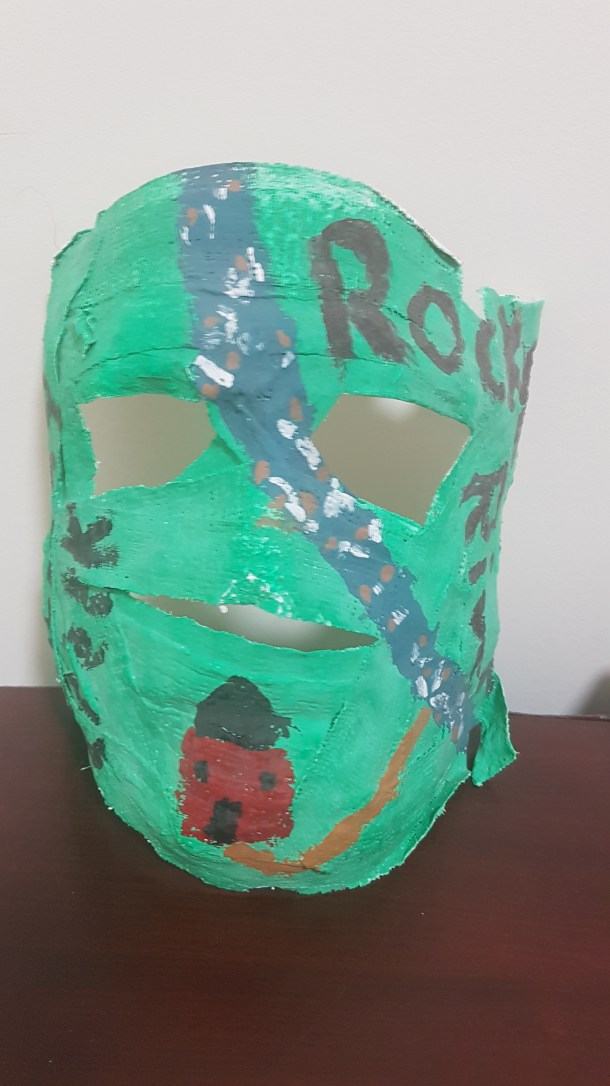
I taught Art the last year. I am no artist. We made, designed, and painted papier mache masks. For some students and me, this signaled the end of our time together. For others, they did not want to do the project, until I said I was going to participate. On our last day, a student said “It is not what you taught we will remember. It is how you taught us we will remember and the lessons of what it means to be a person.” To (re)member is to put things back together, sometimes in partial ways. Between the mask and those words, I put meaning back together about teaching and living life to the fullest.
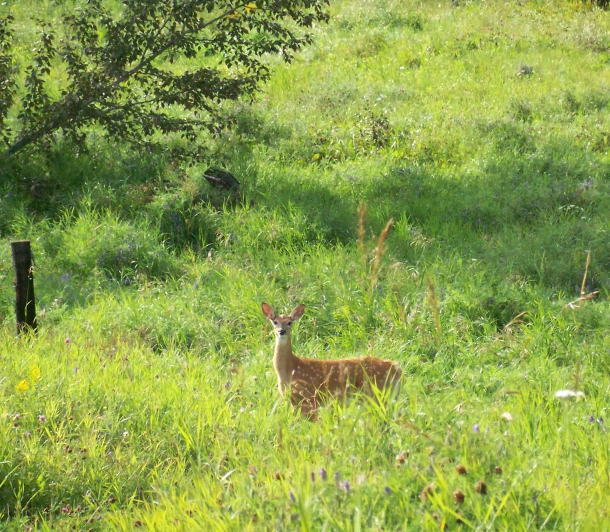
Several years ago, Kathy took this picture at the farm. She walked in from the road and the fields between the house and the road were overgrown. Regardless of whether a place is still physically inhabited or not, it is inhabited with memories, overflowing with meaning. In this sense, visitors abound.
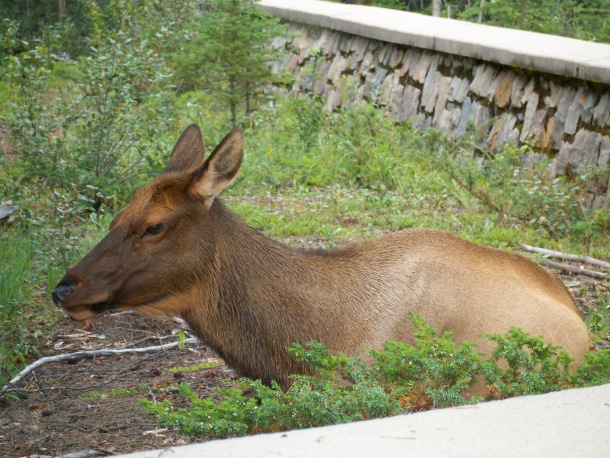
We sat at the kitchen table, watching as various wildlife found safe haven in the midst of human dwelling. Both the wildlife and humans, shared and belonged to the space. As Kathy walked in that day, this beautiful doe looked up and posed to have her picture taken.
It was a perfect day. We wandered in Jasper National Park, enjoyed scenery, surprises and I was with my favourite person. We found the best at the end of the day. I posted a picture of a bull elk on Yellowstone 2005 . I took that picture from 15-20 metres. Kathy took this picture of a cow elk chewing her cud. She seemed aware of our presence. We were quiet and, as others joined us in a secluded area, she posed. The wall was about 1 metre thick wall and a similar height.
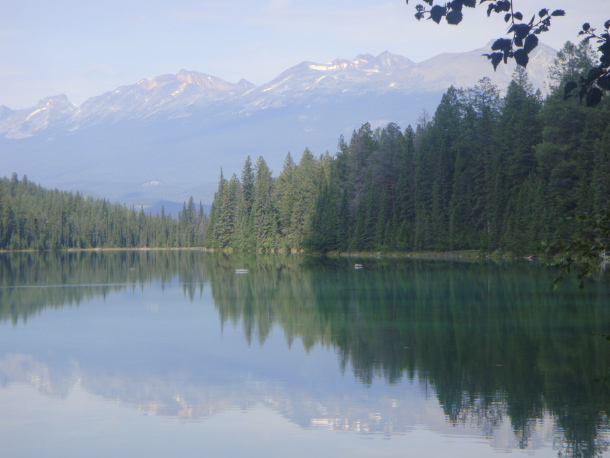
Earlier in the day, we hiked for a couple of hours in the Valley of Five Lakes, exploring some of the small lakes in the valley. We were able to get close to three of the lakes and took pictures. The other two did not have paths into them and were quite deep in the bush. Here are the three lakes we got close to. Each has its own personality, so to speak.
At one of the lakes, I forget which one we came across another visitor who posed for a picture.
Jane Hirshfield wrote the following poem, speaking to hope and resilience. At the end of our rope, we find we have more to give than we realized. It is a sense “this to shall pass” and we can only live in the present moment, which is fleeting.
Hard times reveal fissures in our world and society. Look at who has been hardest hit by Covid-19: people of colour, elderly, poor, etc. We can then see the fissures and who is left out. This became clearer with George Floyd’s killing. It is not enough to question who is left out, but how these humans are left out, dehumanized in the process. Injustice calls us to take account of the life we live, the world we live in, and ask how do we make this better, for each human being we encounter. Injustice calls us to weigh how we speak and act towards one another and to transform who we are for the better.
There are no easy answers to large questions, despite what politicians, carnival barkers, and reality TV hosts would have us believe with their divisive language and actions. We can embrace that we have more in common than separates us. As Paulo Freire proposed, there is unity in difference beyond superficial multiculuralism.
The heart’s reasons
seen clearly,
even the hardest
will carry
its whip-marks and sadness
and must be forgiven.
As the drought-starved
eland forgives
the drought-starved lion
who finally takes her,
enters willingly then
the life she cannot refuse,
and is lion, is fed,
and does not remember the other.
So few grains of happiness
measured against all the dark
and still the scales balance.
The world asks of us
only the strength we have and we give it.
Then it asks more, and we give it.
When I hike in wildnerness settings, I wonder what is around the next curve, over the horizon, on the other side of the mountain, below the surface, etc. I am unaware of so much. What is essential is I lift into critical consciousness what I can to better understand how I can make the world a better place and act on that as best as I can. I will likely never get to the other side of Kootenai Lake or the mountains on the far side, so I can only imagine what is there, a utopia of sorts. The same applies for the world we live in. The difference is we can incrementally get there, together.
As I am called to be a steward of the world, I am called to be a steward and servant in leading others. Without fully understanding where I am going, I am going there.
After I posted, I was listening to the radio and they played this song. It seemed appropriate.
As a result of where family and friends live, Kathy and I drive through the mountains on a regular basis. We see spectacular scenery and inhabitants. We met and lived in Prince George, British Columbia and then lived in other communities in the general area. Despite this, it is always exciting to see the wildlife in these trips.
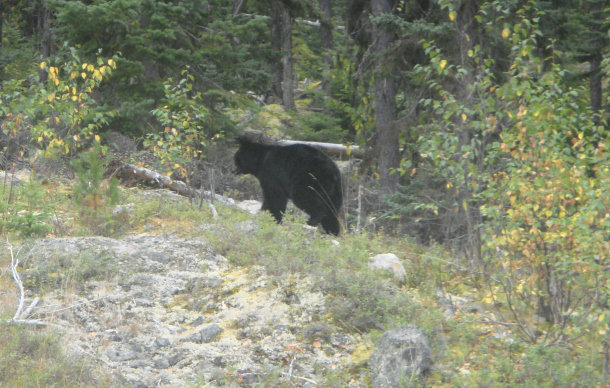
These pictures and the poem emerged on one of our annunal trips. Barely on the road, we spotted a bear browsing on the shoulder above the highway about 10-15 metres from the car. We rolled the window down and he/she posed before disappearing.
A few kilometres up the road, I took this picture of mountains shrouded in clouds. In the foreground, there is evidence of colours turning as summer merged into autumn.
peaks peeking
snow trying to hide
clouds blurring my view.
colours changing
nature’s rich canvas
gentle brush.
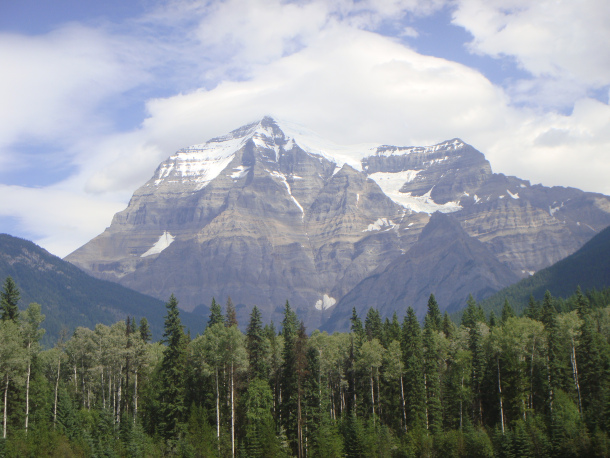
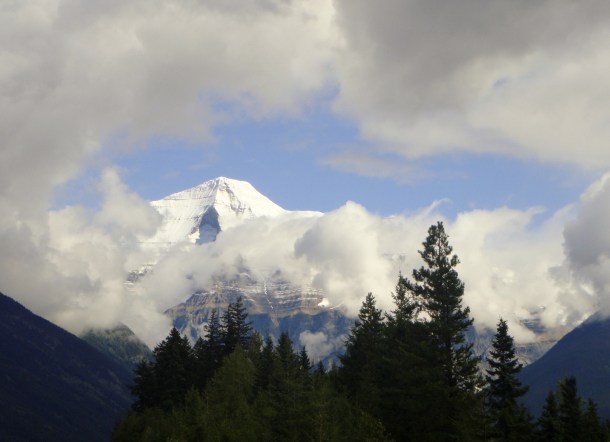
Mount Robson appeared with a cloud-like frame. I enjoy taking pictures of Mount Robson when the clouds show something different.
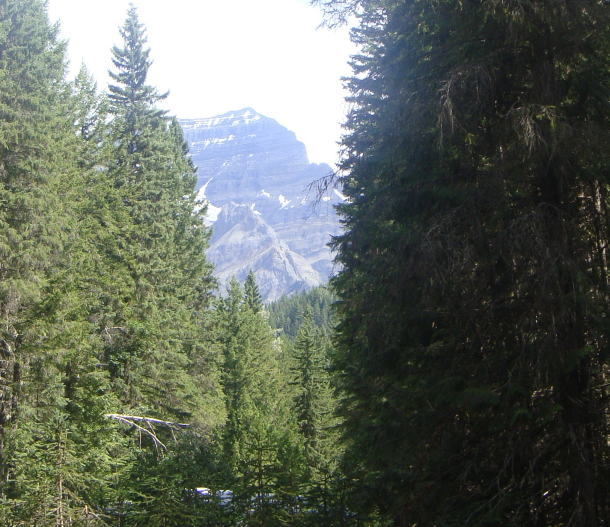
Kathy and I hiked a few hundred metres along the Berg Lake trail. I settled for this shot of Mount Robson which disappears from sight as you move along the path. Peaking out between the trees, is the Robson River which has its headwaters on Mount Robson and flows into the Fraser River a few kilometres down the highway.
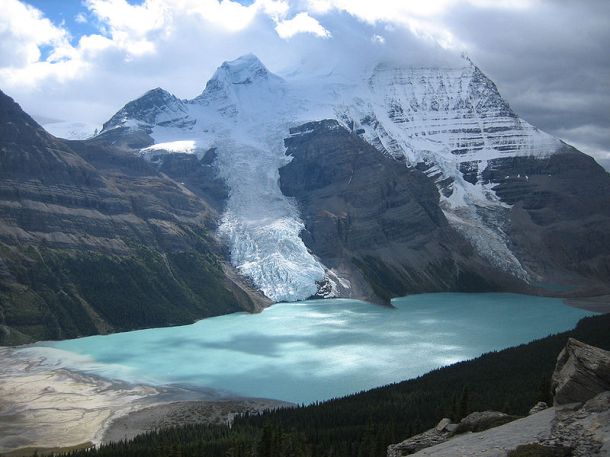
I borrowed this picture from Wikipedia . A bucket list goal is to hike to Berg Lake, camp, and bring back pictures. I am getting old, so who knows if it will happen.
I was going to press a wonderful post from Cheryl’s blog called Living in the Gap. Unfortunately, she does not have a press facility, so I did the next thing. I copied a paragraph from her post that I relate to:
“Am I ready to look at the part I play in the current reality, come out from the safety of the suburbs, and confront my own racism? To take a sober look at my own bias, privilege, and exclusionary practices. This is when I want to curl up like a pill bug and roll away, but this movement is not about me, it’s about listening, learning, and leaning into the race issues currently afflicting our country.”
We are in an unusual moment with the protests. They call us to stop and listen to one another in ways we may not be used to. They also call us to ask questions we have not asked in deep ways, such as “how do I confront my own prejudices? Am I even willing to confront them?” I use the word prejudice to open the space a bit more. It is not only about race. It is about gender, sexual orientation, class, etc.
Currently, I am co-writing an article for publication using Paulo Freire. Freire used critical theory and I paraphrase him here. He said prejudices are interwoven, arising from individual lived histories passed from one generation to another in unquestioned ways. It is listening to others without taking on a saviour role, without drowning their voices, and hearing them speak about their reality. They await opportunities to be raised into consciousness and critically questioned. How I understand this is through a Socratic lens where skepticism begins at home. How do I make the world better, more just, more democratic. Freire suggests it is a slow process. In his book, Pedagogy of Hope, he acknowledged using gender exclusive language in his seminal book, Pedagogy of the Oppressed, published 30 years earlier. He learned to use more inclusive language as he became critically aware of the harm done without it. It was a small and necessary step.
Freire argues we need to listen to one another, not denying difference. Instead, he calls on us to accept “unity in difference.” At our core, (in French coeur is heart and core) we are each human. Too often, we talk over each other and listen to defend entrenched positions. A key theme in Freire’s writing is human “unfinishedness,” always becoming. I reflect when I took-for-granted privilege and wonder how I might overcome this. It is not easy. It will not be finished. I understand my role, as an elder, as one of serving and listening. Leadership is serving, transforming, and mindful, rather than transactional and hierarchical.
Robert Greenleaf stated “the best test [of servant-leadership], and difficult to administer, is: do those being served grow as persons; do they become healthier, wiser, freer, more autonomous while being served: Since so many people seem afraid to grow, the true servant–leader who brings it about is an extraordinary person.” If I look at the next generation and they offer me hope that there is better to come, perhaps I can take some solace in that. Without hope, we wither and flee from the scene, abdicating our responsiblity to one another.
I leave you with a video of Langston Hughes’ poem Mother to Son. If I expand the defintion of pedagogue to its broadest etymology, it is how elders interact with youth, allowing them to dream. Hope is not about a lack of obstacles. After all, no life is a crystal staircase and that is most evident for those on the margins of our societies, including in Canada with its history of residential schools and mistreatment of people of colour. It is, as Freire suggests, being willing to struggle and fight to overcome overt and covert injustices and inequities we encounter and witness. It is listening and testifying in those moments to offer a hand to those in need, regardless of race, gender, orientation, creed, and class without being dogmatic. How do we testify in each of those moments? It is not succumbing to historical amnesia and existential weariness.
In keeping with Why Do I Write Poetry, the following poem is one I wrote many at about the same time. This is the third time I visited the poem in terms of writing and editing. Several years ago and while explaining the importance of teaching poetry, a student asked if I wrote poetry in junior high school and I responded, “Yes!”. He asked me to share with them. I found them in a small lock box I keep at home and shared several with the class. We talked about the context I wrote the poem in. Even in Canada, I lived in the shadow of the Vietnam conflict and struggled with what that meant.
Sam Intrator suggested teachers expose adolescent students complex, existential questions of life as they move through those formative years. I wrote my poems in 1969. It was a time when identity was increasingly rooted in a global nature of the world, not just immediate community and family. War entered homes via television. Increasingly, I discovered my voice through poetry, expressing an abhorrence to institutional and government sanctioned killing. What set me apart from my peers, was I took no sides. Each was equally wrong in my mind, advancing their ideological stance. My teacher, Mr. McKenzie, an innovative English teacher, encouraged us to discover our voices.
I shared the following poem with my students. We talked about how metaphors of war are used commonly in various institutions and how I found this as troubling as the violence and trauma of war. That feeling re-emerged over the past months with describing dealing with Covid-19 in war-like terms and the troubling events of the past weeks where purported leaders feel it is OK to speak about human beings, not citizens, as an enemy and objects to be manipulated for financial gain based on the basest forms of self-interests. It is worse than the war as it takes on invisible and pervasive forms. It is a form of Social Darwinism where the strong survive, trampling on those further down what is understood as a food chain premised on unfettered oppression of other humans, including various forms of systemic violence. Consider billionaires, in the Covid-19 crisis, gained while those in most need lose what little support they had.
I contrast this with Jacinda Ardern‘s message as the Prime Minister of New Zealand. In The Atlantic, Uri Friedman describes her as an empathetic leader. What emerged in reading the article was we de-serve better leadership, mindful, transforming, serving, etc. focusing on people as humans, not objects.
Students asked me to share poems and I did, with the context within which I wrote them. Parents, who were in the classroom each day, asked about my candour. I responded “I am not about changing minds. I try to change how each student thinks about the world, to see under the surface, reveal a sordid underbelly, and revel in the wonderfulness of human life.” This is a hopeful message, and the leadership we need is evident e.g. Jesus, Buddha, Muhammed, Mary Wollenstonecroft, Anne Frank, Maya Angelou, Soujouner Truth, Rosa Parks, etc.
Win or Lose: What Difference Does it Make?
A game–
Darwin misunderstood,
No great thing to win.
War and it language!
Bells ringing hollow,
Men, women, children gone!
Woe! vanquished losers and winners;
Humans, vanquished in every sense–
Thriving on dividing.
Resenting conquerors,
Rebuilding ruins–
On countless graves.
Morally rudderless,
Blaming the fallen,
Beggaring humans.
Homes on streets,
Hollowing souls–
What war brings?
Innocence dying–
Prryhric victories,
What war brings?
Comrades fallen,
Enemies vanquished–
Proving nothing.
Will we learn?
I pray
For human survival.
I leave you with the following video and song. We listened to Harry Belafonte, and I still do, with his uplifting and hopeful message. We are in this together, not against one another, with each other.
On some mornings and evenings, I observe the sun rising/setting with the moon in the sky. Several years ago, early in the school year this occured. I began haiku class with poems describing phenomena we often take for granted. I emphasized poetry often emerges from what is overlooked.
Great poets have a way of lifting extraordinary phenomena into fuller view for us. I modeled this with shared from Pablo Neruda, Mary Oliver, Wendell Berry, etc. I try to write poetry in a similar way.
Greeting and adieu
Sharing the sky together,
Guiding one’s journey.
I took this picture as I approached Waterton Lakes National Park enroute to Spokane. It was a beautiful evening with just a wisp of cloud below the rising moon. It was as if Nature decided a needed two guides on my trip.
On many trips, I pass mountains, which, even when I stopped, I did not grasp their majesty. It is as if they have their own language and ways of being.
Clouds surrounding,
Momentarily crowning,
In regal splendour.
I take many pictures of Mount Robson as I drive from Edmonton to parts of British Columbia. Even with clouds, it has a majesty about it.






 ivonprefontaine
 Teacher as Transformer
