Tag Archives: teacher as transformer

New Intersections

I began to write my first sentence to introduce the poem I intended to post and realized the prose had a poetic quality. I have been fussing since writing Autumn Promises about a lack of inspiration.

Inspiration is not something we chase. Instead, it emerges. I am reading Deeper than Words by Brother David Steindl-Rast. He refers to Jung’s concept of synchronicity. There are moments things emerge from nowhere with no real explanation.

The last few weeks I spent ruminating over where I am going. I am not teaching in a classroom and teaching is calling for me, deeply spirtual and inspiriting for me. When I talk to colleagues and others, they think I would be a good fit for college and university education faculties, but there is little happening and little on the horizon.

As a result, I considers how I reshape, without certainty and chasing, where I go next. The result is a Youtube channel and a Facebook Page with an introductory video about mindfulness in daily life. In various forms, I wrote about this topic in my PhD course work, presented on it, and facilitated retreats and workshops.

I posted the video below. If you have feedback on content, delivery, and directions for this project, please let me know.

Day arrives,

New intersections in life,

“Where next?”

Paths unmarked,

No map,

Experience informs a blurred present.

Take each step,

Inspired by hope,

Inspired by wonder,

Inspired by awe,

Mindful,

Aware of words and acts,

Fill with love and kindness,

Care for one another.


Autumn Promises

In preparing a short presentation on mindfulness in daily life and autumn, I ended up writing a poem about autumn. More than writing, I reflected on how I understand seasonal cycles, including the equinox we experienced on the weekend.

I considered how I define phenomena. For example, autumn or fall was defined by my teaching with phrases such as “see you in the fall, school begins in the fall, and have a good summer, see you in the fall for school.” Nature does not define autumn quite so neatly.

Yes, there is a moment where the time from the longest and shortest days of sunlight is exactly balanced, but Nature and her other living beings are responding according to instinct and invisiable cues, not on artificial times. Trees are slow to change colour and shed their leaves this year, the rabbits in the yard are still brown/grey, and the geese are still gathering to feast on the grain left in farmers’ fields.

For me, autumn is a beautiful mix of the other seasons. On my walks, I experience the cool wind hinting of winter, the warmth of the sun suggesting summer is not gone, and the smell of decay to prepare the way for spring renewal and rejuvenation.

As well, there many metaphors and carry in our daily lives. Understood as a time of harvest, gathering, and bounty, autumn reminds me to be mindful of those moments when we gather, the memories and stories we gather to share with one another, and the readying for dormant times in life vital to our rejuvenation. This happens at all times of the year.

Another aspect of reflecting, preparing, and presenting was I felt rejuvenated. I am not teaching this fall and have been a bit down. Yesterday, I felt presenting and the writing that went with it put some “spring” in my step to be a little punny. I recording the presentation as a series of videos to upload and to put some of my poems into a book to publish.

Autumn arrives unannounced,

Alluding to other seasons

Touching body and soul as I walk.

Cool breeze;

Winter’s promise of dormant moments,

Readying for rebirth.

Afternoon sun chasing chill,

Warming body and soul,

Hinting summer remains.

Vibrant aesthetics;

 Artist colouring leave from Her palette,

Hanging above; fallen mates carpet ground.

Secluded, shaded, dampness,

Rich aroma of decay,

Spring depends on fall’s work.

Is there a typical autumn day?

Is there a typical autumn moment?

Nature whispers, “Maybe; Maybe not.”

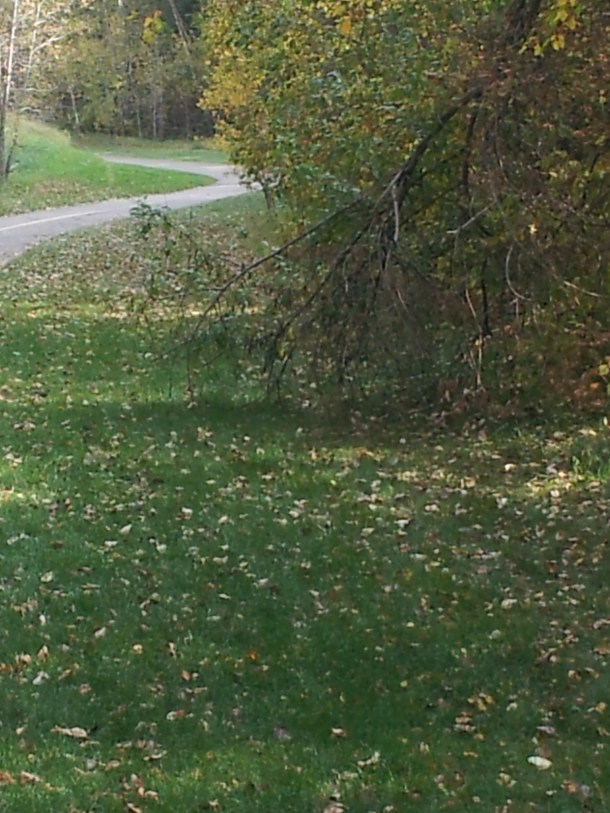
This was a picture I took several years ago in the river valley. I remember the aroma of decay as it had been a cool and wet fall followed by some warmth.

CHANGE OF A WORLDVIEW

via CHANGE OF A WORLDVIEW

Worldview is interesting. I find words, like worldview and mindset, take on meanings based on my most immediate needs as opposed to different, more complex view.

Bruce offered me something to ponder based on the concept of Universal Christ, sometimes referred to as Cosmic Christ. In this, I consider God not as a finite, fixed entity easily imagined and as a complex entity existing beyond my thinking and imagining.

Richard Rohr calls me to understand God and universe as more complex than I am able to imagine. It is OK to try imagine who and what they might be, but they are so complex my mind cannot grasp them. There is always a considerable amount beyond my reach, calling me to resist temptation of neo-Platonic and neo-Thomistic views locking me into finite, fixed ways reflecting my own limits rather than those of God and universe. There is always something “uncanny” and hidden from my view.

Reading Father Rohr, I find echoes of Thomas Merton. Both authors remind me there is far more I do not know than I do and can know. Through nature, God is always revealing and telling me something new, humbling me in the face of my ignorance.

100_4747

Kathy took this picture several years ago driving through Glacier National Park. Although the picture is fixed, the landscape itself never can be. It is always changing with snow melting and falling; trees growing, the stream eroding the landscape, etc.

It reminds me of the Herclitus quote: “No man ever steps in the same river twice, for it’s not the same river and he’s not the same man.”

Mountains, Clouds, and Love

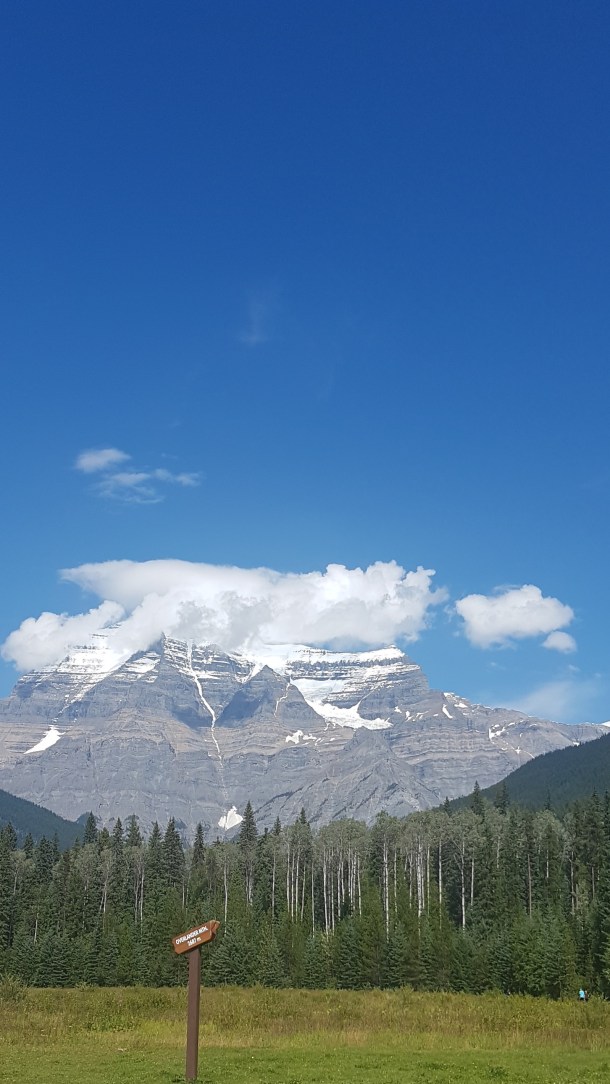
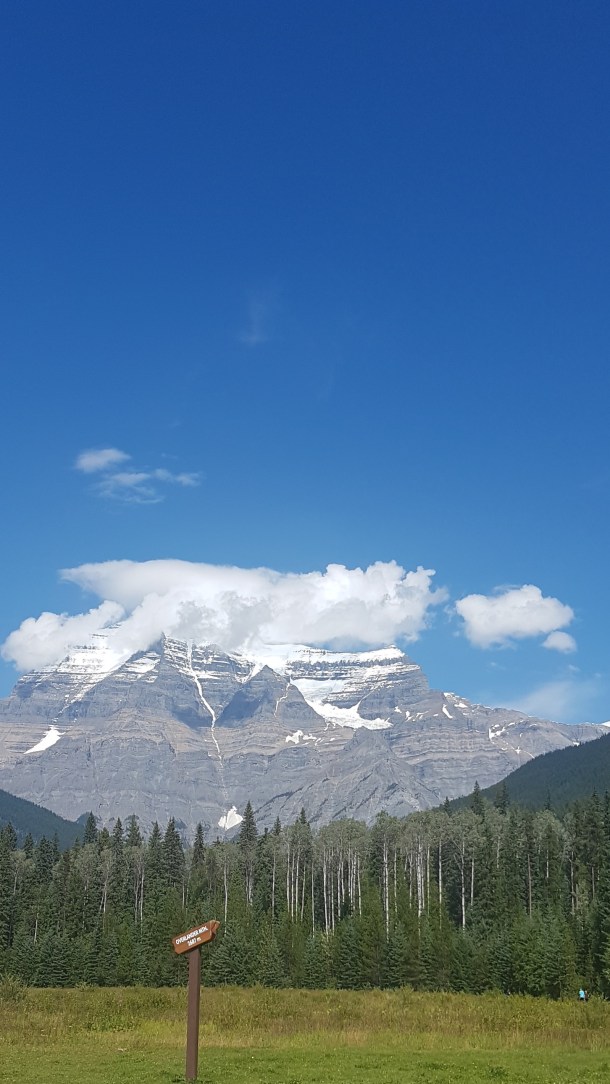
Kathy and I were in British Columbia, visiting family, for a week. We stop at Mount Robson on our way to Prince George, which is where we first met and lived after we were married.

Mount Robson is highest point in the Canadian Rockies and we have driven by it many times on our way to and from Prince George. We take pictures of it at every opportunity and stop to bask in its majesty and richness.

Toni Morrison provided this wonderful quote about mountains and leaders:

“Did you ever see the way the clouds love a mountain? They circle all around it; sometimes you can’t even see the mountain for the clouds. But you know what? You go up top and what do you see? His head. The clouds never cover the head. His head pokes through, because the clouds let him; they don’t wrap him up. They let him keep his head up high, free, with nothing to hide him or bind him.”

Here are two pictures I took of Mount Robson with a little cloud cover circling and loving the mountain at the top, letting its head poke through.


THERE IS FOREVER IN A FOREST

via THERE IS FOREVER IN A FOREST

Eric offers the reader a beautiful poem and image. The poem reminds me of how Wendell Berry might write about a forest. Nature, in each of its forms, is infinite, existing forever.

It is interesting how serdentipitous life can be. I read Wendell Berry this morning and emailed about him with a colleague yesterday, specifically his poem The Peace of Wild Things. It is a short poem I turn to when I struggle with things and the world. It reminds me there is beauty in the world that can be our salvation. Instead of being outside Nature, we grow to understand ourselves as embedded and part of Nature.

When despair for the world grows in me
and I wake in the night at the least sound
in fear of what my life and my children’s lives may be,
I go and lie down where the wood drake
rests in his beauty on the water, and the great heron feeds.
I come into the peace of wild things
who do not tax their lives with forethought
of grief. I come into the presence of still water.
And I feel above me the day-blind stars
waiting with their light. For a time
I rest in the grace of the world, and am free.


SOLITUDE

via SOLITUDE

Lara provides wonderful images of her neighbourhood, gardens, and pets. This post is one with a single picture and a Khalil Gibran quote about solitude.

Solitude is not loneliness. Teaching can be a lonely profession often done in solitude, largely away from other adults. I was fortunate. For most of my career, I taught in proximity to other adults and this provided rich conversations and insights for reflection to improve my teaching.

Gibran wrote a poem about children, reminding me students I taught were not my children. My favourite line is “their souls dwell in the house of tomorrow.” As a teacher, I only promised I would do my best to prepare students for tomorrow.

In French, the word retirer means to draw back, like an archer. It is in healthy solitude I gather myself, draw back, and find stability in teaching the next generation.

And a woman who held a babe against her bosom said, Speak to us of Children.

     And he said:

     Your children are not your children.

     They are the sons and daughters of Life’s longing for itself.

     They come through you but not from you,

     And though they are with you yet they belong not to you.

     You may give them your love but not your thoughts,

     For they have their own thoughts.

     You may house their bodies but not their souls,

     For their souls dwell in the house of tomorrow, which you cannot visit, not even in your dreams.

     You may strive to be like them, but seek not to make them like you.

     For life goes not backward nor tarries with yesterday.

     You are the bows from which your children as living arrows are sent forth.

     The archer sees the mark upon the path of the infinite, and He bends you with His might that His arrows may go swift and far.

     Let your bending in the archer’s hand be for gladness;

     For even as He loves the arrow that flies, so He loves also the bow that is stable.

Where do we find solitude? I find it in Nature, in writing, in reading, in teaching, and in living. It is not a place. It is a relationship to life, others, and things.

DSC00320

Kathy took this picture in Jasper National Park. The roots of the trees form steps and a path up from the water falls we were visiting.

Dr. Seuss

via Dr. Seuss

Heather offers three Dr. Seuss quotes. I am particularly taken by the third one, which calls on me to step with care and tact.

Regardless of where I am, I am with people, in the world, and in relationships. It is easy to take these for granted. Often, children and youth embrace differences more readily than adults.

Through the use of satire, made up words, and unusual characters, Theodor Geisel took a stand against bullies, hypocrites, and demagogues. I think his characters depict pluralism we live in. Yes, there is no Lorax, Yertle the Turtle, or Cat in the Hat, but we can appreciate and defer to the beauty of their differences. Even within  differences, I find more similarities and common ground with others.

We need this in the world we co-inhabit with other beings, sentient and non-sentient. Too often, people who masquerade as leaders tell us to see difference as problematic, to see Nature as something to exploit, and to separate ourselves from our better angels. Perhaps our better angels are Thing 1 and Thing 2.

298x322 Unique Dr Seuss Images Ideas Dr Seuss Art, Dr

I retrieved this image from Clip Art Mag.

Leonard Cohen

We did not get a chance to see Leonard Cohen live, but I have listened to him for a long time. I bought Songs of Leonard Cohen a couple of years after it was released.

One of the songs on the album was Sisters of Mercy, which Cohen wrote here in Edmonton. As he told the story, he sat in his hotel room, looking out the window, and below he saw nuns walking to and from their convent. He determined they belonged to the Sisters of Mercy and wrote this song.

Leonard Cohen also wrote Hallelujah. My favourite version is by kd lang, another Canadian artist. We have many songs from various stages of her career.

Kathy and I have attended concerts by kd lang (another great Canadian artist) and her version is spell-binding. She has a pure voice and sings with so much power I have goose bumps.

Behind your image…

via Behind your image…

Natalie‘s beautiful image and John O’Donohue‘s wonderful blessings serve as reminders that life is to be lived in extra-sensory ways. It is about the mystery we cannot see, touch, and feel about how a flower simply exists to be a flower..

When I have faith in more than what I experience and the mysteries of what that means in life, I feel free to live life and embrace the mysteries of living. Sometimes, it is the simplest forms that escape our attention. It reminds me of the following quote from Meister Eckhardt, which can mean more in a person’s than I can ever know.

“If the only prayer you said was thank you, that would be enough.”

Thanking others as part of being alive and aware of their presence is a simple and profound prayer.

A Simpler Life

Kathy and I are doing some house cleaning and it is interesting what we find.

Kathy looked through some papers we had stored and found poetry I wrote in 1969, in Grade 10. There are things that are consistent in life and one of them is seeking moments of solitude and silence, which I wrote about in this poem. I took liberties and edited the poem, orginally called The Simple Life.

It is good to be alone at times,

Sheltered by comforting trees,

The wind singing a song,

Here, I experience freedom and peace,

For the moment, worries set aside.

Minnows dart at the water’s edge,

Dancing between light and shadows,

Seemingly, without a care,

There, they experience home’s safety;

Its primal call.

Here, this is me,

I experience a simpler life;

An unseen hand beckons me,

I wave to this simpler life,

Enjoying it each time I return.

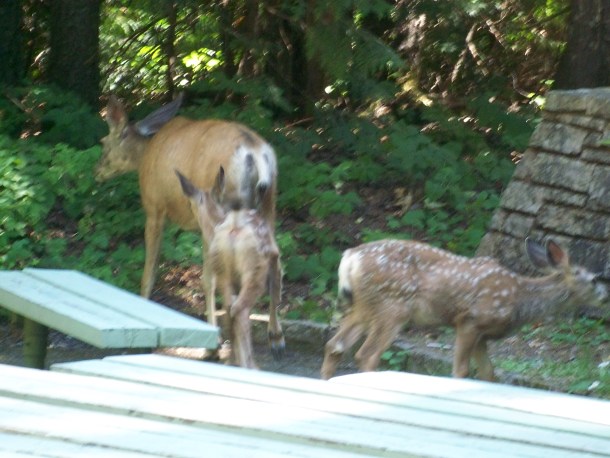
I took this picture in Waterton Lake National Park several years ago. I came around a corner and there was a doe and two fawn. I could have touched the one fawn it was so close, but it was separated from its mother. I stood as still as possible, moving slowly to get the camera ready. The mother whistled to the one fawn and waited until the young one found its way over to her, back to the safety of where it belonged.