Monthly Archives: November 2014

Is Helping The Hungry And Homeless A Crime?

This article raises many questions. The one for me is about the whether we want to hide the poverty, homelessness, and hunger behind closed doors in wealthy countries such as Canada and the US. These are real issues and more importantly real peopled. They have faces, names, and stories.

Gator Woman's avatartahtonka - A Journey Through Global Culture

Abbott

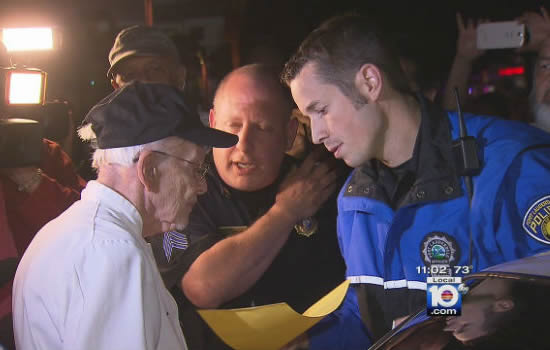
Arnold Abbott: the Police and the Politics of public feeding.
Picture source: Unknown

At first glance this story appears to be just another case of politics bullying charity, but not so fast.

This story should have been written a few days ago, but it was not to be, as I was once again up in Gainesville getting my  melanomas tended to.

Now it’s back to work this morning…

If you have not heard of this man yet, you will.

His name is Arnold Abbott and he is a 90-year-old advocate for the homeless and hungry in Fort Lauderdale, Florida.

Arnold has for many years been feeding the homeless on the beach at Ft Lauderdale.

There are many who support him in his charitable endeavors, but as usual, there are also those who are very much opposed.

There are kind generous souls in many places around Florida and the Country,  who also do this…

View original post 641 more words

Once you realize…

Once you realize….

Nisargadatta is new to me, but the short message is inspirational. Responsibility for who we are and the way we live is essential to living. Emmanuel Levinas called it being response-able. We are able to be responsible for living and becoming the person we are.

When we let the world inside shine onto the world outside, we are able to respond to the world more fully. Levinas’ work is often connected to ethics and living a good life. Ethics is about a practical rather than theoretical way of living. It is easy to take the moral high ground. It is not so easy to live the moral high ground. Being able to respond, to be mindfully responsible is essential to living well and fully.

The open door

“Be the vastness says. Be without adverbs, descriptors, or qualities. Be so alive that awareness bares itself uncloaked and unadorned.”

drbillwooten's avatarDr Bill Wooten

“A door opens. Maybe I’ve been standing here shuffling my weight from foot to foot for decades, or maybe I only knocked once. In truth, it doesn’t matter. A door opens and I walk through without a backward glance. This is it, then, one moment of truth in a lifetime of truth; a choice made, a path taken, the gravitational pull of Spirit too compelling to ignore any longer. I am received by something far too vast to see. It has roots in antiquity but speaks clearly in the present tense. “Be,” the vastness says. “Be without adverbs, descriptors, or qualities. Be so alive that awareness bares itself uncloaked and unadorned. Then go forth to give what you alone can give, awake to love and suffering, unburdened by the weight of expectations. Go forth to see and be seen, blossoming, always blossoming into your magnificence.”

~ Danna Faulds

Door

View original post

Your Sunrise

Your Sunrise.

Rumi speaks about paradox in the quote introducing the poem. We often think of entrances as being an external portal but, when we seek sanctuary, we turn in looking for the entrance to that sanctuary. The entrance is inside us leading further inside.

As the poem suggests, to be human is to be sacred. It is the coming together of two worlds, one outside and one inside. The inner one is much harder to reach as we try opening the door the wrong way quite often. We push out rather than turning in and pulling gently revealing light from the inner sanctuary that shines on us as we sit quietly waiting for silence to speak.

temporary

This a wonderful combination of quotes, prose, poetry, and image.

The Other Kingdoms

It is Sabbath and winter arrived over night. It snowed and is colder. Mary Oliver`s poem speaks about the way the Inuit use many expressions describing snow. In doing so, they are mindful and aware of the world they live in. It speaks to them and shares its experiences in ways words used are meaningful. But, it happens only when we are present and attentive of extraordinary events co-mingling with the ordinary world we think we experience. We rush past the world and lose the words it speaks quickly. We lose the kingdom we live in unless we slow down and drink from its cup fully.

When we slow down, we grow wild and are in the wild world around us and in us. The wildness animates us and we live more fully. Snow today means slippery roads, drivers who have forgotten what it means to drive in the snow, and a blanket beginning to cover the ground as it slumbers. Snow means more than just one word to me. It is how I experience the snow that speaks of snow. There is nobility in the titles the world carries that we have not given names for and can not find the words for those titles.

Consider the other kingdoms.  The
trees, for example, with their mellow-sounding
titles: oak, aspen, willow.
Or the snow, for which the peoples of the north
have dozens of words to describe its
different arrivals.  Or the creatures, with their
thick fur, their shy and wordless gaze.  Their
infallible sense of what their lives
are meant to be.  Thus the world
grows rich, grows wild, and you too,
grow rich, grow sweetly wild, as you too
were born to be.

I think ; therefore I am & Je pense, donc je suis & Penso dunque sono & Ich denke, also bin ich & Pienso, luego existo & Düşünüyorum, öyleyse varım !!

I think ; therefore I am & Je pense, donc je suis & Penso dunque sono & Ich denke, also bin ich & Pienso, luego existo & Düşünüyorum, öyleyse varım !!.

The link included quotes from Rumi and Tolstoy. We begin changing the world as an internal project, one that changes who we are first. The ripple effect is only possible, not certain. I say possible, because there is no certainty in life’s project. They take time, patience, and compassion to encounter who we are in an honest way. Living is hard work and it is not easily completed.

The change in self is possibly easier when we are older and take time living. It is also harder. Are we able to move the same way we did as a younger person? We can be more mindful and attentive perhaps. We can only hope the ripple reaches those close and they are able to use those ripples in meaningful ways.

Whatever we do, we should only expect the change to be our change. We can only till the soil closest and most meaningful to us.


It is an issue of private shame

It is an issue of private shame.

The link is not to a poem, but rather to a series of quotes about hunger and the personal shame that comes with it. Politicians use hunger and other social justice issues as talking points and not seeing it as a matter of private and public shame in countries such as Canada and the US with their wealth.

On the left, we have politicians who would subscribe to giving people something. On the right, politicians would blame those who go hungry including the children. Giving people a hand up is important and walking with them is a part of the longer journey. Solving issues such as hunger is community work. It takes neighbours helping each other in those moments of need. Regardless of what we have, we share. Wouldn’t that be a powerful learning in our schools.

Home

Bruce Weigl wrote this lovely poem. When we practice, the Sabbath we find our way home. We re-discover roots we often leave behind in the busyness of our day-to-day lives.

There is a paradox in this leaving of roots. They remain attached as we can detach from them. We can ignore the roots, but the are always there. We cannot shake loose from them. They follow us and eventually we stop the shaking. We let the roots feed and nurture us the way they can.

In Sabbath practice, we listen to the music that translates the world into dirt fields that always call us. We rejoice in the dirt fields of our youth and find our spirit in those dirt fields. The roots helped make us who we are. We can never escape from those roots or plow them under.

I didn’t know I was grateful

           for such late-autumn

                       bent-up cornfields

yellow in the after-harvest

             sun before the

                       cold plow turns it all over

into never.

           I didn’t know

                        I would enter this music

that translates the world

             back into dirt fields

                         that have always called to me

as if I were a thing

             come from the dirt,

                         like a tuber,

or like a needful boy. End

             Lonely days, I believe. End the exiled

                           and unraveling strangeness.