Monthly Archives: April 2017

Hope

This Emily Dickinson poem reminds me of Langston HughesDreams. There are  direct and indirect metaphors to birds and a sense hope and dreams feed to lighten one’s spirit.

Being mindful of one’s dreams can give a person hope and something to look forward to. It is not to say we lose ourselves in our dreams, living in a fantasy. Our dreams nourish a hope essential to sustain our spirit and who we are becoming as a person.

Dreams call to us, even in challenging times. We share them with others and they bring hope, not to one person, but to a larger collective. Dreams and hope exist as questions, which we can reflect on alone and together.

Hope is the thing with feathers
That perches in the soul,
And sings the tune without the words,
And never stops at all,
And sweetest in the gale is heard;
And sore must be the storm
That could abash the little bird
That kept so many warm.
I’ve heard it in the chillest land,
And on the strangest sea;
Yet, never, in extremity,
It asked a crumb of me.
Here is the Langston Hughes poem.

Hold fast to dreams
For if dreams die
Life is a broken-winged bird
That cannot fly.
Hold fast to dreams
For when dreams go
Life is a barren field
Frozen with snow.

From the Book of the Samurai

When one writes, mindfulness and attention to the choice of words. Tsunetomo Yamomoto offered the following advice in the Book of the Samurai. He quoted the Zen priest Ryōzan, concluding the result of a well-written letter, even a short one, would lead to the recipient making “it into a hanging scroll.”

Mindfulness and attention are used in all facets of one’s life. Living mindfully is celebrating one’s life fully, living each moment to the fullest.

“Practice in letter writing goes to the extent of taking care in even one-line letters. It is good if all the above contain a quiet strength. Moreover, according to what the priest Ryōzan heard when he was in the Kamigata area, when one is writing a letter, he should think that the recipient will make it into a hanging scroll.”

Nothing Left to See Through

This poem arrived today. I waited for it and did not chase after it. When I read it, the words spoke to me.

The Zen Master Ryōkan reminded me that change is inevitable. It happens. Like yesterday’s post, chasing after and holding things, as if they were permanent, is done in vain.

To take time, to be mindful, and sit quietly can bring peace in which one can discover the essence of things and understand mistaken views. Hans-Georg Gadamer said dialogue begins not through shared understanding, but mis-understanding. This includes inner dialogue one has with ones’ self.

Past has passed away.

Future has not arrived.

Present does not remain.

Nothing is reliable; everything must change.

You hold on to letters and names in vain,

forcing yourself to believe in them.

Stop chasing new knowledge.

Leave old views behind.

Study the essential

and then see through it.

When there is nothing left to see through,

then you will know your mistaken views.

2 By Lao Tzu

Through the concept of deconstruction, the philosopher Jacques Derrida argued we do not live in a world of binaries. Derrida contended between words that appeared to be opposites there was no space and they appeared as long/short. One cannot think of long without understanding short.

Lao Tzu made a similar argument in the first part of this poem: “is and is not produce one another.” Ted Aoki, who was an Alberta-based educator, described the essence of things as being embedded in their “isness.” In the second part, Lao Tzu spoke about a teacher being a person who teaches without a need to possess the words he/she speaks and receiving merit for their teaching.

While I was journaling this morning, I thought of teaching’s essential nature, which is less about the words we speak as teachers and the way we comport ourselves.

As a Frenchman, Derrida used the proper to describe how one comports themself. A person can have rhetoric to fool people, but they do not possess good character if their actions are improper and incongruent with their “good speech.” A person of good character is mindful of the words they use and how they sometimes betray their character.

Beauty and ugliness have one origin.

Name beauty, and ugliness is.

Recognizing virtue recognizes evil.

Is and is not produce one another.

The difficult is born in the easy,

long is defined by short, the high by the low.

Instrument and voice achieve one harmony.

Before and after have places.

That is why the sage can act without effort

and teach without words,

nurture things without possessing them,

and accomplish things without expecting merit:

only one who makes no attempt to possess it

cannot lose it.

Whispers of Love

Rumi used paradoxical language in his poetry. Whenever I read his poetry, I find myself searching for the meaning of those words.

In this poem, I think he is suggesting that, when a person feels wanted and loved, there is a sense of belonging. A person can surrender to love, when they are cared for, belonging in a relationship.

The reciprocity of love makes one whole, healing them. The title proposes that love is quiet and a person has to listen closely, still themselves and their thoughts to hear the call addressing them. In this sense, love is a mindful and attentive way of living.

Love whispers in my ear,

Better to be a prey than a hunter.

Make yourself My fool.

Stop trying to be the sun and become a speck!

Dwell at My door and be homeless.

Dont pretend to be a candle, be a moth,

so you may taste the savor of Life

and know the power hidden in serving.”

Welcoming Spring

On my walk today, I saw my first robin. It appeared perplexed and it might have good reason for feeling that way. It is supposed to get cool with snow, possibly accumulating over the next days.

I imagine food is at a premium for robins now, unlike the magpie I saw a few steps further along the path.

A sign of spring–

A robin walks someone’s fence,

Anxious and tentative.

It moves cautiously,

Not taking flight

Less concerned with me, than food.

Winter ground cold,

No food in the hardpan–

No earthworms tilling the soil.

Image from All About Birds © Christopher L. Wood

Longing for the Mountains of Solitude

Kathy and I enjoy driving to and through the mountains. Where Kathy grew up, the Rockies are visible in the distance. We try to make a trip once a year, but have not this past year, with my finishing the dissertation. I say “a trip” as we have access to several routes.

Today, I came across this poem by Za Paltrül Rinpoche. I could not find a link to the poet, but the words spoke to me. Although I am terrified of heights, mountains invite me to find ways to safely explore them, finding peace and solitude in safe ways.

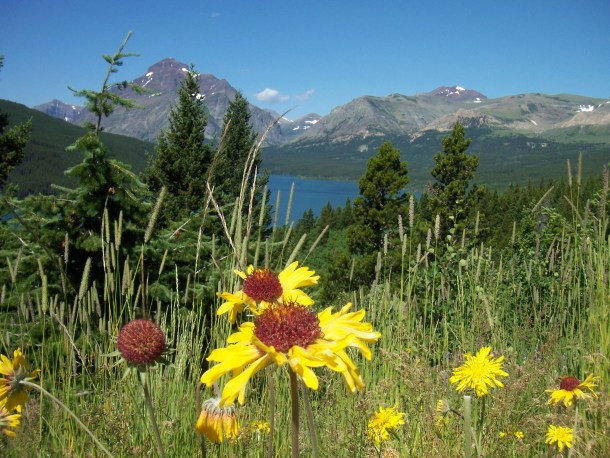
Kathy took this picture on the Going to the Sun Highway in Glacier National Park in Montana.
This is Mount Robson, BC. It is the highest point in the Canadian Rockies at almost 4, 000 metres (almost 13, 000). Due to its height, the top is not always visible. I took this picture on one of our many trips past Mount Robson. It is one of those views that never disappoints. One year we walked along Robson River for several kilometres.

Fooled in samsara town—

the endless cycle of countless chores,

preoccupations of a delusory world—

this boy’s mind longs for mountains of solitude.

Hassled by monastery life—

the hustle of duties and communal dues,

pursuits of pointless distraction—

This boy’s mind longs for mountains of solitude.

Whomever I look at, I see at death’s threshold;

whatever I think on, I sense denial of dying,

grasping at the deathless; in this courtyard of death,

this boy’s mind longs for mountains of solitude.

Whomever I meet with manifests clinging and repulsion;

whomever I talk to brings deception and lies;

faced by companions without virtuous conduct,

this boy’s mind longs for mountains of solitude.

Behold, beings in the three realms are fooled by afflictions;

the beings of the six realms are led astray;

delusion engenders the birth of suffering for all;

this boy’s mind longs for mountains of solitude.

By the blessings of the undeceiving guru and the [Three] Jewels,

may I attain and persevere in solitude;

by the force of a place of seclusion,

may I attain a mystic’s isolation

of body, speech, and mind.

May I be blessed by the mountains of solitude.

Today

Today is a dreary, cold, and wet day. In contrast, we experienced warm, dry weather for most of the last week. It is spring in Alberta and the weather changes on a regular basis.

I tried my hand at writing a poem again and this was the result.

Today, spoke in dreary tones,

The cold a knife;

Snow and rain danced together,

The sun hid itself away.

The world soaked with dampness,

It spoke not inviting words;

There were no paths to walk,

Instead, it was a day of solitude.

My inner world lightened,

Where the sun found its way;

Words arose from that source,

They find their way to this page.

The Archer’s Need to Win

To just be in the moment and be present to what one is doing takes us beyond the need to win and not lose. In the last line of this poem, Chuang Tzu reminds us that the need to win or not to lose drains the archer of his power.

Several years ago, we visited our son and his family. At the time, our grandson was about 5 months old. We went for dinner our last evening and, after I finished eating, I took him. I was in front of a mirrored wall. When he noticed there was a little boy in the mirror, our grandson played with that little boy for about 5-10 minutes, until he became tired. He had no other goal than to play and just be in that moment.

We lose that childlike way and those purely phenomenological moments of just being in the world. Remembering is being mindful and calling something to mind. When we do so, Parker Palmer wrote that to re-member is to make and keep one’s self whole.

When an archer is shooting for fun
He has all his skill.

If he shoots for a brass buckle
He is already nervous.

If he shoots for a prize of gold
He goes blind

Or sees two targets –
He is out of his mind.

His skill has not changed,
But the prize divides him.

He cares
He thinks more of winning
Than of shooting –
And the need to win
Drains him of power.

A Gift

Hans-Georg Gadamer described eloquent questions, as questions that do not have pre-supposed answers. Eloquent questions become and bound dialogue.

I used eloquent questions in my dissertation to explore how teachers experience using curriculum. Instead of arriving as a prescribed text with fixed answers, curriculum transforms into questions. Each student’s and teacher’s lived-experiences transform into questions held gently so as not to injure. The word transform means to go beyond the existing form and through the gift of dialogue and eloquent questions we can.

Denise Levertov‘s poem is about holding other’s questions as if they are fragile and are the answers to one’s own questions. Questions are gifts. When we watch a child open a gift, the joy is in watching them turn the gift to explore it from different angles. After all, differences make a difference.

Just when you seem to yourself
nothing but a flimsy web
of questions, you are given
the questions of others to hold
in the emptiness of your hands,
songbird eggs that can still hatch
if you keep them warm,
butterflies opening and closing themselves
in your cupped palms, trusting you not to injure
their scintillant fur, their dust.
You are given the questions of others
as if they were answers
to all you ask. Yes, perhaps
this gift is your answer.