Category Archives: Reflective Moments

The Summer Day

I could have entitled this post calling, vocation, voice, etc. Mary Oliver shares what it means to be called and how we respond to this call through our particular life. Voice and vocation share etymology and come from the Latin verb to call: vocare.

Mary Oliver captures the essence of a calling with a metaphor of a grasshopper, which has its role to play and expresses herself in how she fulfills this role. This poem reminds me of Matthew‘s verse about the lily of the field and how God provides for each plant and animal. We each have a role and place in a complex way of being and we each respond according to how we interpret what that might mean.

The first three lines and the last two, as questions, speak to me. I am never certain of what life holds for me. Life emerges as eloquent questions that are open and not foreclosed by easy answers, yet emerge from the first three questions. I ask eloquent questions without predetermined answers. They inform my dialogue with the world and with others.

Since completing my dissertation, the last question has become part of my thinking about the themes. It was not in the dissertation, but is essential to experiencing and understanding teaching as a calling, which holds deep spiritual meaning.

I posted my dissertation on Academia and an executive summary on Medium.

Who made the world?

Who made the swan, and the black bear?

Who made the grasshopper?

This grasshopper, I mean-

the one who has flung herself out of the grass,

the one who is eating sugar out of my hand,

who is moving her jaws back and forth instead of up and down-

who is gazing around with her enormous and complicated eyes.

Now she lifts her pale forearms and thoroughly washes her face.

Now she snaps her wings open, and floats away.

I don’t know exactly what a prayer is.

I do know how to pay attention, how to fall down

into the grass, how to kneel down in the grass,

how to be idle and blessed, how to stroll through the fields,

which is what I have been doing all day.

Tell me, what else should I have done?

Doesn’t everything die at last, and too soon?

Tell me, what is it you plan to do

with your one wild and precious life?
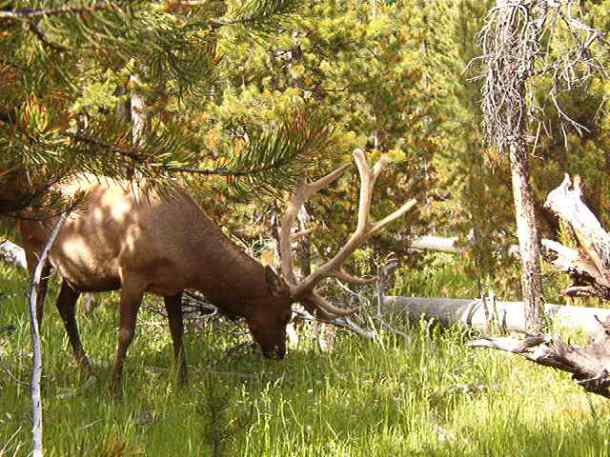
 

I took this picture in Yellowstone several years ago. I was about 25-30 feet (8-10 metres) away from this wonderful animal. He knew I was there, but seemed unconcerned. We were both living our lives.
The Prayer of St. Francis

Today, is our anniversary. We recited the Prayer of St. Francis at our wedding and have it displayed on a small and simple plaque. It reminds me of what it means to be human, in relationship with another person, and in relationship with God.

When I was in Spokane, I printed a copy and put it on the wall of the small room I stayed in. I refer to the room as my monastic cell and the Prayer of St. Francis seems a fitting complement to any monastic cell.

During challenging moments, I recite parts of the prayer to bring me peace and be present in the world.

Lord, make me an instrument of your peace:
where there is hatred, let me sow love;
where there is injury, pardon;
where there is doubt, faith;
where there is despair, hope;
where there is darkness, light;
where there is sadness, joy.

O divine Master, grant that I may not so much seek
to be consoled as to console,
to be understood as to understand,
to be loved as to love.
For it is in giving that we receive,
it is in pardoning that we are pardoned,
and it is in dying that we are born to eternal life.
Amen.

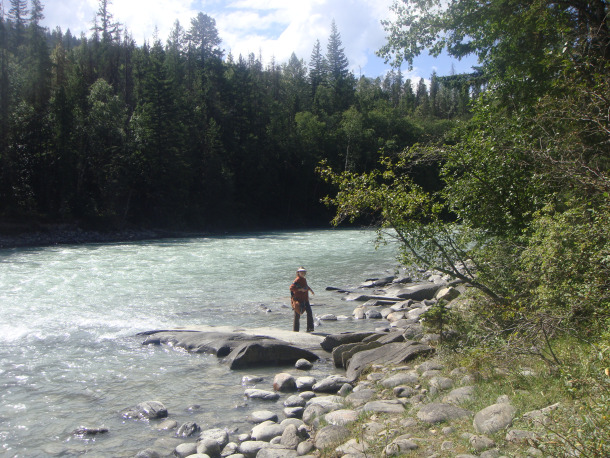
The picture is one I took several years ago of Kathy standing above a set of waterfalls close to the headwaters of the Fraser River.

Silently Blooming

via Silently Blooming

Shobna provides a beautiful images and Thich Nhat Hanh‘s quote about silence. Parker Palmer says that community and solitude form a paradox. They do not exist without one another.

It is in moments of solitude I find meaning in living in community. What I share in common with others far outweighs what makes me different although the differences are essential to what makes each of us unique beings.

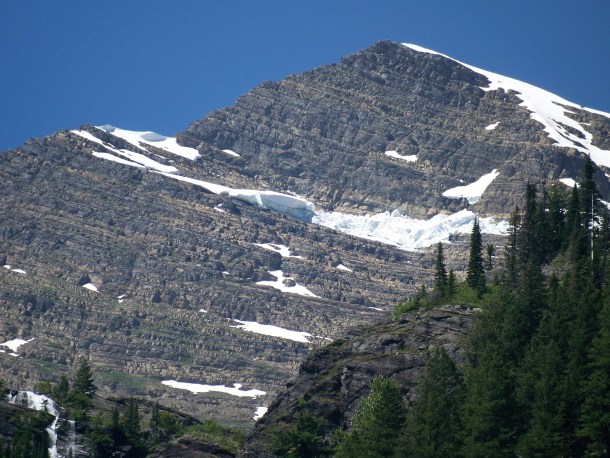
It is in moments of silence I look at my life as if it were a mountain revealing its story through the striations it formed throughout its existence. In silence, my life takes on meaning. It is there that my relationships take form and mean more than they did in the busyness of the day.

Mountain's Layers

I Have Realities in My Past

via I Have Realities In My Past

One of the first classes I took in my doctoral journey introduced me to Viktor Frankl‘s work and finding meaning in one’s life, which is the primary reason we live.

In his post, Kevin shares a quote from “Man’s Search for Meaning.” We search for and discover meaning in ways unique to each of us. That search/quest is not someone else’s, even though there may be shared characteristics.

Frankl survived the horrors of Auschwitz believing his wife was alive, often hearing her speak to him. As it turned out, she died during her internment, but it was her daemon nature that gave him reasons to live and press on. Many of us would say our spouse/partner gives us reasons to live and that would be true, but it is in different ways than Frankl and others.

Differences make a difference.

Leap of Faith

via Quote: Mary Oliver

Mary Oliver is one of my favourite poets. Even when she writes lines in declaratory ways, there is a profound question being asked.

In this wonderful quote shared on Rethinking Life the question is what happens next. Even under the best and most controlled of circumstances, we do not know what will happen in the next moment.

Living is a leap of faith filled with mystery we can embrace. When we believe we control the next moment, the next instance, we fall short. Mindfulness can help us embrace the mystery. Being grounded in each ensuing moment is the only place we can be.

Where Words Fails

via Where Words Fail

Thank you to Misifusa for this wonderful post.

I have not posted for some time. This seemed like a good way to begin again, afresh. When I was growing up, we listened to a wide variety of music, including Nat King Cole, Louis Armstrong, and Ella Fitzgerald. I thought it was the norm and grew into a die-hard blues fan, attending concerts by Willie Dixon, John Lee Hooker, and King Biscuit when they traveled to Canada.

As an adult, I saw BB King, John Mayall, Etta James, Ruthie Foster, Taj Mahal, The Blind Boys of Alabama, and others. An American friend told me this was not the norm in the US. He did not have the same opportunities to see these performers as I did or, if he did, it was long after they were in their primes.

The Hans Christian Anderson quote fits well “where words fail, music speaks”. Music breaks down barriers without realizing they are coming down. As a Canadian, I had freedoms I took-for-granted, like the music I listened to and the concerts I attended. When I taught, I played a wide variety of music each morning. It ranged from the blues to jazz to country to folk to old rock and to more contemporary music. Students enjoyed it and it surprised them when they heard me play old Johnny Cash, the blues, and rock-a-billy.

Music is colour-blind or, better yet, music is blind to colour.

I like this particular John Lee Hooker song, which I first heard in the early 1970’s. George Thorogood plays it in most of his concerts in tribute to John Lee. Enjoy.


Merry Christmas

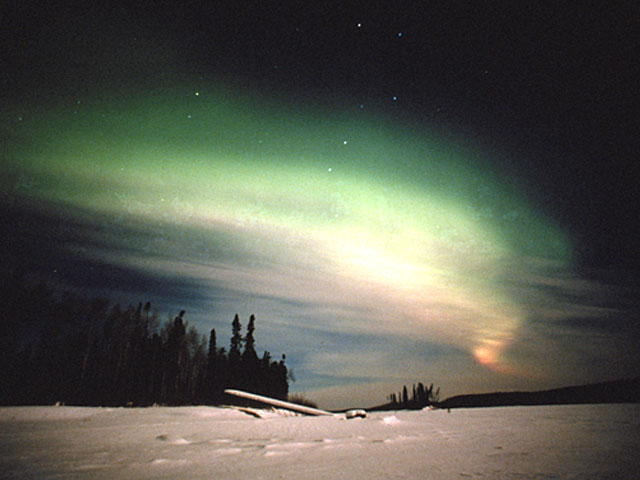
I wrote this poem several years ago about the magic provided by the Northern Lights (Aurora Borealis) and Christmas. What message was in those celestial colours and sounds? As a child, I thought the sky talked to me and told me a creation story.

I grew up in Northern Alberta and Christmas was a special time. I recall cold winter nights. I mean they were cold–almost minus 40 at night. Our windows upstairs were almost completely frosted over. On moonlit nights, the light kept me awake or that is what I told others.

During Advent, my mom and older brothers walked across the street for evening Mass. The younger ones, including me, went to bed. I did not fall asleep right away and would watch out the window for them to come home. I thought no one saw me, but my Mom would come up and tell me to go to bed.

At that time of year, I recall is the Northern Lights and how you could hear them as well as see them light up the sky as they danced across the sky. We don’t see them very often in Edmonton with the urban light.

When we spend time at the farm at Christmas, we hear and see them again. On cold nights we hear the train (about a mile away) and it sounds like it is coming through the house.

Small children–

Breathlessly awaiting,

Peering through frosted window

Soaking it in.

Heavens rippling–

Lights undulating;

A celebratory fury

An indisputable guide.

This old house speaks;

Nature answers–

Heavens crackle

Sweet symphonic sounds shimmering.

Earth’s floor–

Blanketed in white

Celestial colours speaking

Capturing young senses.

A vivid winter scene,

A sensual, sensory palette,

Reminding us–

Christ’s Mass is here.

pic_wonder_northern_lights_lg

Wildness

via Wildness

Michele‘s post reminded me of poems by two of my favourite poets.

Environmentalists refer to Wendell Berry and Mary Oliver‘s poems. An educated guess is that Henry David Thoreau, who Michele quotes, informed their writing.

Wendell Berry wrote in moments of despair he “comes into the peace of wild things who do not tax their lives with forethought.”

Mary Oliver ends Summer Day with the following question: “Tell me, what is it you plan to do/ with your one wild and precious life?” Paradoxically, the question is an answer to her eloquent questions about who created nature.

Nature has a way of being and providing us with lessons for life. It is in meditative moments, when we just are, we grow to understand what that can mean. We grow and value what is essential not to us, but to those who come after us.

“We do not inherit the world from our ancestors, but borrow it from our children.”

A Book Lover’s Tag

via A BOOK LOVER’S TAG 

Diana passed on a tag and posed 13 questions to her followers with this re-blog. The best part of the her post was the John O’Donohue blessing about how our words make the invisible visible through our personal artistry and creativity.

  1. Do you have a favourite place to read? No, I read everywhere but in vehicles.
  2. Do you use bookmarks or random pieces of paper? I use both and more. I turn corners, highlight, and use sticky notes with notes.
  3. Do you eat or drink while you read? I drink tea, but rarely ever eat while I read.
  4. Do you listen to music or watch TV? There always seems to be music playing, but I find the TV distracting. Music fades into the background.
  5. Do you read one book or several at a time? I do both. I find reading one book helps me focus, but I cannot help reading more books.
  6. Do you prefer reading at home or elsewhere? There is a small coffee shop a few minutes from the house. The baristas and owners welcome me almost each day.
  7. Do you read silently or out loud? I read silently most of the time, but, when I read something of particular interest, I read it to Kathy. I enjoy reading to our grandson when we visit with him.
  8. Do you read ahead or skip about? I skip about. I like to read the index in a book and see who references are if it is a book I use for my writing. I cheat and read ahead in non-fiction.
  9. Do you break the spine or treat it like new? I buy many of my books used, so they come well used. If I get a new book, I mark it up inside, but treat it like new.
  10. Do you write in books? I mark them up with a felt marker and make notes for future reference. The exception is when I read non-fiction and poetry.
  11. What books are you reading now? I am reading The Company of Strangers by Parker Palmer.
  12. What is your childhood favourite book? I don’t have one, but I remember reading Little Golden Books and having them read to me as a special part of my early reading.
  13. What is your favourite book of all time? That is like choosing who my favourite child is. I think it depends on mood and time. I enjoy great poetry i.e. Mary Oliver and Wendell Berry. I read books about spirituality i.e. Parker Palmer. I read about education i.e. William Pinar, John Dewey, and Madeline Grumet. I read about philosophy i.e. Aristotle, Hannah Arendt, and Paul Ricoeur. My favourite fiction writers are John D. MacDonald and Paulo Coehlo.


How Quotes Enoble Us

via How Quotations Ennoble Us

I love quotes. They make me reflect about meanings that are not clear. They raise eloquent questions that have no pat answers. They inspire me. Balroop provided three quotes that underscore these points.

Poetry is like quotes and I find many quotes from poems and poets. There are spaces between words, lines, and stanzas I can stand in and wonder.

I leave you with quotes that inspire me to think deeply and ask questions about the meaning of my life.

The first two are from Mary Oliver.

“Tell me, what is it you plan to do with your one wild and precious life?”

“Said the river: imagine everything you can imagine, then keep on going.”

The following is from Wendell Berry.

When despair for the world grows in me
and I wake in the night at the least sound…
I come into the peace of wild things
who do not tax their lives with forethought
of grief. I come into the presence of still water.
And I feel above me the day-blind stars
waiting with their light. For a time
I rest in the grace of the world, and am free.