Category Archives: Social Justice

Happy Birthday Dr. Seuss

Regardless of where I am, I am in relationship with other humans and the world we share. It is easy to take these relationships for granted. Over the years, I discovered, children and youth embrace differences more readily than adults.

Through the use of satire, made up words, and unusual characters, Theodor Geisel, better known to us as Dr. Seuss, took a stand against bullies, hypocrites, and demagogues. In this way, I think his characters depict pluralism we live in. Yes, there is no Lorax, Yertle the Turtle, or Cat in the Hat, but we can learn to appreciate and defer to their beautiful differences. Even within  differences, I find more similarities and common ground with others, a sense of community of humans.

We need this in the world we co-inhabit with other sentient and non-sentient beings. Too often, people who masquerade as leaders tell us to see difference as a problem, to exploit Nature, and to separate ourselves from our better angels. Perhaps our better angels are Thing 1 and Thing 2.

298x322 Unique Dr Seuss Images Ideas Dr Seuss Art, Dr

I retrieved the Thing 1 and Thing 2 image from Clip Art Mag.

I took this picture Sunday at the Japanese Friendship Garden. Even in the midst of an urban setting, like Phoenix, we discover spots where nature and humans co-exist in almost perfect harmony. In truth, we are never separate from nature and humans. It is only in our thoughts we are separate, somehow superior. When we are present and mindful, we recognize there are no boundaries.

Here are four of my favourite Dr. Seuss quotes:

Today you are You, that is truer than true.
There is no one alive who is Youer than You.

Don’t cry because it’s over. Smile because it happened.
Unless someone like you cares a whole awful lot, nothing is going to get better. It’s not.

So be sure when you step, step with care and great tact.
And remember that life’s A Great Balancing Act.
On Langston Hughes – Black History Month Tribute to a Great Poet

via On Langston Hughes – Black History Month Tribute to a Great Poet

Melba posted a wonderful poem, Mother to Son, written by legendary African-American poet, Langston Hughes.

I used Langston Hughes’s poetry in our poetry unit each year. The metaphor of life as a staircase, sometimes smooth and other times unevern, seemed to fit junior high students. My students responded to it well.

Another aspect of including his work and Maya Angelou‘s poetry was around the issue of civil rights. In Grade 7, we read the book The Cay, by Theodore Taylor who dedicated it to Martin Luther King shortly after he was assassinated, about the relationship of a young white boy and an elderly black man to discuss what being well-educated meant. I included my mother’s line, which was “who would you rather be lost in the wilderness, someone who read about it or an indigenous person, with no schooling, who lived it?”

In Grade 8, we exoplored civil rights through the lens of heros. I let students choose, but some struggled with this choice. Knowing my students well, I introduced them to Jackie Robinson, Willie O’Ree, and Wilma Rudolph, if they were interested in sports. Others, who came from religious families, I encouraged them to consider Martin Luther King  and Mother Teresa. If they were interested in people who stood for the rights of the oppressed, but might not be considered a religious person we talked about Nelson Mandela and Mahatama Gandhi. Regardless, I found, when I tapped into who each student was, colour, ethnicity, and gender dissolved and wonderful projects emerged.

Another Hughes’s poem we read was Dream Deferred, is sprinked with questions from beginning to end:

What happens to a dream deferred?
Does it dry up
Like a raisin in the sun?
Or fester like a sore–
And then run?
Does it stink like rotten meat?
Or crust and sugar over–
like a syrupy sweet?
Maybe it just sags
like a heavy load.
Or does it explode?

Here, is a video of the poem read by the poet.

https://youtu.be/79YjXKYeWCk

What Do You Plan to Do with Your One Wild Life?

Mary Oliver wrote the beautiful poem The Summer Day. She ended the poem with a question: “what is it you plan to do with your one wild and precious life?” Actually, she included several questions, which are not answerable in any certain way. Life is unpredictable, but what we want to do with it echoes Hans-Georg Gadamer who wrote “desire beyond wanting.” To me, this suggests we each aspire, perhaps can aspire, to something beyond simply knowing and planning. There is more to life than we can plan and predict, yet we can hope.

I think, as important, the question is about vocation and what calls us forward and animates each of our spirits. Thomas Merton and Parker Palmer write about how vocation and voice relate to one another and are how we express who we are in life. Merton goes so far as to say some of us are perhaps destined to search without discovering what calls us.

I wonder, “have we lost this sense of spiritual purpose in the early part of the 21st Century?” We look out there, read the newspapers, follow 24/7 news, etc. and feel deep despair and hopelessness, perhaps even disinterest to follow what beckons. I don’t say this lightly. Two incidents led me to wonder about this. First, at a recent community engagement conference, I was struck by how much despair filled the room. Second, in a private conversation with a parent, they commented how a child was struggling with what exists beyond our individual life. The child is experiencing a sense of despair over this. In part, this is exacerbated because the parents are atheists and feel unable to give guidance in a spiritual way. Finding our voice and who we are is more than an instrumental process of work. It goes beyond to the spiritual essence of who each are and how that brings meaning to our lives and the world.

In the latter setting, I emphasized the idea that we conflate religion and spirituality. One can be deeply spiritual and non-religious and non-theist. One can be religious and theist without being spiritual. The essence of spirituality is to find what calls to me and respond with the qualities of life I want to find in the world. I don’t think those in short supply, but, if we listen to the media, we come away with a different view. At the heart of this, might be the great existential questions poets, like Mary Oliver, ask us.

Who made the world?

Who made the swan, and the black bear?

Who made the grasshopper?

This grasshopper, I mean-

the one who has flung herself out of the grass,

the one who is eating sugar out of my hand,

who is moving her jaws back and forth instead of up and down-

who is gazing around with her enormous and complicated eyes.

Now she lifts her pale forearms and thoroughly washes her face.

Now she snaps her wings open, and floats away.

I don’t know exactly what a prayer is.

I do know how to pay attention, how to fall down

into the grass, how to kneel down in the grass,

how to be idle and blessed, how to stroll through the fields,

which is what I have been doing all day.

Tell me, what else should I have done?

Doesn’t everything die at last, and too soon?

Tell me, what is it you plan to do

with your one wild and precious life?

I include a lovely reading by Mary Oliver of this poem.

My Ojibwa prayer.

via My Ojibwa prayer.

John shares a beautiful prayer and a wonderful segue into a New Year. Many Indigenous peoples, like the Ojibwa (Anishinaabe and Saulteaux) cherished Mother Earth in their spirituality. Also in his post, there is a cover of John Lennon‘s Imagine.

When I read the prayer, I consider what questions arise from the various words and lines John shares. What if each human being prayed for peace? What would this mean? What if we questioned how much an acre of land is worth in human life, lives of other creatures, and destruction to land ? What if we each reflected on sacred places we seek refuge in, whether they are in some remote spot, a city park, or our backyard garden? What do those places mean to each of us? What is the cost to us if they disappear?

John’s words remind me of a story Leo Tolstoy wrote, How Much Land Does a Man Need? The main character Pahom consumed with greed makes a bargain with the devil to acquire as much land by walking around and returning to the starting point by the time the sun sets. As it turns out, Pahom’s greed gets in the way and he fails, giving up his soul and life in exchange for a grave that constitutes the amount of land he needs in his life.

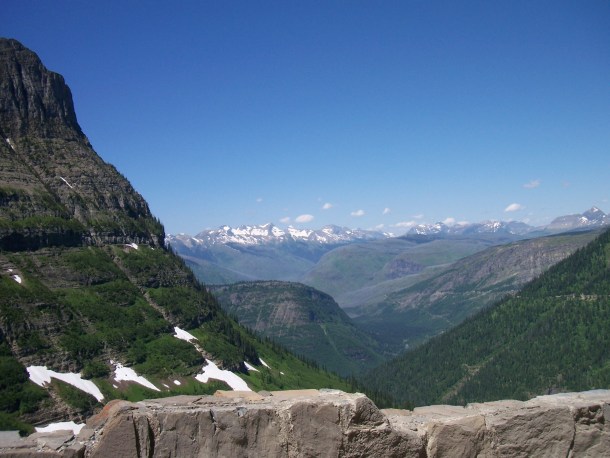
100_4758

Kathy took this picture from the one of the overviews on the Road to the Sun in Glacier National Park.

There is not a flower that opens, not a seed that falls into the ground, and not an ear of
wheat that nods on the end of its stalk in the wind that does not preach and proclaim the
greatness and the mercy of God to the whole world. There is not an act of kindness or
generosity, not an act of sacrifice done, or a word of peace and gentleness spoken . . .
that does not sing hymns to God.

Thomas Merton, The Seven Storey Mountain (1948)

A spiritual reflection on the Centenary of Thomas Merton – Part 1

via A spiritual reflection on the Centenary of Thomas Merton – Part 1

Bruce posts wonderful text, accompanied by exceptional images. This post caught my eye as I looked through Bruce’s blog. It is about Thomas Merton and his enduring work as a pacifist, activist and support of inter-faith dialogue.

I read Merton and book about his writings frequently. I grew up in the shadow of Vatican II, which promoted inter-faith dialogue and Merton, Brother David Steindel-Rast, Karen Armstrong, Thich Nhat Hanh, etc. attract me to their work.

I find them to be prophetic and mystical, often signaling challenges we will face long before they are evident to most of us. For example, Bruce included a wonderful quote from a letter Merton wrote to Rachel Carson after reading Silent Spring. Both offered prophetic views, as mystics, of a world to come and challenges we faced in the 1950’s.

I leave you with this quote from Thomas Merton and wish each of you the best. However, we each celebrate we need to share our love for each other and the world we share with each other.

The beginning of love
is the will to let those we love
be perfectly themselves,
the resolution not to twist them
to fit our own image.”
~Thomas Merton

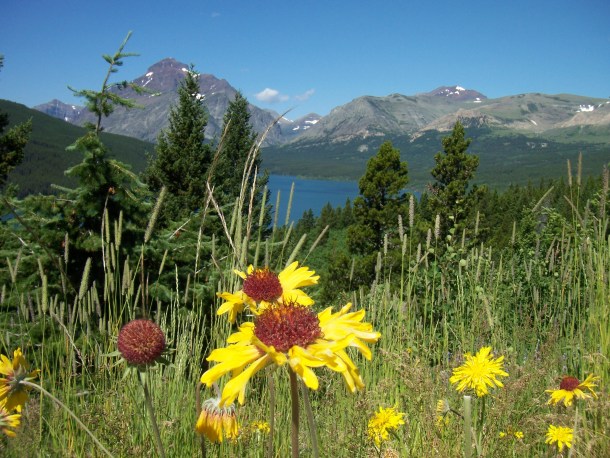
Daffodils, Lake, and Mountain in Glacier

I share this image often. Kathy took it in Glacier National Park. She shared it with me out of love and I share it with my love for the people who will see it and nature we are stewards of, echoing Wendell Berry when we say: We Do Not Inherit the Earth from Our Ancestors; We Borrow It from Our Children

…the little bit of love that I sow now will bear fruits…

via …the little bit of love that I sow now will bear fruits…

Purple Rays shared a beautiful quote from Henri Nouwen, a Catholic priest who spent his early career as an academic and shifted to L’Arche as a caregiver for disabled adults.

I recently read In the Name of Jesus: Reflections on Christian Leadership. He wrote not about leadership writ large, but about his leadership during his early years at L’Arche and how much he learned from those he was to give care.

Transitioning from one role to another is always challenging. Nouwen provides insight into the challenges how he shifted away from leadership focused on being “relevant, popular, and powerful” to leadership more aligned with servant and love for others as a shepherd caring for each member of a flock.

How do I serve others? This is an essential question in my life as I transition from teaching in a classroom and to something new and, as yet, undefined. Perhaps, more importantly, it will always remain, at best, ill-defined.

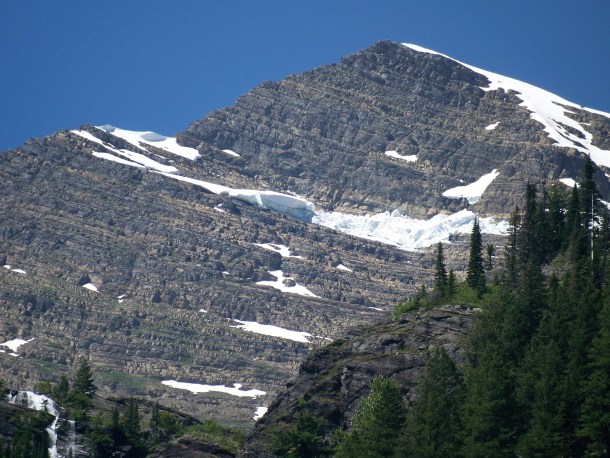
Mountain's Layers

Perhaps, like the mountain, each striation will serve to help me author new stories and embrace the very mystery of the future, based on history and traditions that help me serve and be minful of the needs of others.


Persistence

via Persistence

There is not much to add to Norma Bobb‘s post. She provides an inspiring text along with a beautiful picture and reminds me of my role in helping to protect the Earth for our children and grandchildren.

The post brought to mind the Indigenous quote: “Treat the earth well: it was not given to you by your parents, it was loaned to you by your children. We do not inherit the Earth from our Ancestors, we borrow it from our Children.”
Our care for the Earth is based on being stewards and prophets who look forward without fulling grasping what they will discover. We deceive ourselves with false arguements about ecology and economy as separate. They are linked by their etymology coming from the Greek, oikos, meaning household. How we each care for our household speaks volumes about us.

As Norma Bobb proposes, we each have a duty to persist in caring for the Earth and being stewards in its care.

Pallisades in Banff
I want to share these remparts in Glacier National Park with my grandchildren.

A Powerful Weapon

via A Powerful Weapon

Eddie Two Hawks provides wonderful quotes from various sources. Today’s is one from Nelson Mandela who was a champion of freedom, compassion, and education. Education is leading others into the world they will inhabit and letting them learn about the world. It is a transformative and just process that continuously act on each person as they act on the world they inhabit.

With each new generation, hope springs anew. Education is not just school. It is as John Dewey suggested one’s whole life experience. Dewey suggested life is a person’s meta-vocation and other interests become vocations. Here, I follow Thomas Merton and Parker Palmer and understand vocation as a calling that most fully expresses who I am.

Teachers and elders play substantial roles in one’s education. Furthermore, education does not cease, meaning others play roles throughout our lives in our becoming educated. It is a life-long process, but not in a slick way summarized with glib cliche, life-long learning.

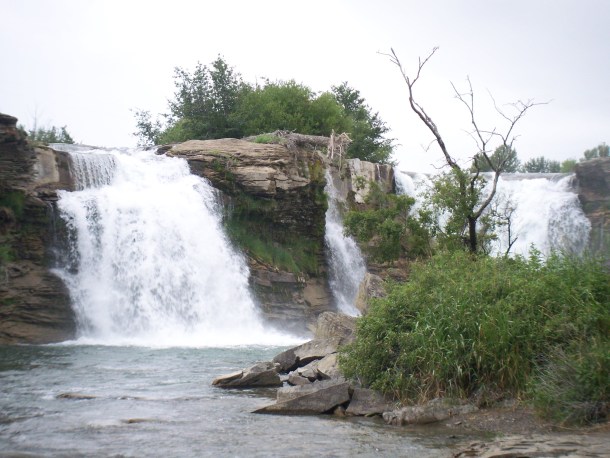
For me, education is best described in poetic terms such as Mary Oliver asking: “Tell me, what is it you plan to do with your one wild and precious life?” It is a waterfall carving out new space, transforming itself and the landscape it passes through with each passing moment.

100_4184


THERE IS FOREVER IN A FOREST

via THERE IS FOREVER IN A FOREST

Eric offers the reader a beautiful poem and image. The poem reminds me of how Wendell Berry might write about a forest. Nature, in each of its forms, is infinite, existing forever.

It is interesting how serdentipitous life can be. I read Wendell Berry this morning and emailed about him with a colleague yesterday, specifically his poem The Peace of Wild Things. It is a short poem I turn to when I struggle with things and the world. It reminds me there is beauty in the world that can be our salvation. Instead of being outside Nature, we grow to understand ourselves as embedded and part of Nature.

When despair for the world grows in me
and I wake in the night at the least sound
in fear of what my life and my children’s lives may be,
I go and lie down where the wood drake
rests in his beauty on the water, and the great heron feeds.
I come into the peace of wild things
who do not tax their lives with forethought
of grief. I come into the presence of still water.
And I feel above me the day-blind stars
waiting with their light. For a time
I rest in the grace of the world, and am free.


Dr. Seuss

via Dr. Seuss

Heather offers three Dr. Seuss quotes. I am particularly taken by the third one, which calls on me to step with care and tact.

Regardless of where I am, I am with people, in the world, and in relationships. It is easy to take these for granted. Often, children and youth embrace differences more readily than adults.

Through the use of satire, made up words, and unusual characters, Theodor Geisel took a stand against bullies, hypocrites, and demagogues. I think his characters depict pluralism we live in. Yes, there is no Lorax, Yertle the Turtle, or Cat in the Hat, but we can appreciate and defer to the beauty of their differences. Even within  differences, I find more similarities and common ground with others.

We need this in the world we co-inhabit with other beings, sentient and non-sentient. Too often, people who masquerade as leaders tell us to see difference as problematic, to see Nature as something to exploit, and to separate ourselves from our better angels. Perhaps our better angels are Thing 1 and Thing 2.

298x322 Unique Dr Seuss Images Ideas Dr Seuss Art, Dr

I retrieved this image from Clip Art Mag.