Tag Archives: Hope

Educating as a Vocation of Hopefulness

I borrow a bell hooks’ quote for my title. Educating is offering a gift of hope, reminding me of a Mary Oliver poem about sorrow: “It took me years to understand that this, too, was a gift.” I learned teaching did not guarantee learning. A student needs to trust a teacher and the hope offered today may take years to realize if ever. The teacher, me, missed the mark and did not go back to understand what that meant

Michelle visits my blog from time to time and what she shares complements my posts. It has been awhile since I posted, so her recent visit led me to look at her posts again. I do regardless of intent to post. The Jane Goodall quote reminds me of one by Elie Wiesel: “The opposite of love is not hate, it’s indifference.” Apathy and indifference are synonyms, so the words are somewhat interchangeable.

Hope has been a frequent part of my recent scholarship and emerges from my life. The Prayer of St. Francis was a reading at our wedding and I have a simple plaque to remind me of what it means in my life. I turn to it in moments where doubt and despair find their way into my life to recite “Lord, make me an instrument of your peace … Where there is despair, hope.”

School can be an unhappy place for many students. In some schools, 60-80% of students are labeled as unwilling and/or unable to learn. When this happens, students lose hope, they become cyphers, and are erased or treated as disposable. Consider the language we direct at others in terms of illegal immigrants, illegal aliens, collateral damage, etc. as if humans are somehow illegal or, as casualties of war, are just a byproduct of being in the wrong place at the wrong time. It is an indictment of those who hold power and the “pathologies of power” (Paul Farmer) that exist in this world. Farmer wrote about his experiences treating Haitians with AIDS, including many women who contracted the disease due to macho posturing of men in a hierarchical society.

The rest of the Prayer of St. Francis is appropriate to reflect upon in considering offering love instead of hate, joy instead of sadness, and being instruments of peace to overcome the indifference and apathy that appears in the language of power and its pathologies. I am an imperfect person who hardly qualifies as a great Christian or Catholic, but the words of the Peace Prayer resonate for me in today’s day to offer hope to others through educating.

In my presentations and articles, I often share Emily Dickinson‘s poem as she reminds me how fragile hope can be. To be accepted, it needs to be offered repeatedly as an authentic gift.

“Hope” is the thing with feathers –

That perches in the soul –

And sings the tune without the words –

And never stops – at all –

And sweetest – in the Gale – is heard –

And sore must be the storm –

That could abash the little Bird

That kept so many warm –

I’ve heard it in the chillest land –

And on the strangest Sea –

Yet – never – in Extremity,

It asked a crumb – of me.

Hope

“Hope” is the thing with feathers –

That perches in the soul –

And sings the tune without the words –

And never stops – at all –

And sweetest – in the Gale – is heard –

And sore must be the storm –

That could abash the little Bird

That kept so many warm –

I’ve heard it in the chillest land –

And on the strangest Sea –

Yet – never – in Extremity,

It asked a crumb – of me.

Emily Dickinson wrote this poem and, although hope is fragile, it has the potential to always be with each of us. Even in the most difficult and inclement times, hope can keep us warm.

More than at any other time in my life, I try to find hope particularly in the small everyday things. I might call those things banal. I often use the opening lines of the poem in writing, publishing, and presenting, which is related to hopeful and nonviolent pedagogy and can be found at Academia.

When I look closely and am mindful of my words and actions, I find seeds of hope in my life that make a change for those closest to me and, in turn, hope they and I nurture those seeds. As bell hooks and Thomas Merton wrote, we enter into communion to take us beyond words and speech. It is an intimate and loving way of being together, sharing, and communicating.

Today, I read Carrie Newcomer‘s Substack essay and the lyrics to her song Sanctuary. What do we do in moments of despair. In a conversation with her friend and mine Parker Palmer, she received the following advice. There are times we march and speak out. Other times, we seek sanctuary, gathering with those we love and respect to share our stories and encourage each other. The word courage comes from the French coeur, meaning heart. What we do is heartfelt as we share the hurt we feel with each other in moments of compassion, the sharing of what we love and the suffering as we look at how it might be overturned. We are not alone. We need to lean on each other and take appropriate action and speak appropriate words even to those we disagree with. Take heart and retain hope in trying times by looking for those people and things that give us hope on a daily basis.

I leave you with Sanctuary by Carrie Newcomer.

Peace Education

Poverty is the [parent] of crime” – Marcus Aurelius

When I completed my PhD, I was uncertain where I would go next. I thought I would write and present about what becoming a teacher meant, after all that was the subject of my dissertation. As good luck would have it, I meandered in a different direction, teaching a philosophy of education course and supervising student-teachers. As well, I began to write and present, initially with colleagues and more on my own, about what we call an andragogy of hope. This morphed re-imagining education, including how we educate aspiring teachers and how they continue to educate themselves once in the profession. Now, I am combining hope, peace, and holistic education under one umbrella. They are interrelated and, in my mind, essential to the future of a world for our children, grandchildren, and future generations.

When I enter K-12 classrooms, and for that matter post-secondary ones, it strikes me how little has changed and what has changed is more a regression than a moving forward. Yes, we have different tools in our classroom, but students often sit in rows, teachers deliver from the front, and there is little true deep dives into curricular topics, exploring the contours of their topography. Teachers tells me they cannot touch certain topics as a small slice of their community will shout others down. Parker Palmer says classrooms should be spaces where tensions, holding our differences hospitably. In other words, they would be safe spaces where dialogue, deep listening, and civil discourse emerge.

Imagine, if teachers educated themselves to open up hospitable spaces, where listening to beloved others was essential. John Lennon wrote and sang “You may say I’m a dreamer/But I’m not the only one/I hope someday you’ll join us/And the world will be as one.” Peace begins as a dream, which suggests it is situational and contextually bound, without giving up its universal elements. Systems theory proposes each person, each classroom can be a node, reaching out to others in a the network. Furthermore, this is trans-disciplinary, which suggests soloed classrooms and teaching one subject at a time is passe.

I understand inertia of the status quo and wishes of ideologues, politicians, bureaucrats, technocrats, etc. in ivory towers act as barriers to transforming education at all levels. It is actually dangerous work, which means teachers at all levels need to be expert in ways they may not have imagined. Dangerous work means being creative:

“Perhaps there is no peace for an [teacher] other than the peace found in the heat of combat. But now the [teacher] is in the amphitheatre. Of necessity, [their] voice is not quite the same; it is not nearly so firm. To create today means to create dangerously” — Albert Camus


This song is from a collaboration between Maria Muldaur and Women’s Voices For Peace Choir.

Looking Back; Looking Forward with Hope and In Peace

It was a busy and eventful year. Retirement is thought of as a time to step back and slow down. I remain busy and choose to do so, as health permits. I had pieces published and presented at two conferences. If anyone wishes to read or browse the book chapter, two articles, and a draft, I uploaded them to Academia. A by-product of one presentation, Re imagining Teacher Education An Andragogy of Hope, was an interview with the Fig Tree Online Magazine, published in October.

The emerging themes are pedagogies and andragogies of hope and peace. Teachers are vital to opening spaces of hope and peace. For various reasons e.g. time, education, assignments, top-down authoritarian dictates, etc., teachers struggle to infuse pedagogies of hope and peace into their teaching. In a role as a field instructor for student-teachers, I observe teachers and student-teachers who lack the education, confidence, and support in these areas. Furthermore, there is interference from outside the classroom as to what can be taught and there is a risk someone complains if a teacher teaches something someone is unhappy with. In Alberta, the government changed rules about complaints going to school and district administration to a committee of largely non-educators and complaints increased noticeably .

In a world where civil discourse is at a premium and we often equate rhetoric to its colloquial meaning of bombast, we need faculties of education to educate and teachers to continue their education in ways that support pedagogies of hope and peace. Dialogue and the proper use of rhetoric, as eloquent speech and deep listening, are essential to make headway to deal with issues that polarize people into competing ideological camps.

Currently, I am preparing for a conference about teacher education as an andragogy of hope, peace, and non-violence. As well, I submitted a proposal to present at a holistic education conference where I hope to show how hope, peace, and non-violence tap into the spiritual domain often overlooked in teaching and learning. What is essential is to focus on what we can change and how we can each make a difference in our small corners of the world. Prudence can make small differences adding up to larger differences.

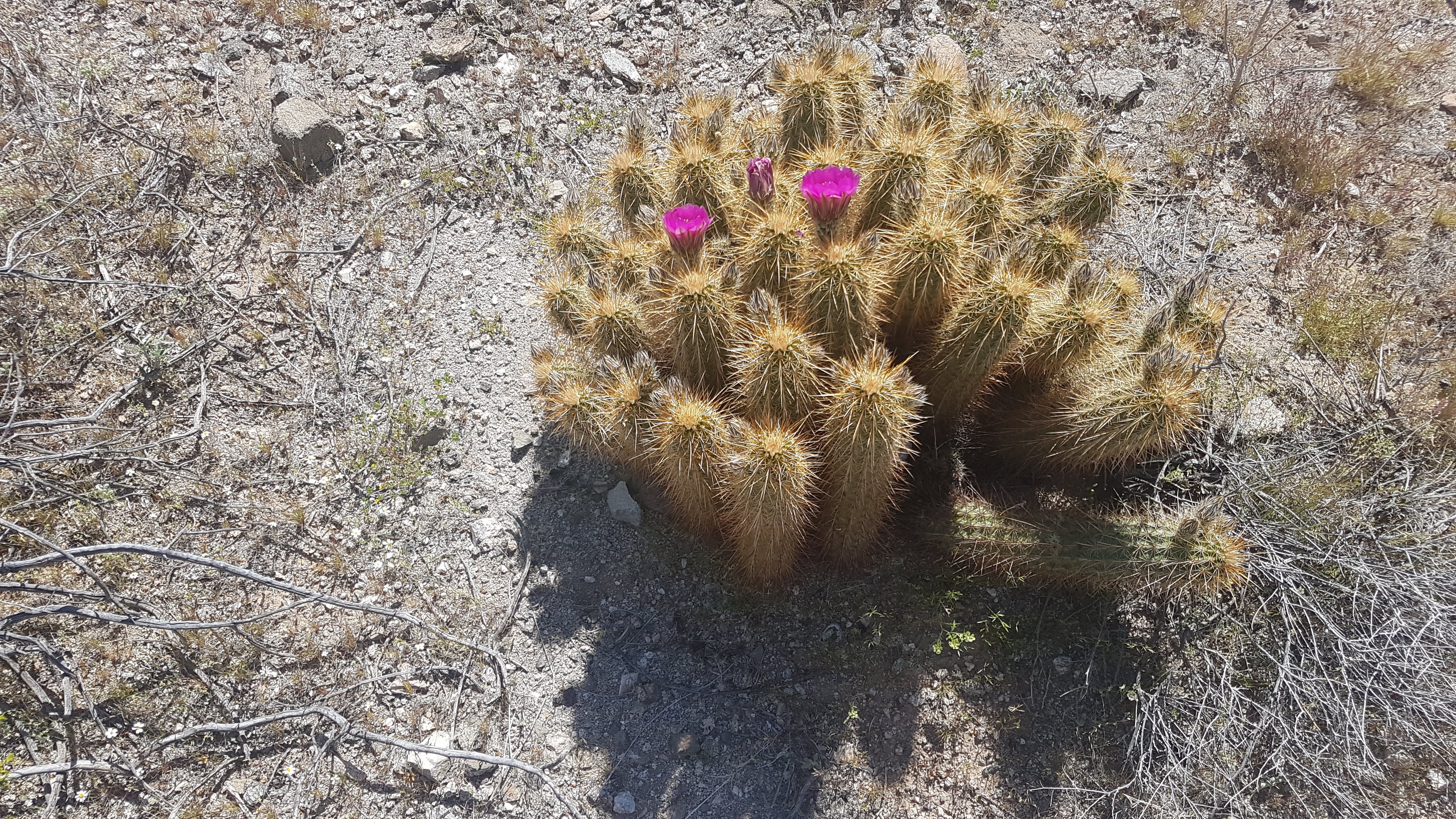
Several years ago, we were in Arizona and hiked in a regional park on an every other day basis. During our hikes, I took pictures of cacti that were blooming. Nature demonstrates hope even in challenging ecological settings. The contrast of the pink with a dull green and brown background serves as a beautiful reminder of hope in challenging times.

I share the Prayer of St. Francis as it has deep meaning in our family and it often referred to as the Peace Prayer. The word peace appears once and is the overarching message. Hope is an integral part of achieving peace.

Here is Sarah McLachlan‘s video of the Peace Prayer.

#One-linerWednesday . . . the smile of innocence. — Purplerays

To me nothing in the world is as precious as a genuinesmile, especially from a child. ~ Rumi♡ Text and image source: Rumi https://www.facebook.com/107050231019471/posts/279057347152091/

#One-linerWednesday . . . the smile of innocence. — Purplerays

Purple Rays comes into my feed on a daily basis with wonderful quotes and pictures. One of my favourite sources is Rumi the 13th Century Persian Sufi poet and philosopher. This quote is no exception.

Children provide a genuine sense of hope with their innocence, love, and ability to live in the most immediate world. They can inspire each of us, as adults, with hope we may not feel in a particular moment.

Part of my current writing is about hope. In a book chapter that will published shortly, we each shared a remembrance of hope in our lives and how it comes to inform our pedagogy of hope as teachers. Mine included the line from The Prayer of St. Francis to offer hope where there is despair.

As educator and pedagogue, each adult who interacts with a child has an obligation and duty to offer hope for each child. When we look into the eyes of children and witness their smiles, we are called to be stewards and serve in unanticipated ways. I use the word steward through its etymological meaning, relating it to the Greek word oikos. Oikos means household and is related to economy and ecology, which also come from the same etymology.

The prudent educator and pedagogue might ask the following questions: “How do I leave my corner of the household a better place for the next generation? How do offer hope to each child of the ensuing ggeneration?”

What is that weird, tingling feeling? Could it possibly be … hope? — Live & Learn

But then the sun came out where I live this week, and I was alive again. Dunno if you’ve noticed this, but it’s been the longest year since records began, and the timing of lockdown restrictions easing this week coinciding with warm weather in parts of England – which the press was more than happy […]

What is that weird, tingling feeling? Could it possibly be … hope? — Live & Learn

I don’t recall when I began following David‘s blog, but it has been a number of years. He shares wonderful daily posts and this one is no exception. He shares a part of a newspaper article with us about how we might be feeling as the light seems to become increasingly larger at the end of COVID tunnel. Of course, it could be a train hurtling down on us, so we must not let our guards down.

Hope is a recurring theme in my writing, publishing, and the publishing I hope to do as I move forward. It is grounded in reality . COVID-19 sharpened my awareness of challenges others face and made me realize there are taken-for-granted challenges. For example, how we treat our elderly, BIPOC humans, sexual and gender minorities, etc. are real challenges. How do we help lift up others in times of need? How do we help infuse hope in the lives of others?

Hope is essential to our dreams. Despite this, what we each dream for is not guaranteed. There is a realistic side to hope that suggests to get to the other side or the end of the tunnel we each need to be resilient. Like passion, which includes suffering for what and who we love, hope has an element of potential failure and suffering. Passion moves to compassion when we share the suffering of others and accept their lives and experiences are different than those we experienced. Hope has a similar collective feel to it. We find hope in community, what we have in common with one another, which is our humanity, how we communicate the common and disparate features of our lives, and how we live in communion with each other.

Hope and its relationship with resilience remind me of the Zen proverb: Fall down seven times, get up eight. How do I compose myself as I get up each time? Is it with grace, compassion, and kindness or do I lash out at others? I find Emily Dickinson and Langston Hughes‘ poems meaningful in days like these, so I share them again.

“Hope” is the thing with feathers

“Hope” is the thing with feathers –
That perches in the soul –
And sings the tune without the words –
And never stops – at all –

And sweetest – in the Gale – is heard –
And sore must be the storm –
That could abash the little Bird
That kept so many warm –

I’ve heard it in the chillest land –
And on the strangest Sea –
Yet – never – in Extremity,
It asked a crumb – of me.
Mother to Son

Well, son, I’ll tell you:
Life for me ain’t been no crystal stair.
It’s had tacks in it,
And splinters,
And boards torn up,
And places with no carpet on the floor—
Bare.
But all the time
I’se been a-climbin’ on,
And reachin’ landin’s,
And turnin’ corners,
And sometimes goin’ in the dark
Where there ain’t been no light.
So boy, don’t you turn back.
Don’t you set down on the steps
’Cause you finds it’s kinder hard.
Don’t you fall now—
For I’se still goin’, honey,
I’se still climbin’,
And life for me ain’t been no crystal stair.

Have a wonderful weekend.

Ode to Joy~ —

Signs of spring. A jolt of joy! Blossoms cheer, weary hearts. Ode to Joy, hope and faith. Cheers to you and Happy Spring~

Ode to Joy~ —

I am back. I took a sabbatical of sorts from the blog, as I only checked in on comments and to follow up through the reader. It has been a busy time supervising student teachers, attending online events, presenting at online events, writing, getting published, and life in general. I am unsure how active I will be. I hope to be posting 2-3 times a week and maybe write some new poetry.

I return with a share from Cindy who takes wonderful pictures of nature close to home in the Holler and further afield. The images remind me we are entering the time of the year where life comes alive after its dormant period, Yes, things do remain in a state of flux with weather. Despite the uncertainty, it is a time to rejoice and search out the joy and beauty located wherever we look in nature.

Cindy shared a video of musicians playing Beethoven’s 9th Symphony as a virtual ensemble. Artists of all forms find ways to lead us in the most challenging times and COVID-19 is no exception. I am grateful we have wonderful artists who take the lead in meaningful ways.

It has been hard this past year for each of us with less social interaction. An emerging area of interest for me is the role virtual communities can and will play in our lives moving forward. It is what I presesnted on this past weekend and am fleshing out an article for submission. People surprised me with their response to what I talked about. I see hope and joy in sharing online. It brings me together, often with people I have not met and likely will never meet.

Common is the root word of community, communicate, and communion. What do we have in common that brings us together, besides our grievances and grief? In short, what gives each of us joy? How do we experience communicating what we receive from others and share with others? How has listening to others changed in this brave new world? Communion goes beyond the religious concept, speaking to a level of intimacy. How do we reveal who we are in a virtual world? Virtual and virtue share etymological roots, speaking to our character in these communities.

I leave you with a video from Mavis Staples. How do we get it together and bring joy into our lives as a collective and community?

A Place; A Space

Over the last few years, I have increasingly exlored how we use language. For example, we use the word organization as a noun for places where we work, learn, and play. It grows static and lifeless Yet, its root, organ, suggests life and interacting with one another. John Dewey and Ivan Illich referred to interacting and communicating as intercourse. This suggests we engage in intimacy and love as we communicate with one another.

As well, an organ, as a musical instrument, needs a human touch. At our best, we organize, work, and learn, through a common purpose, like in a jazz ensemble, and what calls each of us in some meanfinful way. In a neo-liberal and neo-conservative world, organizing, working, and learning fall short of the common good (common weal) and what calls each of us to feel fufilled, perhaps self-actualized.

Out of this reflecting emerged the following poem.

This place–

This space–

Welcoming–

Beckoning.

When cold, aloof–

As a frigid lover–

Pushing us away;

Denying intimacy.

As an anxious lover–

Frantically clinging;

Giving no room to breath.

As a capricious lover–

Now here;

Now gone.

At its best–

Fully alive;

Not on life support!

Exuding hearty warmth–

Healthy, vibrant;

Touching in human ways.

Gentle lover embracing–

Inviting and holding close;

Letting us breath.

A place–

A space–

Wanting to be.

A place–

A space–

Calling, giving voice.

Sharing–

Drawing us each closer;

To our common humanity.

Yesterday, I heard the following song by Mavis Staples. It reminded me, regardless of how things are going, there are always high notes in life.

In Seeming Chaos, Hope

I gave a lot of thought today about hope and its lack of it. I do not confuse hope with positivity and positive mindset. Instead, I understand hope as grounded in reality. Emily Dickinson described it as “the thing with feathers,” suggesting we cannot fully describe it. Its ineffeable nature creates a metaphoric meaning for each of us. Without dreams and hope, Langston Hughes cautions “life is a broken-winged bird/that cannot fly.” With hope and dreams of previous enslaved generations, Maya Angelou repeats the title of her poem “I Rise” as a prayer and refrain against hopelessness.

Too often, people want to pigeon-hole others in binary and dichotomous ways e.g. conservative or progressive. It appears easier and less ambiguous if we can label someone, somehow providing a sense of stability about who this or that person is. What we mis-understand is “and” means something. It acknowledges how complex each human is. We are not usually one thing or the other. Instead, we are mingling of things, experiences informing how we live, and the context within which we live. I want to conserve things e.g. Nature and, at the same time, progress e.g. equity regardless of gender, race, sexual orientation, etc. Neither is premised on political or, in our case, reality TV, sloganeering.

Paulo Freire and bell hooks write about hope, unconditional love, and dialogue in educating children, youth, and adults. I think the critical theory is incorrect. What they propose is critical pedagogy/andragogy where I ground dialogue in listening with lovingkindness to those with different lived-experiences. In mindful, non-judgemental listening, I seek to open up space where the Other shares their reality and wisdom. In acknowledgeing the humanity of the Other and greeting them in dignified silence, I might offer the fragile hope so needed in today’s world. Imagine a world where we greeted one another with dignity, rather than making up slick political mottos and creating disparaging nicknames that assault others?

I wrote this poem after a long, hard day. I thumbed through some right-brain scribbles and this was the result.

Even in chaos, hope–

Faith springing forth,

Beloved Other sharing wisdom:

What do we hold in common.

Communal rhythm,

Symphonic voices arising–

Loving harmonies;

Binding and healing.

Listening,

Giving dignity–

Acknowledging shared ground.

Holding each Other gently,

Unsure together–

Breaking bread

Being safe in this space.

This was the first secular song I heard in church. It was the late 1960’s. Today, I think we do need mountains we have bulldozed, meadows we have paved over, and water we have contaminated. Having said this, we need love and hope equal measure to make those things happen.

Do Pigs Have Udders?

Part of educating for hope is “reading the world” in hopeful while living “in dynamic interrelationships” with others (Paulo Freire, Pedagogy of the Oppressed, p. 102). This means opening the world to eloquent questions without presupposed answers and without the threat of violence of any form. I used the quote in a recent book chapter I co-authored with a colleague from North Carolina. The book is to be published in late 2020 or early 2021. What does it mean to live in a world full of hope; a hope(ful) world.

My first day back from the retreat I posted about in Welcoming Differences and Gentle Rain I noticed the students were subdued. In the afternoon, I was alone, which was unusual. Without an adult and teaching three grades, it could be demanding. Other times, it provided interesting moments, and this turned into one of those moments.

I had contacted a substitute teacher I had used several years before and who was available again after completing a long term assignment for an ill teacher. As we talked about what was bothering me, the students told me they had not enjoyed the teacher. I was surprised, as he had seemed a good fit before. I asked for an example and they told me he had told them their conversation was inappropriate. This was unusual, as the students in this group were well-behaved and respectful. I asked them what the conversation was about and they told me, while completing some Science, one student asked “Do pigs have udders?” Apparently, this became a hotly debated topic and it was brought up again today.

I laughed. For me, it was funny and pointed to an irrevocable human truth: curiosity about the world we live in and eloquent questions leading to exploring the world and learning about it. We had serious fun as we talked about what udders were and their role in feeding offspring. I even phone Kathy, who was raised on a farm, and asked he. She was not sure, but thought it was a structural thing and pigs probably did not have it. We left it as an open question.

Simple question,

Emerging eloquently,

Not presupposing answers;

Fueling curiousity–

Energizing learning.

What does this mean?

Is it true?

Querying and questing;

Seeking to fill gaps;

Not with certitude;

New questions emerging.

With passing years,

Recalling that moment,

Smiling, chuckling;

Appreciating simple, provocative question–

Do pigs have udders?

As best as we can learn, they do and it was fun trying to figure it out. Adolescent children ask the darnedest things. Laughter is an antidote for difficult moments. Something I learned as a student teacher was a safe classroom allows children, youth, and probably adults to ask provocative questions with no preconceived answers. In the polarized world we live in, we have lost that assurance of safety and are reluctant to ask questions needing answers.

I will save you looking up the answer on the Internet. Pigs do not have udders. Udders are a reference to mammary glands on certain mammals and it has to do with their structure. I read a version of this poem for a group at a retreat in Wisconsin. As I finished, adults wanted to know the answer. I said I didn’t know and someone looked it up on the spot.

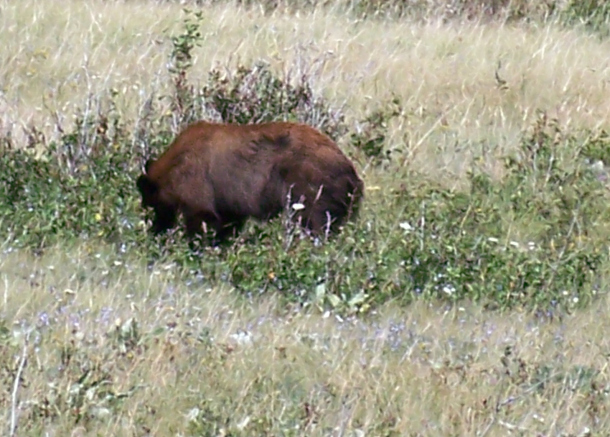
I don’t have a picture of a pig. Here is one of a bear I took in Waterton Lakes National Park. Bear and pigs are related, so it was as close as I could get.