I am headed to New Zealand to present at an International Peace Conference and have been thinking of resistance so needed today. Music, poetry, and art play a significant role in resisting violence, including that imposed by governments and other institutions that are supposed to protect.
One of the first albums I bought was The Freewheelin’ Bob Dylan. I was about 16-years old and I still have the album. It is iconic with songs like Blowin’ In the Wind (melody based on a spiritual called No More Auction Block), Masters of War, A Hard Rain’s a-Gonna Fall, Oxford Town about resistance to desegregation in the American South, and Talkin’ World War III Blues. Dylan covered Lead Belly’s version of I Shall Be Free.
Talkin’ World War III Blues is my favourite song on the album. Dylan was at his best in the spontaneity of the song and it fits with the talking blues genre. In I Shall Be Free, he sings about making love to Elizabeth Taylor. Even in the early 60’s a was a way to avoid the reality that hung over the world was to turn to popular culture as a distraction from the threats of nuclear war.
About the same time, I wrote a poem in school. I know Mr. P. writes poetry is hard to imagine for my students. The poem was about the tragedy of war and it stole lives in absolute ways whether through death or through the physical and psychic damage done to those who were forced into service in a war they did not understand. Many of those who died or were left deeply scarred with the trauma of war were from the African American population, which was about 12% of the American population at the time. Their deaths alone represented about 25% of the casualties, so statistically overrepresented. The personal narratives within their families and communities can not be quantified.
I borrow a bell hooks’ quote for my title. Educating is offering a gift of hope, reminding me of a Mary Oliver poem about sorrow: “It took me years to understand that this, too, was a gift.” I learned teaching did not guarantee learning. A student needs to trust a teacher and the hope offered today may take years to realize if ever. The teacher, me, missed the mark and did not go back to understand what that meant
Michelle visits my blog from time to time and what she shares complements my posts. It has been awhile since I posted, so her recent visit led me to look at her posts again. I do regardless of intent to post. The Jane Goodall quote reminds me of one by Elie Wiesel: “The opposite of love is not hate, it’s indifference.” Apathy and indifference are synonyms, so the words are somewhat interchangeable.
Hope has been a frequent part of my recent scholarship and emerges from my life. The Prayer of St. Francis was a reading at our wedding and I have a simple plaque to remind me of what it means in my life. I turn to it in moments where doubt and despair find their way into my life to recite “Lord, make me an instrument of your peace … Where there is despair, hope.”
School can be an unhappy place for many students. In some schools, 60-80% of students are labeled as unwilling and/or unable to learn. When this happens, students lose hope, they become cyphers, and are erased or treated as disposable. Consider the language we direct at others in terms of illegal immigrants, illegal aliens, collateral damage, etc. as if humans are somehow illegal or, as casualties of war, are just a byproduct of being in the wrong place at the wrong time. It is an indictment of those who hold power and the “pathologies of power” (Paul Farmer) that exist in this world. Farmer wrote about his experiences treating Haitians with AIDS, including many women who contracted the disease due to macho posturing of men in a hierarchical society.
The rest of the Prayer of St. Francis is appropriate to reflect upon in considering offering love instead of hate, joy instead of sadness, and being instruments of peace to overcome the indifference and apathy that appears in the language of power and its pathologies. I am an imperfect person who hardly qualifies as a great Christian or Catholic, but the words of the Peace Prayer resonate for me in today’s day to offer hope to others through educating.
In my presentations and articles, I often share Emily Dickinson‘s poem as she reminds me how fragile hope can be. To be accepted, it needs to be offered repeatedly as an authentic gift.
The recent killing of the CEO of United Health Insurance reflected the violence (himsa) we find ourselves embedded in. I refuse to condone violence in any form. What flies under the radar is the daily violence humans are subjected to when they are denied healthcare, when it is delayed. Hannah Arendt introduced us to the term “the banality of evil”, which underscores both forms of violence, although the former is more obvious than the latter. Schools and teachers can play a vital role in educating children, youth, and adults in ways that help them unearth the roots of violence.
For the past 2-3 years, I focused on re-imagining teacher education as an andragogy of hope and nonviolence. A third pillar is dialogue and civil discourse. One objective is to have a manageable endeavor for teachers from the moment aspiring teachers enter schools of education to the end of their careers. The second is to move away from what Paulo Freire referred to as a banking model of education where information is deposited in students to a dialogic form with teachers and students engaging as teachers and learners. When I enter K-12 classrooms, I observe how little has changed in our schools and this conditions education students the banking model. It is embraced by those who decide how schools and teaching function.
Currently, teachers experience top-down mandates reflecting a neo-liberal , market-driven, top-down process set down by politicians, bureaucrats, technocrats, and autocrats. Those in ivory towers design schools where competing for marks, individual rankings, and accreditation are the focus as opposed to considering the collective good and forming of character. Fortunately, good teachers do grow to explore, navigate, and discover ways to overcome top-down and politically motivated mandates.
Schools limit the ability to think critically and discern what systemic issues exist that prevent real change from occurring. It is easier to allow unfounded, unwarranted conspiracy theories, instead of considering other potential causes that require this critical thinking and discernment. For example, global warming likely has more to do with increased illnesses and syndromes than vaccines. Global warming means we have to make committed and transform how we each live and living collectively. Conspiracy theories carry no such weight. Critical thinking gives way to accepting opinions largely based on opinions. Dialogue gives way to supposed free speech.
Anyone who undertakes a challenge of this magnitude faces inertia of immovable forces. Having said this, it reminds me that Margaret Mead said: “Never doubt that a small group of thoughtful, committed [humans] can change the world; indeed, it’s the only thing that ever has.” The change we seek calls for the volition and will to press forward, express one’s self in a human and humane way, and make those changes in the face of opposition and resistance. What we need to avoid is acts of violence as acceptable to achieve our goals. This lowers and debases those who seek humane ways forward to the level of those who excuse the systemic violence and oppression that permeates us.
The word humane is essential to this re-imagining as much of the violence is associated with inequity and oppression. Growing up in the 1960’s and 70’s, my mother, hardly a Marxist or social democrat, used to tell us “the rich get richer and the poor get poorer” and we should be grateful for what we had, as many others had less. It is also essential to speak out and advocate for a world where it is unacceptable to put material wealth before human life and the life of the planet.
Poverty and oppression are forms of violence that exist as a products of the banality of evil and the system that promotes it. Gustavo Gutiérrez argued “the poor are a by-product of the system in which we live and for which we are responsible. They are marginalized by our social and cultural world. They are the oppressed, exploited proletariat, robbed of the fruit of their labor and despoiled of their humanity. Hence the poverty of the poor is not a call to generous relief action, but a demand that we go and build a different social order.” Part of a different social order is educating teachers and, in turn, teachers educating themselves to create a humane, equitable social order.
This was a challenging post to write with many edits. It is different than other posts, however it is consistent with my recent presenting, writing, and publishing. When I received a PhD, I did not anticipate traveling this route, but one thing led to another and here I am. It is “the path less traveled” as Robert Frost suggests.
I leave with a Wendell Berry poem: Manifesto: The Mad Farmer Liberation Front
Love the quick profit, the annual raise, vacation with pay. Want more of everything ready-made. Be afraid to know your neighbors and to die. And you will have a window in your head. Not even your future will be a mystery any more. Your mind will be punched in a card and shut away in a little drawer. When they want you to buy something they will call you. When they want you to die for profit they will let you know.
So, friends, every day do something that won’t compute. Love the Lord. Love the world. Work for nothing. Take all that you have and be poor. Love someone who does not deserve it. Denounce the government and embrace the flag. Hope to live in that free republic for which it stands. Give your approval to all you cannot understand. Praise ignorance, for what man has not encountered he has not destroyed.
Ask the questions that have no answers. Invest in the millenium. Plant sequoias. Say that your main crop is the forest that you did not plant, that you will not live to harvest. Say that the leaves are harvested when they have rotted into the mold. Call that profit. Prophesy such returns.
Put your faith in the two inches of humus that will build under the trees every thousand years. Listen to carrion – put your ear close, and hear the faint chattering of the songs that are to come. Expect the end of the world. Laugh. Laughter is immeasurable. Be joyful though you have considered all the facts. So long as women do not go cheap for power, please women more than men. Ask yourself: Will this satisfy a woman satisfied to bear a child? Will this disturb the sleep of a woman near to giving birth?
Go with your love to the fields. Lie down in the shade. Rest your head in her lap. Swear allegiance to what is nighest your thoughts. As soon as the generals and the politicos can predict the motions of your mind, lose it. Leave it as a sign to mark the false trail, the way you didn’t go. Be like the fox who makes more tracks than necessary, some in the wrong direction. Practice resurrection.
And a Bob Dylan video, a song I forgot about until this morning. He reminds me conspiracy theories, and a need to address violence and its underlying causes have been with us for a long time.
Emily Dickinson wrote this poem and, although hope is fragile, it has the potential to always be with each of us. Even in the most difficult and inclement times, hope can keep us warm.
More than at any other time in my life, I try to find hope particularly in the small everyday things. I might call those things banal. I often use the opening lines of the poem in writing, publishing, and presenting, which is related to hopeful and nonviolent pedagogy and can be found at Academia.
When I look closely and am mindful of my words and actions, I find seeds of hope in my life that make a change for those closest to me and, in turn, hope they and I nurture those seeds. As bell hooks and Thomas Merton wrote, we enter into communion to take us beyond words and speech. It is an intimate and loving way of being together, sharing, and communicating.
Today, I read Carrie Newcomer‘s Substack essay and the lyrics to her song Sanctuary. What do we do in moments of despair. In a conversation with her friend and mine Parker Palmer, she received the following advice. There are times we march and speak out. Other times, we seek sanctuary, gathering with those we love and respect to share our stories and encourage each other. The word courage comes from the French coeur, meaning heart. What we do is heartfelt as we share the hurt we feel with each other in moments of compassion, the sharing of what we love and the suffering as we look at how it might be overturned. We are not alone. We need to lean on each other and take appropriate action and speak appropriate words even to those we disagree with. Take heart and retain hope in trying times by looking for those people and things that give us hope on a daily basis.
When I completed my PhD, I was uncertain where I would go next. I thought I would write and present about what becoming a teacher meant, after all that was the subject of my dissertation. As good luck would have it, I meandered in a different direction, teaching a philosophy of education course and supervising student-teachers. As well, I began to write and present, initially with colleagues and more on my own, about what we call an andragogy of hope. This morphed re-imagining education, including how we educate aspiring teachers and how they continue to educate themselves once in the profession. Now, I am combining hope, peace, and holistic education under one umbrella. They are interrelated and, in my mind, essential to the future of a world for our children, grandchildren, and future generations.
When I enter K-12 classrooms, and for that matter post-secondary ones, it strikes me how little has changed and what has changed is more a regression than a moving forward. Yes, we have different tools in our classroom, but students often sit in rows, teachers deliver from the front, and there is little true deep dives into curricular topics, exploring the contours of their topography. Teachers tells me they cannot touch certain topics as a small slice of their community will shout others down. Parker Palmer says classrooms should be spaces where tensions, holding our differences hospitably. In other words, they would be safe spaces where dialogue, deep listening, and civil discourse emerge.
Imagine, if teachers educated themselves to open up hospitable spaces, where listening to beloved others was essential. John Lennon wrote and sang “You may say I’m a dreamer/But I’m not the only one/I hope someday you’ll join us/And the world will be as one.” Peace begins as a dream, which suggests it is situational and contextually bound, without giving up its universal elements. Systems theory proposes each person, each classroom can be a node, reaching out to others in a the network. Furthermore, this is trans-disciplinary, which suggests soloed classrooms and teaching one subject at a time is passe.
I understand inertia of the status quo and wishes of ideologues, politicians, bureaucrats, technocrats, etc. in ivory towers act as barriers to transforming education at all levels. It is actually dangerous work, which means teachers at all levels need to be expert in ways they may not have imagined. Dangerous work means being creative:
“Perhaps there is no peace for an [teacher] other than the peace found in the heat of combat. But now the [teacher] is in the amphitheatre. Of necessity, [their] voice is not quite the same; it is not nearly so firm. To create today means to create dangerously” — Albert Camus
This song is from a collaboration between Maria Muldaur and Women’s Voices For Peace Choir.
It was a busy and eventful year. Retirement is thought of as a time to step back and slow down. I remain busy and choose to do so, as health permits. I had pieces published and presented at two conferences. If anyone wishes to read or browse the book chapter, two articles, and a draft, I uploaded them to Academia. A by-product of one presentation, Re imagining Teacher Education An Andragogy of Hope, was an interview with the Fig Tree Online Magazine, published in October.
The emerging themes are pedagogies and andragogies of hope and peace. Teachers are vital to opening spaces of hope and peace. For various reasons e.g. time, education, assignments, top-down authoritarian dictates, etc., teachers struggle to infuse pedagogies of hope and peace into their teaching. In a role as a field instructor for student-teachers, I observe teachers and student-teachers who lack the education, confidence, and support in these areas. Furthermore, there is interference from outside the classroom as to what can be taught and there is a risk someone complains if a teacher teaches something someone is unhappy with. In Alberta, the government changed rules about complaints going to school and district administration to a committee of largely non-educators and complaints increased noticeably .
In a world where civil discourse is at a premium and we often equate rhetoric to its colloquial meaning of bombast, we need faculties of education to educate and teachers to continue their education in ways that support pedagogies of hope and peace. Dialogue and the proper use of rhetoric, as eloquent speech and deep listening, are essential to make headway to deal with issues that polarize people into competing ideological camps.
Currently, I am preparing for a conference about teacher education as an andragogy of hope, peace, and non-violence. As well, I submitted a proposal to present at a holistic education conference where I hope to show how hope, peace, and non-violence tap into the spiritual domain often overlooked in teaching and learning. What is essential is to focus on what we can change and how we can each make a difference in our small corners of the world. Prudence can make small differences adding up to larger differences.
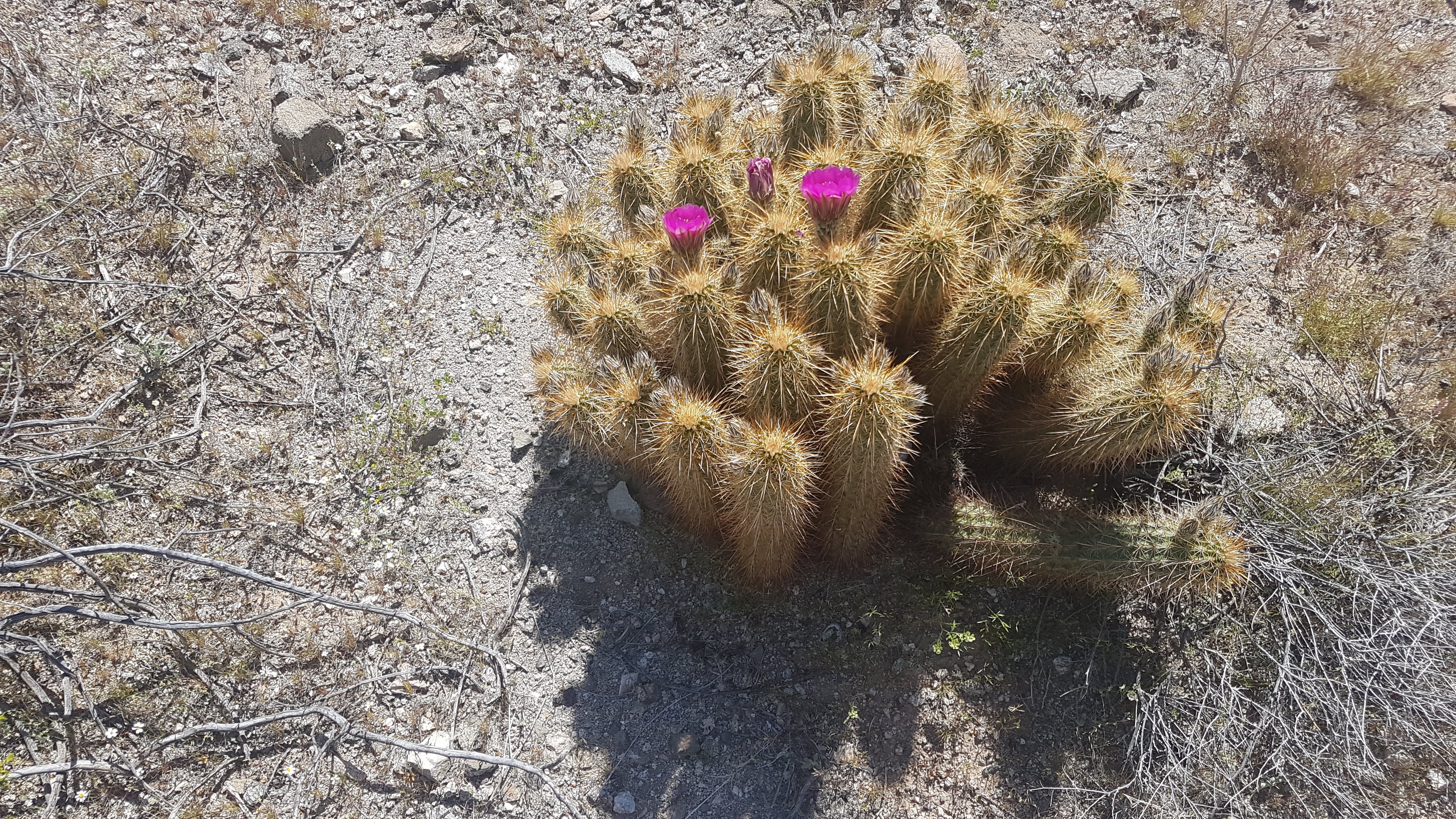
Several years ago, we were in Arizona and hiked in a regional park on an every other day basis. During our hikes, I took pictures of cacti that were blooming. Nature demonstrates hope even in challenging ecological settings. The contrast of the pink with a dull green and brown background serves as a beautiful reminder of hope in challenging times.
I share the Prayer of St. Francis as it has deep meaning in our family and it often referred to as the Peace Prayer. The word peace appears once and is the overarching message. Hope is an integral part of achieving peace.
Espirational provides short posts that are often accompanied by lovely images. This quote from Thich Nhat Hanh relates to my post, Deep, the other day. It was Bela‘s post I shared and expanded on a bit.
If we think of Earth and Nature as living bodies, we can expand this quote about health as an expression of gratitude to encompass more than just each of us individuals and human bodies. In moments of gratitude, we should ask who benefits from pillaging the Earth and Nature? We can also ask who is most harmed?
Currently, I am reading a book by Gustavo Gutiérrez and Paul Farmer. Father Gutiérrez is a pioneers of Liberation Theology and Paul Farmer is a medical doctor and medical anthropologist who helped found Partners in Health. Part of the reading is to write about leadership, education, and how hope can inform each of us as we emerge from COVID-19, if we actually do.
I hoped a crisis of this magnitude, plus the social and racial justice reckonings, might be a time to (re)imagine and (trans)form leadership and education. I am unsure this is what will happen, as the agenda of the very wealthy does not seek a “preferential option for the poor” and those most in need, inlcuding Gaia and Mother Nature. Yes, there is talk, but most of that is empty words and political theatre, posturing and peformativity for one’s constituents. It takes peope filled with courage and hope to stand up and say we need something different.
My hope rests in the next generation, the young people who are already making a mark. I hope they do not become disenchanged and discouraged. In this vein, I leave you with the following quote, attributed to Tasunke Witko (Crazy Horse) days before he was killed.
Upon suffering beyond suffering:
The Red Nation shall rise again and it shall be a blessing for a sick world; a world filled with broken promises, selfishness and separations; a world longing for light again.
I see a time of Seven Generations when all the colors of mankind will gather under the Sacred Tree of Life and the whole Earth will become one circle again.
In that day, there will be those among the Lakota who will carry knowledge and understanding of unity among all living things and the young white ones will come to those of my people and ask for this wisdom.
I salute the light within your eyes where the whole Universe dwells. For when you are at that center within you and I am that place within me, we shall be one.
I learned new words today. I read an article by Judith Butler who used the word carceral, meaning “relating to prison.” It fits with systemic prejudices e.g., racism, where particular groups of people are imprisoned at a greater rate than their percentage of a society or country.
But, it includes how people are limited to a geographic space, so they do not come in contact with the elites. It extends injustice and oppression those groups and individuals experience. Paulo Freire argued this cuts across racial, gender, and linguistic lines and includes class distinction. People are trapped and imprisoned within a life that offers little hope for them and their children.
I am unsure Rainer Maria Rilke intended to make a political statement in The Panther, but it serves as an analogy to understand how another might experiences life in the midst of oppression. In not witness ing another’s disenfranchisement e.g., economic, political, educational, etc., I grow to think their plight is not real. But, bars, literal and figurative, become reality. As Rilke states “a great will stands stunned and numbed.”
The opposite of my indifference is love and serving, reaching out to give a hand to those who need help to cut the bars away that oppression has built around them. It is less about doing for them and more about valuing their lived-experiences in meaningful ways. Freire said to read the word, humans first read their world, bringing their understanding of living to formal education.
From seeing the bars, his seeing is so exhausted
that it no longer holds anything anymore.
To him the world is bars, a hundred thousand
bars, and behind the bars, nothing.
The lithe swinging of that rhythmical easy stride
which circles down to the tiniest hub
is like a dance of energy around a point
in which a great will stands stunned and numb.
Only at times the curtains of the pupil rise
without a second … then a shape enters,
slips through the tightened silence of the shoulders,
reaches the heart, and dies.
I love the blues. A sad thing about the genre is many women who were pioneers were not recorded as often as men. It is a treat to hear someone like Sister Rosetta Tharpe sing.
I began to think about what I might post today and, as a good fortune would have it, Eddie’s post showed up and answered my question.
Eddie shares a lovely quote from Chief Seattle about humankind’s interconnectedness with the web of life. We have not woven the web, but a thread in it, binding and connecting us to one another and to the universe.
Hannah Arendt wrote about how our actions, including speech, transcend the time and space we currently inhabit. This is particularly the case for teachers. We are connected and bound to a future we cannot predict, that is far more complex and larger than the immediate environment we inhabit, which is incredibly complex and large.
A word spoken in haste to a student, a parent, a colleague has the potential to resonate in ways we cannot anticipate, regardless of profession or role in someone’s life. How we each treat our local environment has considerable impact on those downstream in terms of time and place. Cutting down old growth forests has more than an immediate impact. It resonates for generations. As humans, we have free will to act and speak in responsible ways. How we do these things has great meaning about who we each are as a human.
This video echoes Chief Seattle’s message of interconnectedness and how, in recognizing that point, we find our way to the peace train arriving from the darkness. Yussuf Islam (Cat Stevens) has received several awards for his work in the area of peace.
Sunday night, I stayed up late. I stayed up until 10:00, which is late for me. As a result, I listened to a radio show I don’t normally get a chance to, The Road Home, on CKUA. I like the show, because the host, Bob Chelmick, plays eclectic music, reads poetry, and uses readings of poetry.
It appears we share a love of Mary Oliver and Wendell Berry‘s poetry with him, as he often highlights their poetry. On Sunday, the host had a reading by Wendell Berry of Manifesto: The Mad Liberation Front. There is too much in this poem for me to do justice to unpacking it. It speaks to the moment we are experiencing. How we got here is by taking shortcuts and ignoring the inequities in those shortcuts. We sacrifice community, certainty, and care for one another for quick profit, the ready made, and a lack of mystery in our lives.
I remember reading this poem for the first time and realizing how much we sacrifice for the “good life,” instead of appreciating what we have in our daily lives.
Love the quick profit, the annual raise,
vacation with pay. Want more
of everything ready-made. Be afraid
to know your neighbors and to die.
And you will have a window in your head.
Not even your future will be a mystery
any more. Your mind will be punched in a card
and shut away in a little drawer.
When they want you to buy something
they will call you. When they want you
to die for profit they will let you know.
So, friends, every day do something
that won’t compute. Love the Lord.
Love the world. Work for nothing.
Take all that you have and be poor.
Love someone who does not deserve it.
Denounce the government and embrace
the flag. Hope to live in that free
republic for which it stands.
Give your approval to all you cannot
understand. Praise ignorance, for what man
has not encountered he has not destroyed.
Ask the questions that have no answers.
Invest in the millenium. Plant sequoias.
Say that your main crop is the forest
that you did not plant,
that you will not live to harvest.
Say that the leaves are harvested
when they have rotted into the mold.
Call that profit. Prophesy such returns.
Put your faith in the two inches of humus
that will build under the trees
every thousand years.
Listen to carrion – put your ear
close, and hear the faint chattering
of the songs that are to come.
Expect the end of the world. Laugh.
Laughter is immeasurable. Be joyful
though you have considered all the facts.
So long as women do not go cheap
for power, please women more than men.
Ask yourself: Will this satisfy
a woman satisfied to bear a child?
Will this disturb the sleep
of a woman near to giving birth?
Go with your love to the fields.
Lie down in the shade. Rest your head
in her lap. Swear allegiance
to what is nighest your thoughts.
As soon as the generals and the politicos
can predict the motions of your mind,
lose it. Leave it as a sign
to mark the false trail, the way
you didn’t go. Be like the fox
who makes more tracks than necessary,
some in the wrong direction.
Practice resurrection.
The health crisis reveals gaps in ,many forms of equity: gender, race, ethnicity, class, etc. The environmental crisis is doing the same thing as fires rage out of control. I love the last line: practice resurrenction. Rise up and live life in meaningful and ethical ways.
Although it is often referred to as the African-American National Anthem, I think Lift Every Voice and Sing speaks to what we need in today’s world. We need to join voices and hands to enact our words in concrete ways and make the world a better place.