Category Archives: Poetry

Pointers to Non-Duality

I am back to post. I am reading and writing. I am working to intersect hermeneutic phenomenology, which I used as my research methodology for my dissertation and the method of currere. The latter is an autobiographical method, in part, based on existential philosophy to explore curriculum through one’s lived-experience. As well, it uses Freudian psychoanalytic theory as part of its foundations. It is this latter aspect I am contrasting with hermeneutic phenomenology as both are interpretive methods.

I moved to radical hermeneutics, linking it with my writing. What I found is there is an overlap with poetry and non-duality.

Bill Pinar developed the method of currere and used Zen philosophy as a third leg for the method. The voice in hermeneutics is poetic, seeking to understand the world in non-dualistic ways and subvert binary thinking.  As I looked for a poem, I found this one by Wu Hsin.

When I am mindful and present to the world in its past, present, and future moments the text I live comes to life with new meaning.

Just as the honey is not sweetness,

The words of Wu Hsin are not

The truth.

However, time spent with these words is like

The aftermath of rain.

In due course, a sprouting of

Understanding will occur and

Will bear fruit at a pace

Outside of one’s control.

The Meeting

A couple of weeks ago I was out for one of my daily walks. We live in neighbourhood that is well inside the city, so what happened was a surprise. A deer was on one of the lawns. It saw me, but by the time I had my cell phone and camera out is was two blocks away. Just the same, it was an unexpected moment to bethoroughly enjoyed.

The deer’s unexpected appearance reminded me of what Thich Nhat Hanh says about the ordinary being part of the extraordinary. We just have to remain open.

When I am quiet,

When I just am,

Openings appear;

Something shows itself.

In those ordinary moments,

Miracles appear,

Making the moment (extra)ordinary,

The enjoyment exceeds itself.

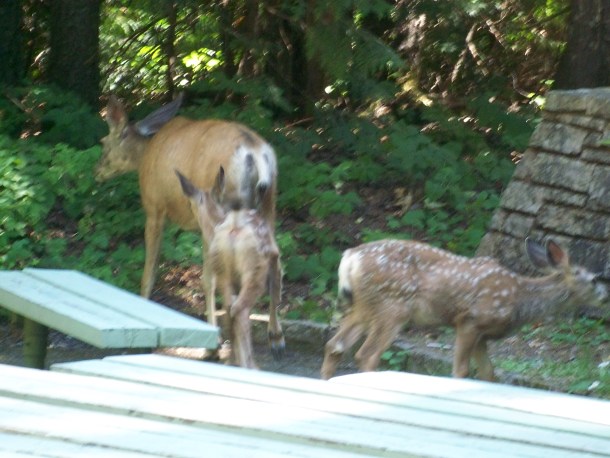
We took this picture in Waterton Lakes National Park. I walked around a corner and one of the young ones was within arm’s length, but separated from the doe. I stayed still, until mother and child reunited.

Darling

I was not going to post today, but I came across this poem by Naomi Shihab Nye and it resonated with me. She wrote about language’s paradoxical power and fragility. Even though we may use the same words, they each mean something different to each of us based on our culture, history, and personal experiences. We have to be mindful and attentive to our use of language. It speaks to our character in the story we narrate through the words we choose and share with others.

Language possesses the power to bridge differences. The fragility lies in the idea that we can only hope language bridges differences.

The opening lines remind me of the  etymological roots of companion, meaning to break bread with others on a journey, but, in this instance, it is a fragile journey. The food and tea do not taste quite right under the circumstances.

The last stanza speaks about holding words delicately and pressing our lips on each syllable as we are kissing them, hence the title of the poem.

I break this toast for the ghost of bread in Lebanon.
The split stone, the toppled doorway.

Someone’s kettle has been crushed.
Someone’s sister has a gash above her right eye.

And now our tea has trouble being sweet.
A strawberry softens, turns musty,

overnight each apple grows a bruise.
I tie both shoes on Lebanon’s feet.

All day the sky in Texas which has seen no rain since June
is raining Lebanese mountains, Lebanese trees.

What if the air grew damp with the names of mothers,
the clear belled voices of first-graders

pinned to the map of Lebanon like a shield?
When I visited the camp of the opposition

near the lonely Golan, looking northward toward
Syria and Lebanon, a vine was springing pinkly from a tin can

and a woman with generous hips like my mother’s
said Follow me.

2

Someone was there.
Someone not there now was standing.
Someone in the wrong place
with a small moon-shaped scar on his left cheek
and a boy by the hand.

Who had just drunk water, sharing the glass.
Who had not thought about it deeply
though they might have, had they known.
Someone grown and someone not-grown.
Who thought they had different amounts of time left.
This guessing game ends with our hands in the air,
becoming air.
One who was there is not there, for no reason.
Two who were there.

It was almost too big to see.

3

Our friend from Turkey says language is so delicate
he likens it to a darling.

We will take this word in our arms.
It will be small and breathing.
We will not wish to scare it.
Pressing lips to the edge of each syllable.
Nothing else will save us now.
The word “together” wants to live in every house.
To Read a Poem…To Write a Poem

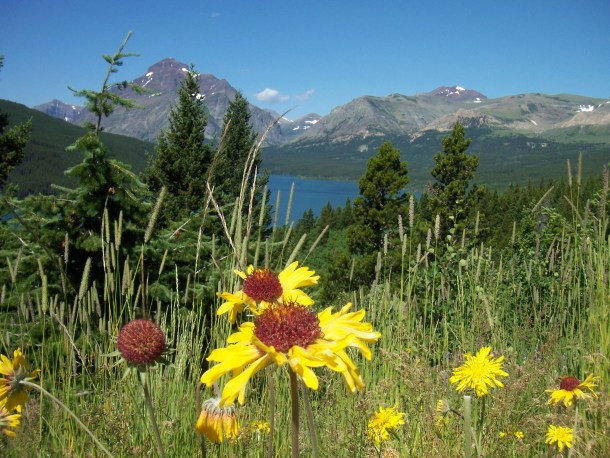
This poem rattled around in my mind and body for the last few days. I did not write it out in rough form, so this is it.

To read a poem;

That is to breath in the world,

Meditating on that world

(Re)membering a fleeting moment–

A moment my whole body experienced;

The smell of pine forest

The distant white-topped mountain

Rocks disturbing a river’s flows

The touch of a gentle breeze,

Cooling a sun-burnt face.

To write a poem;

Breathing out,

A lived-experience,

Giving words to a fleeting moment–

Flowers gesturing towards mountains,

Trees caressed by mountain wind,

Nature’s fragrances arise from the valley

A silence encroaching upon my mediation.


Make Music with Your Life

I am writing again, so I am blogging less. I know that sounds like an oxymoron, but I am writing an article.

Bob O’Mealley’s poem speaks to me in several ways, despite how short it is. How we live is precious. It is musical and offers us jewels to wear.

For me, a second message is the blues. I love the blues and listen to them. I don’t sing well, but, when there is a blues song on that I know, I howl like a guitar player and cut every deep day madness into jewels.

I used to play music many mornings as the students came into the classroom. Music is a universal language and reaches across generations, cultures, ethnicities, etc.

Make music with your life
a
jagged
silver tune
cuts every deepday madness
into jewels that you wear

Carry 16 bars of old blues
with you
everywhere you go
walk thru azure sadness
howlin
Like a guitar player

Saint Francis and the Sow

This poem by Galway Kinnel reminds me everyone is blooming. There is something hidden inside of us we cannot fully know and understand. It is the inner voice that calls us to what we are fully human to do.

It is essential to be mindful and attentive to that voice and find moments of silence. Unlike the sow, humans are able to pause and reflect, pray and listen to the response. Having said this, it is not something that is intuitive and instinctual. It is something we have to remind our self of from time to time.

The bud

stands for all things,

even for those things that don’t flower,

for everything flowers, from within, of self-blessing;

though sometimes it is necessary

to reteach a thing its loveliness,

to put a hand on its brow

of the flower

and retell it in words and in touch

it is lovely

until it flowers again from within, of self-blessing;

as Saint Francis

put his hand on the creased forehead

of the sow, and told her in words and in touch

blessings of earth on the sow, and the sow

began remembering all down her thick length,

from the earthen snout all the way

through the fodder and slops to the spiritual curl of the tail,

from the hard spininess spiked out from the spine

down through the great broken heart

to the sheer blue milken dreaminess spurting and shuddering

from the fourteen teats into the fourteen mouths sucking and blowing beneath them:

the long, perfect loveliness of sow.


Searching For Home

Today, is a cold and miserable day. It actually began yesterday, which is ironic. It was the first day after summer solstice. Summer does not feel like it is here. It has been a bumpy spring with warm and cooler days mixed together.

It has been a few days since I wrote a poem, so I wrote based on today’s non-seasonal weather. It is like the weather is looking for a home and cannot figure out where it is.

Summer fights to arrive,

A day after the solstice,

Winds feel glacial,

Marching coldly down upon us.

The wind wails her sad song,

A lost banshee,

Keening as she searches,

Not feeling at home in early summer.

Although this picture is a few weeks old, the day it was taken it was cold, windy, and rainy. It feels much like that again. The steel-grey skies in the background are like what we have today.


The Poet’s Obligation

I am back. I found it difficult to write a poem and turned to others who might offer me something today.

Pablo Neruda wrote about the poet’s obligation to those cooped up in an office, away from the sounds of nature, and the foam of the sea. Poetry brings the world and its text to people who for whatever reason they are no present to that part of the world.

The poet brings the sea, the thunder, and the foam to the reader in what Neruda called a perpetual cup. Poets share and are part of the world others cannot always find.

The poet is mindful of the world and reflects on it to capture its essence and meaning in ways each person can experience and interpret what that means to them. They pose questions without ready answers to structure each person’s with the world and the poem. The poem becomes a medium to interpret the world as a text.

To whoever is not listening to the sea
this Friday morning, to who ever is cooped up
in house or office, factory or woman
or street or mine or dry prison cell,
to him I come, and without speaking or looking
I arrive and open the door of his prison,
and a vibration starts up, vague and insistent,
a long rumble of thunder adds itself
to the weigh of the planet and the foam,
the groaning rivers of the ocean rise,
the star vibrates quickly in its corona
and the sea beats, dies, and goes on beating.

So. Drawn on by my destiny,
I ceaselessly must listen to and keep
the sea’s lamenting in my consciousness,
I must feel the crash of the hard water
and gather it up in a perpetual cup
so that, wherever those in prison may be,
wherever they suffer the sentence of the autumn,
I may be present with an errant wave,
I may move in and out of the windows,
and hearing me, eyes may lift themselves,
asking “How can I reach the sea?”
And I will pass to them, saying nothing,
the starry echoes of the wave,
a breaking up of foam and quicksand,
a rustling of salt withdrawing itself,
the gray cry of sea birds on the coast.

So, though me, freedom and the sea
will call in answer to the shrouded heart.

To Discriminate

I will not post this weekend, as I am away. As well, I want to begin writing an article, so my schedule will change next week, but I will be back.

After I wrote my poem yesterday, I thought about what it might mean to live in a different way than I do. I cannot. I do not have those experiences. To discriminate is to see and recognize differences. In a world of extreme ideologies, there are those who simply refuse to see differences as essential to our human condition.

Hannah Arendt wrote about living in pluralism being the ultimate human condition. It is what makes us each a person, separates us in some distinct way from others. It is challenging and unavoidable.

I lived in a small town in Northern Alberta when I was young. We were the only French-speaking family with children in the community. I understand others have suffered more than I ever did. It seems it is only the loud ones with most extreme ideology who act and speak with violence that are seen and heard.

Edmund Burke contended “The only thing necessary for the triumph of evil is for good [people] to do nothing.”

Albert Einstein said “Compassionate people are geniuses in the art of living, more necessary to the dignity, security, and joy of humanity than the discoverers of knowledge.”

Thomas Merton pointed us in the direction of mindfulness: “The whole idea of compassion is based on a keen awareness of the interdependence of all these living beings, which are all part of one another, and all involved in one another.”

I think compassion is being mindful of the beauty we find in the differences of others and the world. It is speaking up and out when we see things done that are not proper. It is in being mindful and present to the Other that we are most human. I leave you with these thoughts.

To discriminate,

To see the differences in the Other,

It is what makes living worthwhile.

Without seeing differences,

The world is a monotone,

A sea of sameness.

Without seeing differences,

The world is extreme,

A dangerous place.

Without seeing differences,

I do not see the exceptional,

I cannot see an Other’s humanity.


Dreamers

I thought about some violence we experience in the world. The last few days it is that theme that has drawn me in my writing.

The word compassion comes from sharing a love of something and the suffering that comes from sharing. The word companion comes from sharing a meal, usually on a journey with others.

We have more in common than makes us different. It is differences that make us unique. The ancient concept of common sense (sensus communis) was what a community shared and held in common, to be passed on to the next generation.

With violence, what do we think we are passing on to the next generation? I would like to think we pass on the good we have in common, the sharing of things we love and suffer with, and we will stop for a meal with each other in times we feel strife.

New emerges and we replace what is outdated and unnecessary, but more remains than we replace when we are mindful and attentive to the world we share.

We are dreamers,

Imagining what might be,

Wondering what could be,

Wondering, “who do we share with?”

In suffering and loving,

Experiencing (com)passion.

In moments of passion,

We share with one another,

Delighting us in one moment,

In the next, suffering together

(Com)panions sharing our daily bread.